
Did you know that Staffordshire homes still capture enough daylight to generate over 3,200 kWh of electricity annually, even though the region averages 126 rainy days every year? It's a common myth that you need constant sunshine to make renewable energy profitable. You've likely felt the frustration of receiving conflicting quotes that vary by thousands of pounds while wondering if Smart Export Guarantee rates will ever actually cover your monthly bills. It's difficult to commit when price tags shift as quickly as the weather over Cannock Chase.
This guide provides a transparent breakdown of the current solar panel cost Staffordshire homeowners are facing in 2026. We're stripping away the marketing fluff to show you the real-world ROI and how local installation teams compare to the big brands. You'll discover the latest price ranges for standard 4kW systems, how to access local incentives, and why our specific West Midlands climate won't ruin your long-term financial projections.
Key Takeaways
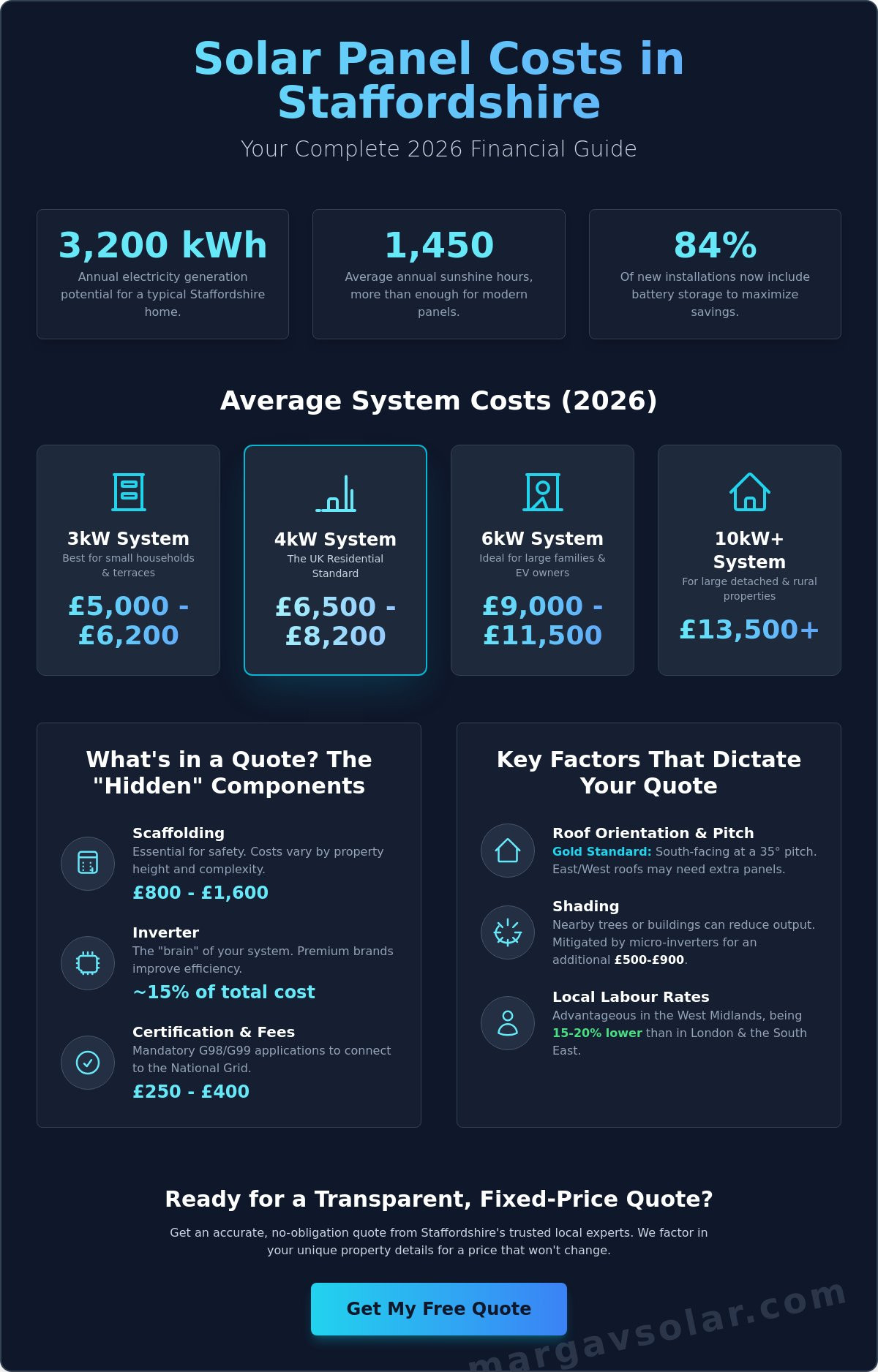
- Get a transparent breakdown of 2026 market pricing for systems ranging from 3kW to 10kW, tailored specifically for the West Midlands residential market.
- Understand how roof pitch, orientation, and local geography influence your final solar panel cost Staffordshire quote and total system efficiency.
- Estimate your long-term ROI by exploring annual energy bill reductions and learning how to maximize earnings through the 2026 Smart Export Guarantee (SEG).
- Follow our step-by-step buying checklist to evaluate local quotes and ensure your installer holds vital certifications like MCS, RECC, and NICEIC.
- Discover the benefits of professional local installation, including the long-term value of fixed-price contracts and regional expertise.
Average Solar Panel Costs in Staffordshire for 2026
In 2026, the average solar panel cost Staffordshire homeowners encounter reflects a market stabilized by mature supply chains but influenced by rising skilled labor rates. While hardware costs for photovoltaic cells dropped by approximately 12% between 2024 and 2025, 2026 installation fees in the West Midlands have climbed by 5% due to a regional shortage of MCS-certified electricians. Most residential systems now fall within the £5,500 to £13,000 range, depending on capacity and storage options.
Hardware efficiency has improved, meaning a standard 4kW system now requires fewer physical panels than it did five years ago. This reduces roof footprint but doesn't necessarily slash the price, as higher-wattage modules carry a premium. Understanding how solar power works helps clarify why investing in quality components, rather than just the cheapest panels, dictates your long-term savings. Modern 2026 systems often prioritize "Solar + Battery" packages, as 84% of Staffordshire residents now opt for storage to avoid high peak-time grid prices.
- 3kW System: £5,000 – £6,200 (Best for small households)
- 4kW System: £6,500 – £8,200 (The UK residential standard)
- 6kW System: £9,000 – £11,500 (Ideal for large families or EV owners)
- 10kW System: £13,500+ (Suitable for large detached properties)
Cost Breakdown by Property Type
For a 2-bedroom terrace in Stafford or Cannock, a 3kW system is usually sufficient, typically costing around £5,800 for a panel-only install. Owners of 4-bedroom detached homes in Lichfield or Tamworth generally require 6kW arrays to offset higher energy demands, with total costs reaching £10,500. Rural Staffordshire farmsteads near Uttoxeter often face higher costs due to complex roof shapes or the need for ground-mounted frames, which can add £2,000 to the base installation price.
The "Hidden" Components of a Staffordshire Quote
Scaffolding remains a significant variable, costing between £800 and £1,600 depending on whether you have a standard two-storey home or a three-storey townhouse in a high-density area. Quality inverters, the "brains" of the system, represent roughly 15% of your quote; opting for a premium brand ensures better performance in the overcast conditions typical of the West Midlands. You'll also need to budget £250 to £400 for electrical certification and G98/G99 application fees. These applications are mandatory for the National Grid Electricity Distribution, which manages the local network across the South Staffordshire Water area, ensuring your system safely interacts with the regional power grid.
Factors That Dictate Your Staffordshire Solar Quote
When calculating the potential solar panel cost Staffordshire homeowners face, several localized variables come into play. Your quote isn't just a reflection of hardware prices; it's a calculation of your property's unique geography and structural needs. For instance, an installation in the tightly packed Victorian terraces of Stoke-on-Trent presents different logistical hurdles than a detached home in the open spaces of Kinver. Installers must account for scaffolding complexity, especially on properties situated on the steep inclines common in the north of the county.
Labor rates in the West Midlands offer a distinct advantage. You'll typically find that local labor costs are 15% to 20% lower than those in London or the South East. However, the complexity of the roof orientation dictates the final figure. A south-facing roof with a 35-degree pitch is the "gold standard" for efficiency. If your roof faces east or west, you might need two or three additional panels to achieve the same energy yield, which increases the total equipment cost. Shading is another critical factor. Properties near Cannock Chase or the rural fringes of Stafford often deal with overhanging woodland, while urban homes may face shading from neighboring chimneys. Modern micro-inverters can mitigate these issues, but they add approximately £500 to £900 to a standard system price.
Staffordshire Weather and Solar Yield
Staffordshire receives an average of 1,450 sunshine hours per year. This is slightly below the South Coast average but remains highly productive for modern photovoltaic cells. The microclimate of the North Staffordshire Moorlands presents a unique case; higher elevations often experience increased cloud cover and lower temperatures. While clouds reduce direct light, the cooler air helps panels maintain efficiency, as solar hardware loses productivity when it overheats. In the context of West Midlands weather, Solar Irradiance is the measure of the sun's power reaching a specific area, usually expressed as kilowatts per square meter. Recent updates to UK government solar standards highlight how evolving technology allows systems to capture more of this irradiance even on overcast days.
Roof Suitability and Material Costs
The material of your roof significantly impacts the installation time. Staffordshire is famous for its blue clay tiles. These are durable but notoriously brittle. Installers must use specific stainless steel roof hooks and take extra care not to crack the tiles, which can add a day to the labor timeline. If you live in an older Victorian property in Stoke-on-Trent, a structural integrity check is a non-negotiable step to ensure the rafters can support the 20kg weight of each panel.
- Bird Proofing: This is essential due to the high pigeon populations in urban Staffordshire. Expect to pay between £300 and £600 for high-quality mesh or spikes.
- Roof Material: Modern slate is easier to work with than traditional clay, often reducing labor costs by £200.
- Access: Narrow access in historic town centers may require specialized narrow-aisle scaffolding.
These regional nuances directly influence the solar panel cost Staffordshire companies provide in their final estimates. If you're unsure about your roof's weight-bearing capacity or tile type, getting a professional site assessment is the most reliable first step to avoid hidden fees later in the process.
Calculating ROI: Savings and Payback in the West Midlands
Investing in solar technology is a long-term financial strategy for Staffordshire families. A typical household in the region can expect to save between £450 and £750 on annual energy bills, depending on system size and consumption habits. These figures are bolstered by the Smart Export Guarantee (SEG), which in 2026 provides a consistent stream of income for surplus energy sent back to the grid. While the initial solar panel cost Staffordshire homeowners face can feel substantial, the reduction in monthly utility outgoings often offsets the investment faster than traditional savings accounts.
Payback periods vary based on the hardware configuration. A system without battery storage typically reaches its break-even point in 10 to 12 years. By contrast, systems paired with high-capacity batteries can achieve payback in 7 to 9 years because they allow you to use your own free energy during expensive peak evening hours. This Energy Saving Trust guide to solar panels highlights how maximizing self-consumption is the most effective way to improve these timelines. Consistent solar panel maintenance is also essential, as it prevents dirt buildup from reducing your generation capacity and dragging down your ROI.
Maximising Self-Consumption with Battery Storage
Adding a GivEnergy battery system transforms the cost-benefit analysis of your installation. By storing energy generated during the day, you avoid buying grid electricity at 2026 market rates. Using the GivEnergy Cloud platform, Staffordshire residents can track real-time savings and automate their energy usage to coincide with the cheapest tariffs. It is financially wiser to install storage from the start; retrofitting a battery later typically costs 18% more than a day-one installation due to separate labor charges and the loss of bundled VAT incentives.
The Impact of EV Charging on Your Solar ROI
Integrating EV charging points into your solar setup creates a closed-loop energy system that dramatically increases your ROI. Instead of selling surplus energy to the grid for 5p to 15p per kWh, you use it to replace petrol or diesel costs. The "Solar-to-EV" efficiency ratio for 2026 systems allows for roughly 1.6 miles of driving for every 1 kWh of solar energy diverted directly to your vehicle. This synergy can reduce the total system payback time by an additional 24 months, making the solar panel cost Staffordshire residents pay much more manageable when viewed as a total transport and home energy solution.
- Average annual savings: £450 – £750
- Payback with battery: 7 – 9 years
- Payback without battery: 10 – 12 years
- Self-consumption rate: Increases from 30% to over 70% with storage
Choosing the Right System: A Staffordshire Buying Checklist
Selecting a solar provider involves more than just comparing the bottom line. While the solar panel cost Staffordshire homeowners pay is a major factor, the cheapest quote often masks inferior components or poor installation standards. Start your journey by requesting detailed quotes from at least three local installers. Each quote should include a predicted annual generation report based on your specific roof orientation and shading profile. It's essential to verify that the installer holds MCS (Microgeneration Certification Scheme) accreditation. Without this, you won't be able to access Smart Export Guarantee payments from energy suppliers like Octopus or British Gas.
Check for RECC or HIES membership to ensure your deposit is protected. Ask specifically about their local maintenance support. A national company might offer a lower price but could take weeks to send a technician to a village like Great Haywood if your system goes offline. Watch out for red flags such as "limited time" government subsidies that aren't officially recognised by the Department for Energy Security and Net Zero. High-pressure sales tactics are a sign to walk away. Understanding the total solar panel cost Staffordshire residents face requires looking at the long-term ROI, not just the initial outlay.
Regulatory and Planning Requirements
Most Staffordshire installations fall under permitted development rights. However, if you live in a conservation area in Stafford Borough or East Staffordshire, rules change. You'll likely need planning permission if your home is a listed building or if panels will be visible from a highway in a protected zone. Ensuring your installer understands these local nuances is vital. Safety is equally critical, which is why NICEIC certification is non-negotiable for any electrical work in your home. It guarantees the high-voltage DC wiring meets current UK building regulations.
Equipment Selection for Durability
The UK climate demands high-performance hardware. Always insist on Tier 1 panels from manufacturers with a proven track record. These panels typically offer a 25-year linear power output warranty. Don't overlook the brain of the system. Planning for inverter upgrades early ensures your system remains compatible with future battery additions or EV chargers. Standard panel warranties cover 25 years, while battery storage units usually offer 10 years or a specific cycle count. Ensure your installer provides a minimum 2-year workmanship warranty to cover the integrity of the roof mounts and seals.
Ready to secure an accurate quote for your home? Contact our Staffordshire solar experts today for a detailed site assessment.
MarGav Solar: Expert Local Installation and Long-Term Value
MarGav Solar has served the Staffordshire region for over 22 years, building a reputation for reliability and technical excellence. We understand that transparency is the primary concern for homeowners investigating renewable energy. To address this, we provide fixed-price installation contracts that protect you from market volatility. You won't face hidden fees or surprise surcharges once the work begins. Our team manages the entire process, including structural assessments, DNO applications, and final MCS certification. This end-to-end support ensures your solar panel cost Staffordshire investment delivers the highest possible return on investment over the system's 25-year lifespan.
Why a Local Installer Beats a National Franchise
Local knowledge is vital for system efficiency. National companies often use generic templates, but we understand the specific nuances of Staffordshire architecture. Whether you own a Victorian terrace in Leek or a modern detached home in Stafford, we tailor the mounting hardware to your specific roof type. In October 2025, we completed a project in Stone where we reduced a homeowner's electricity bill by 74% by optimising panel placement for local micro-climates. Being based nearby means our maintenance teams can reach you within 24 hours if a system alert occurs. National franchises rarely offer this level of rapid, boots-on-the-ground support.
- Bespoke Design: Systems engineered for Staffordshire's specific light levels and roof pitches.
- Rapid Response: Local technicians available for immediate maintenance and repairs.
- Proven Track Record: Hundreds of successful installations across Stoke-on-Trent, Tamworth, and Cannock.
Start Your Energy Transition Today
Beginning your journey to energy independence is straightforward. You can book an initial home energy consultancy to review your historical electricity usage and future needs. During the MarGav Solar site survey, a technician uses precision light-mapping software to calculate your roof's exact solar potential. This data ensures your bespoke quote is accurate to within 5% of actual performance levels. We provide a clear breakdown of your projected solar panel cost Staffordshire alongside estimated payback periods based on current 2026 energy price caps. Our goal is to ensure you have all the facts before committing to an installation.
Ready to save? Get your personalised Staffordshire solar quote from MarGav Solar
Start Your Journey Toward Energy Independence in Staffordshire
Transitioning to renewable energy in 2026 is a strategic move for homeowners looking to hedge against volatile energy markets. By understanding the solar panel cost Staffordshire residents face, you can better navigate the 6 to 10 year payback period typical for UK installations according to Energy Saving Trust data. Successful projects depend on high-quality components and battery integration, specifically GivEnergy systems, to maximize the 25 year lifespan of your hardware.
MarGav Solar brings over 20 years of renewable energy expertise to every West Midlands installation. Our NICEIC and MCS Certified Installers specialize in GivEnergy battery storage solutions that help you capture and use every kilowatt of local sunshine. We focus on providing transparent, data-driven advice so you can make an informed decision for your property's financial future. Don't leave your energy security to chance when expert local help is available.
Request a Fixed-Price Solar Quote for Your Staffordshire Home
Take control of your utility bills today and enjoy the long-term peace of mind that comes with a professionally installed solar array.
Frequently Asked Questions
How much do solar panels cost for a 3-bedroom house in Staffordshire?
A standard 4kW solar system for a 3-bedroom house in Staffordshire typically costs between £6,000 and £9,000. This price includes the hardware, scaffolding, and professional installation. Your final solar panel cost Staffordshire quote depends on roof orientation and panel efficiency. Prices have stabilized since 2024, with high-output 400W+ panels now serving as the standard for residential projects across the county.
Are there any Staffordshire-specific solar grants available in 2026?
Staffordshire residents can access the ECO4 scheme and the Home Upgrade Grant (HUG2) throughout 2026. These grants target low-income households or properties with an EPC rating of D to G. The 0% VAT rate on solar installations also remains a key financial incentive for all homeowners. Local councils like Stafford Borough or Stoke-on-Trent occasionally offer additional green funding through the UK Shared Prosperity Fund.
Do I need planning permission for solar panels in Staffordshire?
Most solar installations in Staffordshire fall under permitted development rights and don't require formal planning permission. You must follow specific rules, such as ensuring panels don't protrude more than 200mm from the roof slope. If you live in a Grade II listed building or a conservation area like Lichfield City Centre, you'll likely need to submit a full application to your local planning authority before starting.
How long is the typical payback period for solar in the West Midlands?
The typical payback period for a solar array in the West Midlands is currently 7 to 10 years. This timeframe assumes you use 50% of the energy you generate and export the remainder. High electricity prices and Smart Export Guarantee (SEG) payments help you recoup your initial solar panel cost Staffordshire faster. Systems paired with battery storage often see even shorter payback cycles by increasing self-consumption to 80%.
Is Staffordshire sunny enough for solar panels to be effective?
Staffordshire receives approximately 1,350 hours of sunshine annually, which is more than enough for high-performance solar generation. Modern photovoltaic cells don't need direct sunlight; they produce electricity from daylight even on overcast days. A south-facing roof in Stafford or Tamworth can generate around 3,400kWh of clean energy per year. This output covers a significant portion of a typical family's annual electricity demand.
What happens to my solar panels when it snows in Staffordshire?
Your solar panels will stop producing electricity if they're completely covered by a thick layer of snow, but this rarely lasts long in Staffordshire. Most panels are installed at a 30 to 40-degree angle, causing snow to slide off naturally as the glass warms up. Even a thin layer of snow allows some light to reach the cells. Panels actually operate more efficiently in cold temperatures once the surface is clear.
Can I add a battery to my existing Staffordshire solar system later?
You can easily add a battery storage unit to your existing system using an AC-coupled inverter. This setup allows the battery to sit alongside your current solar inverter without needing to rewire the entire roof. Adding a 5kWh or 10kWh battery helps you store excess energy generated during the day for use at night. It's a popular upgrade for Staffordshire homeowners looking to reach 85% energy independence.
How much can I earn by selling energy back to the grid in 2026?
You can earn between 5p and 15p per kWh by selling excess energy through the Smart Export Guarantee (SEG). Some leading suppliers offer premium export tariffs that pay significantly more if you have a compatible smart meter. For a typical 4kW system, this could result in annual payments of £150 to £400. You'll need an MCS-certified installation to qualify for these mandatory export payments from UK energy providers.


