

What if installing the largest battery on the market actually slows down your financial return? If you've spent any time comparing solar battery prices Lichfield companies quote, you've likely encountered vague estimates that hide component costs behind generic equipment packages. Between confusing metrics like nominal versus usable capacity and nagging doubts about whether dull winter days justify the expense, working out true value feels needlessly complicated.
You shouldn't have to guess whether your home energy setup will genuinely pay off. By matching usable capacity to your household's real consumption patterns and pairing your system with smart off-peak tariffs, you can dramatically shorten your payback timeline while taking advantage of 0% VAT relief. Here is everything you need to know about how battery storage is priced, how local National Grid approvals work, and how to select the right system size for your Lichfield property.
Key Takeaways
- Learn what truly shapes solar battery prices Lichfield installers quote, looking beyond basic hardware tags to include certified balance-of-system components and labour.
- Distinguish between nominal and usable storage capacity so you avoid paying for surplus capacity that exceeds your household's actual evening demand.
- Navigate Staffordshire grid connection processes smoothly, including when your setup qualifies for straightforward G98 notification with National Grid Electricity Distribution.
- Unlock year-round savings by pairing battery storage with smart time-of-use tariffs to capture cheaper off-peak power during low-generation winter months.
- Protect your budget by choosing fixed-price contracts that deliver fully certified electrical sign-off without unexpected post-survey price increases.
Understanding Solar Battery Investment: What Shapes Installation Quotes in Lichfield?
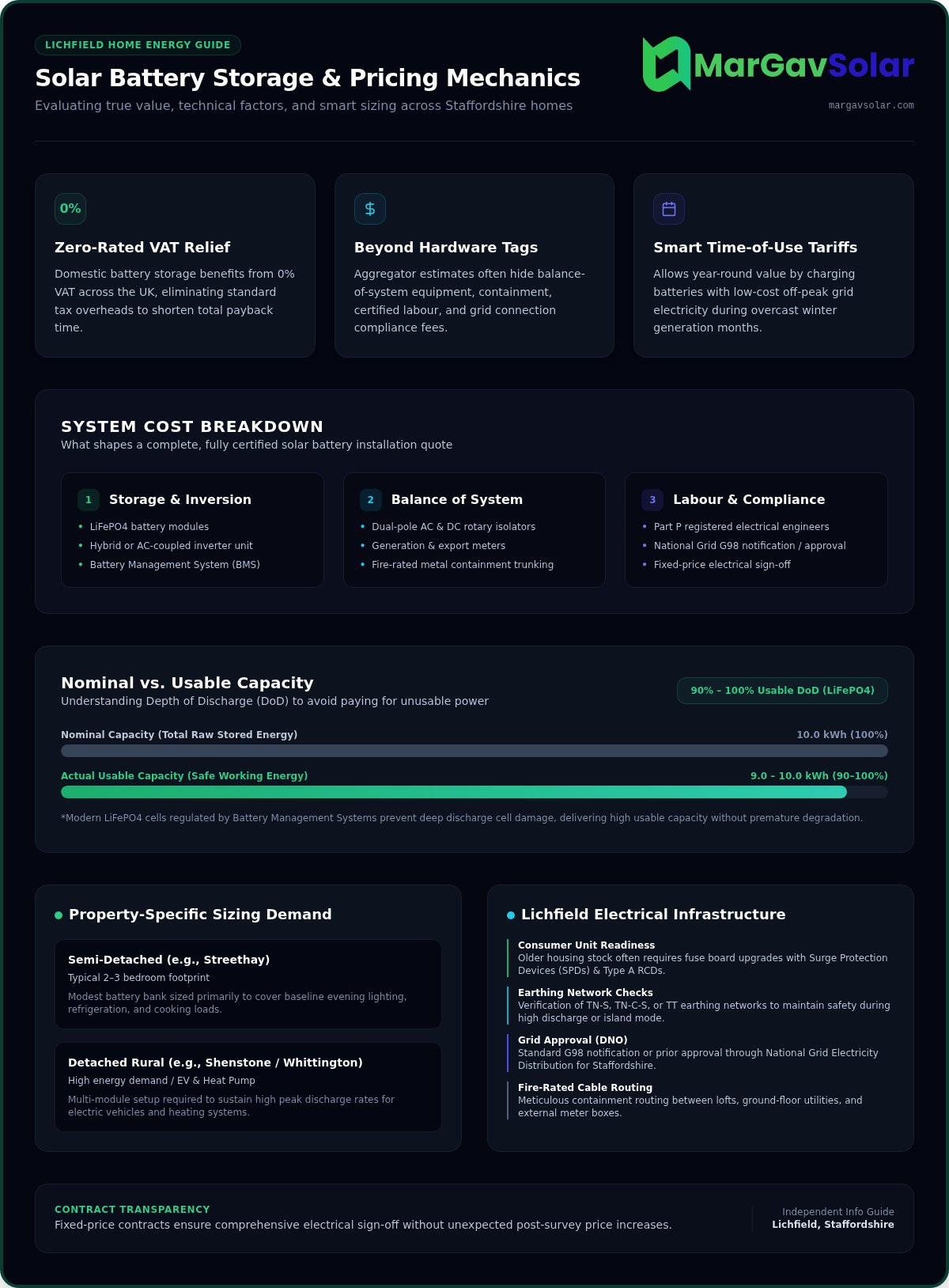
Headline figures on aggregator sites rarely reflect the full reality of a domestic installation. When assessing solar battery prices Lichfield homeowners encounter, you quickly discover that hardware represents only a portion of the overall investment. A fully functional system integrates physical cells with inverters, isolation switches, and structural containment. Professional installation by qualified electrical engineers, along with local grid compliance paperwork and building regulations certification, forms the rest of the contract. Domestic energy storage systems benefit from zero-rated VAT across the UK, which removes standard tax overheads, but securing accurate pricing still demands a bespoke on-site survey rather than generic figures.
Core Hardware vs. Installation Labour Costs
Modern home energy storage relies on advanced rechargeable battery technology, converting direct current from your panels into chemical potential. A complete quote balances this storage unit alongside either an AC-coupled unit or a hybrid inverter. Balance-of-system hardware includes essential safety gear such as:
- Dual-pole AC and DC rotary isolators for rapid maintenance cut-off
- Generation and export meters for accurate output monitoring
- Fire-rated metal containment and trunking to shield external cable runs
Fitting these components demands certified labour from Part P registered electrical engineers. Bespoke technical design ensures optimal system longevity by matching electrical protection devices directly to your home's real operating load, avoiding early component failure.
Electrical Infrastructure & Consumer Unit Readiness
Lichfield features a diverse architectural mix, from Georgian townhouses near the Cathedral to mid-century properties in Boley Park. Older housing stock often contains outdated fuse boards lacking modern surge protection devices (SPDs) or Type A residual current devices (RCDs). Upgrading a consumer unit or establishing a clean, dedicated circuit back to the incoming supply directly influences final solar battery prices Lichfield contractors provide.
Earthing arrangements present another structural hurdle. Technicians must verify whether a property uses a TN-S, TN-C-S, or TT earthing network to maintain earthing integrity during island mode or high-current discharge. Internal cable paths between loft installations, ground-floor utility spaces, and external meter boxes demand meticulous routing to comply with fire safety containment standards without disturbing the building fabric.
Evaluating Battery Capacity: Sizing Storage to Your Lichfield Household Usage
When assessing solar battery prices Lichfield residents often assume a 10 kilowatt-hour system automatically delivers 10 kilowatt-hours of usable power. That isn't how domestic storage works. Stored electricity is bounded by chemical limits, reserve thresholds, and power delivery rates. For impartial advice on home energy management, the Energy Saving Trust provides a helpful home battery storage guide. Getting sizing right from the outset prevents paying for redundant capacity you'll never cycle, or buying an undersized unit that empties before dinner is finished.
Nominal vs. Usable Capacity and Depth of Discharge (DoD)
Nominal capacity measures the total energy stored inside the cells, but drawing a unit down to absolute zero damages the internal structure. Usable capacity represents the realistic amount of energy available for household consumption. Modern lithium iron phosphate (LiFePO4) chemistries comfortably maintain a 90% to 100% Depth of Discharge (DoD) without premature degradation. Intelligent battery management systems continuously regulate individual cell voltage and thermal limits, keeping discharge rates stable over thousands of complete cycles.
Matching Kilowatt-Hour Sizing to Property Footprints
Storage requirements shift dramatically across Staffordshire housing stock. A typical two-to-three-bedroom semi-detached home in Streethay usually requires a modest battery bank sized to cover evening lighting, refrigeration, and cooking loads. In contrast, detached rural residences in villages like Shenstone or Whittington with heat pumps and electric vehicles need multi-module setups with higher peak discharge rates.
Daily solar generation swings significantly between June peaks and gloomy December afternoons. Sizing must balance your baseline evening draw rather than attempting to store massive summer surpluses you can't reuse. Modular hardware gives homeowners the flexibility to expand capacity down the line. Our detailed guide to solar battery storage in Staffordshire breaks down these seasonal dynamics in depth.
Prioritising realistic usage prevents inflated equipment quotes. When comparing solar battery prices Lichfield quotes present, verify that the quoted capacity matches your genuine evening draw rather than a generic rule of thumb. Consulting with experienced regional installers ensures your system architecture handles your property's real electrical demand from day one.
Local Technical Factors: Grid Approvals and Property Types Across Lichfield
Every home energy storage system connects directly to the regional electrical infrastructure. In Lichfield and across Staffordshire, National Grid Electricity Distribution (NGED) manages this network. Navigating distribution network operator rules, along with physical architectural constraints, directly impacts project lead times and final solar battery prices Lichfield homeowners receive. The Energy Saving Trust battery storage guidance emphasises that ensuring your installer manages local network applications is just as crucial as choosing the right hardware.
Navigating National Grid Electricity Distribution (NGED) Guidelines
Connecting generation and storage hardware requires strict adherence to national engineering standards based on system export capabilities:
- G98 Notification: Systems with an inverter capacity discharging at or below 3.68kW per phase qualify for a "connect and notify" process. Registered technicians can commission the equipment immediately, lodging paperwork with NGED within 28 days.
- G99 Prior Approval: Units exceeding 3.68kW per single-phase supply require formal pre-approval. NGED must assess local substation headroom before engineers can begin installation, a review process that can take up to 11 weeks.
Reputable installers handle these technical schematic submissions directly with the network operator. You can verify that your installer possesses the regulatory credentials for these submissions by reviewing NICEIC certification standards.
Physical Installation Locations: Garages, Lofts, and External Enclosures
Selecting the right location for your storage hardware balances daily efficiency with stringent UK wiring regulations. British electrical safety standards (BS 7671 along with PAS 63100) strictly prohibit placing battery units in loft spaces, bedrooms, escape routes, or stairwells. These rules rule out unboarded attics in Victorian homes near Beacon Park, steering installation into safer ground-level spaces.
Attached garages and ground-floor utility rooms offer ideal internal environments. They provide stable ambient temperatures that prevent automated thermal throttling during cold winter snaps. If internal space is tight, IP65-rated weather-resistant enclosures make external wall mounting an attractive alternative. External units require integrated internal heating mats to maintain charging efficiency when Lichfield temperatures plunge below zero, ensuring your hardware runs smoothly year-round.
Maximising Financial Returns: Smart Tariffs, Solar Integration, and Payback
Solar panels alone often leave households exporting daytime generation for modest returns while buying expensive grid power later that evening. A standalone array typically yields self-consumption rates between 30% and 50%. Integrating an energy storage unit transforms those economics, lifting domestic solar self-consumption up to 70% to 90%. Understanding this dynamic helps reframe solar battery prices Lichfield residents evaluate, shifting the focus from upfront capital outlay to genuine annual bill reductions and shortened payback cycles.
Energy Arbitrage and Smart Time-of-Use Electricity Tariffs
Modern battery ownership delivers value every single day of the year, not just when the sun shines. Through smart time-of-use tariffs, households can practice energy arbitrage by automatically charging cells from the grid during overnight off-peak windows at heavily discounted rates. During the expensive evening peak from 4 PM to 7 PM, the battery discharges to run the home, entirely avoiding peak utility rates.
Cloud-based management platforms automate this entire cycle. For instance, monitoring software like the GivEnergy Cloud reads day-ahead weather forecasts and dynamic tariff prices, automatically scheduling overnight grid top-ups when cloudy winter days are predicted. This seasonal flexibility keeps electricity bills low through December and January, ensuring your storage hardware continues paying for itself throughout dark Staffordshire winters.
Smart Export Guarantee (SEG) and Solar PV Synergies
Summer midday generation frequently exceeds baseline consumption and battery capacity combined. Rather than curtailing array output, MCS-certified installations qualify for Smart Export Guarantee (SEG) contracts with energy suppliers. Fixed export rates can reach 20p to 25p per kilowatt-hour on dedicated tariffs, providing a steady secondary income stream for clean energy pushed back to the local network.
Pairing tailored battery capacity with an efficient solar array eliminates wasted daytime generation and ensures your household runs on stored green power long after sunset. To plan an integrated array from scratch, review our complete walkthrough on solar panel installation in Staffordshire. If you are ready to evaluate exact hardware configurations for your property, you can request a bespoke energy assessment from our regional engineering team.
Securing a Reliable Installation: MarGav Solar Fixed-Price Contracts
Headline estimates often shift dramatically once an installation team inspects your property. When comparing solar battery prices Lichfield homeowners frequently encounter vague ballpark figures that balloon after a surveyor discovers routine electrical challenges. MarGav Solar eliminates this uncertainty through fixed-price installation contracts backed by over 20 years of renewable energy industry experience across Staffordshire. Rather than relying on rotating subcontractors, our in-house certified electrical specialists manage the complete design, installation, and commissioning cycle, guaranteeing that the agreed price covers hardware, labour, and certified sign-off.
What Should Be Included in a Professional Battery Storage Quote?
A comprehensive proposal must detail the complete system architecture rather than just an equipment brand name. Evaluating solar battery prices Lichfield quotes present requires verifying whether these essential elements are included upfront:
- Dual-pole AC and DC rotary isolation switches and surge protection
- Fire-rated metal containment and compliant cable routing
- Approved generation metering and smart monitoring hubs
- Complete DNO administrative processing for G98 notifications or G99 approvals
- Part P building regulations certification and long-term equipment warranties
Beware of ambiguous estimates that omit network application administration or commissioning tests, as these exclusions routinely lead to unexpected fees later.
The MarGav Solar Consultation and Commissioning Process
Every home demands an individual engineering approach. Our initial technical survey assesses consumer unit readiness, incoming earthing infrastructure, and half-hourly consumption profiles to match battery discharge rates directly to your household appliances. We tailor system layouts to local architectural styles, whether you own a contemporary detached home in Boley Park or a period brick property.
Following installation, our engineers conduct full electrical safety verification and issue all compliance documentation. The customer handover includes mobile monitoring application configuration and clear operating demonstrations so you can track self-consumption straight away. Comprehensive technical support, including preventive maintenance and future inverter replacements, ensures your system maintains peak operational reliability over its working life.
Take Control of Your Home Energy in Lichfield
Selecting the right domestic energy storage system comes down to precision. Matching your usable capacity directly to evening demand and pairing your unit with smart off-peak tariffs ensures strong financial returns in every season. When comparing solar battery prices Lichfield providers put forward, always prioritise complete transparency regarding balance-of-system components, safety isolators, and local grid compliance over generic promotional estimates.
With over 20 years of renewable installation experience across Staffordshire, MarGav Solar takes the guesswork out of the transition. Our regional engineers manage the entire journey, handling National Grid Electricity Distribution paperwork and delivering fixed-price installation contracts with full electrical certification. Ready to lower your energy bills? Request your tailored fixed-price battery storage quote from MarGav Solar and take the next step toward energy independence today.
Frequently Asked Questions
How much storage capacity does a typical Lichfield home need?
Most three-to-four-bedroom homes in Lichfield require between 5kWh and 10kWh of usable storage capacity. Your actual requirement depends on evening appliance use, heating systems like heat pumps, and daily routines. Matching your battery capacity to your real night-time consumption prevents overspending on unused cells, keeping overall solar battery prices Lichfield residents face directly aligned with genuine energy needs.
Do I have to pay VAT on a domestic solar battery installation in the UK?
No, residential solar battery installations currently qualify for a 0% VAT rate across the UK until March 31, 2027. This government tax relief applies whether you install energy storage alongside a brand-new solar array or retrofit an AC-coupled battery to an existing system. The relief helps lower upfront investment costs significantly without requiring complex grant applications or means-tested eligibility checks.
Can I install a solar battery without having solar panels on my roof?
Yes, you can install a standalone battery storage system without owning solar panels. Standalone units connect directly to your consumer unit and charge from the grid overnight using off-peak smart tariffs. During expensive daytime and peak evening hours, the battery powers your home. This process of tariff arbitrage substantially lowers your daily electricity bills even without generating your own renewable power on-site.
What is the difference between a G98 and a G99 grid connection in Staffordshire?
The main difference centers on inverter discharge capacity and connection approval timing with National Grid Electricity Distribution. Systems discharging at or below 3.68kW per phase fall under G98 rules, allowing installers to connect immediately and notify the network within 28 days. Larger systems exceeding 3.68kW require a formal G99 application and written approval before work begins, which can take several weeks.
How long do modern residential solar batteries last before replacement?
Modern residential lithium iron phosphate (LiFePO4) batteries generally last between 10 and 15 years before degradation impacts performance. Most manufacturers design cells to withstand thousands of charge cycles while maintaining at least 70% of their original storage capacity. Proper installation in dry, temperature-regulated environments like garages ensures battery management systems operate smoothly, maximising the operational lifespan of your hardware.
Can a solar battery provide backup power to my home during a grid power cut?
Yes, but only if your system includes an Emergency Power Supply (EPS) feature and dedicated backup circuit. Standard grid-tied storage systems shut down during power cuts to prevent feeding power back into the grid, which protects electrical engineers working on local power lines. Installing an automatic changeover switch allows the battery to isolate your property safely and power critical household circuits during unexpected blackouts.
Will adding battery storage affect my existing solar panel Feed-in Tariff (FiT) payments?
Adding an AC-coupled battery won't disrupt your existing Feed-in Tariff generation payments. Generation meters record panel output before electricity reaches the battery or household circuits, so your generation payments remain completely unaffected. If you receive deemed export payments based on an assumed 50% export calculation, storing that excess solar electricity on-site allows you to benefit twice without reducing your quarterly tariff income.


