

The charger is only one part of the installation cost. For holiday lets in Staffordshire, the total depends on the charge point, the cable route to the property’s power supply and any additional parts or work required.
It’s sensible to understand the costs before deciding whether to offer guest charging. The value also depends on how the charger will be used, how the property gets its electricity and whether guests pay to charge. The setup should work for both the property and its guests.
This guide explains what affects installation costs, how charging income and electricity costs factor into the decision, and what to consider when planning guest access. It also covers charger placement and the installation process in Staffordshire, helping you understand the practical choices before arranging a professional installation.
Key Takeaways
- Explore whether the Workplace Charging Scheme could help reduce upfront costs for an eligible holiday-let site, and what its parking and business criteria mean for you.
- See how guest charging income, electricity rates and solar diversion can shape the ongoing costs of offering charging.
- Compare the practical charging speed of a dedicated 7 kW home charger with a standard plug when planning for guest stays.
- Learn what affects charger placement and installation in Staffordshire, including the parking layout and whether planning permission is usually needed.
How much does it cost to install an EV charger at home?
Installation costs depend on the charger, cable route and any extra work or parts required. For a holiday let, also plan how guests or staff will access charging and how you’ll recover the electricity costs.
Charger Models and Installed Prices
Hypervolt Home 3 and Zappi V2 are both 7 kW smart chargers. The right model for a holiday let depends on the property’s electrical setup and how guests will use the charge point. Installation pricing varies with the charger chosen, distance from the power supply and additional parts. The price is tailored to the property and provided after a quote request.
Set guest and staff charging prices with electricity costs and payment arrangements in mind. Clear instructions help guests understand how charging is authorised and what they’ll pay.
Typical Installation Prices
A longer cable run or supply upgrade can add to the cost. The work required depends on the parking position, power supply and equipment. For a listed holiday property, don’t assume the general planning position applies: most home installations in Staffordshire do not require planning permission, but the listed status and proposed installation need consideration.
Check how the charge point and guest use fit the property’s insurance cover. Make the arrangements clear to guests, including any fees and how they can access the charger. This helps set expectations around use and responsibility.
Grants and Incentives
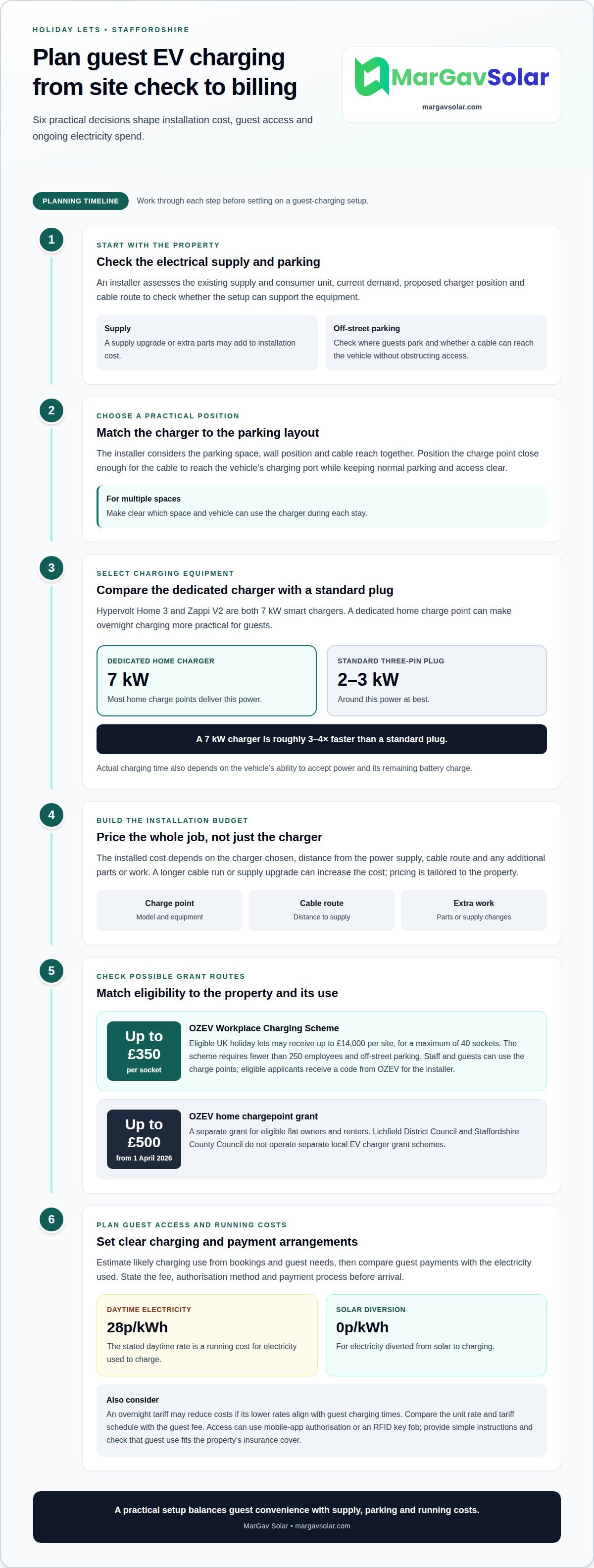
Eligible UK holiday lets can receive up to £350 per socket through the OZEV Workplace Charging Scheme, up to £14,000 per site for a maximum of 40 sockets. The scheme described here requires fewer than 250 employees and off-street parking; according to the Office for Zero Emission Vehicles, sites must have off-street parking. Staff and guests can use the charge points, and eligible applicants receive a code from OZEV for the installer.
A separate OZEV home chargepoint grant offers eligible flat owners and renters up to £500 from 1 April 2026. Lichfield District Council and Staffordshire County Council do not operate separate local EV charger grant schemes. Check which grant route matches the property and its use before budgeting.
Charging income, electricity costs and fees
Guest charging can generate income, but the margin depends on electricity costs and billing. For a Staffordshire holiday let, estimate likely use based on bookings and guest needs, then compare expected payments with the electricity used. As income varies with usage, a clear charging policy helps you understand the running costs.
At the stated daytime rate of 28p/kWh, electricity used for charging is a running cost. Solar diversion can supply charging at 0p/kWh for the diverted electricity.
An overnight electricity tariff may reduce charging costs if its lower rates coincide with guest charging times. Compare the unit rate and tariff schedule with the fee guests pay. Set a clear per-use or per-energy charge, and explain the access and payment process before arrival. The best approach depends on your energy contract and how guests use their vehicles.
Before installation, the electrical supply and consumer unit need to be assessed. The installer considers existing demand, the proposed charger position and the cable route to determine whether the supply can support the equipment. Off-street parking is also required for the Workplace Charging Scheme. Place the charger so its cable can reach a parked vehicle without obstructing access.
Installations must meet applicable UK electrical and building requirements. Most home EV charger installations in Staffordshire do not require planning permission. The property’s electrical supply, parking layout and proposed equipment also inform the safety assessment.
Charging can make a holiday let more convenient for guests travelling by electric vehicle, while adding electricity use and payment administration. A practical charging plan balances guest access with running costs. For a professionally assessed EV charging setup, factor in the supply, parking and intended billing method.
How fast do the chargers charge a car?
Most home charge points deliver 7 kW, while a standard three-pin plug provides around 2-3 kW at best. That makes a 7 kW charger roughly three to four times faster than a standard plug. For holiday-let guests, the faster option can make overnight charging more practical between arrival and departure.
Charging time also depends on the vehicle. Its ability to accept power and the battery’s remaining charge affect how quickly it can take on energy. A guest arriving with a low battery may need longer than someone topping up during an overnight stay. Clear arrival information helps guests understand what charging is practical during their visit.
Placement matters as much as the charger’s rated speed. Position the charge point close to the parking space, with a cable that can reach the vehicle’s charging port. For a driveway, garage or designated off-street space, the installer considers where vehicles park and how guests approach the charger. A suitable position keeps the cable accessible without disrupting normal parking.
Guest access can be managed through mobile-app authorisation or an RFID key fob. Choose a method that fits how guests receive instructions and access the property. For example, provide a key fob with the accommodation keys, or let guests authorise charging through a mobile device. Before arrival, explain how to start a session and outline any charging fees.
Off-street parking lets guests charge at the property rather than rely on a public charge point. The space must be close enough for the installed cable to reach the vehicle. If the property has several spaces, make clear which vehicle can use the charger during each stay.
During installation planning, the installer assesses the parking layout, wall position and cable reach together. This helps match the charger’s 7 kW output to a practical guest setup, rather than treating charging speed as the only decision.
Home EV charger installation in Staffordshire
Planning EV charger installation for holiday lets in Staffordshire starts with a site assessment. The installer considers the electrical supply, parking layout and route between them. For a holiday let in Lichfield, for example, the charger position should suit the usual parking space and allow the cable to reach the vehicle’s charging port.
The charger’s position needs to work for guests as well as the building. A wall near the parked vehicle can keep the cable within reach, while the route should avoid blocking a doorway or access path. If guests use more than one parking space, identify the intended charging bay in the installation plan to make arrival instructions clear.
The installer assesses the existing supply and consumer unit against the proposed charge point. These checks help establish the equipment and installation work required. A well-planned EV charger installation for holiday lets in Staffordshire also accounts for how guests will find and use the charger, rather than leaving access arrangements until later.
Most home EV charger installations in Staffordshire are completed within a few hours and do not require planning permission. Listed holiday properties need particular consideration, however. The proposed position and its effect on the building may affect the planning process, so account for listed status from the start.
For owners, considering the site assessment, charger location and guest access together helps avoid an awkward parking position or a cable that can’t reach the vehicle. It also makes it easier to give clear instructions, such as naming the charging bay in pre-arrival information and explaining how guests can use the charger.
Arrange a professional assessment of your Staffordshire property’s parking layout and electrical supply before installation. Arrange EV charger installation for your holiday let.
MarGav Solar
MarGav Solar helps holiday-let owners plan EV charging around the property, parking layout and guest use. If you’re weighing charging income against electricity costs, consider how a charger could work alongside solar panels or battery storage.
The right setup depends on guest access, parking and how the property uses electricity. MarGav Solar installs EV charging points, residential solar PV systems and battery storage solutions, helping you consider these needs together rather than treating the charger in isolation.
Talk to MarGav Solar when you’re ready to discuss professional installation or how charging could fit your holiday let’s wider energy setup. Contact MarGav Solar to discuss your property and installation needs.
Make charging part of your holiday-let plans
Planning EV charger installation for holiday lets in Staffordshire means looking beyond the equipment. Consider how charging fits the guest experience, property layout and wider energy plans. A clear plan makes it easier to decide how guests will access charging and how it could support future improvements to the property.
MarGav Solar installs EV charging points, residential solar PV systems and battery storage solutions. These options let you consider charging alongside how your holiday let generates, stores and uses electricity. The right combination depends on your property and priorities, so start with the practical needs of the site and its guests.
Ready to discuss the next step for your property? Contact MarGav Solar about installation and explore a setup that works for your holiday let.
Frequently Asked Questions
Will you advise me on the best place to install my EV charger?
Yes. The installer can recommend a position suited to the vehicle and parking arrangement. For a holiday let, check that the cable can reach the charging port when the vehicle is parked normally, without crossing the main guest entrance. The assessment can also account for multiple parking bays, so arrival instructions identify the space intended for charging.
How much space is required for the chargers?
There’s no single space measurement that suits every Staffordshire property. The practical area depends on the mounting position, where the vehicle is parked and whether the cable reaches its charging port. Keep the chosen bay usable for normal parking and leave guests a clear route in and out. A site assessment helps determine a practical position for the charger.
Is this suitable for a single holiday let or small B&B?
Yes, a charge point can serve a single holiday let or a small B&B; the property layout determines the installation arrangement. Eligible UK B&Bs and holiday lets can use the Workplace Charging Scheme, subject to its conditions, including fewer than 250 employees and off-street parking. Charging instructions can be incorporated into guest arrival information, making the access process clear from the outset.
What happens if there is a technical issue?
If the charger displays an error or a session won’t start, note the message and when the issue occurred. Record whether it affects one vehicle or several, and whether access was authorised through an app or RFID key fob. This information helps you describe the problem accurately when reporting it to the installer. Don’t attempt electrical repairs yourself.
What are EV charger installation costs for holiday lets in Staffordshire?
The price depends on the charge point, the cable route from the power supply and any additional parts or electrical work required. A garage installation, longer cable run or supply upgrade can change the scope. The price for a specific property depends on its requirements and is provided after a quote request.
Which EV charger types and power ratings suit holiday accommodation?
A 7 kW smart charger is a common home option, and the Hypervolt Home 3 and Zappi V2 are examples. The suitable choice depends on the property’s electrical supply, parking setup and the vehicle’s charging capability. A vehicle may accept power at a different rate from the charger’s maximum, so the rated output alone doesn’t determine every charging session’s speed.


