

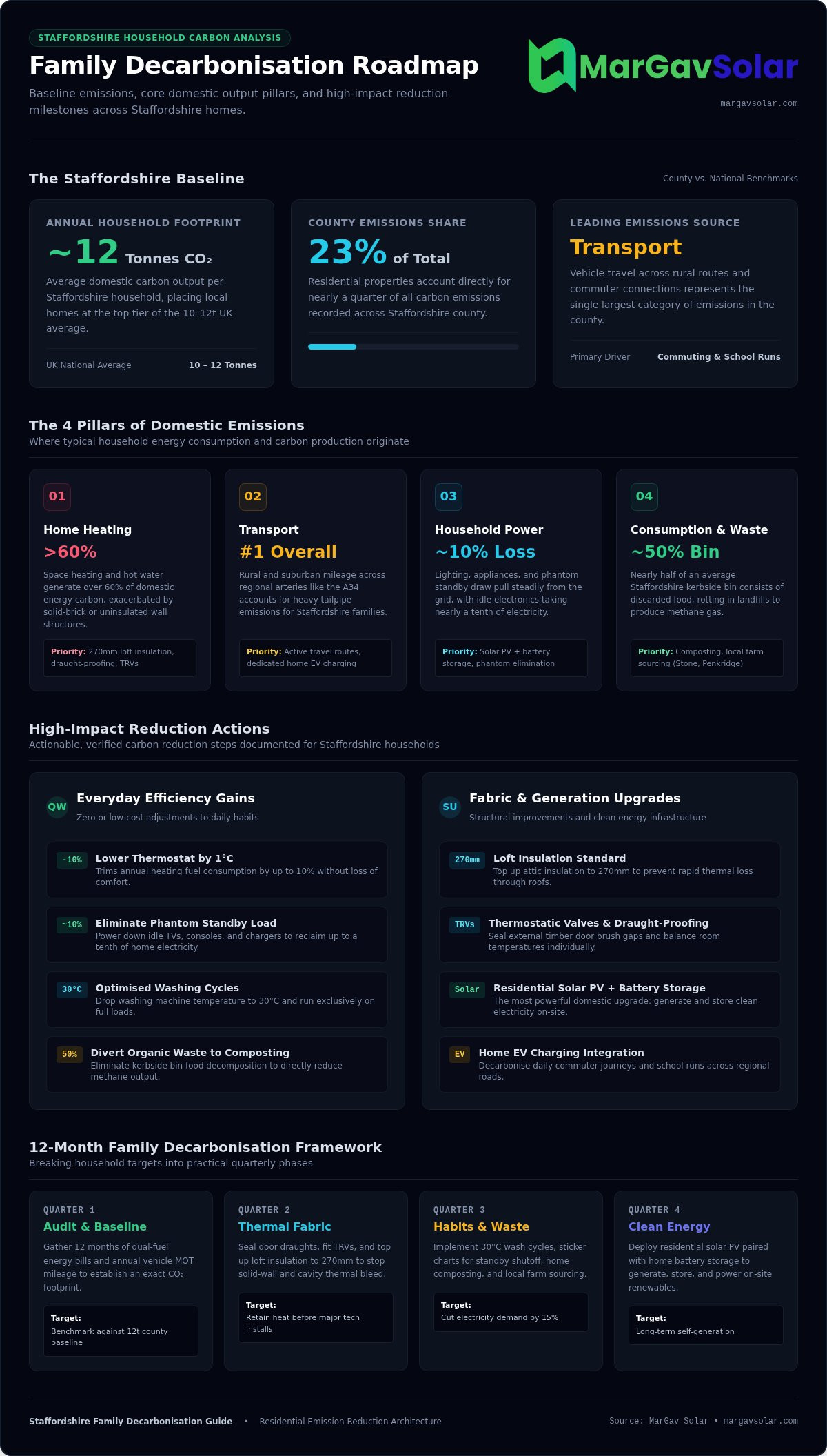
The average Staffordshire household generates approximately 12 tonnes of carbon every year, with residential properties responsible for 23% of the county's overall emissions. When researching practical ways of reducing my family's carbon footprint Staffordshire residents often hit a wall of conflicting eco-advice and steep winter energy bills. You shouldn't have to choose between keeping your family comfortably warm and doing your part for the environment.
Real family decarbonisation doesn't demand drastic sacrifices; it just takes a clear, phased action plan. In this guide, you'll discover a step-by-step roadmap to calculate, lower, and systematically eliminate your household emissions across Staffordshire. We'll explore low-effort daily habits, local recycling and waste schemes, and genuine home energy upgrades like residential solar PV and battery storage that deliver meaningful, long-term carbon cuts.
Key Takeaways
- Establishing a household baseline is the vital first step toward reducing my family's carbon footprint Staffordshire wide, revealing where your domestic emissions peak.
- Zero-cost daily adjustments, from cutting phantom power draw to adopting local waste reduction initiatives, deliver fast carbon savings without compromising comfort.
- Active travel routes and dedicated home EV charging can substantially lower family transport emissions, which represent Staffordshire's largest single emissions category.
- Investing in residential solar PV combined with home battery storage delivers the most powerful domestic upgrade, enabling your family to generate and store clean electricity on-site.
- A phased 12-month decarbonisation plan turns complex eco-goals into manageable quarterly milestones that build lasting sustainable habits.
Understanding Your Family's Carbon Footprint: The Staffordshire Baseline
Every school run down the A34, gas boiler cycle on a frosty morning, and supermarket run contributes directly to your household emissions. If you have ever wondered what is a carbon footprint?, it is simply the total volume of greenhouse gases produced by your family's daily energy use, travel, diet, and consumption habits. In the UK, the average home creates roughly 10 to 12 tonnes of CO2 annually. Staffordshire families often sit at the higher end of that scale due to detached housing layouts, colder rural microclimates, and longer commuter journeys between market towns.
Domestic emissions generally fall into four core pillars:
- Home heating: Space heating and hot water typically generate over 60% of domestic energy carbon.
- Transport: Rural and suburban mileage across Staffordshire adds substantial tailpipe emissions.
- Household power: Lighting, appliances, and electronics drawing from the national grid.
- Consumption and waste: Food purchases, packaging, and goods disposal.
Calculating Your Household Emissions: Where to Begin
Meaningful progress on reducing my family's carbon footprint Staffordshire wide starts with accurate baseline data. Over a single weekend, pull together your last twelve months of dual-fuel energy statements and check the annual mileage figures on your vehicles' MOT certificates. Enter these numbers into validated UK tools, such as the WWF Footprint Calculator or the Energy Saving Trust audit tool. Pinpointing your largest emission hotspots lets your household set realistic short-term targets, such as cutting electricity demand by 15% this winter, before committing to long-term structural changes.
Staffordshire's Housing Stock and Energy Challenges
Local geography shapes local emissions. Many families live in Victorian solid-brick terraces in towns like Leek and Stafford, or post-war detached properties with uninsulated cavity walls. These structures bleed heat rapidly during Midlands winters. Off-grid villages in the Staffordshire Moorlands face additional hurdles, relying on carbon-intensive heating oil or bulk LPG tanks rather than mains gas.
Before exploring major renewable upgrades, plug the basic thermal leaks. Simple draft-proofing around timber doors, topping up loft insulation to 270mm, and installing thermostatic radiator valves deliver immediate efficiency gains. Tackling these fabric repairs ensures your home retains warmth effectively, making later decarbonisation measures far more effective.
Quick Wins: Everyday Family Habits to Slash Emissions
Big lifestyle shifts sound daunting, but immediate carbon reductions begin with how your household uses energy daily. Phantom power draw quietly eats into your budget; leaving televisions on standby, games consoles idle, and phone chargers plugged in can account for nearly 10% of domestic electricity use. Getting children involved turns these adjustments into an engaging routine. Try creating a simple weekend sticker chart where kids track switch-offs and monitor the smart meter display for tangible drops in power use.
Practical Energy Conservation in the Home
Following the Energy Saving Trust's expert advice, knocking your central heating thermostat down by just one degree can trim annual fuel consumption by up to 10% without leaving anyone shivering. Fit simple brush draught excluders to external doors, draw thick curtains at dusk, and swap out remaining halogen bulbs for energy-saving LEDs in high-traffic living areas. In the kitchen, drop your washing machine cycle to 30°C and wait for full loads. While sensible habits form an essential baseline for reducing my family's carbon footprint Staffordshire households eventually hit an efficiency plateau, where pairing these daily routines with clean generation from local specialists like MarGav Solar unlocks the next level of savings.
Sustainable Waste and Food Choices Across Staffordshire
Dietary and waste habits carry substantial hidden emissions. County council data reveals that nearly half of an average Staffordshire kerbside bin consists of discarded food, which rots in landfill to produce damaging methane gas. Setting up a simple garden compost bin diverts vegetable peelings and garden waste instantly while enriching your soil.
Cutting food miles is equally straightforward across our region. Sourcing seasonal vegetables and meat from farm shops around Stone, Penkridge, and the Moorlands bypasses industrial freight networks. When tackling seasonal household clear-outs, make full use of Staffordshire County Council's recycling centres to ensure scrap timber, electronics, and cardboard are properly repurposed rather than dumped.
Decarbonising Family Transport Across Staffordshire Roads
Transport accounts for roughly 40% of Staffordshire's total carbon emissions, making it the single largest polluter in the county. Between rural commutes across the Moorlands and bumper-to-bumper traffic along the A34 and M6 corridor, local families burn significant fossil fuels just handling weekly school runs and supermarket trips. Cutting these transit emissions is critical when reducing my family's carbon footprint Staffordshire wide, requiring a balanced mix of smart travel habits and cleaner technology.
Embracing Active Travel and Public Transport Locally
Short journeys under two miles create disproportionate engine wear and carbon output. Swapping the car for local alternatives delivers immediate environmental relief:
- Canal towpaths and trails: Route daily trips along scenic off-road routes, such as the Trent and Mersey Canal or pathways skirting Cannock Chase, for safer family walking and cycling.
- Walking buses: Team up with nearby parents to rotate walking supervision for the primary school run, taking multiple idling cars off neighbourhood streets.
- Trip chaining: Combine grocery pickups, sports clubs, and errands into single connected loops instead of making repeated cold-start departures throughout the day.
Transitioning to Electric Vehicles and Home Charging
Replacing a petrol or diesel family car with an electric vehicle (EV) permanently slashes operational carbon emissions. Even after accounting for battery manufacturing, an EV driven in the UK produces roughly two-thirds less greenhouse gas over its lifetime than an equivalent combustion vehicle. As the national grid incorporates more offshore wind and renewables, that gap widens further every year.
Public chargers in council car parks help in a pinch, but relying on commercial hubs quickly becomes expensive and inconvenient for busy households. Installing dedicated home EV charging points gives parents the convenience of waking up to a full battery every morning. Modern smart units allow you to schedule charging overnight during ultra-low off-peak grid windows, drastically reducing running costs while keeping domestic travel genuinely sustainable.
Transforming Your Home with Clean Solar Energy and Battery Storage
Behavioural tweaks save energy, but microgeneration transforms how your household operates. Generating clean electricity right on your roof eliminates reliance on fossil-fuelled power stations feeding into the national grid. For homeowners committed to reducing my family's carbon footprint Staffordshire domestic solar and storage setups represent the single most impactful physical upgrade available.
Harnessing Rooftop Solar Panels for Daily Family Needs
Modern residential solar PV systems don't require unbroken Mediterranean sunshine to generate usable power. Modern panels perform reliably under typical Midlands cloud cover, capturing daylight across south-, east-, and west-facing rooftops alike. Booking a professional solar panel installation allows you to power major daytime loads, from running appliances to charging home tech, directly from clean solar energy instead of carbon-heavy grid electricity.
Maximising Efficiency with Home Battery Storage
Solar arrays naturally peak while families are out at school and work, leaving surplus generation exported unless captured. Pairing your panels with dedicated solar battery storage solves this mismatch by capturing midday output for evening dinners, laundry, and lighting. Intelligent management platforms like the GivEnergy cloud let you monitor domestic power flows and charge from off-peak grid tariffs on gloomy winter days. Scheduling routine solar panel maintenance keeps this hardware operating at peak efficiency year after year.
The Value of Certified Local Installation Standards
High-voltage domestic electrical work demands seasoned trade expertise. Choosing engineers backed by NICEIC certification ensures your array meets strict UK safety regulations and Distribution Network Operator standards. Working with qualified regional specialists protects manufacturer warranties and guarantees your installation runs safely for decades. If you are ready to produce clean energy at home, speak to MarGav Solar about tailored residential solar solutions to begin your family's transition.
Creating Your Family's 12-Month Decarbonisation Roadmap
Decarbonising your home doesn't need to happen overnight. Trying to overhaul every domestic system at once causes decision fatigue and stalls practical momentum. A phased schedule lets your household distribute effort and capital logically across four quarters. Taking a structured calendar approach makes reducing my family's carbon footprint Staffordshire wide completely realistic for everyday family life.
Phasing Your Green Home Investments Realistically
Break your annual transformation into distinct seasonal milestones to keep progress steady:
- Months 1-3 (Zero-Cost Baseline): Audit dual-fuel consumption, implement kitchen shut-down routines, lower the central thermostat by one degree, and complete whole-house LED bulb swaps.
- Months 4-6 (Fabric & Thermal Upgrades): Capitalise on milder spring weather to seal door draughts, upgrade loft insulation depth to 270mm, and fit smart thermostatic radiator valves to zone heating per room.
- Months 7-12 (Renewables & Clean Transport): Install rooftop solar PV arrays, integrate battery storage ahead of winter grid spikes, and install a dedicated smart home EV charger.
Partnering with Local Staffordshire Energy Specialists
Once basic thermal improvements are complete, microgeneration delivers the permanent structural cuts required to reach genuine low-carbon living. Every Staffordshire roof has unique characteristics, from Victorian pitch angles in Leek to unshaded tile roofs across Stafford and Lichfield suburbs. Relying on generalised national advice often results in mismatched system sizing.
Working with regional renewable engineers ensures your domestic generation matches your family's real load profile. With over 20 years of UK renewable expertise and NICEIC-certified installation standards, MarGav Solar designs bespoke solar PV, GivEnergy battery storage, and EV charging setups tailored precisely to your property. Their specialists ensure your system achieves seamless grid compliance and maximum self-consumption, cementing your household's clean energy independence for decades ahead.
Take Charge of Your Household's Low-Carbon Future
Decarbonisation doesn't require drastic lifestyle upheaval; it simply demands a clear, realistic plan. By combining everyday efficiency wins with smarter travel choices and targeted home insulation, reducing my family's carbon footprint Staffordshire wide becomes an achievable reality rather than an overwhelming challenge. Each practical change builds real momentum, lowering running costs while keeping your home warm and resilient.
When you're ready for the ultimate step, generating your own renewable power creates lasting energy security. Backed by over 20 years of renewable installation expertise across Staffordshire, MarGav Solar provides comprehensive end-to-end solar PV and battery storage system design installed by fully NICEIC-certified electrical installation specialists. Ready to power your family home with clean energy? Speak with the Staffordshire experts at MarGav Solar and start building your household's self-sufficient future today.
Frequently Asked Questions
How much can a typical Staffordshire family reduce their carbon footprint each year?
A typical Staffordshire family can cut their carbon emissions by 30% to over 60% annually depending on their chosen measures. Simple behavioural tweaks and insulation trim one to two tonnes of carbon. When committing seriously to reducing my family's carbon footprint Staffordshire households can eliminate several additional tonnes each year by combining residential solar PV, battery storage, and electric transport, dramatically transforming their annual environmental impact.
Do solar panels generate enough electricity during overcast Staffordshire winters?
Yes, solar panels work reliably during overcast Midlands winters because they absorb daylight rather than direct heat. While shorter winter days produce less overall power than sunny summer months, photovoltaic cells still generate meaningful daytime electricity through cloud cover. Pairing panels with home battery storage ensures you capture this daytime output, or charge your battery using off-peak green grid tariffs overnight.
What are the most cost-effective first steps for a family starting their green journey?
The most cost-effective starting point involves zero-cost behavioural habits and minor fabric improvements. Lowering the main heating thermostat by a single degree, fixing draught excluders to exterior doors, switching all lighting to LEDs, and cutting food waste create instant reductions. These low-effort adjustments build household momentum and deliver immediate financial savings, which you can later roll into high-impact investments like home renewables.
Do I need planning permission for rooftop solar panels in Staffordshire?
Most residential solar panel installations in Staffordshire fall under Permitted Development rights and do not require full planning permission. Specific conditions apply regarding panel height, roof protrusion, and boundary setbacks. If you live in a listed building or a designated conservation area, such as parts of Lichfield or historic Moorlands villages, you should check with your local borough or district planning authority beforehand.
Can our family combine an electric vehicle charger with our home solar system?
Yes, integrating a dedicated home EV charging point with rooftop solar allows you to charge your vehicle with clean, home-grown electricity. Smart EV chargers communicate directly with your solar inverter and battery storage. When your panels generate surplus electricity that your home isn't using, the charger diverts that clean power straight into your car's battery rather than exporting it back to the grid.
How does home battery storage help cut my family's carbon emissions?
Home battery storage cuts emissions by storing excess daytime solar energy so your family can use clean electricity during peak evening hours. Without a battery, evening electricity demand forces homes to draw from the national grid when fossil-fuel power plants are firing. Storing renewable energy on-site plays an essential role in reducing my family's carbon footprint Staffordshire wide, keeping reliance on carbon-intensive grid electricity to an absolute minimum.


