

The hardware price tag on a wallbox tells you almost nothing about what you will actually spend to charge on your driveway. When researching the realistic home EV charger cost Stafford homeowners often encounter wildly inconsistent figures. A sleek unit might look affordable online, yet initial estimates quickly unravel once an installer accounts for consumer unit upgrades, long cable routes, or incoming electrical supply checks.
It's frustrating to prepare for an electric vehicle only to face unexpected fees lurking behind your meter box. That worry is widespread across Staffordshire, particularly for homes with older fuse boards or looped supply cables. True installation value always depends on electrical survey precision rather than an artificially low hardware price. In this guide, you will discover the exact variables that shape installation pricing, how to tell if your property needs electrical modifications, and how to choose a certified local installer who delivers a transparent, fixed-price setup.
Key Takeaways
- The biggest factor shaping your overall home EV charger cost Stafford estimate isn't the hardware list price, but the complexity of your property's electrical pathway and cable distance.
- Older local properties often require consumer unit modernisations or incoming fuse checks with the network operator before adding a high-load charging circuit.
- Standard single-phase 7kW chargers offer the best balance of overnight charging speed and domestic grid compatibility for typical residential driveways.
- Planning your charger location and assessing spare fuse box capacity in advance eliminates post-survey surprises and keeps project timelines on track.
- Partnering with an NICEIC-certified local contractor secures full compliance with BS 7671 wiring regulations and guarantees peace of mind through a transparent, fixed-price contract.
Understanding the Real Cost Factors of a Home EV Charger
Total installation cost represents the combined sum of the charging hardware, specialised electrical labour, and formal safety certification. When assessing your overall home EV charger cost Stafford quotes often cause confusion because online hardware listings show only part of the equation. A compliant installation requires a dedicated radial circuit from your consumer unit, appropriate surge protection, and isolation switches to prevent electrical overloads. Conducting an accurate upfront technical survey ensures you receive a transparent breakdown rather than facing supplementary invoices on installation day.
Hardware vs. Installation: Deconstructing the Quote
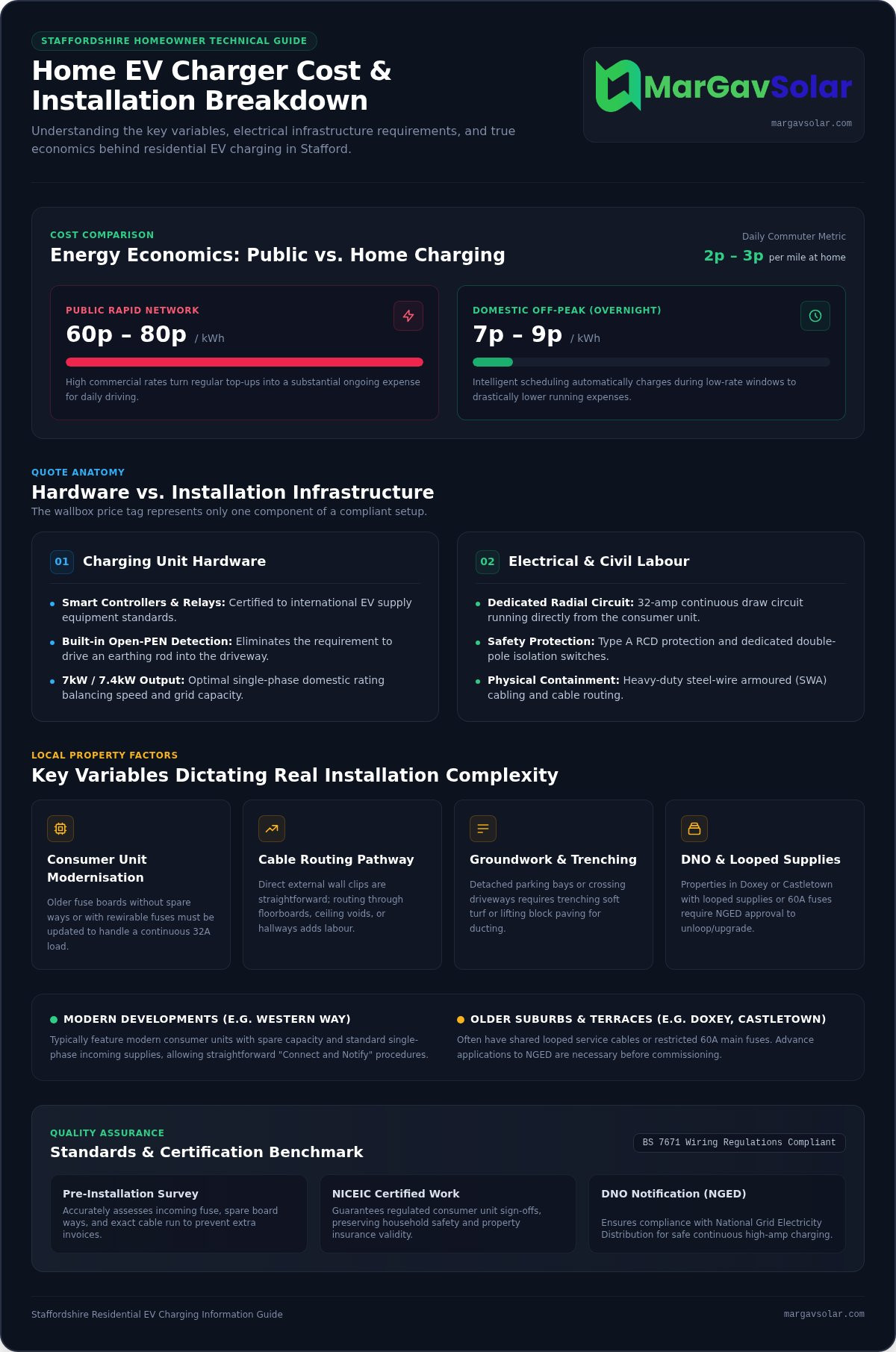
A charging quote separates into two distinct parts: the physical device and the infrastructure supporting it. Inside the wallbox, you are paying for smart controllers, safety relays, and communication modules built to international electric vehicle supply equipment standards. Premium chargers include open-PEN fault detection, eliminating the need to drive an earthing rod into your driveway.
The installation side covers the physical containment and labour. Installers must route heavy-duty EV cabling from your incoming supply to the chosen charging point. When an electrical layout requires routing cables through ceiling voids, beneath floorboards, or along finished interior hallways, labour time increases significantly compared to a direct, back-to-back exterior wall mount.
The Long-Term Economics of Home Charging
While the initial setup requires careful budgeting, home charging completely alters the daily cost of running a vehicle. Public rapid charging networks regularly charge between 60p and 80p per kilowatt-hour, turning routine top-ups into a noticeable expense. In contrast, domestic charging lets you access off-peak energy rates, which often drop to between 7p and 9p per kilowatt-hour overnight.
Modern chargers feature intelligent scheduling that automatically aligns charging sessions with these low-rate overnight windows. For daily commuters across Staffordshire, charging at home can reduce per-mile running costs down to just 2p to 3p. Over several years of driving, the fuel savings generated on your driveway easily offset the upfront installation expenses.
Property Variables That Influence EV Charger Installation in Stafford
Property age and layout heavily dictate the final price of an installation. While modern housing developments around Western Way often have up-to-date electrical systems ready for an immediate connection, Victorian terraces and older homes across Stafford present distinct structural hurdles. Understanding these architectural variables clarifies how your real-world home EV charger cost Stafford quote is calculated.
Consumer Unit Capacity and Electrical Safety Upgrades
Adding a continuous 32-amp electrical draw tests your existing fuse box. If your consumer unit lacks spare ways or relies on outdated rewirable fuses, modernising the board is mandatory before adding an EV circuit. Safe installations demand Type A RCD protection and dedicated double-pole isolation to shield against DC leakage faults. Reviewing practical NICEIC certification guides explains why regulated consumer unit sign-offs protect both household safety and property insurance.
Cable Routing and Groundwork Challenges
Physical distance between your meter and parking bay dictates material expenses and labour hours. Clipping steel-wire armoured cabling neatly along an external wall is relatively simple. However, running cables through floorboards or supplying a detached garage requires extra work. Crossing driveways involves trenching soft turf or lifting block paving to lay protective subterranean ducting, which naturally increases installation time.
Stafford Grid Constraints and DNO Approvals
Stafford's regional electrical network is operated by National Grid Electricity Distribution (NGED). Standard 7.4kW installations usually follow a swift "Connect and Notify" procedure. However, older suburbs like Doxey and Castletown often feature looped service cables shared between neighbouring properties.
When an incoming line is looped, an installer must submit an advance application to NGED to unloop the cable or upgrade a restricted 60A main fuse before commissioning the unit. While eligible flat owners and tenants can offset some upgrade expenses through the government EV chargepoint grant, property owners must account for grid readiness. To identify these supply conditions early without billing surprises, booking an electrical survey with MarGav Solar guarantees a fixed-price contract tailored to your property.
Key Charger Features That Impact Upfront and Running Costs
When budgeting for a realistic home EV charger cost Stafford homeowners quickly realise that feature selection dictates both upfront expenditure and day-to-day operating efficiency. Single-phase 7kW units remain the gold standard across UK residential properties, replenishing roughly 25 to 30 miles of range per hour. Selecting units with dynamic load management protects your incoming supply by automatically dialling down charger draw whenever high-draw household appliances activate.
Tethered vs. Untethered Charging Sockets
A tethered wallbox includes a permanently attached lead, offering unmatched convenience when pulling onto the driveway on rainy evenings. You simply uncoil the cable and plug directly into your vehicle. Conversely, untethered units feature an open Type 2 socket. While untethered units create a cleaner aesthetic on front brickwork and let visiting drivers use their own cables, you must bring your own lead out of the boot for every session. Tethered leads also experience wear over years of daily handling, though replacement cables can be fitted without replacing the wall unit.
Smart Connectivity, Dynamic Tariffs, and App Control
Modern wallboxes must comply with UK smart charging regulations by incorporating Wi-Fi or 4G data links. Stable connectivity lets your charger communicate directly with dynamic energy tariffs that slash unit rates during the early hours. Checking the Energy Saving Trust home charging guide reveals just how much money smart off-peak schedules save compared to standard domestic rates. Smartphone applications also provide remote locking, session scheduling, and granular kilowatt-hour tracking for business expense reporting.
Integrating with Solar Panels and Home Battery Storage
If you generate clean electricity on your roof, choosing an intelligent unit designed for microgeneration transforms your long-term fuel budget. Rather than drawing power blindly from the grid, solar-compatible EV charging points read surplus generation in real time and divert green electricity straight into your car battery.
Connecting your charger with residential solar PV systems allows you to lock in thousands of miles of self-generated driving each year. Adding dedicated solar battery storage completes the loop. A home battery stores cheap overnight electricity or excess afternoon sun, giving you the freedom to charge your vehicle during evening peak hours without paying premium grid prices. When assessing your overall home EV charger cost Stafford properties that integrate solar and storage generate the fastest return on investment.
Steps to Budget and Prepare for Home Charger Installation
Taking a structured approach before contacting installers keeps your project timeline smooth and prevents unexpected variations. Following four foundational preparation steps helps you establish a clear baseline:
- Step 1: Check your main electrical fuse. Locate your incoming supply head to see whether you have a 60A, 80A, or 100A cutout fuse, and check if your consumer unit has spare breaker ways.
- Step 2: Map your parking orientation. Identify your vehicle's charge port location so the charging lead reaches comfortably without stretching across walkways.
- Step 3: Test Wi-Fi strength at the mounting point. Stand at your preferred exterior wall position with a smartphone to ensure steady internet reception for automated app scheduling.
- Step 4: Request comprehensive installation scopes. Ensure any quote covers physical containment, electrical certification, and the distribution network operator (DNO) paperwork handled with National Grid Electricity Distribution.
Evaluating Available Grants and Incentives
Grant eligibility rules have narrowed significantly in recent years. Standard homeowners living in single-family properties with private driveways cannot claim national subsidies for charge points. However, the government EV chargepoint grant provides up to £500 toward purchase and installation for residential tenants and flat owners with dedicated off-street parking. Small business owners operating from residential premises can also tap into the Workplace Charging Scheme to offset installation overheads. Always steer clear of unsolicited social media adverts offering universal domestic subsidies, as these are often misleading lead-generation scams.
Navigating Remote Video Surveys vs. Physical Assessments
Many national installation brokers rely entirely on digital photo uploads to generate quotes. While smartphone photos capture consumer unit labels and external walls reasonably well, remote reviews often miss critical infrastructure nuances common across Staffordshire. They frequently fail to identify shared looped supplies, outdated earth bonding on incoming water pipes, or hidden sub-floor routing restrictions.
Discovering these issues on installation morning usually triggers extra charges or aborted visits. That is why an experienced local specialist evaluates your home with meticulous electrical surveys. You can request a fixed-price survey with MarGav Solar to secure a transparent contract that covers design, hardware, labour, and safety certification without hidden extras.
Selecting a Certified EV Charger Installer in Stafford
Selecting the right team to handle your charging point matters just as much as picking the hardware. While broad trade directories list generic tradespeople, high-voltage vehicle charging requires specialist technical competence. When evaluating the total home EV charger cost Stafford homeowners quickly discover that verified safety credentials and transparent agreements deliver far better long-term value than cut-price, unvetted estimates.
The Importance of NICEIC Certification and Competent Persons Schemes
Under UK Building Regulations Part P, installing a dedicated high-capacity EV circuit is legally notifiable domestic electrical work. Choosing an installer certified under an approved Competent Persons Scheme, such as NICEIC, guarantees strict compliance with BS 7671 IET wiring regulations.
NICEIC-registered contractors undergo regular technical audits to verify their safety procedures, calibrated testing tools, and installation standards. Once work finishes, your certified installer registers the project with local building control and issues an official Electrical Installation Certificate. This paperwork proves essential down the line, safeguarding your home insurance coverage and preventing legal headaches when selling your property.
The MarGav Solar Fixed-Price Installation Commitment
MarGav Solar brings over 20 years of industry experience to households across Staffordshire. Rather than offering open-ended estimates that escalate on installation day, we work under transparent fixed-price installation contracts. These clear agreements cover complete system design, hardware procurement, skilled labour, and electrical certification, protecting you from unexpected material surcharges.
Our local specialists also manage the administrative process, coordinating directly with National Grid Electricity Distribution for all necessary grid notifications and connection approvals. Because we also install residential solar PV systems and battery storage solutions, we design your EV setup to integrate seamlessly with home microgeneration. To plan your installation with dependable local experts, schedule a bespoke home EV charger consultation with our Stafford team today.
Take Control of Your Home EV Charging Setup
Assessing your realistic home EV charger cost Stafford options comes down to technical precision rather than promotional hardware price tags. By evaluating your consumer unit capacity early, mapping sensible cable routes, and verifying incoming supply arrangements, you protect your property from sudden installation-day expenses. Pairing an efficient 7kW charging point with smart off-peak tariffs turns daily electric driving into an effortless, low-cost routine.
Partnering with qualified local specialists ensures your new charging circuit meets strict safety standards from start to finish. Backed by over 20 years of trusted renewable electrical engineering expertise in Staffordshire, our fully accredited NICEIC-certified technicians guarantee total Building Regulations compliance. We deliver comprehensive fixed-price contracts with zero hidden labour or certification fees, giving you complete clarity from day one. Get a fixed-price EV charger installation quote from MarGav Solar and take the first confident step toward reliable charging on your driveway.
Frequently Asked Questions
How much does a typical home EV charger installation cost in Stafford?
Total pricing depends on your property's electrical infrastructure, the distance between your fuse box and driveway, and specific charger features. While basic hardware carries a set price, installation expenses fluctuate based on whether you need consumer unit upgrades or groundwork. When evaluating your overall home EV charger cost Stafford specialists provide fixed-price installation contracts that bundle survey design, materials, labour, and safety certification into one transparent figure.
Can I charge an electric car using a standard UK 3-pin plug socket?
Yes, you can charge using a standard 3-pin domestic socket, but it's meant strictly as an occasional emergency backup. Drawing 2.3kW from a standard household socket takes between 20 and 26 hours to fully charge an average battery. Standard domestic wall plugs aren't engineered for prolonged, continuous high-amp loads, which creates overheating risks. A dedicated 7.4kW home wallbox charges three to four times faster while providing vital built-in electrical safety protections.
Does my home electrical supply need upgrading before installing an EV charger?
Not every home requires an upgrade, but older properties often need electrical modifications before installation can proceed. Your electrician must verify that your consumer unit has adequate spare ways, modern surge protection, and appropriate RCD switches. Additionally, if your property has an older 60-amp main cutout fuse, your installer will coordinate with National Grid Electricity Distribution to upgrade the fuse to 80 or 100 amps to handle the additional continuous electrical load safely.
Is planning permission required to install an EV charge point in Staffordshire?
Planning permission isn't required for most domestic installations because EV chargers fall under permitted development rights across Stafford Borough Council. To qualify, wallboxes must remain under 0.2 cubic metres in size, and ground pedestals cannot exceed 2.3 metres in height. However, you will need to apply for formal planning consent if your property is a listed building or situated within a designated conservation area, such as parts of historic central Stafford.
What is the difference between tethered and untethered home EV chargers?
The fundamental difference is that a tethered charger has a permanently attached charging lead, while an untethered unit features an open socket. Tethered models provide daily convenience, letting you plug straight into your vehicle without retrieving a cable from your boot. Untethered units offer a neater, flush look on exterior walls and allow drivers with different vehicle connector types to plug in using their own bespoke charging cables.
Can my home EV charger run directly from my existing solar panels?
Yes, your EV charger can run directly on solar energy if you install a solar-compatible smart charging unit. These intelligent wallboxes monitor real-time microgeneration and divert surplus green electricity straight into your car rather than exporting it back to the grid. Pairing your charger with residential solar panels and battery storage lets you store excess power during the day and charge your vehicle cleanly overnight, reducing running costs even further.
What happens if my property shares a looped electricity supply with a neighbour?
If your property shares a looped supply, an installer cannot immediately connect a standard 7.4kW charger without distributor intervention. Your installer will submit an application to National Grid Electricity Distribution to separate the shared incoming cable. While de-looping work is carried out by the grid operator at no cost to the homeowner, this necessary supply separation can add several weeks to your overall project timeline before physical installation begins.


