
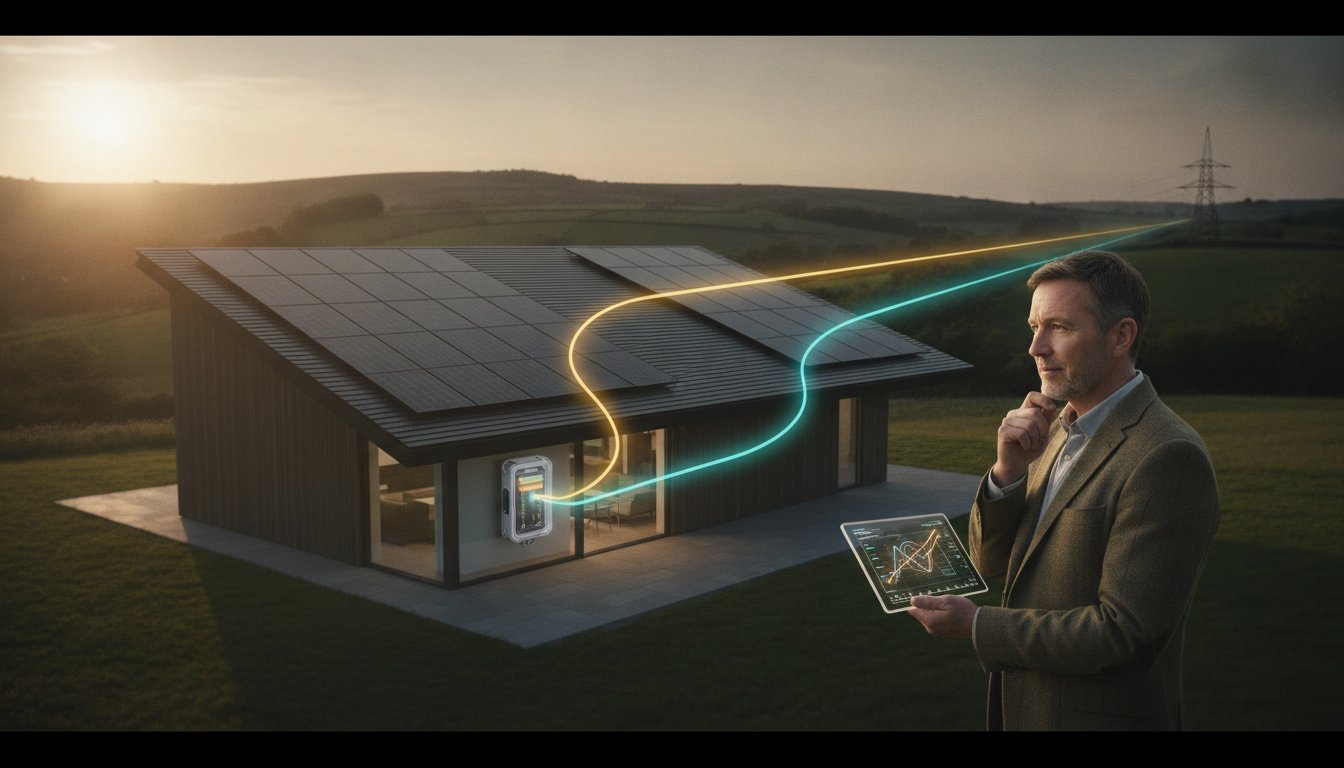
Is your solar battery actually costing you money by holding onto energy you should be selling? Many homeowners in the UK feel trapped between wanting to use their own clean power and the fear that low export rates make selling back to the grid a waste of time. It's a valid concern, especially as major suppliers like British Gas have shifted rates to 12p per kWh while others like Good Energy offer up to 25p for specific setups. You want to save on bills, but you don't want to miss out on the potential profit from your excess generation.
The good news is that the debate over solar battery export vs self-consumption UK has changed for 2026. You don't have to choose one over the other. This guide will show you how to master the strategic balance between using your own power and selling it back using the latest battery technology and smart tariffs. We'll break down the 2026 SEG landscape, explain how to use storage for profit through grid arbitrage, and provide a clear roadmap to getting your MCS and SEG certifications sorted. From 0% VAT benefits to custom energy management, you'll gain a clear strategy to maximise your ROI with confidence.
Key Takeaways
- Learn how the 2026 Smart Export Guarantee (SEG) creates a competitive market for your excess energy, replacing the static rates of the old Feed-in Tariff.
- Master the financial balance of solar battery export vs self-consumption UK by calculating the gap between import savings and top-tier export rates.
- Discover how battery storage enables grid arbitrage, allowing you to buffer your solar power and sell it back during high-demand peak periods.
- Get a step-by-step checklist for securing MCS certification and navigating DNO applications to ensure your home is fully eligible for grid payments.
- Understand why a tailored system design is vital for maximising ROI and ensuring your setup meets the specific export demands of your household.
The 2026 Landscape: Selling Electricity Back to the Grid in the UK
The UK's energy infrastructure has moved far beyond the old model of centralised power stations. In 2026, the National Grid operates as a dynamic exchange where residential solar owners play a vital role in maintaining stability. The central mechanism for this participation is the Smart Export Guarantee (SEG). This policy ensures that any household generating renewable energy has a legal right to sell their excess power back to the market. It's no longer just about being "green"; it's about participating in a high-tech energy economy. This shift has made the choice between solar battery export vs self-consumption UK a primary financial decision for modern homeowners.
2026 is defined as the year of "Agile" energy. The grid now faces massive fluctuations in demand due to the surge in electric vehicle (EV) charging and the phasing out of gas boilers. To cope, the National Grid pays for flexibility. They don't just need power at noon when the sun is brightest; they need it during the evening peaks when demand is highest. This is why the landscape has shifted from simple generation to strategic management. Homeowners who can provide power exactly when the grid is struggling are the ones seeing the highest returns on their investment.
FiT vs. SEG: What Modern Homeowners Need to Know
Many people still remember the Feed-in Tariff (FiT) as the "golden era" of solar, but the 2026 SEG landscape offers advantages that the old scheme couldn't match. While FiT paid a flat rate for every unit generated, the SEG is market-driven and competitive. Some energy suppliers now offer premium export rates, such as 25p per kWh, to customers who have both solar and battery storage installed. This creates a massive incentive for those on older "deemed export" contracts to reconsider their options. The transition from FiT to SEG represents a move from being a passive recipient of subsidies to an active participant in a competitive energy market.
2026 Regulatory Updates and Eligibility
To unlock these export payments, your system must meet strict 2026 compliance standards. The Microgeneration Certification Scheme (MCS) is the non-negotiable foundation. Without an MCS-certified installation, you'll find it nearly impossible to sign up for the most lucrative export tariffs. Additionally, the industry has moved entirely to SMETS2 smart meters. These devices are essential because they record export data every thirty minutes, allowing suppliers to pay you varying rates based on the time of day. As the UK works toward its decarbonisation targets, these regulations ensure that solar battery export vs self-consumption UK strategies are supported by accurate, real-time data that helps prevent local grid overloads.
Self-Consumption vs. Export: The 2026 Financial Tug-of-War
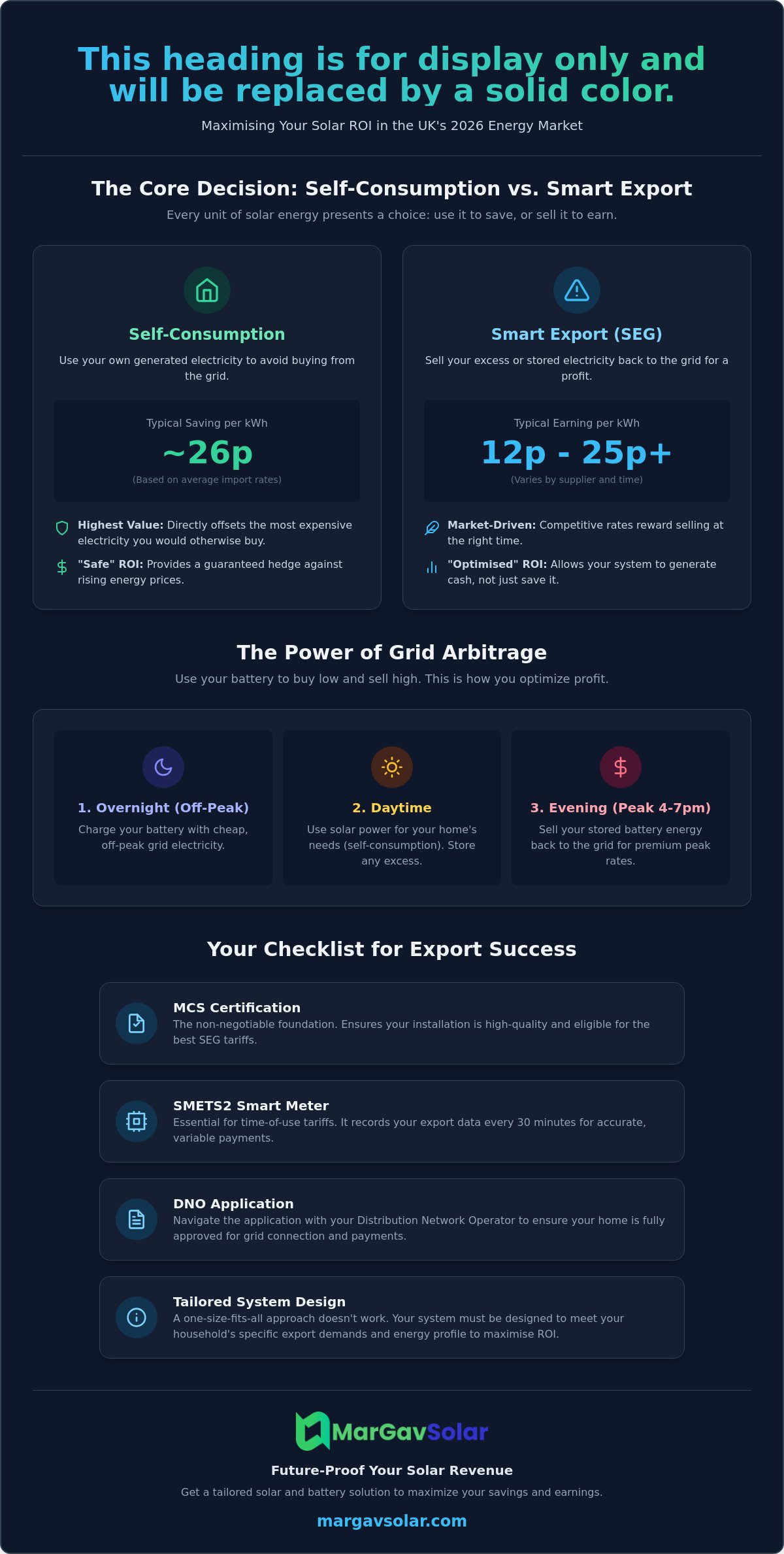
The core of the financial debate around solar battery export vs self-consumption UK lies in the "opportunity cost." Every unit of electricity you generate and use immediately saves you the full cost of importing that same unit from the grid. With average import rates sitting significantly higher than standard export rates, self-consumption remains the most reliable way to shorten your payback period. It's a simple calculation. If you're paying 26p per kWh to buy power but only receiving 12p to sell it, you're 14p better off by using that energy yourself. Self-consumption is the "safe" ROI because it provides a guaranteed hedge against rising energy prices.
However, 2026 has introduced a sophisticated twist to this logic. Smart export is no longer just about getting rid of "waste" energy. With modern time-of-use tariffs, there are specific windows where exporting becomes the superior financial choice. This is known as peak arbitrage. If a tariff offers a premium rate during the 4pm to 7pm peak, it might actually be more profitable to dump your battery's stored energy into the grid and wait for cheaper overnight rates to refill it. This moves your ROI from "safe" to "optimised," allowing your system to generate cash rather than just saving it.
Maximising Savings Through Self-Consumption
Achieving high self-consumption requires a change in household habits. Instead of running heavy appliances like washing machines or dishwashers at night, you should "load shift" them to the middle of the day when generation peaks. A professional solar panel installation in Staffordshire ensures your system is sized correctly to cover these daytime spikes. By hitting a 70% self-consumption rate, typical UK households can reduce their electricity bills by up to 70 per cent. This effectively shields you from the volatility of the global energy market by making your home an energy island during the sunniest hours.
Maximising Revenue Through Smart Export Guarantee (SEG)
When you do have surplus, you shouldn't settle for the first rate your provider offers. Ofgem's official SEG guidance mandates that all large suppliers must offer an export tariff, but the rates vary wildly in 2026. While some providers offer as little as 3p per kWh, others like Good Energy provide up to 25p for their own installation customers. You don't have to use the same company for both import and export. Shopping around for a dedicated export licensee can significantly boost your annual earnings. If you're unsure which setup fits your roof best, you might want to get a professional system assessment to find your ideal balance.
The "Smart Export" Revolution: Using Batteries for Arbitrage
Relying on "dumb" solar is a common mistake that leaves money on the table. Without a storage strategy, your system simply "leaks" excess energy onto the grid the moment it's generated. This usually happens at midday when the sun is brightest but electricity demand and export prices are often at their lowest. By integrating solar battery storage in Staffordshire, you transform your home from a passive generator into a smart energy hub. This technology allows you to buffer your energy, choosing exactly when to use it and when to sell it. It changes the solar battery export vs self-consumption UK debate from a choice of "either/or" into a strategy of "both."
The real profit in 2026 comes from identifying "Export Windows." These are specific times, usually between 4pm and 7pm, when the National Grid faces its highest demand. During these windows, time-of-use tariffs offer significantly higher payouts. Instead of using your stored battery power to run your own dishwasher at 5pm, a smart strategy might involve exporting that stored energy at a high rate and then refilling your battery from the grid at 2am when prices drop to a fraction of the cost. This complex dance is managed entirely by your smart inverter, ensuring you never have to manually flip a switch to make a profit.
GivEnergy Cloud and Automated Revenue
Modern platforms like the GivEnergy Cloud have made this level of management accessible to every homeowner. The system uses machine learning to predict your energy usage and the next day's weather, automatically scheduling export windows to hit peak prices. Smart arbitrage works by charging your battery during cheap off-peak hours and selling that energy back to the grid when prices are at their highest. You can track these earnings in real-time via a mobile app, seeing exactly how much your battery has earned you while you were at work or asleep.
Inverter Upgrades: The Key to Grid Compliance
To participate in these high-yield export schemes, your hardware must be up to the task. Older systems often rely on legacy AC-coupled inverters that struggle with the rapid switching required for grid arbitrage. Professional inverter upgrades in Staffordshire are often necessary to ensure G99 grid compliance, which is the regulatory standard for larger export capacities. A modern hybrid inverter also prevents "clipping," a common issue where excess solar power is wasted because the inverter cannot process it fast enough. Upgrading your core hardware ensures that every watt your panels produce can be either stored for your own use or sold for maximum profit.
Homeowner Checklist: Setting Up for Grid Export Success
Having the latest battery technology is only half the battle. To actually receive payments for the energy you provide to the grid, you must navigate a specific regulatory path. The decision between solar battery export vs self-consumption UK becomes irrelevant if your system isn't legally cleared to sell power. The foundation of this process is your MCS Certificate. This document proves your system meets international standards and is the first thing any energy supplier will ask for when you apply for a Smart Export Guarantee (SEG) tariff.
Safety and insurance are equally critical components of your setup. Working with an installer who holds NICEIC certification ensures that your electrical work complies with the highest UK safety standards. This isn't just for peace of mind. Many export licensees and home insurance providers require proof of professional certification before they'll finalise an agreement. Without these credentials, you're essentially locked out of the export market, regardless of how much excess energy your panels produce.
Finally, you need a way to measure what you're selling. A SMETS2 smart meter is the modern industry standard. These meters track energy flow in both directions every thirty minutes, which is essential for the "agile" tariffs mentioned earlier. If your home still has an older "dumb" meter or a first-generation SMETS1 device, you'll likely need an upgrade before your export payments can begin.
The Application Journey: From Panels to Payments
The technical bridge to the grid is the DNO (District Network Operator) application. In Staffordshire, this usually involves National Grid Electricity Distribution. Most residential systems fall under a G98 notification, which is a simple "fit and inform" process for systems under 3.68kW per phase. Larger systems require a G99 application, which must be approved before installation begins. Once the DNO is satisfied, you'll receive your Export MPAN (Meter Point Administration Number). This unique identifier is what allows your chosen supplier to link your exported units to your bank account. You'll need to provide a commissioning report and your first export reading to trigger your initial payment.
Local Staffordshire Grid Considerations
Grid capacity isn't uniform across the country. Some areas in Staffordshire are "constrained," meaning the local network can only handle a certain amount of exported power at once. In these cases, the DNO might impose an "Export Limitation" on your inverter. Local installers are vital here because they understand these specific neighbourhood constraints and can configure your system to stay within legal limits while still maximising your yield. Regular solar panel maintenance is also crucial. Dirt and debris can reduce your output just enough to miss those lucrative peak-rate export windows. If you're ready to start your application, you should book a professional grid export consultation to ensure your paperwork is as efficient as your panels.
Future-Proofing Your Solar Revenue with MarGav Solar
MarGav Solar brings over 20 years of expertise to the table, helping homeowners navigate the complex choices of the 2026 energy market. While many installers offer a one-size-fits-all approach, we know that generic systems often fail the export test. A system that's too small won't provide enough excess to make export worthwhile, while one that's poorly configured might waste potential revenue during peak windows. We design custom residential solar PV systems and battery storage solutions specifically to balance your household's unique energy profile. This ensures you're never left wondering if you've made the right choice in the solar battery export vs self-consumption UK debate.
The MarGav Advantage: Beyond the Installation
Our service doesn't end when the last panel is fixed to your roof. We provide full end-to-end support, which is vital for navigating the hurdles we've discussed, from DNO paperwork to selecting the right SEG tariff. We understand the specific local grid constraints in Staffordshire because we're based here. Our team also offers dedicated solar panel maintenance and cleaning services to prevent the gradual yield drop-off that can eat into your profits. We're committed to being local experts who understand the nuances of the UK market and the financial needs of Staffordshire homeowners.
Ready to Start Selling Back?
Your journey to energy independence and grid revenue starts with a detailed property assessment. We evaluate your roof orientation, current energy usage, and local grid capacity to build a roadmap for your ROI. In 2026, your home should be doing more than just sitting there; it should be working for you. You can transform your home into a revenue-generating power plant with MarGav Solar by booking your consultation today. Let's find the perfect balance for your solar battery export vs self-consumption UK strategy together and ensure your home is ready for the future of the smart grid.
Take Control of Your Energy Future
Navigating the 2026 energy market doesn't have to be a guessing game. By understanding that the Smart Export Guarantee is a competitive marketplace rather than a fixed subsidy, you can stop leaving money on the table. The most successful homeowners are those who move beyond simple generation and embrace smart arbitrage. This means using your battery to store cheap power and selling it back when the grid is under pressure. Mastering the balance of solar battery export vs self-consumption UK isn't just about saving pennies; it's about building a resilient, revenue-generating home.
Success starts with the right foundation. You need a system designed by experts who understand the Staffordshire grid and hold the necessary MCS and NICEIC certifications to ensure your export payments actually arrive. With over 20 years of industry expertise and a commitment to local support, MarGav Solar is here to help you navigate every DNO application and technical hurdle. It's time to stop paying for energy you could be making for yourself. Get a Fixed-Price Solar & Battery Quote from MarGav Solar and start your journey toward a smarter, more profitable home today.
Frequently Asked Questions
Is it still worth selling electricity back to the grid in 2026?
Selling electricity back remains highly beneficial in 2026 because of the shift toward time-of-use tariffs. While standard rates might be around 12p per kWh, peak-time exports can reach 25p or higher with specific providers. This makes the strategic balance of solar battery export vs self-consumption UK more profitable than ever, as you can sell energy when the grid needs it most.
Do I need a battery to sell electricity back to the grid?
You don't need a battery to receive SEG payments, but without one, you can only export energy the moment it's generated. This usually happens at midday when export rates are often at their lowest. Adding a battery allows you to hold that energy and sell it during high-demand evening windows, significantly increasing your potential return on investment compared to a solar-only setup.
Can I sell solar power back if I am still on a Feed-in Tariff?
You can sell solar power back while on a Feed-in Tariff (FiT), but you must decide which scheme handles your "export" element. Most legacy FiT systems use "deemed" export, which assumes you sell 50 per cent of what you generate. In 2026, many homeowners find that switching their export to a metered SEG tariff pays more, though you'll keep your FiT "generation" payments regardless.
How much can I realistically earn from SEG payments in 2026?
Annual earnings vary based on your system size and chosen tariff. For a typical 4kW system, homeowners using smart tariffs like those from OVO or Good Energy might see annual export payments between £150 and £500. This revenue is purely from the electricity you don't use at home, making the choice of solar battery export vs self-consumption UK a vital part of your financial planning.
What is the difference between a smart meter and an export meter?
A modern SMETS2 smart meter functions as your export meter by recording energy flowing in both directions. In the past, some homes required a separate, physical export meter, but today's smart technology handles this digitally. It sends half-hourly readings to your supplier, which is essential for accessing the most lucrative time-of-use export rates available in the current market.
Can I sell electricity back to a different supplier than the one I buy from?
You can absolutely sell your electricity to a different supplier than the one providing your home's power. This is a common strategy to maximise ROI, as some companies offer premium export rates to attract new customers even if they don't provide the import tariff. Always compare the market to ensure you aren't tied to a low export rate just because of your import contract.
What happens to my SEG payments if I move house?
SEG payments are tied to the account holder, not just the property. If you move house, you must notify your supplier to close the export account and take a final meter reading. The new owner won't automatically receive payments. They'll need to submit their own application with the MCS certificate and evidence of their own smart meter setup to start receiving export revenue. Additionally, when selling a property with solar technology, you'll need to provide an updated Energy Performance Certificate (EPC) to reflect its improved efficiency, which AG Property Services can provide as part of your property compliance documentation.
Does the UK government tax the income made from selling solar power?
Income generated from selling solar power via the Smart Export Guarantee is typically exempt from UK Income Tax for domestic installations. As long as the system is primarily intended for use in your own home and the generation capacity remains within residential limits, the money you earn is yours to keep. This tax-free status adds another layer of financial appeal to modern solar and battery investments.


