
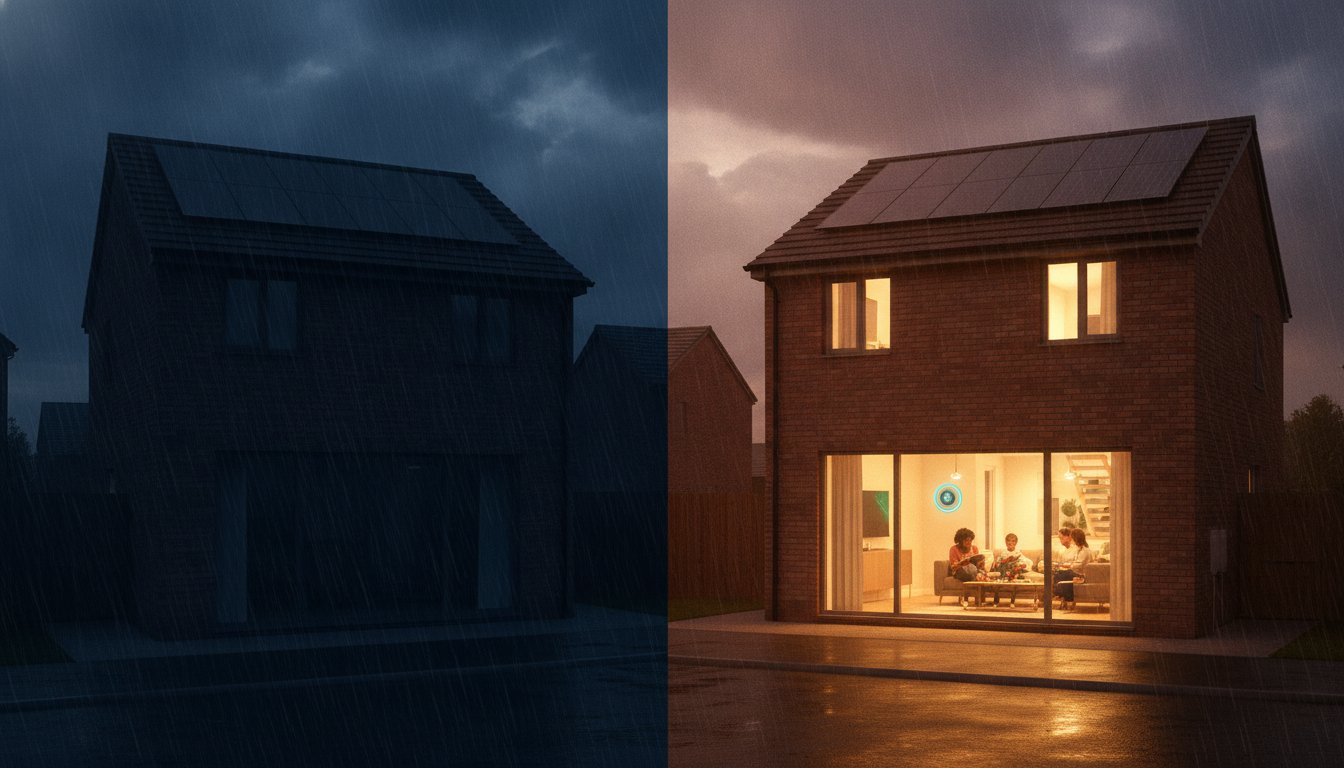
What if your high-tech energy system is designed to leave you in the dark exactly when you need it most? Many UK homeowners invest in renewable energy expecting total independence, only to be surprised by what happens during a power cut with solar panels. Even with the sun shining, your standard grid-tied system shuts down the moment the local network fails. This isn't a technical fault; it's a mandatory safety feature called anti-islanding that protects utility workers from electrocution while they repair the lines.
It's completely understandable to feel frustrated or even anxious when a storm hits and your lights go out despite having panels on your roof. You deserve the peace of mind that your freezer stays cold and your essential appliances keep running. This 2026 guide promises to clear up the confusion by explaining current safety regulations and showing you how to achieve genuine independence. We'll explore how battery storage solutions and inverter upgrades can turn your home into a self-sufficient power island, ensuring you're never left waiting for the grid to recover.
Key Takeaways
- Understand the safety protocols that dictate what happens during a power cut with solar panels and why standard systems disconnect from the grid.
- Discover how battery storage solutions can create a local microgrid to keep your home powered when the utility network fails.
- Learn the technical differences between backing up essential appliances, like freezers and lights, versus achieving whole-home energy independence.
- Identify the specific hardware and inverter upgrades required to ensure your system switches to backup mode safely and automatically.
- Gain practical steps for monitoring your energy reserves via mobile apps so you can manage your power usage effectively during an outage.
Why Solar Panels Automatically Shut Down During a Power Outage
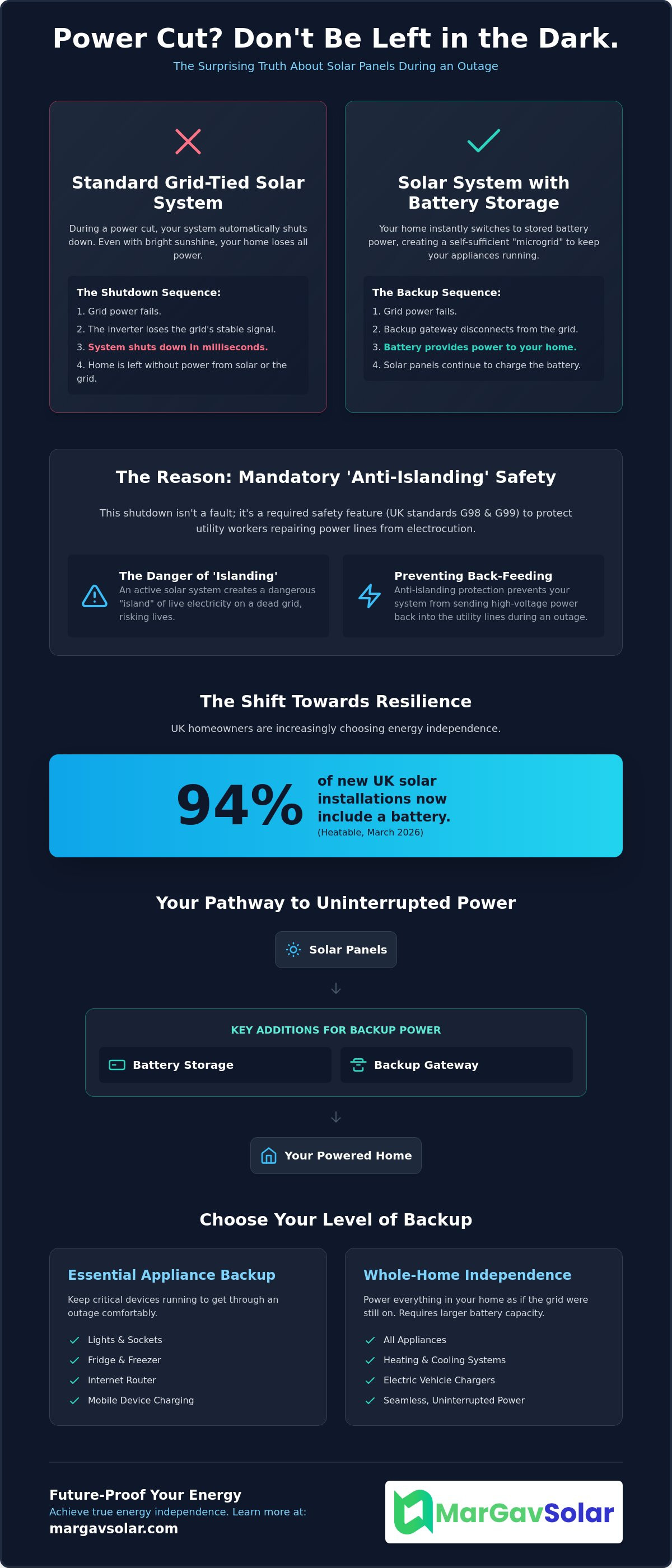
It’s a common frustration for UK homeowners: the sun is shining, your panels are clear, but your lights are out. Getting a clearer picture of what happens during a power cut with solar panels starts with recognizing that your system is designed to fail safe. Most residential solar PV systems are grid-tied, meaning they rely on the national grid's stable signal to function. Without this external reference, your system doesn't just stop sending power to the grid; it stops providing power to your home entirely.
Understanding Anti-Islanding Regulations
Islanding occurs when a distributed generator, like your solar array, continues to power a location even though the local grid is down. This creates a dangerous "island" of electricity. If engineers are working on local lines to restore power, an active solar system could back-feed high-voltage electricity into those wires, causing life-threatening injuries. To prevent this, UK safety standards G98 and G99 require every grid-connected inverter to include anti-islanding protection. Anti-islanding is a mandatory safety feature that prevents back-feeding electricity into a dead grid.
These regulations aren't just suggestions. They're legal requirements that every professional installer must verify during the commissioning of your system. While this might feel like a limitation, it’s a fundamental part of being a responsible generator. For those seeking to bypass this shutdown, the solution isn't to disable safety features but to invest in grid energy storage solutions. These technologies allow your home to safely disconnect from the grid and operate as its own independent power source.
The Inverter's Shutdown Sequence
Your solar inverter acts as the system's brain. It constantly monitors the grid's frequency, which is 50Hz in the UK, and the incoming voltage. When a power cut occurs, these parameters drop or fluctuate instantly. The inverter's internal sensors detect this change and trigger a shutdown sequence in milliseconds. It’s a rapid, automatic response that ensures no power escapes your property while the grid is unstable. Many people believe that as long as they have sunlight, they have electricity, but standard inverters simply can't generate a stable AC signal without the grid's heartbeat to sync with.
While it might seem counterintuitive to have a power plant on your roof that doesn't work when you need it most, understanding what happens during a power cut with solar panels is vital for safety. Without a specific backup configuration or battery storage, your inverter remains in a standby state until it detects that the grid has been stable for several minutes. This delay prevents your system from oscillating on and off if the grid flickers during repairs. If you want your system to stay active during these periods, you'll need to look into inverter upgrades or battery storage solutions that can "spoof" the grid signal safely.
How to Keep Your Solar Power Running During a Blackout
If you've already discovered what happens during a power cut with solar panels, you know the frustration of having a silent system while the grid is down. To keep your home powered, you must create a "microgrid" that allows your panels to operate independently from the national network. This is achieved by installing a battery storage system paired with a backup gateway or a changeover switch. These components act as a digital gatekeeper, instantly disconnecting your home from the grid so your solar energy can safely flow to your appliances without endangering utility workers.
Battery Storage: The Key to Energy Independence
A battery is no longer just an optional extra for saving money on evening electricity. As of March 2026, data from Heatable shows that 94% of new UK solar installations now include a battery. This shift is driven by the desire for resilience. When the grid fails, solar battery storage provides the necessary voltage to keep your inverter active. Without this stored energy, your inverter has no "heartbeat" to sync with, and your panels will remain idle even in bright sunshine. While UK regulations are specific, looking at how European neighbors manage storage can be insightful; for instance, you can explore Thuisbatterij solutions in the Netherlands to see how they approach grid independence.
When choosing a system, the architecture matters. DC-coupled batteries are often more efficient for new installations because the energy stays in its native form from the panels to the cells. AC-coupled systems are excellent for retrofitting to existing arrays but may require a slightly more complex gateway to manage the backup transition. For a deep dive into which hardware suits your property, read our guide on solar battery storage in Staffordshire.
The Emergency Power Supply (EPS) Explained
The Emergency Power Supply, or EPS, is a dedicated output on modern hybrid inverters designed specifically for blackouts. When the inverter detects a grid failure, it switches to EPS mode. This can happen automatically in milliseconds, meaning your Wi-Fi might not even flicker, or it may require a manual changeover switch depending on your budget and technical setup. However, it's vital to understand the limits of this technology. Most EPS outputs provide a restricted amount of power, typically between 3kW and 5kW.
This capacity is perfect for keeping your fridge-freezer running, powering your LED lights, and charging your phones. It isn't, however, designed for heavy loads. You won't be able to run a hot tub, an electric shower, or a heat pump solely on a standard EPS circuit during a blackout. If you want to protect your home against winter storms, exploring bespoke battery storage solutions is the most effective way to ensure your essential circuits stay live. With 0% VAT currently available on battery installations until April 2027, now is an ideal time to upgrade your system's resilience.
Technical Configurations for Solar Backup in the UK
Configuring your system for resilience requires more than just adding a battery. It involves a strategic rethink of your home’s internal wiring. When considering what happens during a power cut with solar panels, the most important technical decision is whether you want to back up your entire property or just the essentials. While a standard installation shuts down for safety, a backup-ready configuration uses a dedicated gateway to isolate your home from the grid, allowing your inverter to continue generating and distributing power locally.
Essential vs. Non-Essential Loads
For most Staffordshire households, an "essential load" setup is the most practical choice. This involves installing a small sub-consumer unit that powers only your most critical appliances. Typically, this includes your fridge-freezer, LED lighting circuits, and your Wi-Fi router. By separating these from high-draw appliances like electric kettles or EV charging points, you prevent the system from overloading. A kettle can pull 3kW of power instantly, which might exceed the discharge limit of a smaller battery and cause the whole backup system to trip. Designing these dedicated circuits ensures your food stays frozen and your internet stays live without risking a total system shutdown.
Achieving true energy independence also requires a physical earth rod. When your home "islands" or disconnects from the grid, it loses the grid's earthing connection. UK wiring regulations require a local earth rod to ensure that safety devices, like RCDs, still function correctly during an outage. Without this, your system cannot legally or safely operate in backup mode. It's a small but critical technical detail that distinguishes a basic solar installation from a robust, off-grid capable energy solution.
GivEnergy and Smart Backup Management
Modern hardware has made managing these transitions much simpler. The GivEnergy system, for example, features a "Storm Guard" mode that uses real-time weather data. If a severe storm is predicted for your area, the software automatically pre-charges your battery to 100% from the grid, ensuring you have maximum reserves before a potential cut occurs. This proactive approach to managing your "State of Charge" means you aren't left with an empty battery just because the sun wasn't shining that afternoon.
The GivEnergy Gateway plays a central role here, providing a seamless transition from grid power to battery power. It also allows for sophisticated remote monitoring. By using the GivEnergy Cloud guide, homeowners can track exactly how much power they have left and which appliances are consuming the most energy during an outage. This level of visibility is essential for stretching your stored energy as far as possible until the grid is restored. Understanding these technical layers helps you move beyond the basic question of what happens during a power cut with solar panels and toward a system that truly protects your home.
Practical Guide: Managing a Power Cut in Staffordshire
When the grid fails, the theoretical knowledge of what happens during a power cut with solar panels becomes a practical reality. For most homeowners, the first sign of an outage is the sudden silence of household appliances or the flickering of lights. If your system includes a battery storage solution with a backup gateway, your home should transition into island mode within seconds. If you don't have a backup configuration, your solar inverter will remain offline until the grid is restored. Taking the right steps in those first few minutes can help you manage your energy reserves effectively.
The Solar Owner's Power Cut Protocol
Your first action should be to consult your system’s mobile monitoring app. This will confirm whether your home has successfully disconnected from the grid and is now running on battery power. Modern systems will clearly display "Island Mode" or "Backup Active." Once you've confirmed you're running on stored energy, you must prioritise your consumption. While it's tempting to continue as normal, turning off non-essential items like dishwashers, electric heaters, or large TVs will significantly extend your uptime.
Check your system's mobile app to view the current State of Charge (SoC) percentage, which tells you exactly how much energy is left in your battery to power your home. By keeping an eye on this figure, you can estimate how many hours of power you have left based on your current usage. If the sun is out, your panels will continue to charge the battery while powering your home, but you should still be cautious. Managing your load ensures that critical items, like your Wi-Fi and fridge, stay online through the night.
Local Considerations for Staffordshire Residents
In Staffordshire, power cuts are often the result of severe weather impacting rural grid lines, particularly in areas bordering the Peak District or the more exposed parts of the Cannock Chase district. If you experience an outage, it's important to report it to your District Network Operator (DNO). For our region, this is National Grid Electricity Distribution. You can call 105 to report the fault or check their live outage map for estimated restoration times. Even if your solar system is providing power, notifying the DNO helps them track the extent of the problem in your local community.
Rural residents should prepare for potentially longer restoration times during winter storms. If you're relying on your solar and battery system, try to keep your home's doors closed to retain heat, as electric heating elements will drain a battery very quickly. Understanding what happens during a power cut with solar panels allows you to stay calm and make informed decisions about your energy use. If you want to ensure your home is ready for the next storm, you can request a quote for resilient solar PV systems and battery storage from a local professional.
Future-Proofing Your Energy with MarGav Solar
MarGav Solar has spent over 20 years helping Staffordshire homeowners navigate the complexities of renewable energy. Transitioning from a standard grid-tied setup to a resilient backup system requires precision and deep technical knowledge. While we've discussed what happens during a power cut with solar panels, the actual implementation of a backup gateway is a complex electrical task that shouldn't be handled by anyone other than a qualified professional. Professional installation ensures that your system remains a safe asset rather than a liability during a crisis. Our team focuses on creating systems that don't just generate power but manage it intelligently when the external network fails.
Expert Consultancy for Resilient Systems
Designing a system that effectively isolates your home during a blackout involves more than just plugging in a battery. We assess your specific energy needs to determine which circuits are truly essential for your lifestyle. For this level of technical work, choosing an installer with NICEIC certification is vital. This ensures that every component, from the earthing rods to the automatic changeover switches, meets the highest safety standards in the UK. Long-term reliability also depends on regular solar panel maintenance and cleaning to ensure your generation remains at peak levels. Professional care ensures your battery and inverter are ready to respond the moment the grid fails, providing the peace of mind you expected when you first went solar.
Upgrading Your Current Installation
Many people ask if they can add a battery to an older solar array. The answer is almost always yes. Retrofitting a battery storage solution is a common way to gain independence from the grid without replacing your entire roof setup. In some cases, inverter upgrades are the most cost-effective path to better performance during a blackout. Modern hybrid inverters are significantly more efficient than the models installed a decade ago and offer the smart software needed for storm protection. They can detect grid instability much faster and manage the transition to battery power with minimal disruption.
With the current 0% VAT policy on battery installations set to end in April 2027, now is a strategic time to consider these enhancements. Contact MarGav Solar today for a fixed-price installation quote and take the final step toward true energy independence. Whether you need a full system design or a simple battery addition, our local experts are here to help you stay powered through any storm. Understanding what happens during a power cut with solar panels is the first step, but having the right technology in place is what keeps the lights on.
Secure Your Energy Independence Today
Understanding what happens during a power cut with solar panels is the first step toward building a truly resilient home. While standard systems must disconnect for safety, you've seen how battery storage and smart gateways can bridge the gap. By isolating your home from the grid, you ensure that your essential appliances stay active even when the local network fails. This transition from being a passive generator to an independent power house provides the security your family needs during unpredictable weather.
Don't wait for the next winter storm to discover your system's limitations. With over 20 years of renewable energy expertise, MarGav Solar specialises in designing and maintaining backup-ready systems for homes across Staffordshire. Our NICEIC Certified Installers provide local support and technical precision to ensure your installation is safe and legally compliant. You can request a fixed-price solar backup consultation from MarGav Solar to explore how an inverter upgrade or battery addition can protect your property. Taking control of your energy future today means you'll never have to worry about being left in the dark again.
Frequently Asked Questions
Will my solar panels charge my battery during a power cut?
Yes, your panels can charge your battery during a blackout if your system is configured for "island mode." This requires a hybrid inverter or a backup gateway to create a local signal. Without this specific setup, the inverter shuts down for safety. When correctly installed, your array becomes a self-sustaining power source that recharges your storage during daylight hours to keep your home running independently.
Do I need a special type of solar panel for it to work in a blackout?
You don't need special solar panels to maintain power during a blackout. Standard photovoltaic panels work perfectly well. The ability to keep the lights on depends entirely on your inverter and battery storage system. These components manage the transition from grid-tied to independent operation, meaning any high-quality panel on the market can be part of a resilient backup solution if paired with the right hardware.
How long will a solar battery power my house during an outage?
Runtime depends on your battery's capacity and what you choose to power. A standard 5.2kWh battery can often keep essential lights, Wi-Fi, and a fridge-freezer running for about 15 to 20 hours. If you try to run heavy loads like an electric oven or a tumble dryer, you'll likely empty the battery in less than 60 minutes. Careful energy management is the key to longevity during longer outages.
Can I use my EV charger during a power cut if I have solar?
You shouldn't try to use your EV charger during a power cut. Most residential backup systems are limited to a discharge rate of 3kW to 5kW, while EV chargers often pull 7kW or more. Attempting to charge your vehicle will likely overload your backup inverter and cause the system to shut down. It's better to save your stored energy for essential household needs like lighting and food preservation.
Is it legal to run my house off-grid during a power cut in the UK?
It's perfectly legal to run your house off-grid during an outage, provided your system meets UK wiring regulations. Your installation must include an automatic or manual disconnect that prevents power from leaking back into the grid. This safety feature is mandatory to protect engineers working on local lines. Professional installation ensures your system complies with G98 or G99 standards for safe, legal isolation from the network.
What is a 'Backup Gateway' and do I need one?
A Backup Gateway is a smart device that manages the connection between your home, your solar system, and the grid. You need one if you want your system to automatically detect a power cut and switch to battery power without any manual intervention. It acts as a digital gatekeeper, ensuring your home safely disconnects from the utility network before activating your local power supply to keep your circuits live.
Why did my solar system turn off even though I have a battery?
Your system might turn off because it lacks an "Emergency Power Supply" (EPS) configuration. Many people are surprised by what happens during a power cut with solar panels when they realize a battery alone doesn't guarantee backup. If your inverter isn't wired to a backup circuit or a gateway, it will shut down to follow safety protocols. Overloading the system with too many appliances can also cause a shutdown.
Can solar panels work at night during a power cut?
Solar panels cannot generate power at night because they require sunlight to function. However, your home can still stay powered during a nighttime outage if you have a battery storage system. The battery will discharge the energy it collected during the day to keep your lights and appliances running. Once the sun rises, your panels will begin recharging the battery again to maintain your energy independence through the next day.


