

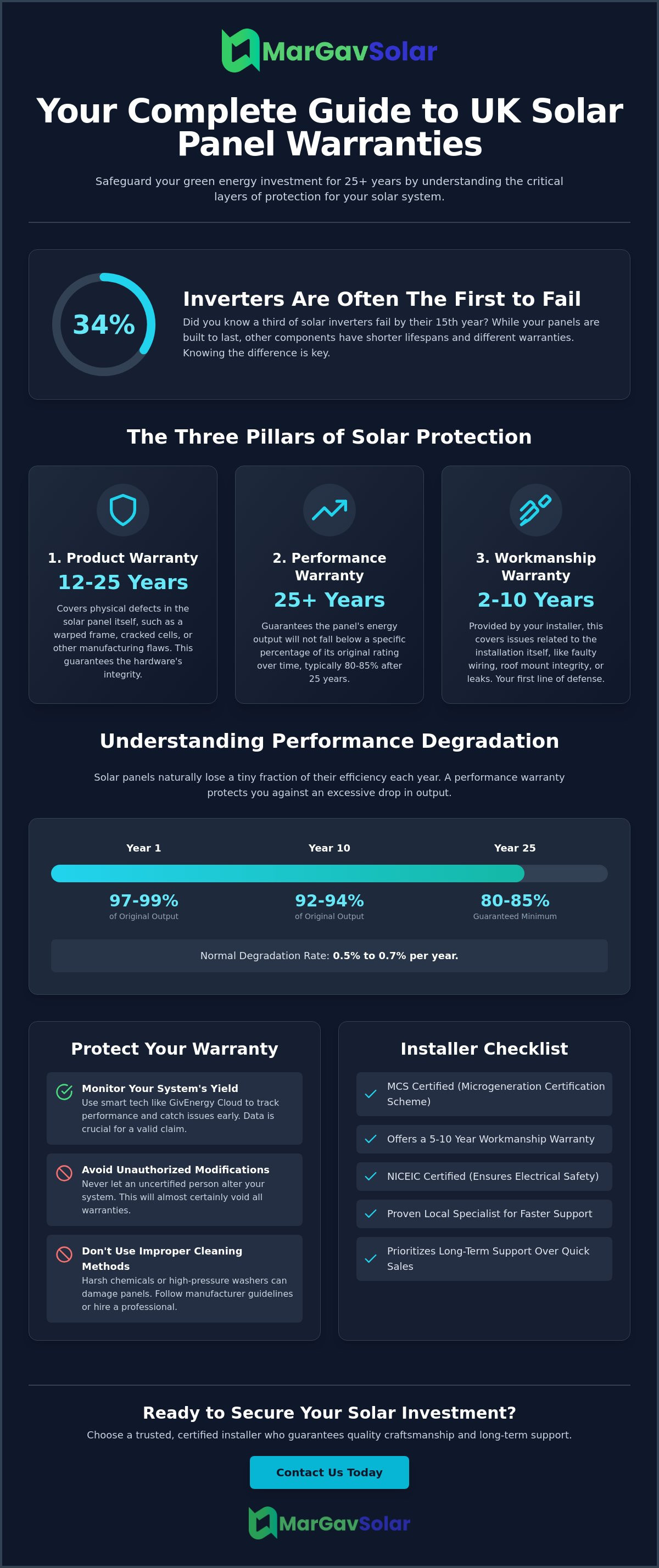
Did you know that 34% of solar inverters fail by their 15th year? While your panels are built to last for decades, the components keeping them running are often the first to go. Securing a robust solar panel warranty UK homeowners can actually rely on is the difference between a stress-free investment and a mounting pile of repair bills. It's natural to feel uneasy about "solar cowboys" vanishing overnight or getting hit with hidden costs for repairs that were supposed to be free.
This guide will show you how to safeguard your green energy investment for 25 years or more with expert, UK-specific guidance. You'll learn the vital differences between product and performance guarantees, how the 2026 MCS standards impact your protection, and the simple maintenance steps required to keep your paperwork valid. We'll give you the tools to choose an installer with staying power and ensure your system remains a high-performing asset for its entire lifespan.
Key Takeaways
- Distinguish between the three pillars of protection so you know exactly who is responsible for repairs if something goes wrong.
- Learn how to monitor your system's output to differentiate between expected annual degradation and genuine warranty claims.
- Master the specifics of a solar panel warranty UK providers offer, including the unique terms for inverters and battery storage units.
- Protect your investment by avoiding common mistakes, such as improper cleaning or unauthorized modifications, that can invalidate your coverage.
- Gain the confidence to select a certified local installer who prioritizes long-term support and quality craftsmanship over quick sales.
The Three Pillars of Solar Panel Warranties in the UK
A solar panel warranty UK homeowners sign today is actually a combination of three distinct protections. Think of it as a three-tiered safety net; if one layer fails, you need the others to hold firm. These pillars include the manufacturer’s product guarantee, the performance output promise, and the installer’s workmanship warranty. Understanding how they interact is vital because a failure in your system often falls into a specific category that determines who pays for the fix. Over a 25-year lifespan, these tiers will expire at different times, leaving you with varying levels of protection as your system ages.
Product Warranty vs. Performance Warranty
Most homeowners focus on the headline "25-year warranty," but this usually refers to performance, not the physical hardware. In 2026, standard product warranties cover manufacturing defects for 12 to 25 years. This protects you if a frame warps or a cell cracks due to a factory flaw. In contrast, the performance warranty specifically guarantees efficiency. Because of how solar panels work, they naturally degrade over time. A performance warranty ensures they don't drop below a specific threshold, typically 80% to 85% of their original capacity after 25 years. Crucially, a performance claim might prove your panel is inefficient, but it won't always cover the labour costs to climb onto the roof and replace it. Hardware integrity and energy output are two different legal promises.
The Role of the Workmanship Warranty
Your installer’s workmanship warranty is your first line of defence. While the manufacturer covers the parts, the installer covers the assembly. This includes everything from the roof mount integrity to the complex wiring connecting your panels to the inverter. Under 2026 MCS standards, certified installers must provide at least a two-year warranty, though the industry standard for quality firms now ranges from 5 to 10 years. NICEIC certification adds another layer of security, ensuring the electrical components meet strict UK safety regulations.
Choosing a local specialist in Staffordshire offers a distinct advantage here. If a cable shakes loose or a roof seal fails, proximity reduces the friction of a warranty claim. A local team can often respond to a workmanship call-out much faster than a national firm with no local presence. This tier ensures that the physical installation remains as durable as the high-tech components themselves, protecting your home's structure and your system's connectivity.
Understanding Performance Degradation and Claims
Every solar panel loses a small fraction of its power generation capability every year. This isn't a sign of a broken system; it's a natural chemical process. For a standard solar panel warranty UK homeowners receive, "normal" degradation is typically defined as a loss of 0.5% to 0.7% per year. While this sounds minor, it means your panels are legally expected to produce around 92% of their original output after a decade. Under the Consumer Rights Act 2015, you have the right to expect your system to be installed with reasonable care and to perform within these industry-accepted parameters.
Monitoring Your Yield with Smart Technology
The biggest challenge for homeowners is distinguishing between a cloudy week in Staffordshire and a genuine hardware fault. Smart monitoring platforms, such as the GivEnergy Cloud, provide real-time data that removes the guesswork. By setting "low yield" alerts, you can catch sudden performance drops that might indicate a faulty string or a failing cell before they impact your energy bills. Performance monitoring is the digital paper trail that turns a suspicion of low yield into a valid warranty claim. Without this data, manufacturers may dismiss your claim as simple weather variation.
Normal vs. Excessive Degradation
Manufacturers will only honour a performance claim if the degradation exceeds the "curve" specified in your contract. If your panels drop to 70% efficiency in year five, you likely have a claimable issue like a "hot spot" or a micro-crack. However, if they are at 94%, they are performing perfectly. Professional solar panel maintenance is often a requirement to prove your claim; manufacturers may argue that dirt or bird droppings, rather than internal defects, are causing the drop.
- Year 1: 97% to 99% of original rated output.
- Year 10: 92% to 94% of original rated output.
- Year 25: 80% to 85% of original rated output.
If you notice your generation stats aren't hitting these marks, it's worth investigating. A quick solar panel maintenance and cleaning check can often restore performance, but if the numbers stay low, your performance monitoring data will be your strongest evidence when contacting the manufacturer.
Warranties for Inverters and Battery Storage
While your solar panels are designed to sit quietly on the roof for thirty years, the rest of your system works much harder. The inverter acts as the "brain" of the installation, constantly converting raw DC energy into usable AC power for your home. Because of this mechanical stress, a solar panel warranty UK package usually features shorter terms for inverters than for the panels themselves. Statistics show that around 34% of inverters fail by their 15th year, making the warranty on this specific component a critical part of your long-term financial planning.
Inverter Warranty Lengths and Extensions
Standard manufacturer warranties for inverters in 2026 typically range from 5 to 10 years. Many homeowners wonder if paying for a 20-year extension at the point of purchase is worth the cost. If your system was installed by a provider following the Microgeneration Certification Scheme (MCS) standards, you're already starting with high-quality hardware. However, given the failure rates, an extension can offer peace of mind. If your system is approaching its tenth birthday, it's often more cost-effective to look into inverter upgrades in Staffordshire rather than simply repairing an out-of-warranty unit with older technology.
Battery Storage: The 'Cycle' Clause
Battery warranties are slightly more complex than a simple date on a calendar. Most 2026 industry standards offer a 10-year term, but this is almost always tied to a "cycle" or "throughput" limit. A cycle is one full charge and discharge of the battery. If you use your battery heavily to avoid peak grid prices, you might hit your 10,000-cycle limit before the ten years are up. It's also vital to check the "Depth of Discharge" (DoD) clause. Some warranties are voided if you consistently drain the battery to 0%, as this damages the cells. For Staffordshire homeowners using solar battery storage, choosing a system with a high throughput rating ensures your protection lasts as long as the hardware.
To simplify future claims, many people now opt for "All-in-One" ecosystems like those from GivEnergy. Having your panels, inverter, and battery under a single manufacturer's umbrella prevents the "finger-pointing" that can happen when different brands are mixed. If a fault occurs, there's only one technical support team to call. This streamlined approach, combined with regular maintenance, ensures your ROI remains protected even as individual components reach their mid-life replacement stage.
Consumer Rights and What Voids Your Warranty
Many homeowners assume their solar panel warranty UK protection is ironclad, but certain actions can render your certificates worthless. The most common pitfall is the "DIY fix." Attempting to repair a loose mounting bracket or adding a third-party component without professional oversight usually voids both the manufacturer and workmanship warranties immediately. Even using a pressure washer for cleaning can be enough to invalidate a claim, as the high-pressure water can damage the seals around the glass. Beyond hardware changes, the Consumer Rights Act 2015 provides a powerful layer of protection that often goes unmentioned. This legislation requires that any service, including a solar installation, be performed with "reasonable care and skill." If an installer fails this legal standard, they're obligated to rectify the issue, providing a statutory fallback that exists alongside your written warranty.
The 'Installer Gone Bust' Scenario
A major fear for many is the "solar cowboy" installer who disappears after a few years. If your original installer goes out of business, your workmanship warranty could vanish with them unless you have an Insurance-Backed Guarantee (IBG). An IBG is mandatory for reputable UK solar installations. These policies, often provided through schemes like HIES or RECC, ensure that another certified professional can complete repairs if your original firm is no longer trading. Looking for NICEIC certification is equally vital; it confirms the installer meets the UK's highest electrical safety standards, significantly reducing the likelihood of a claim in the first place.
Maintenance: The Warranty's Best Friend
Manufacturers expect you to take "reasonable care" of your system to keep the paperwork valid. A common "hidden" exclusion in many contracts involves damage caused by pests or lack of hygiene. If pigeons nest under your panels and cause heat spots or wiring damage, a manufacturer may reject a claim, citing it as an external environmental factor rather than a product defect. Bird proofing is a small investment that prevents this specific exclusion from being triggered. You should also ensure that any cleaning is done with deionised water and soft brushes, as abrasive chemicals can strip the anti-reflective coating from the panels. Keeping an "Installation File" is essential; this folder should contain your MCS certificate, electrical sign-off documents, and IBG paperwork. Having these ready is the difference between a fast resolution and a rejected claim.
If you're worried about maintaining your coverage or need to verify the health of your system, our team can help. Learn more about our professional solar panel maintenance and cleaning services to ensure your protection stays active and your investment remains secure.
Choosing a Reliable Installer in Staffordshire
A solar panel warranty UK homeowners can trust is only as strong as the company standing behind it. While a 25-year performance guarantee looks impressive on paper, it offers little comfort if your installer is difficult to reach when a fault occurs. Selecting a local specialist isn't just about supporting the regional economy; it's a strategic move to ensure your warranty remains actionable. National companies often struggle with the logistics of small repair call-outs, leading to long wait times that drain your potential energy savings. A local provider has a vested interest in their reputation within the community and can typically respond to technical queries or workmanship issues far faster than a firm managing thousands of accounts from a distant head office.
Why Staffordshire Proximity Matters
Staffordshire has a diverse range of property types, from historic slate roofs to modern new-builds. A local installer understands the specific structural challenges and wind load requirements of the region, ensuring the physical installation is built to last. At MarGav Solar, we support local residents with end-to-end maintenance and support that national firms often overlook. Because we're based in the heart of the county, we can provide the regular cleaning and health checks that manufacturers require to keep your warranties valid. This proximity reduces the friction of warranty claims, as our team is already familiar with your specific system and local grid requirements.
Securing Your 2026 Solar Investment
With 0% VAT on solar and battery installations set to continue until March 2027, 2026 is a pivotal year for UK homeowners. However, the rush to install shouldn't lead to cutting corners on quality. Before signing a contract, verify that your chosen firm holds MCS, NICEIC, and RECC memberships. These aren't just badges; they're your legal safety net. A professional solar panel installation in Staffordshire should always include a detailed handover pack containing your insurance-backed guarantee and all relevant component certificates.
Your journey toward energy independence should be backed by experts who plan for the next three decades, not just the next three months. Whether you're looking for a brand-new system or need an upgrade for an existing setup, we're here to help. Contact MarGav Solar for a comprehensive system consultation and ensure your green energy investment is fully protected for the long term.
Secure Your Energy Future with Confidence
Investing in renewable energy is a significant step toward independence, but the real value lies in the long-term security of your setup. By now, you know that a comprehensive solar panel warranty UK homeowners can trust relies on more than just a manufacturer's sticker. It requires a balance of high-quality hardware, diligent maintenance, and the support of a local installer who won't disappear when you need them most. Whether you're tracking performance through smart apps or ensuring your battery cycles stay within limits, your proactive care is what keeps those 25-year promises alive.
With over 20 years of industry expertise and a team of NICEIC Certified Installers, we specialise in protecting Staffordshire residential solar investments. We don't just install panels; we build lasting energy systems designed for durability and peak performance. If you're ready to start your journey or need to ensure your current system is fully protected, our experts are here to provide clear, honest guidance. Take the next step toward a worry-free green home today.
Book a Professional Solar Consultation with MarGav Solar
Frequently Asked Questions
Do solar panel warranties cover the cost of labour for repairs?
Manufacturer product warranties typically only cover the replacement hardware, leaving the homeowner responsible for labour and scaffolding costs. However, a workmanship warranty provided by your installer should cover the cost of the engineer's time and the physical installation work. It's vital to check your specific contract terms, as some premium manufacturers now offer all-inclusive terms for the first few years of the system's life.
What happens to my solar warranty if I move house?
Most solar warranties are tied to the installation address and the equipment itself, meaning they automatically transfer to the new homeowner. You should provide the new owners with the original MCS certificate, the manufacturer’s warranty documents, and any insurance-backed guarantee paperwork. Keeping these documents in a dedicated home folder ensures a smooth transition and maintains the system's value during the property sale.
Are solar panels covered by my standard UK buildings insurance?
Most UK buildings insurance policies cover solar panels because they are considered permanent fixtures of the property. You must notify your insurance provider once the installation is complete to ensure they are included in your sum insured value. While insurance covers external damage like fire, storm, or theft, it won't cover internal mechanical failures or natural degradation, which is why a separate solar panel warranty UK is essential.
Can I clean my own solar panels without voiding the warranty?
You can clean your own panels, but you must follow the manufacturer's strict guidelines to avoid voiding your protection. Never use a pressure washer, abrasive chemicals, or hard-bristled brushes, as these can damage the anti-reflective coating or the glass seals. Using deionised water and a soft telescopic brush is generally safe, but many homeowners prefer professional cleaning to ensure a maintenance log is kept as warranty evidence.
What is an Insurance-Backed Guarantee (IBG) and do I need one?
An Insurance-Backed Guarantee (IBG) is a policy that honours your installer’s workmanship warranty if the original company ceases trading. It's a mandatory requirement for reputable UK installers and provides essential peace of mind for the duration of your contract. If your installer goes out of business, the IBG provider will appoint another certified professional to carry out any necessary repairs at no extra cost to you.
How do I claim on a solar warranty if the manufacturer is based overseas?
Claims for overseas manufacturers are typically handled through your original installer or the brand’s UK-based distributor. This is a primary reason why choosing a reliable local installer is so important; they act as your advocate and manage the logistics of the claim. If the manufacturer has no UK presence, the process can be slower, but established global brands usually have dedicated service partners within the UK to handle hardware replacements.
Will a bird infestation void my solar panel performance warranty?
A bird infestation won't void your entire warranty, but manufacturers will reject any claims for damage specifically caused by nesting or droppings. Pigeons nesting under panels can cause hot spots or wire damage, which are classified as external environmental factors rather than manufacturing defects. Installing bird proofing is a highly recommended preventative measure to ensure your performance guarantees remain valid and your system stays clear of debris.
Is the inverter warranty separate from the solar panel warranty?
Yes, the inverter warranty is a separate agreement with a different lifespan than your panels. While panels often carry 25-year guarantees, standard inverter warranties typically last between 5 and 10 years. Because the inverter is the most active part of the system, it's likely to need replacement or a warranty claim sooner than the panels themselves. You should keep both sets of documents safe and track their individual expiry dates.


