

Chasing the highest advertised export rate could actually cost you more in the long run. Many homeowners feel trapped between choosing a high export price and being stuck with an expensive import tariff. With Smart Export Guarantee (SEG) tariff rates 2026 ranging from a low 4p to a high 25p per kWh, it's easy to see why the market feels like a minefield. You've likely spent hours wondering if you need a specific battery or if your MCS certification is enough to start earning.
It's true that some of the best rates are tied to specific installers or import deals, but the real secret to profitability in 2026 lies in your self-consumption ratio. We'll show you exactly how to identify the highest-paying tariffs, including top-tier offers from providers like Good Energy and EDF. You'll also learn why pairing your solar panels with battery storage is the most effective way to exploit peak export windows. This guide provides a clear roadmap to navigate smart meter requirements and start receiving the payments you're owed.
Key Takeaways
- Learn how to distinguish between "tied" and "open" tariffs to secure the highest possible p/kWh rate for your specific energy setup.
- Compare the latest Smart Export Guarantee (SEG) tariff rates 2026 to see which suppliers are offering top-tier payments of up to 25p/kWh.
- Understand the critical technical requirements, including MCS certification and smart meter compatibility, needed to qualify for any export scheme.
- Discover how battery storage solutions enable "export arbitrage," allowing you to sell power back to the grid during the most profitable peak windows.
- Identify why prioritising your self-consumption ratio is often more financially rewarding than simply chasing the highest export price.
What is the Smart Export Guarantee (SEG) in 2026?
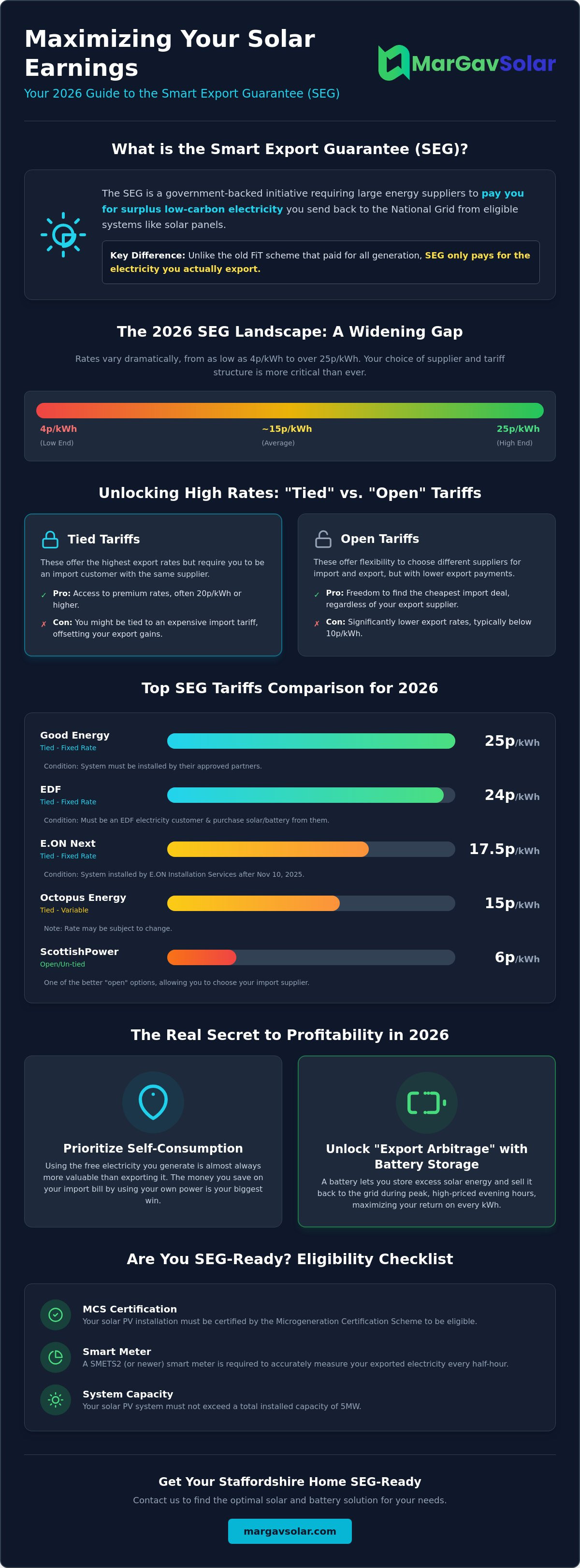
The Smart Export Guarantee (SEG) is a government-backed initiative that requires large energy suppliers to pay you for every unit of low-carbon electricity you send back to the National Grid. It effectively turned the UK's energy market on its head by allowing homeowners to act as mini power stations. Unlike the old Feed-in Tariff (FiT) system, which provided a fixed subsidy for every kilowatt generated, the SEG focuses purely on what you export. You can find a detailed history of how this scheme evolved by visiting the Smart Export Guarantee on Wikipedia.
The 2026 landscape is defined by a significant gap between the best and worst rates. While the law only requires suppliers to offer a rate greater than zero, the actual Smart Export Guarantee (SEG) tariff rates 2026 vary wildly between providers. Some offer a token 4p, while others pay 25p or more to specific customers. This disparity means your return on investment is no longer guaranteed by a flat government rate. Instead, it depends on your ability to shop around and match your export habits with the right supplier. In this market, you'll encounter Mandatory Licensees, which are suppliers with over 150,000 customers required by law to offer a tariff, and Voluntary Licensees who choose to participate to attract eco-conscious homeowners.
Key Technologies Eligible for SEG
Solar PV remains the primary driver for residential renewable energy in Staffordshire. Most homeowners find it the most practical way to generate excess power during the day. However, the scheme also covers onshore wind, hydro, anaerobic digestion, and micro-CHP installations. To qualify, your solar system must not exceed a capacity of 5MW. For micro-CHP, the limit is much lower at 50kW. This high ceiling for solar ensures that even large residential properties and small commercial sites can participate in the market without hitting regulatory barriers.
Why 2026 is a Turning Point for Export Tariffs
This year marks a major shift in how the UK grid operates. The National Grid now relies heavily on domestic flexibility to manage demand spikes. As a result, we're seeing a transition from simple flat rates to "Agile" and "Dynamic" export pricing that changes based on wholesale market costs. The SEG is a mandatory obligation for suppliers with over 150,000 customers. By 2026, these suppliers are using competitive Smart Export Guarantee (SEG) tariff rates 2026 to attract homeowners who have invested in battery storage. This shift turns domestic rooftops into a vital part of the UK's energy infrastructure, rewarding those who can export power when the grid needs it most.
Comparison of the Best SEG Tariff Rates for 2026
Choosing the right energy provider in 2026 is no longer just about finding the cheapest import price. The market has split into "tied" and "open" tariffs, creating a leaderboard where the gap between the highest and lowest payers is wider than ever. The highest Smart Export Guarantee (SEG) tariff rates 2026 are almost exclusively reserved for "tied" customers. These are homeowners who use the same company for both their energy supply and their solar export. For example, Good Energy currently leads the market with a 25p/kWh fixed rate, but this is only available to those who had their system installed by their approved partners.
If you prefer to keep your import and export suppliers separate, your "open" options are more limited. ScottishPower offers a "SmartGen" tariff at 6p/kWh, which remains one of the better un-tied rates available. To understand the full list of companies legally required to offer these payments, you can check Ofgem's official SEG guidance. While a 25p rate sounds attractive, you must weigh it against the supplier's import costs. A high export rate is often used as a "loss leader" to lock customers into more expensive standard variable import tariffs. Many savvy homeowners are now opting for no-exit fee tariffs to maintain flexibility as new, more competitive offers emerge throughout the year.
Top 3 High-Export Tariffs for Solar Owners
- EDF - Export Exclusive 12m V2: This tariff offers a substantial 24p/kWh fixed for 12 months. It's specifically designed for EDF electricity customers who purchase their solar or battery solutions directly from the supplier.
- E.ON Next - Next Export Premium v3: At 17.5p/kWh, this fixed-rate tariff provides excellent stability. It is available to homeowners who had their systems installed by E.ON Installation Services on or after November 10, 2025.
- Octopus Energy - Outgoing Octopus: Octopus provides 15p/kWh, though this is scheduled to drop to 12p/kWh from March 1, 2026. Their "Agile" model remains popular for those who want their export rates to track wholesale market prices in real-time.
Tied vs. Un-Tied Tariffs: Which is Better?
The decision to bundle your services usually comes down to your "Self-Consumption Ratio." If you use most of the power you generate, a high export rate won't benefit you as much as a low import rate. Homeowners who use GivEnergy Cloud to monitor their data often find that the freedom of an un-tied tariff allows them to switch import providers whenever a better deal appears. You should also watch out for standing charges; some suppliers increase these daily fees on SEG-linked accounts, which can quickly erode your monthly profits. If you're unsure which setup fits your property, speaking with an expert about residential solar PV systems can help clarify your potential ROI.
Flat rates provide predictability, which is helpful for budgeting, but they may not be the most profitable path. A 12p flat rate might actually outperform a 20p peak-only rate if your solar array generates most of its power during the middle of the day when "peak" windows aren't active. Always calculate your earnings based on when your system actually exports, rather than the headline figure alone.
Maximising Profits: Batteries and Smart Tech in 2026
Simply installing solar panels is only the first step toward energy independence. To truly capitalise on the Smart Export Guarantee (SEG) tariff rates 2026, you need a strategy that moves beyond passive generation. The most successful homeowners in 2026 use a technique called export arbitrage. This involves using solar battery storage to hold onto the electricity your panels produce during the day. Instead of letting that power spill onto the grid for a standard rate, you save it and "dump" it back to the grid during high-demand peak windows when certain tariffs pay significantly more.
There is a constant debate between self-consumption and exporting. In the current market, using your own power is usually worth 25p or more per unit because that's the cost you avoid paying your supplier. In contrast, even the best export rates often hover around 15p to 24p. Math dictates that you should prioritise powering your own appliances first. For a broader look at the scheme's legal framework, the UK Government's SEG information provides a solid foundation for understanding your rights as a small-scale generator.
Technology acts as the bridge between your roof and your bank account. Modern inverter upgrades now feature integrated AI that can track wholesale market prices and automate your exports. These smart systems ensure you aren't manually toggling switches to find the best Smart Export Guarantee (SEG) tariff rates 2026. They do the heavy lifting for you, ensuring your home remains a profitable asset even while you sleep.
The Role of GivEnergy in SEG Optimization
GivEnergy systems have become a favourite for Staffordshire homeowners looking to master their export income. These batteries allow for a "forced discharge" mode, which is essential for time-of-use tariffs that reward evening exports. By using the GivEnergy Cloud, you can monitor your generation and export data in real-time, seeing exactly how much every kilowatt-hour is worth. Battery storage can increase effective solar yield by up to 30% by capturing mid-day peaks that would otherwise be wasted or sold too cheaply.
Smart Export vs. Smart Charging
Integrated energy management is vital if you own an electric vehicle. You must ensure your EV charging points are set to "Eco" or "Solar" modes. Without this logic, your car might accidentally drain your battery's surplus just before a high-paying export window opens. Your seasonal strategy should also shift; in summer, you'll likely have a massive surplus to export, while in winter, your priority should be storing every drop of solar energy to cover your evening heating and lighting needs.
How to Apply for SEG: Eligibility and Requirements
Securing the best Smart Export Guarantee (SEG) tariff rates 2026 requires more than just a rooftop of panels. You must navigate a specific administrative process to prove your system is safe, efficient, and accurately metered. Skipping these steps often results in homeowners being stuck on the lowest "default" rates or, worse, being rejected by the most profitable licensees. The application journey is structured to ensure every kilowatt-hour you contribute to the grid is verified and accounted for.
- Step 1: Verify MCS Certification. This certificate is your "passport" to the export market. It proves your system was installed to high industry standards by a qualified professional.
- Step 2: Check Your Metering. You must have a smart meter capable of taking half-hourly readings. This is non-negotiable for the top-paying variable and agile tariffs.
- Step 3: Request Your Export MPAN. Your Meter Point Administration Number (MPAN) for export is different from your import number. You usually get this from your Distribution Network Operator (DNO).
- Step 4: Apply to Your Chosen Licensee. Once your paperwork is ready, submit your MCS certificate and initial meter readings to your preferred supplier.
The Importance of MCS Certification
You cannot access high-value export deals without a valid Microgeneration Certification Scheme (MCS) certificate. Suppliers use this document to verify that your installation won't damage the grid or present a fire risk. At MarGav Solar, we ensure every solar panel installation is fully compliant from day one, providing all the documentation you need for a smooth SEG application. If you have a legacy system without certification, you'll find it nearly impossible to join the best schemes. In these cases, you might need a certified installer to perform a full system audit and remedial work to bring the setup up to modern standards.
Metering Requirements for 2026
The UK energy market is moving toward mandatory half-hourly settlement for all homes by 2026. This means your old SMETS1 meter might no longer be sufficient for the most competitive Smart Export Guarantee (SEG) tariff rates 2026. While some SMETS1 meters were upgraded remotely, a SMETS2 meter is the industry standard for reliability. These devices communicate directly with your supplier every thirty minutes, allowing you to benefit from "Agile" rates that pay more when the grid is under pressure. If you're still using a traditional dial meter, you'll need to request a smart upgrade from your energy supplier before you can even begin the application process.
Ready to ensure your home is fully equipped to earn? You can contact MarGav Solar to discuss a new, SEG-ready residential solar PV system today.
Why Staffordshire Homeowners Choose MarGav Solar for SEG Readiness
MarGav Solar has spent over 20 years helping Staffordshire residents secure their energy future. We understand that the technical side of applying for the best Smart Export Guarantee (SEG) tariff rates 2026 can be overwhelming. Our team provides end-to-end support, ensuring your system isn't just generating power but is also fully eligible for the highest payments on the market. From initial design to long-term solar panel maintenance, we handle the administrative and technical details that suppliers look for during the application process.
Staffordshire presents unique challenges for solar exporters that national companies often overlook. We have deep local knowledge of Western Power Distribution (WPD) requirements and specific grid constraints in areas like Stoke-on-Trent, Stafford, and the Moorlands. This expertise allows us to manage G98 and G99 grid applications efficiently, avoiding the common pitfalls that can delay your export MPAN or limit your export capacity. We don't just look at current rates; we focus on future-proofing. By designing systems today that are ready for the evolving export tariffs of 2030, we ensure your investment continues to pay off as the UK grid becomes increasingly decentralised and dynamic.
Professional Installation & NICEIC Standards
Safety and compliance are the foundations of a profitable solar array. Our NICEIC certification ensures that every component of your installation meets the highest UK safety standards. This isn't just about peace of mind; it's a strict requirement for many top-tier export schemes that demand rigorous proof of electrical safety. MarGav Solar provides all necessary electrical certifications required by energy suppliers for SEG applications. We also carefully select high-efficiency hardware and smart inverters to maximise your exportable surplus. This ensures you have as much energy as possible to sell back to the grid during those high-paying peak windows discussed earlier in this guide.
Get a SEG-Ready Consultation in Staffordshire
Calculating your potential return on investment shouldn't involve guesswork or generic online calculators. Our Staffordshire-based team works directly with local residents to model their potential earnings based on their specific roof orientation, shading, and energy habits. We'll help you decide if a battery storage solution is the right addition to help you chase those 25p rates or if a simpler setup better fits your current budget. Every home is different, so we provide bespoke system designs that prioritise your long-term profit and system longevity. Book your solar consultation with MarGav Solar today to start your journey toward a smarter, more profitable home.
Secure Your Energy Independence Today
Transitioning to a smart energy home is no longer just about reducing your carbon footprint; it's a strategic financial decision. By understanding the Smart Export Guarantee (SEG) tariff rates 2026, you can transform your rooftop from a simple shelter into a revenue-generating asset. The key lies in combining the right supplier with advanced battery technology to capture every drop of value from your generation. This approach ensures you aren't just saving on bills but actively earning from the green energy you produce.
Whether you're looking to switch to a high-paying agile tariff or you're starting your solar journey from scratch, compliance is your foundation. Working with MCS and NICEIC Certified Installers ensures your system meets the strict eligibility criteria required by top energy providers. MarGav Solar brings over 20 years of industry experience and dedicated Staffordshire-based support to every project. We'll help you navigate the complexities of the grid and the application process with ease.
Maximize your solar earnings with a SEG-ready installation from MarGav Solar and start building a more profitable, sustainable future for your home today.
Frequently Asked Questions
What is the highest SEG rate available in 2026?
The highest fixed rate currently available is 25p/kWh from Good Energy, provided you use them for both your energy supply and system installation. EDF offers a similar exclusive rate of 24p/kWh for their customers. If you're willing to use a time-of-use tariff, peak rates on schemes like Octopus Flux can reach approximately 29.32p/kWh during the early evening hours when grid demand is highest.
Can I get SEG payments without an MCS certificate?
No, an MCS certificate is a mandatory requirement for almost all energy suppliers participating in the scheme. This certificate serves as proof that your solar PV system was installed to high industry standards by a qualified professional. Without it, you'll find it nearly impossible to register for Smart Export Guarantee (SEG) tariff rates 2026, as suppliers use this document to verify the safety and eligibility of your installation.
Do I need a battery to benefit from the Smart Export Guarantee?
You don't strictly need a battery to receive payments, but it significantly increases your earning potential. Without storage, you can only export power the moment your panels generate it, which usually happens when prices are lower. A battery allows you to store that energy and "dump" it back to the grid during peak windows, which is essential for accessing the most profitable time-of-use export tariffs.
Can I switch my SEG provider without switching my electricity supplier?
Yes, you can choose a different company for your export payments than the one that supplies your electricity. These are known as "un-tied" or "no-switch" tariffs, such as ScottishPower’s SmartGen which offers 6p/kWh. While this provides flexibility, be aware that these open market rates are generally much lower than the "tied" rates offered to customers who bundle their import and export services together.
How much can a typical Staffordshire home earn from SEG annually?
A typical 3.5kWp solar system that exports 1,500 kWh per year can expect to earn around £225 annually at a rate of 15p/kWh. Your actual income will vary based on your system's size and how much energy you use yourself versus how much you send to the grid. Homeowners who actively manage their exports to align with high-paying Smart Export Guarantee (SEG) tariff rates 2026 often see higher returns.
What happens to my SEG if I move house?
The SEG contract is tied to the individual account holder rather than the property itself. If you move, you must notify your supplier to close the account and take a final meter reading so you receive your final payment. The new homeowner won't automatically take over your tariff; they'll need to apply for their own SEG contract and provide their own documentation to start receiving payments.
Is the Smart Export Guarantee taxable income for UK residents?
For the vast majority of UK homeowners, income generated through the SEG is exempt from Income Tax. This is because the electricity is produced primarily for domestic use on your own property rather than as a commercial venture. As long as your system capacity remains below the 5MW threshold and is located at your main residence, you typically won't need to declare these earnings to HMRC.
Can I have both the Feed-in Tariff (FiT) and SEG?
You can't receive export payments from both schemes at the same time for the same installation. However, many homeowners choose to keep their FiT "generation" payments while opting out of their FiT "export" payments to join a more lucrative SEG tariff. You should check your current FiT export rate first, as older FiT contracts often pay more than the standard variable SEG rates currently available.


