
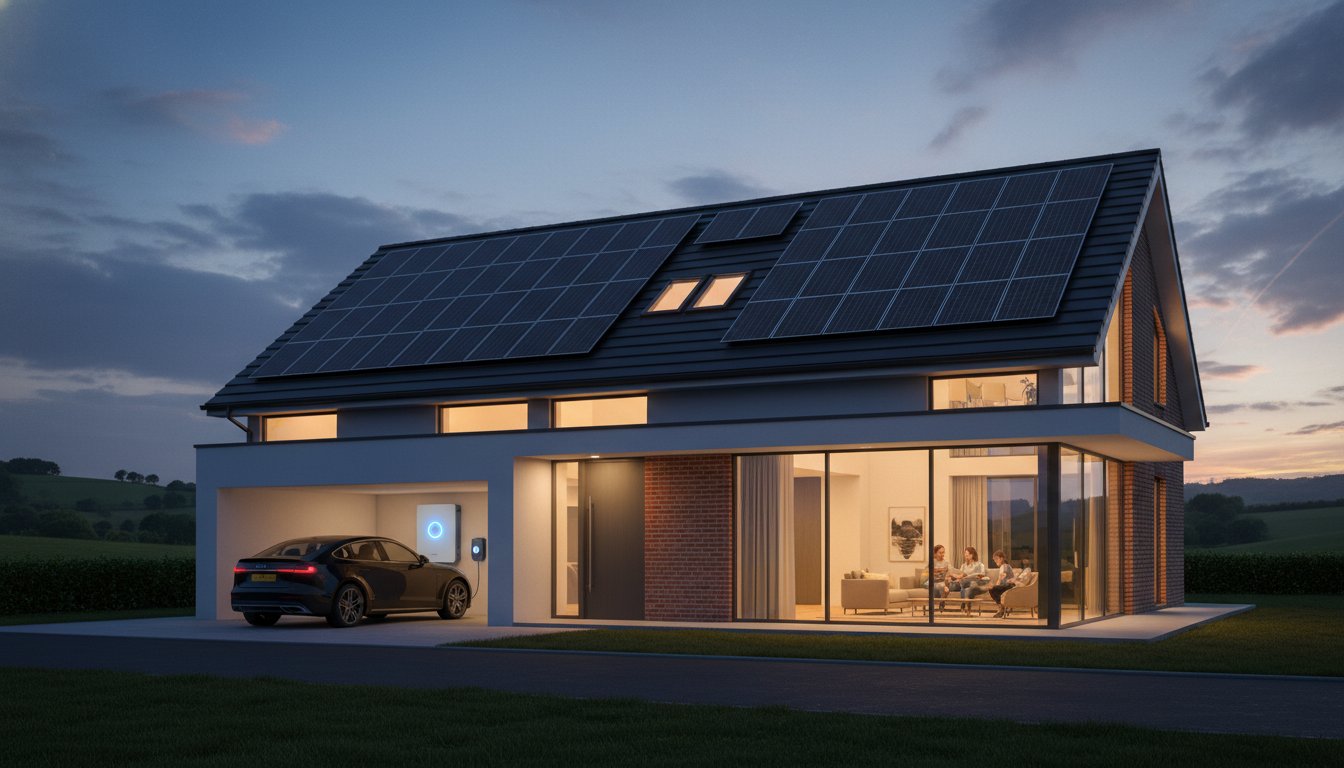
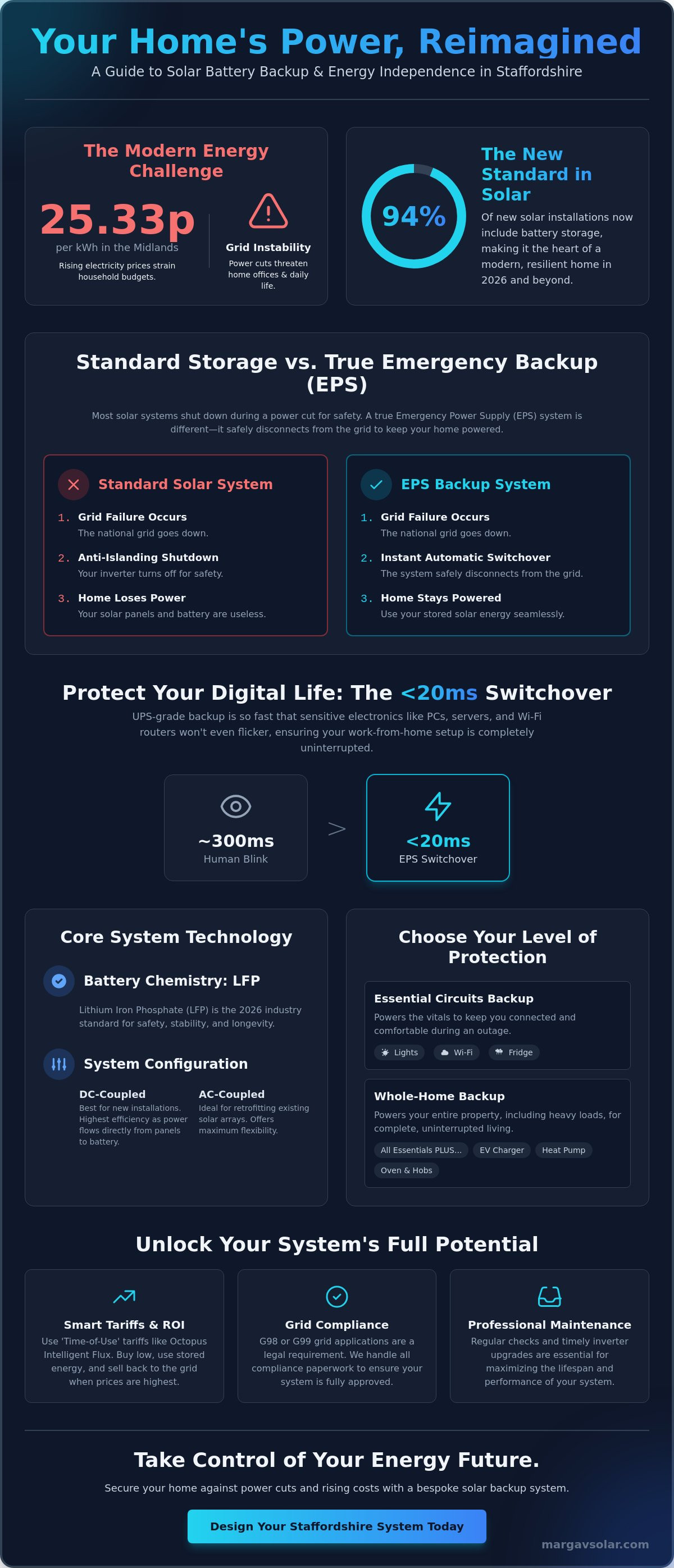
Did you know that 94% of new solar installations now include storage? In 2026, a solar battery backup system Staffordshire homeowners trust is no longer just an optional extra; it's the heart of a modern, resilient home. You're likely tired of watching electricity prices in the Midlands hover around 25.33p per kWh while worrying if a sudden power cut will drop your home office offline. It's frustrating to generate green energy all day only to feel like you're still at the mercy of the national grid.
This guide will show you how to achieve true energy independence and protect your property with advanced backup technology. We'll explain the difference between basic emergency power and whole-home backup, show you how to maximize ROI with smart tariffs like Octopus Intelligent Flux, and clarify the latest planning rules for Stone, Eccleshall, and the wider county. By the end, you'll know exactly how to turn your roof into a smart energy hub that keeps the lights on when everyone else is in the dark.
Key Takeaways
- Distinguish between simple storage and true Emergency Power Supply (EPS) to ensure your home remains functional during a total grid failure.
- Identify the right solar battery backup system Staffordshire homeowners need for sub-20ms switchover times that protect sensitive home office electronics.
- Learn how to use smart energy arbitrage and time-of-use tariffs to sell power back to the grid when prices are highest.
- Navigate local planning rules and the G98 or G99 grid application process to ensure your system is fully compliant with Staffordshire regulations.
- Understand why professional maintenance and timely inverter upgrades are essential for maximizing the lifespan of your residential solar PV system.
What is a Solar Battery Backup System and Why Does Staffordshire Need It?
A solar battery backup system Staffordshire homeowners install today is a sophisticated piece of technology that does more than just save money. It's an energy management hub designed to keep your home running when the National Grid fails. While many people assume any battery will work during a blackout, most standard systems actually shut down for safety reasons. A true backup system is different; it has the ability to decouple your home from the wider grid, allowing you to use your stored solar power even when your neighbours are in the dark.
Modern home energy storage systems are the backbone of this independence. As we move deeper into 2026, the transition from fossil fuels to clean, local generation has reached a tipping point. With average electricity prices in the Midlands currently at 25.33p per kWh, the financial argument is strong. However, for many in our county, the primary driver is now resilience. Whether you're running a home business in Stafford or managing a household in the rural Moorlands, power continuity is no longer a luxury.
The Shift from Storage to Resilience
Standard solar inverters are designed with "anti-islanding" protection. This is a safety feature that ensures your system doesn't pump electricity back into a dead grid, which could be fatal for engineers working on the lines. Consequently, if the grid goes down, your solar panels stop working too. To solve this, a backup system uses an Emergency Power Supply (EPS) circuit or a dedicated backup gateway. This hardware creates a physical break from the grid. It allows your home to continue generating and consuming energy safely. When planning a solar panel installation, deciding between simple storage and full resilience is the most important choice you'll make.
Local Context: Grid Reliability in the West Midlands
Staffordshire's mix of bustling town centres and isolated rural communities creates unique challenges for the local grid. Rural overhead lines are particularly vulnerable to the increasingly volatile weather we've seen in recent years. Investing in a solar battery backup system Staffordshire households can rely on provides a vital safety net. Beyond personal gain, these systems help the wider community. By storing energy locally, you reduce the strain on the West Midlands infrastructure during peak times. With 94% of new UK solar installations now including a battery, 2026 has become the year where energy security and financial savings finally align for Staffordshire residents.
Technical Breakdown: How Backup Systems Function During a Blackout
Understanding the hardware behind a solar battery backup system Staffordshire homeowners choose is vital for setting realistic expectations. At the core of these systems is the hybrid inverter. This device acts as the brain of your energy hub, directing power from your panels to your appliances, your battery, or the grid. In 2026, the industry standard for safety and longevity is Lithium Iron Phosphate (LFP) chemistry. Unlike older battery types, LFP cells handle thousands of charge cycles and remain stable even under heavy use, making them ideal for the variable weather conditions we experience in the Midlands.
When selecting a system, you'll need to choose between AC-coupled and DC-coupled setups. DC-coupled systems are incredibly efficient for new installations because the energy stays in a high-voltage DC format from the panels to the battery. However, for those looking to add resilience to an existing array, AC-coupled solutions are the go-to choice for retrofitting. You can learn more about how battery storage works to determine which configuration fits your current setup. If you're unsure about your existing hardware, a professional assessment of your battery storage solutions can help clarify the best path forward.
Switchover time is the most critical technical spec for anyone working from home. Standard backup systems might take several seconds to kick in, which is enough to cause your PC to reboot or your Wi-Fi to drop. High-end systems offer UPS-grade (Uninterruptible Power Supply) performance with a switchover time of less than 20 milliseconds. This is so fast that most sensitive electronics won't even flicker when the grid goes down.
Essential Circuits vs. Whole-Home Backup
A common misconception is that a battery will automatically power your entire house, including heavy loads like heat pumps or EV charging points. While whole-home backup is possible, it requires significant battery capacity and high-output inverters. Most Staffordshire residents opt for "Essential Circuits" backup. This involves wiring your lights, fridge-freezer, and internet router to a dedicated backup output. This strategy ensures your food stays cold and your home remains habitable for days rather than just hours during a prolonged blackout.
The Importance of Inverter Capacity
While many focus on the storage capacity (kWh), the inverter's discharge rate (kW) is actually more important during a power cut. If you have a 10kWh battery but only a 3kW inverter, you can't run a 3.5kW kettle without the system tripping. For a typical Staffordshire detached home, we often recommend modular systems like GivEnergy. These allow you to start with a manageable capacity and add more battery modules later as your energy needs grow or as you transition more of your home's heating away from fossil fuels.
Maximising ROI: Smart Tariffs and Energy Trading in Staffordshire
In 2026, a solar battery backup system Staffordshire residents install is far more than an insurance policy against blackouts; it's a financial tool. The traditional model of simply saving solar energy for the evening has evolved into "energy arbitrage." This process involves using AI-driven software to automatically charge your battery from the grid when prices are at their lowest, typically overnight, and then using or selling that cheap power during expensive peak hours. With the average electricity price in the Midlands sitting at 25.33p per kWh, the ability to shift your consumption away from these peak rates can reduce your annual bills by up to 90%.
The real secret to high ROI lies in integration with smart "time-of-use" tariffs. Providers like Octopus Energy offer specialized plans such as Octopus Intelligent Flux, which can pay up to 32.17p per kWh during peak export windows. This is significantly higher than the standard Smart Export Guarantee (SEG) rates offered by many other suppliers. By timing your exports to coincide with these high-demand periods, your battery actively generates revenue while you sleep. For a typical Staffordshire household consuming 3,400kWh a year, these smart trading strategies drastically shorten the payback period of the initial investment.
GivEnergy Cloud and Smart Management
Managing these complex energy movements is simple with the right software. Many local homeowners use the GivEnergy Cloud to monitor their system's performance in real time. This platform allows you to automate your battery's behaviour, participating in "Demand Side Response" events where the National Grid pays you to discharge power during times of high stress. It turns your home into a mini power station that supports the wider Staffordshire infrastructure while padding your bank account.
Comparing Battery Lifespans and Warranties
To secure long-term ROI, you must look beyond the initial price tag and focus on the degradation curve. Most modern LFP batteries are rated for at least 6,000 cycles, which typically equates to 15 to 20 years of daily use. While a 10-year warranty is standard, some premium manufacturers now offer 12 or 15-year terms. Maintaining these components is straightforward but essential. Regular professional maintenance ensures your inverter remains efficient and your battery cells stay balanced. This proactive care prevents efficiency drops, ensuring your system continues to "Arb" the market effectively well into the 2030s.
Installation Requirements and Local Staffordshire Regulations
Before you can enjoy the security of a solar battery backup system Staffordshire homes must meet specific regulatory and technical standards. While the hardware is the most exciting part, the paperwork and site preparation are what ensure your system is legal, safe, and covered by insurance. In most cases, installing a battery alongside your solar panels is considered "permitted development." This means you won't need full planning permission from Stafford Borough Council or your local authority, provided the property isn't a listed building or situated in a conservation area. However, residents in Stone, Eccleshall, and Burton Manor Village should be aware that Article 4 Directions are in place, which restrict these rights for some properties. It's always best to check with your local planning office before starting work.
The DNO Application Process
Connecting a high-capacity backup system to the grid requires permission from National Grid Electricity Distribution, the Distribution Network Operator (DNO) for the Midlands. The process usually falls into two categories. For smaller systems, typically under 3.68kW per phase, we follow the G98 "fit and inform" process. However, for the advanced backup systems most Staffordshire homeowners want in 2026, a G99 application is usually necessary. This involves a formal request to the DNO to ensure your home's cut-out fuse and the local cable network can handle the additional load. Receiving a "Letter of Consent" is a non-negotiable step before the system goes live. If you're feeling overwhelmed by the paperwork, our team can handle the entire process when you invest in our battery storage solutions.
Site Preparation and Safety
Choosing the right location for your battery is about more than just finding a spare corner. While many homeowners prefer the garage or a dedicated external cabinet, modern LFP batteries require adequate ventilation to manage heat during rapid charging cycles. Lofts are generally avoided due to temperature extremes and structural weight considerations. When installing a solar battery backup system Staffordshire weather should also be considered. While LFP chemistry is robust, extreme cold can reduce charging efficiency, so an insulated garage or a sheltered external wall is often the best compromise. It's also vital to ensure the installation meets the latest fire safety standards, keeping units away from primary escape routes.
Finally, never overlook the importance of professional accreditation. An NICEIC certification is essential for proving that your electrical work meets UK building regulations. Attempting a "DIY" installation not only voids your manufacturer's warranty but will almost certainly invalidate your home insurance policy. Using a certified professional ensures your system is safe and qualifies you for the Smart Export Guarantee (SEG) payments that make the system financially viable.
Why Choose MarGav Solar for Your Staffordshire Backup System?
MarGav Solar has spent over 20 years perfecting the art of solar panel installation across the county. From the historic streets of Stafford town centre to the exposed heights of the Moorlands, we understand the local climate and grid challenges better than anyone. We don't just sell equipment; we build long-term relationships through expert service and transparent, fixed-price contracts. Our local roots mean we're familiar with the specific requirements of Staffordshire's diverse housing stock, whether you're in a modern detached home in Uttoxeter or a traditional cottage near the Peak District.
When you invest in a solar battery backup system Staffordshire homeowners can trust, you're getting an end-to-end service. This includes managing the complex G99 DNO applications discussed earlier and providing long-term support such as inverter upgrades to keep your system at peak performance. We ensure every electrical certification is handled correctly. You won't find hidden fees for administrative work or grid notifications in our quotes. We believe in clear communication and honest pricing, ensuring your path to energy independence is as smooth as possible.
Our Bespoke Design Philosophy
We don't believe in "one size fits all" battery kits. Every home in Staffordshire has a different energy profile based on its size, occupancy, and heating systems. Our approach involves modeling your specific usage to ensure your battery capacity matches your generation potential and backup needs. This synergy extends to EV charging points, where we can configure your system to prioritize charging your vehicle with excess solar before storing it for household use. By looking at your home as a complete energy ecosystem, we help you maximize every kilowatt-hour your panels produce.
Start Your Journey to Energy Independence
Your transition to a resilient, independent home begins with a conversation. During a free local energy consultation, we'll assess your property's suitability and discuss your goals for backup power. We only use high-efficiency, Tier 1 hardware from reputable manufacturers to ensure your investment stands the test of time. We've seen many systems fail because of poor component choices, so we refuse to compromise on quality. Whether you're looking to retrofit a battery to an existing array or install a brand-new PV system, MarGav Solar provides the local expertise you need to succeed in 2026. Contact our team today to find out how we can help you protect your home from rising costs and grid instability.
Take Control of Your Home’s Energy Future
The landscape of home power has fundamentally changed. In 2026, a solar battery backup system Staffordshire residents can rely on is about more than just green credentials. It's a strategic tool for financial gain and total peace of mind. By combining advanced LFP battery chemistry with smart energy trading, you can insulate your household from rising grid costs while ensuring your lights stay on during local blackouts. Whether you're protecting a home office or looking to maximize the ROI of your existing solar panels, the technology is now ready to deliver true independence.
Choosing the right partner for this transition is vital. With over 20 years of industry experience, MarGav Solar provides the local expertise needed to navigate complex DNO applications and bespoke system designs. Our NICEIC and MCS accredited installers work to a fixed-price installation guarantee, so you won't face unexpected costs. Don't leave your energy security to chance. It's time to stop being a passive consumer and start being a producer.
Book Your Free Staffordshire Solar & Battery Survey Today and start building a more resilient home.
Frequently Asked Questions
Will a solar battery backup work during a total grid failure?
Yes, a solar battery backup system Staffordshire residents install will work during a blackout if it features an Emergency Power Supply (EPS) or a backup gateway. This hardware physically disconnects your home from the grid, allowing your solar panels and battery to operate as an independent "island." Without this specific equipment, your system will shut down for safety to prevent feeding power back into the grid while engineers are working on the lines.
How long can a 10kWh battery power a typical Staffordshire home?
A 10kWh battery can typically power the essential circuits of a Staffordshire home for 24 to 36 hours. Given that the average UK household consumes approximately 3,400kWh annually, or roughly 9.3kWh per day, a full battery provides a significant buffer. If you're running heavy appliances like electric showers or ovens, this duration will decrease rapidly. Most homeowners prioritize lights, refrigeration, and Wi-Fi to ensure the home remains functional during a cut.
Do I need planning permission for a solar battery in Staffordshire?
Most residential battery installations in Staffordshire fall under "permitted development" and don't require formal planning permission. However, restrictions apply in conservation areas or for listed buildings. Specifically, Stafford Borough Council has Article 4 Directions in Stone, Eccleshall, and Burton Manor Village that may remove some of these rights. It's always best to verify with your local planning department or a professional installer before proceeding with the work.
Can I add a battery backup system to my existing solar panels?
You can definitely add a battery to an existing solar array using an AC-coupled configuration. This setup allows the battery to work alongside your current inverter without needing to replace your entire existing system. It's an excellent way to upgrade an older installation and start benefiting from energy storage. We often perform these retrofits for homeowners looking to increase their self-consumption and protect against power cuts without disturbing their original panels.
What is the difference between EPS and a UPS?
The primary difference is the speed of the switchover. A UPS (Uninterruptible Power Supply) switches in less than 20 milliseconds, which is fast enough to keep a desktop computer or router from rebooting. An EPS (Emergency Power Supply) usually takes a few seconds to kick in. While an EPS is perfectly fine for keeping the fridge running, a UPS-grade solar battery backup system Staffordshire families use is far better for protecting sensitive home office equipment.
How much does it cost to install a solar battery backup in 2026?
In 2026, the industry average for a 5kWh battery installed alongside solar panels ranges between £3,000 and £4,000. Larger units, like the 13.5kWh Tesla Powerwall 3, typically cost around £9,000 including installation. Prices vary based on your home's wiring and the complexity of the backup circuits required. Remember that 0% VAT is currently applicable on these installations until March 31, 2027, which offers a significant saving on the total project cost.
Which battery brands are best for UK weather conditions?
Batteries using Lithium Iron Phosphate (LFP) chemistry are generally considered the best for the UK's variable climate. They are more thermally stable than older lithium-ion types and can handle the damp, cold conditions often found in Staffordshire garages or utility rooms. Brands like GivEnergy and Tesla are popular choices because they offer robust enclosures and sophisticated temperature management systems that maintain efficiency even during the coldest Midlands winters.
Is it worth getting a battery if I don’t have solar panels?
It is absolutely worth it if you can access a smart time-of-use tariff. Even without solar panels, you can charge the battery using cheap overnight electricity, which is currently around 25.33p per kWh during standard hours in the Midlands. You then use that stored energy during peak hours when prices are highest. This "energy arbitrage" can lead to substantial bill reductions and provides vital backup protection during grid failures regardless of the weather outside.


