
Most Staffordshire homeowners believe our grey skies are a dealbreaker for renewable energy, but they're actually missing out on one of the most lucrative financial windows in a decade. While it's easy to assume solar only works in the south, the solar panel payback period Staffordshire residents can expect is now remarkably competitive. With the West Midlands electricity price cap at 24.5p per kWh as of June 2026 and a 0% VAT rate currently in effect, your roof is more than just a shelter; it's a dormant asset.
We understand the frustration of trying to track volatile energy prices or deciphering Smart Export Guarantee (SEG) rates that vary wildly between 24p and 32p per kWh. It's confusing to know if you're getting a fair deal or if the clouds will ruin your ROI. You deserve a clear answer on when your system will start paying for itself. This guide promises to break down the math for 2026, helping you understand how to hit that sweet spot of a 6 to 10 year payback range.
We'll preview the impact of adding battery storage to your setup, the importance of regular solar panel maintenance, and how to navigate local incentives like the Warm Homes Plan. By the end, you'll have the confidence to choose the right local solutions, from residential PV systems to EV charging points, to maximize your home's efficiency.
Key Takeaways
- Understand why the typical solar panel payback period Staffordshire homeowners experience currently sits between 7 and 10 years and how to calculate your own break-even point.
- Learn the "Avoided Cost" principle to understand why using your own solar energy is three times more valuable than exporting it back to the grid.
- Discover how adding battery storage solutions can boost your home's energy self-consumption from 30% to 80%, significantly speeding up your return on investment.
- Identify specific Staffordshire factors, such as roof orientation and local shading, that influence your system's efficiency and total annual savings.
- Find out how professional solar panel maintenance and cleaning prevents dirt from extending your payback timeline and protects your long-term financial yield.
What is the Solar Panel Payback Period for Staffordshire Homes?
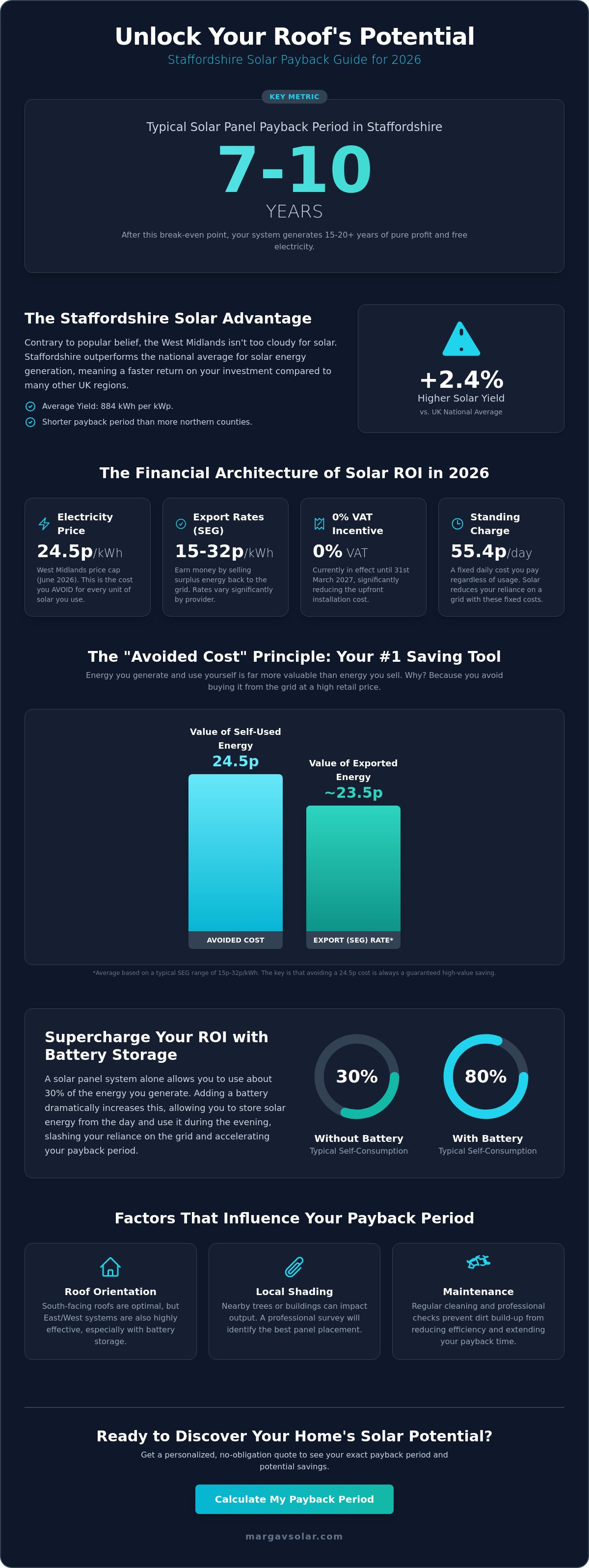
The concept of a payback period is straightforward: it is the time it takes for your energy savings and export earnings to cover the total cost of your investment. For homeowners in our region, the solar panel payback period Staffordshire currently offers typically falls between 7 and 10 years. Once you hit this "break-even" point, your system continues to generate electricity for another 15 to 20 years. This means you enjoy over a decade of pure profit and energy independence after the initial costs are recovered.
Understanding how payback time is calculated involves looking at your total upfront expenditure and subtracting the annual financial benefits. In 2026, these benefits are higher than they were five years ago. This is largely due to high energy prices and significantly improved export rates. While the initial cost of residential solar PV systems is the primary hurdle, the speed at which you recoup that money has accelerated.
The Staffordshire Solar Yield Advantage
You might think the West Midlands is too cloudy for solar to be effective, but the data tells a different story. Staffordshire actually outperforms the national average for solar yield by 2.4%, a statistic often overlooked by national installers who focus on the south coast. With an average yield of 884 kWh/kWp across the county, towns like Stafford, Cannock, and Stoke-on-Trent receive more than enough irradiance to make solar a high-performing asset. This 2.4% yield advantage means Staffordshire homes often reach their break-even point months or even years sooner than properties in more northern counties. Local weather patterns provide a consistent enough "fuel source" to keep your panels producing even on overcast days.
Calculating Your Personal ROI Baseline
To find your baseline, you need to weigh the initial system cost against your annual electricity bill reduction. In 2026, the West Midlands electricity price cap sits at approximately 24.5p per kWh. Every unit of energy you generate and use at home is money you don't have to pay your supplier. This "avoided cost" is the most powerful driver of your ROI.
The Smart Export Guarantee (SEG) also plays a massive role in your calculation. With some providers offering flat rates of 25p per kWh or variable rates reaching 32.17p per kWh, your surplus power becomes a steady revenue stream rather than wasted energy. You should also consider the 0% VAT incentive on residential installations, which remains in place until 31 March 2027. This tax break significantly lowers the entry price of solar, shortening the time it takes to see a full return on your investment before the rate is scheduled to rise to 5%.
The Financial Architecture of Solar ROI in 2026
The financial structure of your investment changes once you pass the initial break-even point. While the first decade focuses on recouping costs, the subsequent 15 years of a system's lifecycle transition into pure revenue generation. To reach this stage quickly, you must understand the "Avoided Cost" principle. This concept dictates that every unit of electricity you generate and use yourself is significantly more valuable than the units you sell back to the grid. Because you're avoiding the 24.5p per kWh retail price (the West Midlands cap as of June 2026), your home-grown energy effectively works harder for your wallet than any export tariff could. This logic is the primary engine behind a shorter solar panel payback period Staffordshire residents can achieve.
Energy prices in the West Midlands have stabilised but remain high enough to make self-generation attractive. With a daily standing charge of 55.4p, the only way to truly slash your monthly outgoings is by reducing the volume of units you buy from the grid. Government initiatives like the Future Homes Standard continue to shape how we value low-carbon technology, ensuring that energy-efficient homes remain more resilient against market fluctuations.
Supplier choice matters just as much as the weather. In 2026, Smart Export Guarantee (SEG) rates are no longer a "one size fits all" figure. While some standard tariffs offer around 15p per kWh, top-tier providers like Octopus Energy or Good Energy offer rates between 25p and 32.17p per kWh for those with the right equipment. Aligning your export strategy with these premium rates can shave years off your total payback time.
Avoided Costs vs. Export Revenue
Your daily routine is the biggest variable in your ROI. If you work from home in Stafford or Stoke, you can align your heavy appliance use with peak daylight hours, capturing energy worth roughly 25-30p per kWh in avoided costs. Conversely, if you're out all day and export that energy, you might only receive 5-15p per kWh on a standard SEG rate. Maximising daytime usage is the simplest, zero-cost way to accelerate your return. If you find your energy needs are growing, you might view our residential solar PV systems to see how modern arrays handle higher demands.
The 2026 Hardware Factor
High-efficiency panels, often exceeding 450W, now allow you to generate more power from a smaller roof footprint. This efficiency means you need fewer components to reach your target yield, lowering the initial installation hurdle. Longevity also plays a role; periodic inverter upgrades ensure your system remains efficient well into its second decade. Finally, remember that MCS certification is essential. Without it, you won't be able to access the lucrative SEG payments that are vital for your financial calculations.
How Battery Storage Accelerates Payback in the West Midlands
Adding a battery to your installation introduces what industry experts call the Battery Paradox. While a battery increases your initial investment, it often results in a more robust long-term financial yield. Without storage, a typical Staffordshire family only uses about 30% of the energy their panels generate because production peaks while they're at work. Integrating solar battery storage flips this script, pushing self-consumption up to 80% by holding that energy for evening use. This shift is vital for the solar panel payback period Staffordshire homeowners calculate, as it maximises the "avoided cost" of grid electricity during peak hours.
Recent data on UK solar panel payback periods in 2026 suggests that while a 4kW system with battery storage typically costs between £10,000 and £14,000, the protection it offers against grid prices is unparalleled. By charging your battery from the grid at night using time-of-use tariffs like Octopus Flux, you can fill your storage with cheap energy during off-peak windows and use it when the West Midlands price cap is at its highest. This strategic "load shifting" ensures you never pay the full 24.5p per kWh rate if you don't have to.
The GivEnergy Cloud and ROI
Smart management is the secret to shortening your ROI. Using the GivEnergy Cloud, you can monitor energy flows in real-time and set your system to export power when SEG rates are most profitable. Some "Intelligent Flux" tariffs allow you to sell battery power back to the grid for up to 32.17p per kWh during peak demand. By using AI-driven battery management to automate charging and discharging cycles, Staffordshire homeowners can effectively shave 12 to 18 months off their total system payback window. This automation turns your home into a mini power station that trades energy for profit while you sleep.
Real-World Scenario: Solar Alone vs. Solar + Battery
Consider a standard 4kWp system in a town like Leek or Cannock. Without a battery, you might save £500 to £700 per year on bills. However, adding a 9.5kWh battery can double those savings by capturing the solar energy that would otherwise be exported for a lower rate. When evaluating your investment, the "Total Cost of Ownership" is a far better metric than "Initial Payback." A system with storage doesn't just pay for itself; it acts as a permanent hedge against future energy price spikes. This setup ensures that the solar panel payback period Staffordshire residents experience remains stable even if national energy costs fluctuate again in the late 2020s.
Local Factors Influencing Your Staffordshire Payback Period
While national averages provide a useful baseline, your specific location within the county determines your exact solar panel payback period Staffordshire timeline. Your property's physical characteristics, such as roof orientation and pitch, are the primary drivers of efficiency. A south-facing roof in Stafford or Newcastle-under-Lyme remains the gold standard for maximum generation. However, East/West splits are increasingly popular across the West Midlands. These configurations allow you to capture energy during the morning and late afternoon, which often aligns better with when families are actually at home using appliances.
The "Cannock Chase Factor" is another local consideration. If your home is situated near the heavy woodland of the Chase or the rolling hills of the Staffordshire Moorlands, local shading becomes a significant variable. Even partial shading from a single tree or a neighbouring chimney can disproportionately affect an entire string of panels. To maintain a fast ROI, your system design must account for these obstructions using power optimisers or micro-inverters. Additionally, the pitch of your roof plays a role; an angle of 30 to 40 degrees is ideal for capturing the West Midlands sun at its most effective heights throughout the year.
Administrative factors can also influence your project's timeline and eventual return. Depending on the size of your system and the local network capacity, your installer may need to submit G98 or G99 applications to the District Network Operator (DNO). While G98 notifications are standard for smaller systems, larger arrays with significant battery storage may require a G99 application to ensure the local grid can handle the potential export. Navigating these local constraints early prevents delays that could push back your break-even point.
Optimising for the Staffordshire Climate
Many homeowners worry that our local weather might hinder their investment, but the Staffordshire climate has hidden benefits. Solar panels are electronic components that perform more efficiently in cooler temperatures. The crisp, clear days we often experience in the spring are actually more productive for energy generation than the sweltering heatwaves seen in the south. While winter irradiance is lower, the 2.4% yield advantage Staffordshire holds over the national average ensures your annual total remains robust. Choosing panels with high low-light sensitivity helps you squeeze every possible watt out of shorter December days.
The Importance of Professional Design
A one-size-fits-all approach is the fastest way to extend your payback period unnecessarily. A professional solar panel installation in Staffordshire must be bespoke to your specific energy habits and roof layout. Correctly sizing your system is a delicate balance; an oversized array without a battery leads to excessive export at lower rates, while an undersized system leaves you vulnerable to the 24.5p per kWh grid price. By working with experts who understand West Midlands sun angles and local grid requirements, you ensure your system is an asset rather than a liability. If you want to ensure your roof is reaching its full financial potential, contact us for a professional site survey to get an accurate ROI projection.
Protecting Your Investment: Maintenance and Long-Term ROI
Once your system is live, the journey to energy independence has just begun. To ensure the solar panel payback period Staffordshire projections you were promised actually materialise, you must treat your system as a high-performance asset. Neglecting the physical condition of your panels is a hidden cost that many homeowners overlook until their energy bills start creeping back up. A system that isn't performing at 100% efficiency is a system that's actively pushing your break-even point further into the future.
Professional solar panel maintenance acts as an insurance policy for your ROI. It isn't just about aesthetics; it's about preserving the electrical integrity of your array. Regular checks can identify micro-cracks or shading issues that aren't visible from the ground. Monitoring your inverter is equally vital. If an inverter fails and goes unnoticed for even a few weeks during the summer, you lose the most profitable generation window of the year. Catching these issues early through smart monitoring and periodic inspections is the only way to protect your 25-year financial lifecycle.
MarGav Solar provides end-to-end support that extends far beyond the initial installation. We offer a comprehensive suite of services including battery storage solutions, EV charging points, and dedicated solar panel maintenance and cleaning. Our goal is to support your system through its entire lifespan, from the first consultation to eventual inverter upgrades and replacements. By keeping your hardware in peak condition, we ensure your transition from payback to pure profit happens as quickly as possible.
Efficiency Preservation Strategies
While Staffordshire gets its fair share of rainfall, rain alone isn't enough to keep panels at peak performance. It often leaves behind a film of dust or moves debris into the corners of the frame, which can lead to "hot spots" that permanently damage cells. Bird proofing is another critical step, as nesting under panels can damage wiring and lead to costly repairs that rain certainly won't fix. Research indicates that unmaintained panels can lose as much as 20% of their output efficiency over a five-year period, a drop that can add years to your overall investment timeline.
Your Next Steps to Solar Freedom
The path to a shorter payback period starts with an accurate, technical assessment of your property. Booking a survey with a local Staffordshire expert allows you to move past generic estimates and see exactly how your roof orientation and local shading will impact your yield. You'll receive a bespoke quote that includes a projected payback date based on current 2026 energy prices and export rates. Don't leave your ROI to chance by choosing a "set and forget" approach.
Get your personalised Staffordshire solar ROI calculation from MarGav Solar and take the first step toward a more efficient, profitable home energy system.
Take Control of Your Staffordshire Energy Future
Investing in renewable energy is no longer just an environmental choice; it's a strategic financial move for your home. By understanding the solar panel payback period Staffordshire homeowners can realistically achieve, you're better equipped to navigate the 2026 energy landscape. Remember that the current 0% VAT incentive is only available until 31 March 2027, making this a prime window to lock in your savings. Whether you're looking to maximize self-consumption with battery storage or simply want to slash your monthly bills, the technology is now more efficient than ever.
Success depends on choosing a partner who understands our local geography and grid requirements. With over 20 years of local Staffordshire expertise and NICEIC-certified professional installers, we specialize in high-performance systems and GivEnergy battery integration. Don't leave your ROI to chance with generic estimates. Request Your Bespoke Staffordshire Solar ROI Quote today to see exactly how much you can save. Your journey toward a self-sufficient, lower-cost home is just one consultation away.
Frequently Asked Questions
Is Staffordshire sunny enough for solar panels to pay back?
Yes, Staffordshire receives more than enough sunlight to make solar a highly profitable investment. The county actually outperforms the national average for solar yield by 2.4%, providing an average yield of 884 kWh/kWp across the West Midlands. Modern PV systems are designed to generate electricity from daylight rather than just direct heat. This consistent generation ensures that the solar panel payback period Staffordshire homeowners expect remains financially attractive even during our typical overcast days.
How much does the Smart Export Guarantee (SEG) speed up payback?
The SEG significantly accelerates your ROI by paying you for every unit of surplus electricity you send back to the grid. As of May 2026, some suppliers offer fixed export rates of 24p per kWh, while "intelligent" tariffs can reach up to 32.17p per kWh during peak windows. These payments turn your excess energy into a steady revenue stream. Without these tariffs, that energy would effectively be wasted, extending your break-even point by several years.
Does a solar battery actually shorten the payback period?
A solar battery can shorten your payback period by increasing your home's energy self-consumption from roughly 30% to 80%. By storing energy generated during the day for use at night, you avoid buying grid electricity at the West Midlands price cap of 24.5p per kWh. While battery storage solutions require a higher upfront investment, the ability to "load shift" and use your own power during expensive peak hours often results in a faster total return.
What is the average cost of solar panels in Staffordshire in 2026?
Average costs for a system depend on your specific energy requirements, roof size, and the hardware efficiency you choose. While baseline figures for a typical 3-bedroom home exist, your final price will vary based on whether you include battery storage or EV charging points. It's important to remember that the 0% VAT rate on residential installations is currently in effect until March 2027. This tax incentive significantly lowers the initial entry price for Staffordshire homeowners.
Can I get a grant for solar panels in Staffordshire?
Several support schemes are available for Staffordshire residents in 2026, including the ECO4 scheme for low-income households with lower EPC ratings. Staffordshire County Council also promotes the Warm Homes Plan, which offers fully funded support or low-interest loans for renewable energy measures. Homeowners should also explore the Boiler Upgrade Scheme if they're considering a heat pump alongside their solar array. These programs can drastically reduce your initial costs and speed up your ROI.
How does roof direction affect my solar ROI?
Roof orientation is a primary factor in determining the total energy your system will harvest each year. A south-facing roof is the most efficient, but East/West configurations are excellent for capturing energy during the morning and evening when household demand is often highest. Correct orientation ensures you maximize your self-consumption and minimize grid reliance. A professional site survey is the only way to accurately project your specific solar panel payback period Staffordshire based on your roof's unique angles.
Do I need to clean my solar panels to maintain the payback period?
Yes, keeping your panels clean is vital for maintaining the financial yield of your system. Dirt, bird droppings, and debris can block sunlight and reduce your system's efficiency by up to 20% over time. This loss in generation directly translates to higher energy bills and a longer payback timeline. Regular solar panel maintenance and cleaning ensure you're getting the maximum possible watt-hours from your investment every single day of the year.
What happens to my payback period if energy prices go down?
If grid energy prices decrease, the "avoided cost" value of your solar energy also drops, which can slightly extend your payback period. However, even with price fluctuations, the 24.5p per kWh price cap in the West Midlands remains high enough to make self-generation a smart choice. Additionally, the ability to earn through SEG export tariffs provides a financial buffer. Solar remains a permanent hedge against the long-term volatility of the UK energy market.


