
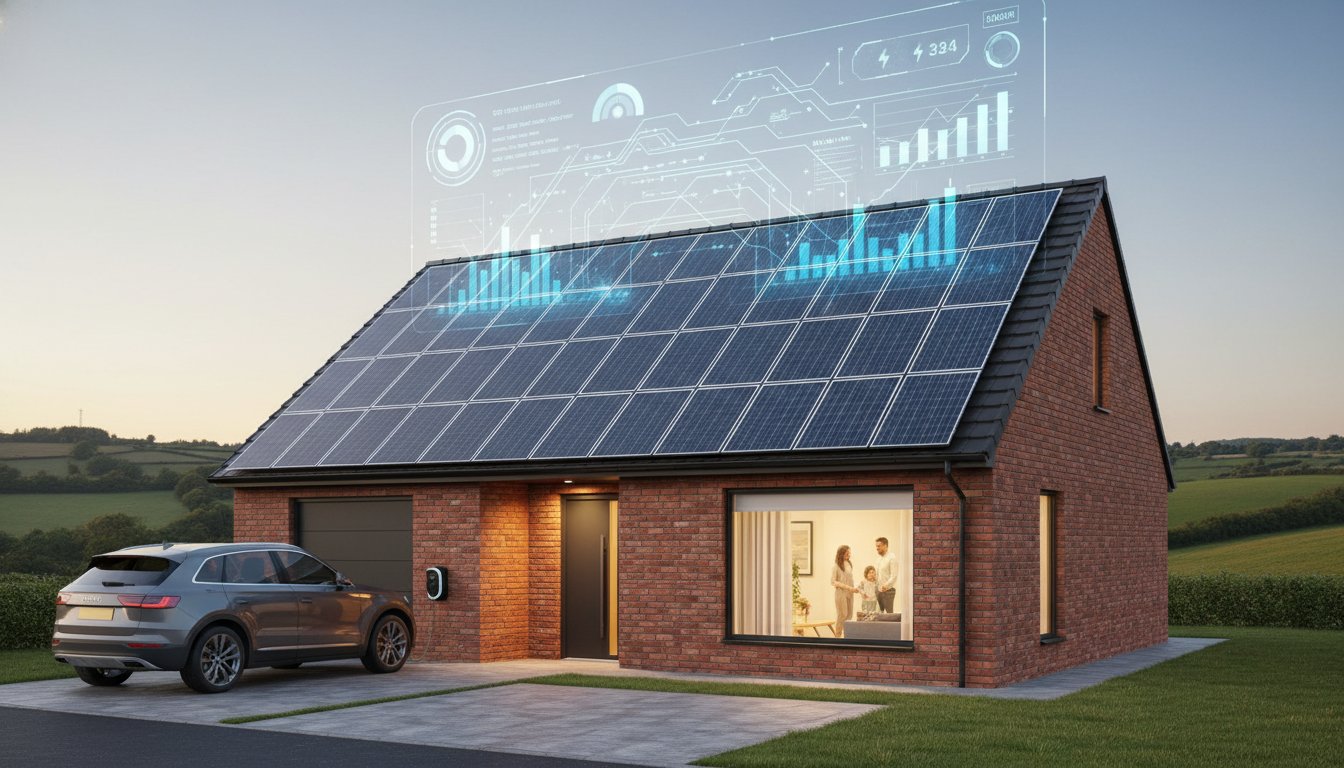
Why are your energy bills still climbing when you have a roof full of solar panels? It's frustrating to see your clean energy sent back to the grid for pennies while you pay record-high rates during the evening peak. With the Ofgem price cap projected to rise to £1,862 in July 2026, learning how to get the most out of solar panels UK homeowners rely on has never been more critical. You aren't alone in this struggle; the mismatch between when you generate power and when you actually use it is the biggest hurdle to true energy independence.
We'll show you how to bridge that gap and achieve up to 80% self-consumption. This guide covers the essential strategies for 2026, from timing your appliances to the latest battery storage solutions and inverter upgrades. You'll also learn how to protect your investment with professional maintenance and take advantage of the 0% VAT rate before it expires in March 2027. It's time to stop settling for low export rates and turn your solar setup into a high-performance energy ecosystem that works for your schedule and your budget.
Key Takeaways
- Sync your heavy appliance use with peak daylight hours to shift from exporting cheap energy to using it yourself.
- Learn how to get the most out of solar panels UK systems offer by adopting the "one appliance at a time" rule to stay within your generation threshold.
- Discover why battery storage and solar diverters are the essential tools for hitting 70-80% self-consumption in 2026.
- Protect your yield from a 20% efficiency drop by understanding why UK rain isn't enough to clear traffic film and lichen.
- Future-proof your home by integrating EV charging points and heat pumps into a single, smart energy ecosystem.
Understanding the UK Solar Curve: Why Generation Doesn't Always Equal Savings
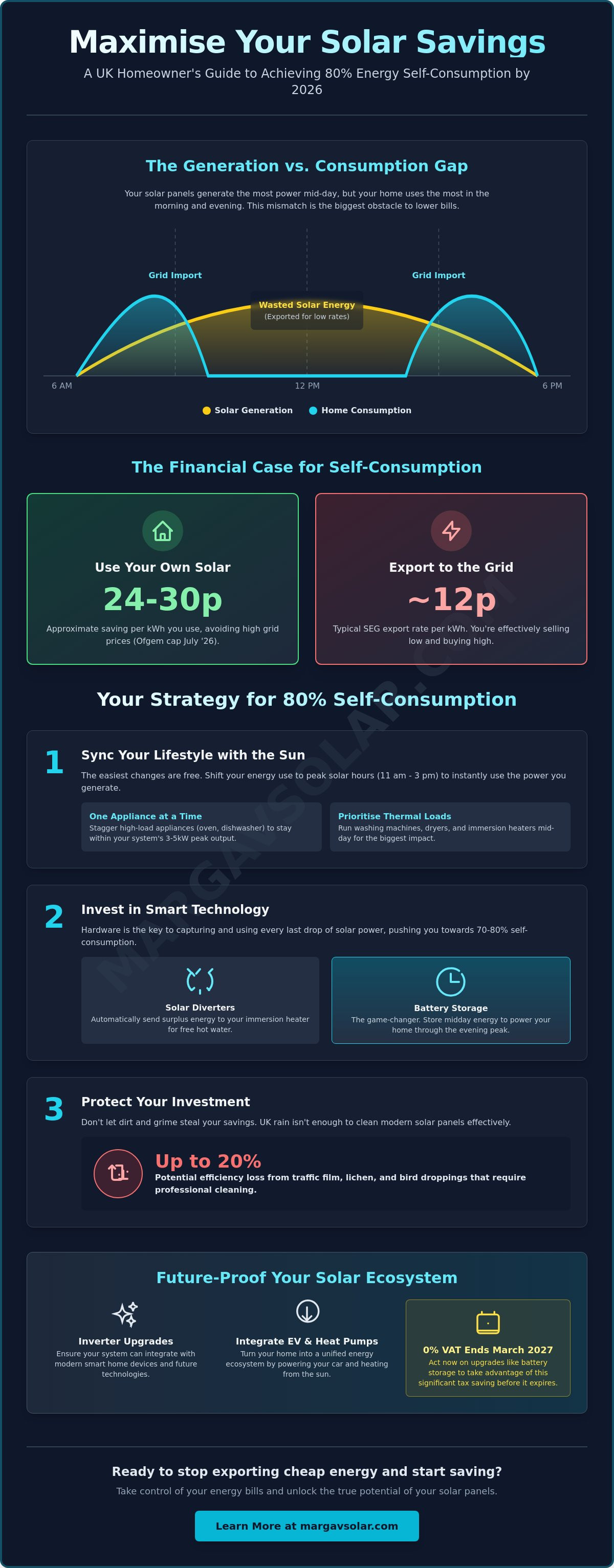
The "Solar Curve" is the bell-shaped graph of your daily energy production. In the UK, this curve usually peaks between 11 am and 3 pm. During these hours, your panels work at their hardest, often producing far more electricity than a typical home can immediately use. However, the average household's demand looks very different. Most people experience "spikes" in the early morning before work and in the evening when everyone returns home. This gap between when you make power and when you need it is the biggest obstacle to lowering your bills.
Understanding this dynamic is essential to learning how to get the most out of solar panels UK families have installed. Historically, exporting surplus energy was a simple way to earn a bit of money back. In 2026, the financial landscape has changed. With the Ofgem price cap rising to £1,862 in July, every unit of solar energy you use yourself saves you roughly 24p to 30p. In contrast, many Smart Export Guarantee (SEG) rates are significantly lower. For example, British Gas is scheduled to drop its export rate to 12p per kWh for systems up to 15kW on July 6, 2026. If you export your power instead of using it, you're effectively selling low and buying high. This makes self-consumption the most important metric for your return on investment.
The Mismatch: Generation vs. Consumption
A typical UK home has a "double hump" energy profile. You use power for breakfast and showers, then the house goes quiet, then usage surges for dinner and entertainment. Solar generation is the opposite. It's a single hump that peaks while you might be out of the house. According to UK solar power statistics, generation is also highly seasonal. You might generate ten times more energy on a clear June day than a cloudy December afternoon. Those morning and evening spikes are your primary financial leaks because you're forced to buy expensive grid energy while your potential solar savings are wasted.
The Role of Smart Meters in 2026
By 2026, smart meters and half-hourly settlement have transformed how we manage energy. Instead of one flat rate, many suppliers now offer dynamic tariffs that change prices every thirty minutes. To truly master how to get the most out of solar panels UK weather permits, you must understand your "baseload." This is the minimum amount of power your home uses constantly for fridges, routers, and standby devices. Once you know your baseload, you can use smart meter data to identify exactly when your generation exceeds your needs. This precision allows you to shift heavy tasks into that peak solar window, turning a surplus into a saving.
Behavioural Shifts: How to Sync Your Lifestyle with the Sun
Changing how you use electricity is the most immediate way to slash your bills without spending a penny on new hardware. Mastering how to get the most out of solar panels UK weather provides starts with the "one appliance at a time" rule. Most residential systems are sized to produce between 3kW and 5kW at peak performance. If you run your oven, dishwasher, and washing machine simultaneously, you'll likely exceed what your panels are generating. This forces your home to pull the extra power from the grid at full price. By staggering these tasks, you ensure that your free solar energy covers the entire load.
Prioritise "thermal" appliances first. These are machines that use electricity to generate heat, such as dishwashers, tumble dryers, and immersion heaters. They have the highest energy draw and offer the biggest savings when powered by the sun. You can find more details on appliance efficiency in this Energy Saving Trust solar panel guide. In 2026, many homeowners are using Home Energy Management Systems (HEMS) to automate this process. These systems can track weather forecasts and automatically trigger smart plugs when generation is high, taking the guesswork out of your daily routine.
Staggering Your High-Load Appliances
Understanding the hierarchy of energy draw is vital. A kettle can pull 3kW instantly, while a dishwasher might pull 1.5kW over a longer cycle. If you're boiling the kettle, wait until it's finished before starting the washing machine. Using delay timers is a simple way to schedule these high-draw cycles for the middle of the day. If your current system feels limited by older technology, you might consider Inverter Upgrades and Replacements to better handle modern smart appliance integration.
Solar Noon and Your Peak Window
Your "peak window" depends entirely on your roof's orientation. South-facing panels usually hit their stride at "solar noon," typically between 12 pm and 1 pm. However, if you have an East/West split, you'll have two smaller peaks: one in the morning and one in the late afternoon. Adjust your habits to match these specific windows. For East/West systems, do your heavy laundry at 10 am rather than midday. Even on cloudy days, your panels will produce power, but you should adjust your expectations. On grey days, focus on low-draw tasks like charging laptops or running the fridge, and save the tumble dryer for a clear sky forecast.
Maximising Efficiency with Advanced Storage and Diverters
While changing your habits helps, technology provides the automation needed to reach 70% to 80% self-consumption. Relying on manual appliance scheduling only takes you so far. If you want to know how to get the most out of solar panels UK systems offer, you have to address the storage gap. On a bright June afternoon, a typical 4kWp system produces far more than your fridge and router require. Without a way to capture that energy, it spills onto the grid for low export rates. By 2026, the strategy has shifted from simply generating power to intelligently storing it for the expensive 4 pm to 8 pm peak window.
Smart inverters now act as the brain of your home energy system. They manage the flow between your panels, your appliances, and the grid without any manual intervention. These devices can even communicate with weather APIs to decide whether to save battery power for a cloudy afternoon or discharge it during a high-tariff period. This level of control ensures you aren't buying grid energy when your roof has already provided enough for the day.
The Power of Solar Battery Storage
Battery storage is the missing link for most UK homeowners. It allows you to "time-shift" your clean energy, using midday sun to power your evening television and cooking. Many residents are now exploring solar battery storage in Staffordshire to shield themselves from rising price caps. Platforms like the GivEnergy Cloud allow you to monitor this storage in real-time. It's also a financially savvy time to upgrade, as the 0% VAT rate on battery installations remains in effect until March 31, 2027.
Solar to Hot Water: Using Diverters
A solar PV diverter is one of the most cost-effective ways to store energy without a chemical battery. It "senses" when you're about to export surplus electricity and redirects it to your immersion heater instead. This turns your water cylinder into a thermal battery, providing free hot water for showers and cleaning. The Centre for Sustainable Energy provides excellent advice on making the most of your solar panels through these types of hardware additions. Integrating these diverters with your existing setup can significantly reduce your gas or oil consumption. When you combine this with smart EV charging points, you can ensure that every single watt your panels produce is used to power your life rather than being sold back to the grid for a fraction of its value.
Proactive Maintenance: Protecting Your Yield from Dirt and Pests
Generating free energy is only half the battle. If you want to know how to get the most out of solar panels UK homeowners often overlook the physical condition of their array. Many people assume that the frequent British rain is enough to keep their panels clean. Unfortunately, rain often does more harm than good. It can leave behind a layer of "traffic film," dust, and pollen that acts like a thin veil over your solar cells. This buildup, along with stubborn lichen growth, can lead to a "hidden cost of dirt" that reduces your system's efficiency by as much as 20%. When your yield drops, your energy bills inevitably rise.
Maintaining peak performance also requires looking beneath the panels. In 2026, bird-proofing has become a standard necessity rather than an optional extra. Pigeons and other birds are attracted to the warmth and shelter provided by the gap between your roof and the panels. Their nesting materials and droppings aren't just unsightly; they can cause hot spots on the cells and even damage sensitive wiring. Proactive care ensures that your investment remains safe and productive for its entire lifespan.
Professional Cleaning vs. DIY
While it might be tempting to use a garden hose, DIY cleaning often creates new problems. Standard UK tap water is "hard" in many regions, meaning it contains minerals that leave limescale deposits on the glass. These deposits can permanently cloud the surface. Professional Solar Panel Maintenance & Cleaning uses de-ionised water and soft brushes to restore factory-level transparency without scratching the anti-reflective coating. For homes in Staffordshire near busy roads or agricultural areas, a professional clean every 12 to 18 months is usually necessary to combat the heavy buildup of industrial soot and organic debris.
Bird Proofing and System Safety
Nesting birds are more than just a noise nuisance. Their presence can lead to acidic droppings corroding the frame or blocking the drainage channels of your mounting system. Installing mesh guarding or spikes is a one-time investment that prevents these issues before they start. It's also worth considering the health of your internal components. If your system is over a decade old, inverter upgrades can significantly improve how your system handles the energy it generates. You can find a detailed breakdown of these services in our guide to solar panel maintenance in Staffordshire. Keeping your system clean and clear is the simplest way to ensure you're getting every kilowatt you paid for.
If you've noticed a dip in your generation or see birds frequenting your roof, it's time to act. Book a professional Solar Panel Maintenance & Cleaning service today to restore your system's efficiency and protect your long-term savings.
Future-Proofing Your UK Solar Investment in 2026
As we move further into 2026, the goal for any homeowner is to transition from a simple solar setup to a fully integrated smart home. Learning how to get the most out of solar panels UK residents have installed now involves looking beyond the roof to your driveway and heating system. By combining your PV array with a heat pump, you can effectively move toward a gas-free home. Since heat pumps require electricity to move heat from the air or ground into your radiators, powering them with your own solar generation is the ultimate way to shield yourself from the volatile gas market.
Staying ahead of government policy is equally vital for protecting your ROI. The 0% VAT rate on solar and battery installations is currently scheduled to expire on March 31, 2027. Additionally, energy suppliers are frequently adjusting their export rewards. For instance, British Gas is set to reduce its SEG export tariff on July 6, 2026, making it even more important to use your energy on-site rather than selling it back. Ensuring your system is installed and maintained by NICEIC-certified installers is the best way to guarantee that all modifications meet the latest safety and efficiency standards required for these shifting regulations.
Integrating EV Charging
Your electric vehicle is essentially a massive mobile battery. By installing EV charging points that feature "Solar Match" technology, you can program your car to charge only when your panels are producing a surplus. This prevents you from pulling expensive power from the grid during the day and significantly increases your home's total self-consumption rate. Instead of selling your excess energy for a few pence per kilowatt, you're using it to provide 100% green motoring. You can learn more about local installation requirements in our EV Charging guide for Staffordshire.
Choosing the Right Local Partner
When you decide to expand your system with new technology, local expertise is invaluable. In Staffordshire, navigating grid applications and obtaining Distribution Network Operator (DNO) approvals can be complex for larger systems that include both batteries and EV chargers. Working with a partner who has 20+ years of experience in the UK renewables market ensures these administrative hurdles are handled correctly. A local specialist understands the specific challenges of the regional grid and can help you fine-tune your setup for maximum efficiency. If you want to ensure your system is performing at its peak, contact MarGav Solar for a system efficiency audit to identify exactly where you can save more on your energy bills.
Take Control of Your Energy Future
Maximising your solar investment in 2026 requires more than just clear skies. It's about closing the gap between generation and usage through smart behavioral shifts and the right technology. By staggering your high-load appliances and integrating storage solutions like batteries or hot water diverters, you can protect yourself from rising energy price caps and falling export rates. Mastering how to get the most out of solar panels UK weather provides ensures that every kilowatt produced on your roof stays in your home, where it's most valuable.
Don't let dirt, pests, or outdated inverters drain your potential savings. Whether you need to upgrade your storage or schedule a professional cleaning, expert guidance makes the difference. With 20+ years of renewable energy expertise, MarGav Solar is Staffordshire's leading GivEnergy specialist. Our NICEIC-certified professional installers are ready to help you future-proof your home with EV charging points and advanced system optimisations. Book your 2026 Solar Efficiency Audit with MarGav Solar today to ensure your system is performing at its absolute peak. You've already made the switch to green energy; now it's time to make it work harder for you.
Frequently Asked Questions
Do solar panels work on cloudy days in the UK?
Solar panels definitely work on cloudy days by using diffuse light rather than just direct sunlight. While production is lower than on a clear day, UK panels still generate power even under heavy cloud cover. To understand how to get the most out of solar panels UK weather conditions offer, it's best to focus on high-efficiency monocrystalline panels that perform better in low-light environments.
How much can I save with the Smart Export Guarantee (SEG) in 2026?
Your SEG savings depend on your supplier and whether you have a battery. As of June 2026, Octopus Intelligent Flux offers up to 32p/kWh, while British Gas is set to drop its rate to 12p/kWh in July. A typical 3.5kWp system exporting 1,500 kWh annually could earn around £225 at a 15p rate. Shopping around is essential since rates vary significantly between energy companies in the current market.
Is it worth getting a solar battery if I'm already at home during the day?
A solar battery is often worth the investment even if you're home during the day. Most households still use a large portion of their energy in the early morning and late evening when generation is low. A battery allows you to avoid the expensive Ofgem price cap rates, which are projected to hit £1,862 in July 2026. This technology lets you shift your daytime surplus to cover those high-cost peak periods when you're cooking or relaxing.
How often should I have my solar panels professionally cleaned?
You should have your panels professionally cleaned every 12 to 18 months. While rain clears loose dust, it doesn't remove the sticky traffic film, bird droppings, or lichen that build up over time. These obstructions can cause a 20% drop in total efficiency. Professional cleaning with de-ionised water ensures you continue to see the best possible return on your investment without leaving behind mineral deposits or limescale from tap water.
Can I add more panels to my existing UK solar system?
Yes, you can usually add more panels to an existing system, but it requires careful planning. You'll need to check if your current inverter can handle the extra load or if it's time for an upgrade. Adding panels also requires updated DNO approval to ensure the local grid can manage the increased capacity. It's an effective way to expand your green energy footprint as your household's electricity needs grow over time.
Does bird-proofing my solar panels affect the warranty?
Professional bird-proofing usually doesn't affect your panel warranty as long as it's installed correctly. Reputable installers use non-invasive clips that attach to the frame rather than drilling into the components. This protects the physical integrity of the modules while preventing pigeons from nesting underneath. It's a one-time investment that prevents wiring damage and debris buildup. Always check with your specific installer to confirm their policy on these external modifications.
What is the best orientation for solar panels in the UK?
South-facing roofs are traditionally considered the best orientation for maximum annual yield in the UK. However, an East/West split is becoming increasingly popular for modern lifestyles. This setup provides two smaller peaks of generation in the morning and late afternoon. This often aligns better with when families are actually at home using high-draw appliances, which helps you reduce the need for expensive grid imports during the start and end of the day.
How long do solar inverters typically last before needing an upgrade?
Most solar inverters have a lifespan of 10 to 12 years. If your system was installed over a decade ago, an upgrade could significantly improve your total efficiency. Modern inverters offer much better monitoring tools and are often compatible with the latest battery storage solutions. Upgrading is a key part of learning how to get the most out of solar panels UK homeowners have owned for years, ensuring the system remains safe and productive.


