
Why are you still letting your solar panels export energy to the grid for pennies while your own electricity bills stay stubbornly high? For many residents looking into home battery storage Lichfield is now the primary battleground for true energy independence. You likely feel that the current system of high standing charges and wasted solar generation is stacked against you. It's frustrating to know your roof is producing power that you can't actually use when the sun goes down. This guide promises to clear the confusion around kWh sizes and the April 2026 safety regulations that now prohibit installations in lofts or hallways.
We will explore how the extended 0% VAT and the £15 billion Warm Homes Plan make 2026 the most cost-effective year to invest. You'll learn how to secure a fixed-price installation from local experts like MarGav Solar to provide backup power during grid outages and slash your monthly costs by up to £700 annually. We will also break down the latest grant eligibility and the Smart Export Guarantee rates to ensure your system pays for itself as quickly as possible.
Key Takeaways
- Learn why prioritizing self-consumption in 2026 is more profitable than exporting energy, thanks to current UK price structures and the extended 0% VAT.
- Discover how to calculate the ideal kWh capacity for home battery storage Lichfield based on your specific solar array size and household energy usage.
- Understand the technical differences between AC-coupled and DC-coupled systems to determine the best way to add storage to your existing solar panels.
- Identify the critical safety standards and certifications, such as NICEIC, that ensure your installation complies with the strict 2026 building regulations.
- Find out how to avoid hidden costs with fixed-price installation contracts and why choosing a local Staffordshire specialist provides better long-term support.
Why Lichfield Homeowners are Prioritising Battery Storage in 2026
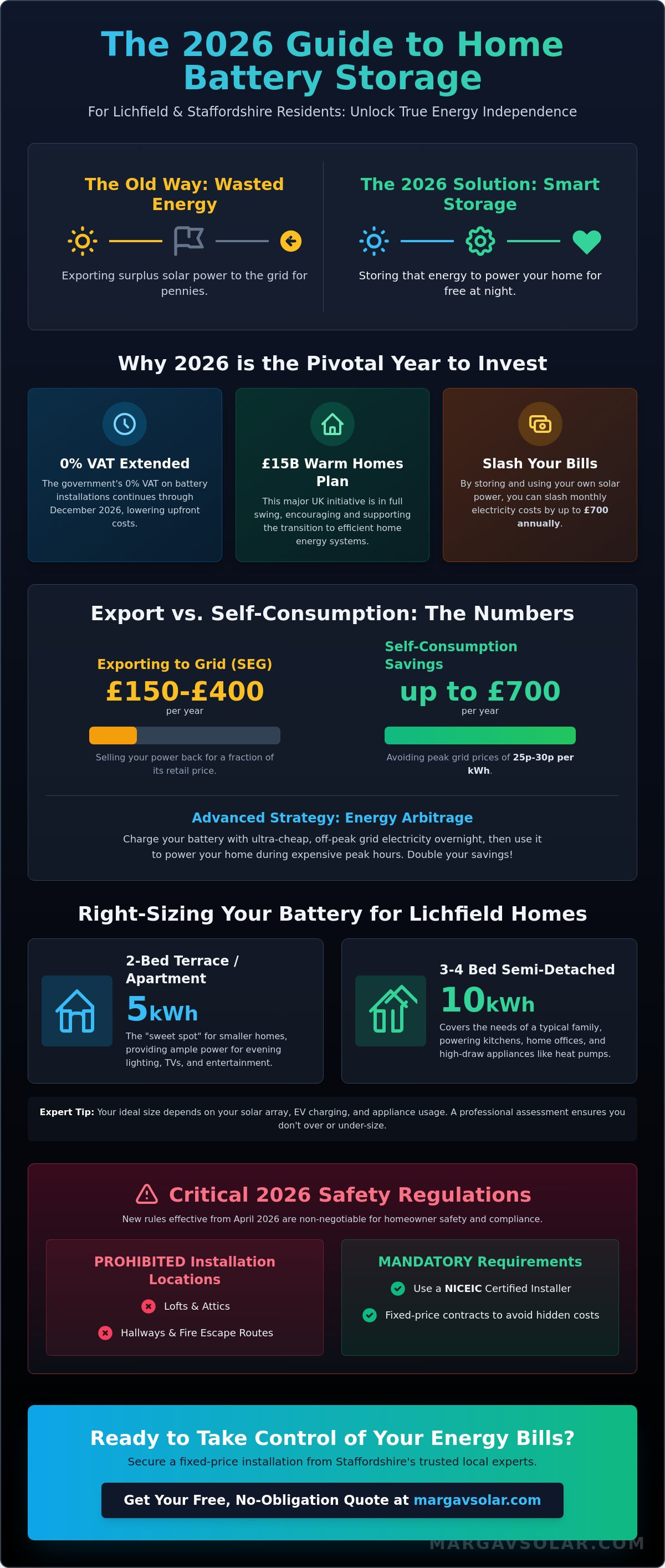
For most households in Staffordshire, the era of simply installing solar panels and hoping for the best is over. In 2026, the real value lies in how you manage that power. A home battery storage Lichfield system acts as a personal energy reservoir; it captures the surplus electricity generated by your solar panels during the day so you can use it when the sun goes down or when grid prices spike. This shift is driven by a clear financial reality: it's now far more profitable to consume your own energy than to sell it back to the grid for a fraction of its worth.
With the UK government's £15 billion Warm Homes Plan now in full swing and 0% VAT on battery installations extended through December 2026, the barriers to entry have dropped. Modern home energy storage technology has evolved to become the brain of the household. It doesn't just store power; it intelligently manages it to ensure you aren't paying peak rates to your supplier. In a city like Lichfield, where residents are increasingly aware of their carbon footprint and rising standing charges, this technology offers a practical path to genuine power independence.
The Shift from Exporting to Energy Arbitrage
The Smart Export Guarantee (SEG) typically pays homeowners between £150 and £400 per year for a standard 4kWp system. While that sounds helpful, it's often a poor trade compared to the 25p to 30p per unit you might pay to buy that same energy back later in the evening. This price gap is why "self-consumption" has become the mantra for 2026. By using home battery storage Lichfield owners can avoid these high retail rates entirely.
Many Staffordshire homeowners are now moving toward smart tariffs that offer exceptionally low rates during off-peak hours. Energy arbitrage is the practice of charging from the grid at off-peak rates to avoid peak-time costs. By filling your battery when electricity is cheapest, you can power your home through the expensive breakfast and dinner rushes without drawing a single watt from the grid at high prices.
Local Energy Resilience in Staffordshire
Reliability is a growing concern for properties in more rural parts of the district, such as Whittington, Shenstone, or the outskirts of Burntwood. Grid fluctuations can be common in these areas, especially during winter storms. Modern battery systems now feature "Island Mode," which allows your home to remain powered even if the local grid fails. This isn't just about keeping the lights on; it's about the security of knowing your home office, fridge, and heating controls stay operational. For the thousands of Lichfield residents who now work from home at least part-time, this level of resilience provides essential peace of mind that the national grid simply cannot guarantee.
Choosing the Right Capacity: A Guide for Staffordshire Properties
Selecting the ideal capacity for home battery storage Lichfield isn't a matter of simply buying the largest unit your budget allows. It's a technical balancing act. If you install a massive 20kWh battery but only have a small 2.5kWp solar array, you'll rarely generate enough surplus to fill it. Conversely, a tiny 5kWh battery paired with a modern 6kWp system and an electric vehicle (EV) will be depleted long before your evening energy usage peak. In 2026, data shows that over-sizing a system can be just as detrimental to your return on investment as under-sizing it, as the upfront capital costs may never be fully recouped through energy savings.
Your appliance profile is the biggest driver of capacity requirements. Since the rollout of the UK government's Warm Homes Plan in early 2026, more Lichfield residents have transitioned to heat pumps and induction hobs. These high-draw appliances require a battery with a high "C-rating," which is the speed at which the battery can discharge its stored power. When you're evaluating your home's needs, it's helpful to speak with a specialist like MarGav Solar to model your expected winter and summer generation against your actual consumption patterns.
Matching Battery Size to House Type
- 2-bed terrace or apartment: For smaller homes in areas like Darwin Park, a 5kWh system is often the "sweet spot." It provides enough power for evening lighting and entertainment without taking up excessive floor space.
- 3-4 bed semi-detached: This is the most common requirement for home battery storage Lichfield. A capacity of 10kWh to 13.5kWh typically covers the daily needs of a family, providing enough buffer for laundry cycles and evening cooking.
- Large detached homes: Properties in areas like Borrowcop or near the Cathedral often require 20kWh or more. Modular, stackable systems are best here, allowing you to add more capacity if you later install an EV charger or a second heat pump.
Technical Factors: Depth of Discharge (DoD) and Cycle Life
Modern lithium-ion batteries in 2026 have moved toward a 100% Depth of Discharge (DoD) as the industry standard. This means you can use the entire capacity of the battery without damaging its internal chemistry. When checking safety standards for battery storage, ensure your chosen unit is rated for at least 6,000 to 10,000 cycles. For a typical Lichfield home, this equates to a lifespan of 10 to 15 years, usually backed by a comprehensive manufacturer warranty.
Placement is also a critical factor due to the April 15, 2026 building regulation updates (BS 7671:2018, Amendment 4). These new rules prohibit battery installations in lofts or along escape routes like hallways. Instead, you'll need to plan for space in a garage, a utility room, or an external weatherproof enclosure. These locations also help maintain the battery at an optimal temperature, ensuring it operates at peak efficiency year-round.
Retrofitting Batteries to Existing Solar Panels in Lichfield
Many homeowners in areas like Leamonsley or St. Johns installed solar panels during the early feed-in-tariff booms between 2011 and 2015. A common misconception among these residents is that they "missed the boat" for storage technology. This couldn't be further from the truth. Adding home battery storage Lichfield to an existing array is one of the most effective ways to modernize an older system. It allows you to transition from being a passive energy exporter to an active energy manager, ensuring you use every kilowatt your roof produces.
In heritage-adjacent properties near the city centre, where roof space is often limited and planning constraints are tight, maximizing the output of an existing array is crucial. You don't necessarily need more panels to lower your bills; you just need to capture more of what you already generate. When looking for advice on choosing a home battery, the first technical decision involves how that battery will talk to your existing panels. This is where the choice between AC and DC coupling becomes vital for Staffordshire homeowners.
AC-Coupled Systems: The Retrofit King
AC-coupling is the standard choice for retrofitting because of its universal compatibility. It works by adding a separate battery inverter alongside your existing solar inverter. This means it doesn't matter if your solar panels were installed 15 years ago; the system is brand-agnostic and won't interfere with your current setup. The primary benefit is the speed and simplicity of installation. You won't need to rewire your existing roof-side DC strings. While there's a minor efficiency loss as power is converted from DC to AC and back to DC for storage, the lower labour costs often make this the most sensible choice for a Lichfield retrofit.
Hybrid Inverters: The All-in-One Solution
If your solar inverter is over 10 years old, it's likely approaching the end of its natural lifespan. In this case, it's often more economical to replace the old unit entirely with a hybrid model. This device combines solar and battery management into one sleek unit. It's a cleaner installation that streamlines your energy management into a single smartphone app. You should consider inverter upgrades as part of your project to ensure your home is fully compatible with the smart energy tariffs of 2026. This "full system refresh" often provides better long-term ROI than a simple add-on for aging systems.
Buying Guide: Evaluating Local Solar Storage Installers
Choosing a provider for home battery storage Lichfield requires more than just comparing the bottom line on three different quotes. While national companies often dominate search results with massive marketing budgets, they frequently lack the granular understanding of Staffordshire's local electrical infrastructure. A local installer isn't just a contractor; they're a long-term partner who will be there if you need a system optimization or a warranty claim five years down the line. National "sales-first" firms often subcontract their labour to the lowest bidder, which can lead to a significant disconnect between the salesperson’s promises and the actual installation quality on the day.
Local expertise is particularly vital in 2026 as the UK transitions toward more complex "hybrid ecosystems." These systems require an installer who understands how to integrate your battery with smart energy tariffs and existing home automation. If you want a transparent, expert-led approach to your energy future, you can book a technical site survey with a local specialist to ensure your property is actually suitable for the latest hardware.
Certifications and Warranties You Must Check
Technical vetting is your best defense against poor workmanship. You must verify that your installer holds a valid NICEIC certification to ensure all high-voltage work meets the current BS 7671 standards. Additionally, MCS accreditation is essential for future-proofing your investment; without it, you'll be ineligible for Smart Export Guarantee (SEG) payments or the government-backed low-interest loans introduced in the 2026 Warm Homes Plan. A reputable installer should provide HIES or IWA insurance-backed guarantees. While product warranties for premium brands often cover 10 to 12 years, you should also ensure your installer provides a workmanship warranty of at least 24 months to cover the physical installation itself.
The Value of 20+ Years of Local Experience
With over 20 years of local experience, a Staffordshire-based specialist understands the nuances of the regional grid managed by National Grid Electricity Distribution. They know which areas of Lichfield might face stricter limitations for exporting power and can manage the DNO (Distribution Network Operator) applications on your behalf. This expertise is invaluable when installing solar battery storage from UK-based brands like GivEnergy, which are designed specifically for the British climate and grid constraints.
To spot "solar cowboys" in the Lichfield market, look for red flags like high-pressure sales tactics or a refusal to provide a physical business address in the Midlands. If an installer doesn't mention the April 15, 2026 building regulation updates regarding battery placement in escape routes, they likely aren't up to date with the latest safety requirements. Local referrals and case studies from nearby streets are the best indicators of quality, as a local business relies entirely on its reputation within the community to survive.
MarGav Solar: Your Trusted Choice for Lichfield Battery Storage
When you're ready to invest in home battery storage Lichfield homeowners often worry about the "hidden extra." MarGav Solar addresses this directly with our Fixed-Price Installation Contracts. Unlike national installers that might add unexpected electrical remedial costs on the day of fitting, our quote is the final price you pay. With over 20 years of industry heritage, we've built our reputation on transparency and technical excellence across Staffordshire. We don't believe in high-pressure sales; we believe in providing the right technical solution for your specific property.
Our relationship with clients doesn't end when the battery is switched on and the installers leave. We provide a comprehensive end-to-end service that begins with a detailed energy audit of your home and extends to long-term solar panel maintenance. This ensures your entire system, from the cells on your roof to the storage units in your garage, operates at peak efficiency for the next decade or more. Being based in Rugeley, we're perfectly positioned to provide rapid local support whenever you need us.
Why We Recommend GivEnergy for Lichfield
We've partnered with GivEnergy because they're a UK-based leader in energy management. Their hardware is designed for the specific demands of the British grid and our varied weather patterns. One of the most powerful features for our customers is the GivEnergy Cloud, which allows you to monitor your generation, storage, and consumption in real-time from any device. This level of insight is essential for home battery storage Lichfield users who want to master energy arbitrage and smart tariffs.
- UK-Based Technical Support: If you ever have a technical query, you're talking to experts based right here in the UK, not an overseas call centre.
- Scalability: GivEnergy systems are modular. You can start with a single 9.5kWh battery and add more units as your energy needs change, such as when you buy an EV.
- Industry-Leading Safety: Their batteries use Lithium Iron Phosphate (LiFePO4) chemistry, which is one of the safest and most stable storage technologies available in 2026.
Start Your Energy Journey Today
The MarGav process is designed to be as stress-free as possible. It begins with a no-obligation consultation where we assess your property’s suitability and your energy goals. We then create a bespoke design that meets the latest April 2026 building regulations for safe battery placement. Our professional fitting team, who are all directly employed and NICEIC certified, will handle the installation with minimal disruption to your home. You'll receive a full demonstration of the system and the monitoring app before we consider the job complete.
Ready to take control of your energy bills? Book your free home battery storage consultation with MarGav Solar today and receive a transparent, fixed-price quote tailored to your Lichfield property.
Secure Your Energy Independence in Lichfield
The landscape of UK energy has shifted significantly in 2026. With the April 15 building regulation updates and the extended 0% VAT incentive, there's never been a more logical time to invest in your home's resilience. You now have the tools to choose the right kWh capacity and understand why local, certified expertise is non-negotiable for a safe, compliant installation. Implementing home battery storage Lichfield isn't just about avoiding high peak rates; it's about future-proofing your property against grid instability and rising standing charges.
As a NICEIC Certified Installer and an expert GivEnergy Platinum Partner with over 20 years of industry experience, MarGav Solar is ready to help you navigate these technical choices. We provide the local support and transparent pricing that national firms simply can't match. Our team ensures your system is optimized for the latest smart tariffs, allowing you to maximize every kilowatt of generation. Take the first step toward a more sustainable and cost-effective home today.
Request a Fixed-Price Battery Storage Quote for Your Lichfield Home
Frequently Asked Questions
How much does home battery storage cost in Lichfield in 2026?
The cost for home battery storage Lichfield currently ranges from £2,500 to £8,000 depending on the capacity and brand you choose. Data from April 23, 2026, indicates that the average UK price for a fully installed system is approximately £5,500. This total includes the battery unit and labour but excludes major electrical remedial work.
Labour costs for these installations typically range from £300 to £1,200. While the upfront investment is significant, the 0% VAT extension through 2026 helps keep these prices more accessible for Staffordshire homeowners than in previous years.
Can I install a battery if I don't have solar panels yet?
Yes, you can install a standalone battery system to take advantage of "energy arbitrage" by charging it from the grid. This allows you to fill the battery during off-peak hours when electricity is cheapest and use that stored power during expensive peak times. Many residents use this method to bypass high standing charges and peak-rate tariffs.
This approach is particularly effective if you're on a smart tariff designed for EV owners or heat pump users. While adding solar panels later will increase your savings, a standalone battery still provides immediate protection against price spikes and offers essential backup power during local grid outages.
How long will a 10kWh battery power my Lichfield home during a blackout?
A 10kWh battery will typically power essential household circuits for 8 to 12 hours during a grid outage. This estimate assumes you're running low-draw items like LED lighting, a fridge-freezer, and your internet router. If you limit your usage strictly to these essentials, the battery can often last through an entire night.
However, using high-power appliances will deplete the storage much faster. An electric shower or a kettle can draw 3kW to 9kW instantly, which could empty a 10kWh battery in about an hour. Most modern systems allow you to designate "protected circuits" so your most important appliances stay on while non-essentials are automatically disconnected.
Do I need planning permission for a solar battery in Lichfield?
Most battery installations fall under Permitted Development and don't require formal planning permission from Lichfield District Council. The units are generally considered minor electrical improvements. However, if your property is a listed building or you live in a sensitive area like the Lichfield City Conservation Area, it's vital to check with a planning officer first.
The main constraints in 2026 are related to building regulations rather than planning law. Following the April 15, 2026, update to BS 7671, your installer must ensure the battery isn't placed in a loft or along an escape route. These safety standards are mandatory for all residential properties across Staffordshire.
How long does it take to install a home battery system?
A standard installation usually takes between 4 and 8 hours to complete. Most projects are finished within a single working day, causing minimal disruption to your household. The process involves mounting the battery, installing the inverter, and connecting the system to your consumer unit.
Your power will need to be switched off for approximately 2 hours during the final commissioning phase. If you're opting for a complex retrofit that requires a full consumer unit upgrade or extensive rewiring, the project might extend into a second day. Your installer should provide a clear timeline during your initial site survey.
Are there any grants for solar batteries in Staffordshire in 2026?
Several financial incentives are active in 2026, including the £15 billion Warm Homes Plan which provides grants and low-interest loans for energy upgrades. The ECO4 scheme also continues to support low-income households with funding for solar and storage measures. For those in rural areas not connected to the gas grid, the Home Upgrade Grant (HUG) can provide up to £25,000 for energy improvements.
The most universal benefit is the 0% VAT rate on battery storage, which applies to both standalone and solar-linked systems. This represents a direct saving on the total invoice price. Always ensure your installer is MCS-certified to remain eligible for these government-backed schemes and the Smart Export Guarantee.
What is the lifespan of a modern lithium-ion solar battery?
Modern lithium-ion batteries, specifically Lithium Iron Phosphate (LiFePO4) models, have an expected lifespan of 10 to 15 years. Most premium manufacturers provide warranties that guarantee the battery will retain at least 70% of its original capacity after 6,000 to 10,000 charge cycles. A "cycle" represents one full discharge and one full recharge.
Environmental factors like temperature play a role in how well the battery ages. By following the 2026 regulations and installing the unit in a well-ventilated garage or external enclosure rather than a hot loft, you'll likely see better long-term performance. After 15 years, the battery won't suddenly fail; it will simply hold less charge than it did when new.
Can I charge my car from my home battery storage system?
You can use home battery storage Lichfield to provide power to an electric vehicle (EV), but it's generally not the most efficient way to fully charge a car. A standard 10kWh home battery would only provide about 30 miles of range to a typical EV. Most homeowners find it's better to use the home battery for household appliances while the EV draws directly from the grid during cheap overnight windows.
However, many smart systems now allow for "integrated charging." This means your battery and EV charger work together to ensure you never draw power from the grid during expensive peak hours. This setup is ideal for topping up your car's range using surplus solar energy that would otherwise be exported for a lower rate.


