

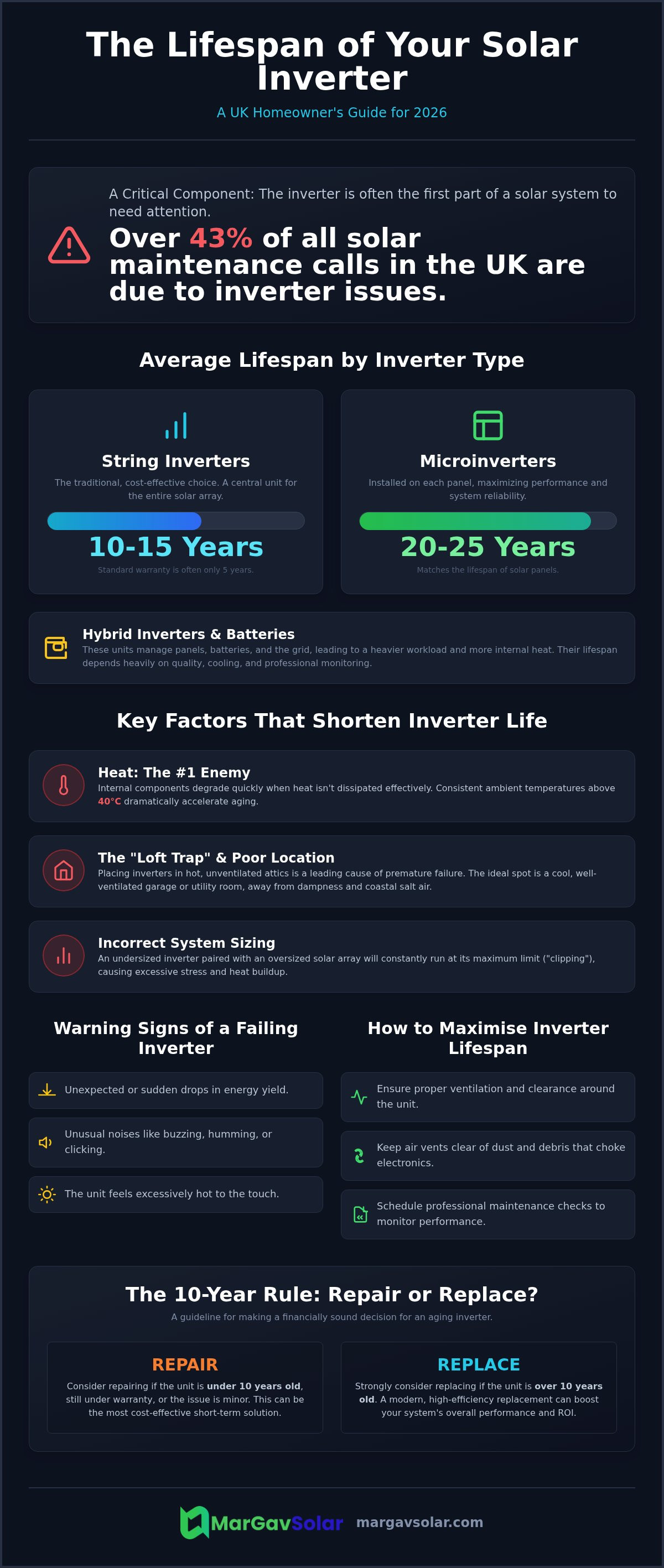
Did you know that inverter issues account for over 43% of all solar maintenance calls across the UK? As the "beating heart" of your installation, this component works harder than any other part of the system by constantly converting raw energy into usable power. It’s perfectly normal to feel a bit anxious about how long do solar inverters last UK weather conditions and usage patterns. You want to ensure your investment keeps paying off without being hit by a surprise replacement bill just as your panels reach their peak efficiency.
We understand the confusion caused by the gap between a standard five-year warranty and the actual hardware life. This 2026 guide provides a realistic timeline for component replacement and shows you how to maximise your system’s ROI through proactive care. Drawing on over 20 years of expertise here in Staffordshire, we have gathered the latest data to help you spot early failure signs before they become costly problems.
You will learn the specific lifespans of string versus microinverters, discover practical maintenance tips to keep your electronics cool, and understand the financial benefits of modern upgrades. By the end of this guide, you'll have a clear roadmap for your system's future health and performance.
Key Takeaways
- Learn exactly how long do solar inverters last UK homeowners based on 2026 benchmarks for both string and microinverter technologies.
- Discover why the "Loft Trap" is a leading cause of hardware failure and how proper positioning can extend your system's life by years.
- Identify critical warning signs of a failing unit, including unexpected yield drops and physical indicators like unusual noise or heat.
- Understand how professional maintenance and keeping air vents clear prevents the dust build-up that chokes sensitive electronics.
- Master the 10-year rule to help you decide whether to repair an aging unit or invest in a high-efficiency replacement that boosts your ROI.
Average Lifespan of Solar Inverters in the UK
The inverter is the most active component in your solar PV system. While your panels sit silently on the roof, the inverter works tirelessly to convert direct current (DC) into alternating current (AC) for your home. Because it handles high-voltage electricity and generates significant internal heat, it's the component most likely to require attention during the system's life. As of 2026, the industry benchmark for how long do solar inverters last UK wide is typically 10 to 15 years for standard string inverters.
This timeline differs significantly from solar panels, which often boast 25-year performance warranties. Panels are passive, solid-state devices with no moving parts. In contrast, a Solar inverter contains complex electronics like capacitors and cooling fans that eventually degrade over time. Savvy homeowners now view an inverter replacement not as a system failure, but as a planned maintenance event. Factoring this into your long-term financial calculations ensures your solar ROI remains accurate and predictable.
String Inverters vs. Microinverters
String inverters are the traditional choice for many Staffordshire homes. They are cost-effective but act as a central point of failure; if the inverter stops, the whole system goes dark. Microinverters, which are installed behind each individual panel, offer a different value proposition. They generally have a lifespan of 20 to 25 years, closely matching the longevity of the panels themselves. The UK market is seeing a major shift toward microinverters for complex roofs with shading, as they eliminate the "weakest link" problem and offer much longer manufacturer warranties that often span two decades.
Hybrid Inverters and Battery Storage
When evaluating how long do solar inverters last UK residents must also consider the impact of battery integration. If you have a battery storage solution, your system likely uses a hybrid inverter. These units handle a much heavier workload than solar-only models. They manage the flow of energy between the panels, the battery, the home, and the grid simultaneously. This constant daily cycling for battery charging and discharging increases internal temperatures. Proper heat dissipation is critical for these units. While high-quality hybrid models are built for this stress, the added complexity means that professional monitoring is essential to ensure the electronics aren't being pushed beyond their thermal limits during peak summer months.
Factors That Determine How Long Your Inverter Lasts
Heat is the primary enemy of any power electronic device. Because the inverter is constantly processing high-voltage electricity, it generates its own internal warmth. If this heat isn't dissipated effectively, it places immense stress on the capacitors and sensitive circuitry. When homeowners ask how long do solar inverters last UK weather conditions play a much larger role than many realize. While our climate is generally temperate, the way we house these units can create artificial environments that lead to premature failure.
The "Loft Trap" is a common issue across the UK. To keep the living space tidy, many installers tuck the inverter away in the attic. During a British summer, loft temperatures can soar well above 40°C. Without proper ventilation, the inverter can't shed heat, forcing it to "derate" or reduce its power output to protect itself. This constant thermal cycling is the number one killer of inverter electronics. Regional grid stability is another factor; in parts of Staffordshire, small fluctuations in grid voltage can cause the inverter to work harder to maintain a steady sync, slowly wearing down budget-grade components.
Optimal Placement for Longevity
Choosing the right location is vital. While some units are IP-rated for outdoor use, the UK’s damp winters and salt-heavy air in coastal regions can lead to terminal corrosion. A cool, ventilated garage or a dedicated utility room is often the "Goldilocks" zone. Most high-quality string inverters are designed to function between -25°C and 60°C, but their internal components age significantly faster if ambient temperatures consistently exceed 40°C. If your unit is currently in a cramped, unventilated space, considering inverter upgrades and replacements to a better-ventilated area can add years to your system's life.
The Impact of System Sizing
Professional system design prevents hardware exhaustion. If your solar array is significantly "over-sized" compared to your inverter's capacity, the unit will frequently run at its maximum limit, a phenomenon known as clipping. While some over-sizing is standard to maximize morning and evening yield, pushing this too far forces internal capacitors to operate at their thermal limit for hours on end. The Energy Saving Trust notes that while some components naturally have shorter lifespans than panels, a well-balanced system ensures no single part is overworked. Using Tier-1 hardware with robust heat sinks ensures your system handles these loads without burning out early.
Signs Your Solar Inverter is Failing
Identifying a failing inverter isn't always as simple as seeing a blank screen. While a "dead" display is a clear indicator of total failure, many units degrade gradually over several months. You might notice an unexpected drop in energy yield during peak sunlight hours. If your panels are clean and the sky is clear, but your generation is lower than previous years, the inverter's internal components may be struggling to process the load. When homeowners track how long do solar inverters last UK systems often show these subtle performance dips before a complete breakdown occurs.
Physical warning signs are equally important. Excessive buzzing or loud humming often indicates that internal cooling fans are failing or that a transformer is under significant stress. In rare cases, a distinct smell of burning plastic suggests that a capacitor has failed. Intermittent "tripping" of your home's circuit breakers without a clear cause is another red flag. This often happens as the inverter attempts to sync with the grid but fails due to internal timing issues or relay wear. Because issues with inverters account for over 43% of all solar maintenance calls, catching these signs early can prevent a total loss of generation.
Using Monitoring Apps to Spot Issues
Modern systems make it much easier to track hardware health. Platforms like the GivEnergy Cloud allow you to view real-time data and historical performance from your smartphone. One specific sign to look for is "flat-lining" on your daily graphs. This occurs when the inverter abruptly cuts out during the hottest part of the day or fails to ramp up as the sun rises. Checking your monitoring portal at least once a month helps you identify if the workload from your battery storage is causing the unit to overheat or cycle incorrectly.
Common Error Categories
Error codes generally fall into three categories that provide clues about the unit's health. Isolation faults are common in the UK's damp climate; they occur when moisture enters the system, causing a safety shutdown to prevent electrical leaks. Grid undervoltage or overvoltage errors often indicate that the issue is external to your home, likely caused by local grid instability in your part of Staffordshire. Finally, relay failures are a sign of mechanical wear inside the unit. These internal switches have a finite number of cycles. Once they wear out, the unit can no longer connect to the grid safely, which is a definitive sign that it's time for a professional health check.
Maximising Inverter Life: Maintenance and Care
While the industry average suggests a specific window for how long do solar inverters last UK homes, these numbers aren't set in stone. Proactive care can push a standard string inverter toward the upper end of that 15-year estimate. The most basic step is ensuring the unit can breathe. Dust and cobwebs are surprisingly effective insulators; if they clog the cooling fins or air vents, internal temperatures rise and component degradation accelerates. A simple annual wipe-down of the external casing and a quick check of the vents can prevent unnecessary thermal stress.
In 2026, software is just as critical as hardware. Manufacturers frequently release firmware updates that improve how the inverter handles grid fluctuations or manages battery cycling. Keeping your system’s software current ensures the electronics operate at peak efficiency, reducing the physical strain on internal relays. Combining these updates with professional solar maintenance ensures that both the digital and physical components of your system remain in sync. This holistic approach is the best way to influence how long do solar inverters last UK weather notwithstanding.
The Importance of Electrical Health Checks
Over time, the constant heating and cooling of electrical cables can lead to loose connections. These tiny gaps create resistance, which leads to heat and, in extreme cases, electrical arcing. During a professional health check, technicians test DC isolators and AC breakers to ensure they still trip correctly under fault conditions. It’s vital to use NICEIC-certified installers for these inspections. They have the specialist tools required to measure resistance and identify "hot spots" that a standard visual check would miss.
Cleaning and Environmental Control
Staffordshire’s humidity can be a silent threat to electronics, especially if the inverter is installed in a damp garage or outbuilding. Ensuring there is at least 15cm to 20cm of clear space around the unit allows for natural convection cooling. You should also check for signs of pests. Rodents are often attracted to the warmth of the inverter and may chew through internal wiring, causing short circuits that lead to terminal hardware failure. If you haven't had your system inspected recently, our team can provide a comprehensive solar panel maintenance and cleaning service to protect your investment and extend the life of your hardware.
When to Repair vs. Replace Your Inverter
Once your system crosses the 10-year threshold, the question of repair versus replacement becomes critical. While it’s tempting to swap out a single internal component, this is often a false economy. If one part of the power board has failed due to age, other components are likely nearing the end of their functional life too. Modern units are also significantly more efficient than those manufactured a decade ago. A new unit can often squeeze 3% to 5% more energy from the same panel array, helping the hardware pay for itself through increased generation over time.
When considering how long do solar inverters last UK homeowners should also look at their future energy needs. If you’ve been thinking about adding battery storage, replacing a failing string inverter with a hybrid model is the most cost-effective path. This avoids the need for a separate battery inverter later. It’s also vital to ensure any new unit is compatible with your existing panel voltages to prevent under-performance. An inverter upgrade provides the perfect opportunity to modernise your entire energy setup while ensuring your system remains safe and efficient.
Warranty Claims and Extensions
Before committing to a purchase, check if your unit is still under a manufacturer guarantee. Standard warranties in 2026 typically range from 5 to 10 years, though many brands offer extensions up to 20 or 25 years if purchased within the first year of installation. If your original installer has ceased trading, a local specialist can still process warranty claims on your behalf with the manufacturer. We often find that homeowners aren't aware their hardware is still covered, so it's always worth a professional health check before assuming you need to pay for a full replacement out of pocket.
Choosing a Replacement Inverter
Inverter technology has moved on significantly. Modern replacement units offer superior shade management and rapid shutdown features that weren't standard ten years ago. Any new installation must be G98 or G99 compliant to meet UK grid regulations. This certification is essential for your home insurance and for maintaining your Smart Export Guarantee (SEG) payments. Because high-voltage DC electricity is involved, professional installation by NICEIC-certified experts is required. This ensures the new unit is safely integrated into your home's wiring and that all safety benchmarks for how long do solar inverters last UK are met or exceeded.
Securing Your Solar Investment for the Next Decade
Your inverter doesn't have to be a source of maintenance stress. While the question of how long do solar inverters last UK often leads to a standard 10 to 15-year estimate, your proactive choices dictate the actual hardware life. By avoiding high-heat environments like unventilated lofts and scheduling regular electrical health checks, you ensure your system remains the efficient "beating heart" of your home's energy production for as long as possible.
If you’ve noticed a dip in yield or your unit is approaching its tenth birthday, it's the perfect time for a professional assessment. With 20+ years of local Staffordshire expertise, our NICEIC-Certified Technicians are specialists in inverter upgrades and replacements. We can help you decide if a simple repair is viable or if a modern, high-efficiency upgrade will better serve your long-term ROI and energy independence goals.
Don't wait for a total system shutdown to take action. Book a Professional Inverter Health Check with MarGav Solar today to ensure your clean energy keeps flowing. It's the smartest way to protect your investment and maintain peace of mind as your system matures.
Frequently Asked Questions
Do solar inverters really only last 10 years?
Standard string inverters usually last between 10 and 15 years, while microinverters can reach 25 years. This 10-year figure is often used as a conservative estimate for financial planning. In Staffordshire, factors like humidity in outdoor installations or excessive heat in lofts can impact these timelines. Regular professional maintenance can often push a high-quality unit toward the upper end of its expected lifespan.
How much does it cost to replace a solar inverter in the UK?
Typical industry replacement costs for a string inverter range from £500 to £1,500 depending on the power output and brand. Microinverters generally cost between £20 and £100 per unit plus installation. While these are broad UK market averages, the final cost depends on your specific system requirements and labor. Investing in a quality replacement ensures your system continues to meet G98 or G99 grid compliance standards.
Can I replace my own solar inverter?
You should never attempt to replace a solar inverter yourself. These units handle high-voltage DC electricity from the panels and AC power from the grid, posing a significant risk of fire or electrocution. Professional installation by NICEIC-certified technicians is required for safety and insurance purposes. A DIY replacement will also void your manufacturer warranty and may disqualify you from receiving Smart Export Guarantee (SEG) payments.
Is it worth repairing an out-of-warranty inverter?
Repairing an old unit is often a false economy once it passes the 10-year mark. The cost of specialist labor and legacy parts can approach the price of a modern replacement. Newer models are significantly more efficient and offer better shade management. If your inverter has failed outside its warranty, upgrading to a modern hybrid model often provides better long-term value and improved energy yield for your Staffordshire home.
Will a new inverter make my solar panels more efficient?
A new inverter won't change the physical efficiency of your panels, but it will improve the overall system yield. Modern hardware features better conversion rates and advanced Maximum Power Point Tracking (MPPT) technology. This allows the system to harvest more energy during low-light conditions or partial shading. Upgrading is a strategic way to improve the ROI of an aging system while ensuring compatibility with modern battery storage solutions.
Does a dead inverter mean my solar panels are broken?
A dead inverter does not mean your panels are broken. Solar panels are passive components with no moving parts, often lasting over 25 years. The inverter is a complex electronic device that works much harder, making it the most common point of failure. If your system stops generating, a professional health check can confirm if the panels are still healthy while identifying the specific fault within the inverter hardware.
How do I find the warranty information for my inverter?
You can find warranty details by checking the sticker on the side of the unit for the serial number and model name. This information should also be in the handover pack provided by your installer. Most manufacturers have online portals where you can enter the serial number to check the remaining coverage. If you're unsure, our team helps Staffordshire homeowners identify their equipment and verify if a replacement is covered.
What is the best place to install a solar inverter for longevity?
The best location for longevity is a cool, dry, and well-ventilated space like a garage or utility room. When considering how long do solar inverters last UK homeowners should avoid unventilated lofts where temperatures soar in summer. Keeping the unit away from direct sunlight and ensuring at least 15cm of clearance for airflow helps dissipate heat. This simple placement choice prevents the thermal stress that leads to premature failure.


