

What if the most expensive appliance in your Staffordshire home isn't the one you think it is? Most homeowners only start calculating my home's energy usage after a shocking winter bill arrives, but waiting for the postman puts you on the back foot. It's completely normal to feel overwhelmed by the constant fluctuation of the Ofgem price cap or the confusing distinction between a kilowatt (kW) and a kilowatt-hour (kWh). You aren't alone in wondering why your monthly direct debit keeps climbing despite your best efforts to switch off the lights.
This guide will strip away the jargon and show you how to master your meter readings to slash your bills and perfectly size a future energy solution. We'll walk through identifying "vampire" power drains and establishing a rock-solid daily kWh figure. This data serves as the essential first step before considering a professional solar PV or battery storage consultation, ensuring any future system is engineered for your specific needs rather than guesswork. By the end, you'll have the data needed to take control of your utility costs for 2026 and beyond.
Key Takeaways
- Learn how accurate data prevents you from over-investing in a solar PV system that's larger than your household actually needs.
- Discover the step-by-step process for calculating my home's energy usage using both manual meter readings and historical bill analysis.
- Identify the hidden 'energy hogs' in your home to understand which appliances are driving up your monthly costs.
- Factor in future energy demands from EV charging points and heat pumps to ensure your energy strategy remains robust for years to come.
- Prepare for a professional consultation by gathering the data that NICEIC-certified specialists use to design efficient, bespoke systems.
Why Calculating Your Home's Energy Usage is the First Step to Savings
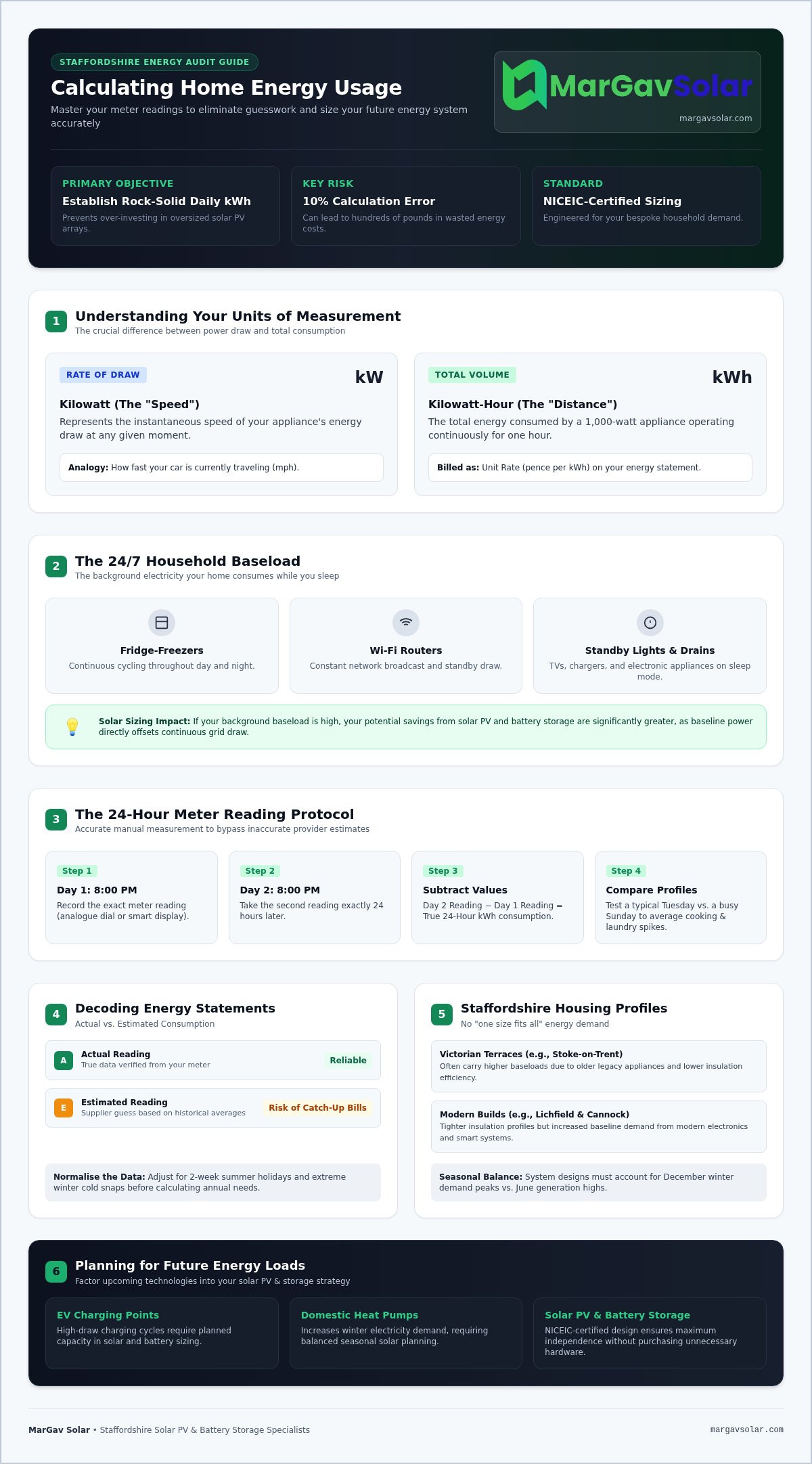
Staffordshire's diverse housing stock means there's no "one size fits all" for energy. A Victorian terrace in Stoke-on-Trent will have a vastly different energy profile than a modern build in Lichfield or Cannock. Older properties often suffer from higher baseloads due to less efficient insulation or legacy appliances. Calculating my home's energy usage starts with looking at the actual meter rather than the "Estimated" figures energy providers often use. These estimates are based on historical averages that might not reflect your current habits, often leading to a nasty "catch-up" bill that disrupts your household budget.
Understanding your baseload is a critical first step. This is the electricity your home gulps down while you're asleep, powered by standby lights, wifi routers, and fridge-freezers. If this background hum is high, your potential savings from solar are even greater, but you need to know the exact number first. Knowing your actual consumption prevents you from over-investing in a solar system that is too large for your needs, saving you thousands on the initial setup.
Understanding the kWh: Your Unit of Measurement
A kilowatt-hour (kWh) is the energy used by a 1,000-watt appliance running for one hour. Many beginners confuse kW with kWh. Think of kW as the "speed" of your appliance's energy draw and kWh as the total "distance" it has travelled. To find your current cost, look for the "Unit Rate" on your energy statement, which is usually expressed in pence per kWh. Understanding how electricity meters measure your home's energy consumption is the best way to move from guessing to knowing. Once you know your unit price, you can see exactly how much that extra tumble dryer cycle is costing you.
The Financial Impact of Data Accuracy
Accuracy isn't just about curiosity; it's about your bank balance. Even a 10% error in calculating my home's energy usage can lead to hundreds of pounds in wasted energy or an incorrectly sized solar array. If you base your system size on December's high usage without accounting for seasonal drops, you might over-invest in panels you don't need. This data is the foundation of the Solar Panel Installation in Staffordshire process. By mapping out your seasonal peaks and troughs, MarGav Solar can design a system that balances winter demand with summer generation perfectly. This ensures every pound you spend on hardware contributes to your energy independence.
Step-by-Step: How to Calculate Your Daily and Monthly Energy Usage
Calculating my home's energy usage doesn't require a degree in electrical engineering. While most modern homes now feature smart meters, many Staffordshire residents still rely on older analogue dials or face occasional connectivity issues with their In-Home Displays (IHD). Understanding your actual consumption is the only way to navigate the Ofgem energy price cap with confidence. By moving beyond the estimated figures provided by energy suppliers, you can build a precise map of your household's power needs.
The 24-Hour Meter Reading Challenge
The most accurate manual way to find your daily consumption is the 24-hour snapshot. Record your meter reading at exactly 8 PM on Day 1, then take a second reading at 8 PM on Day 2. Subtract the first figure from the second to reveal your true 24-hour kWh usage. It is critical to repeat this process on both a typical Tuesday and a busy Sunday. Weekend usage in Staffordshire homes often spikes due to increased laundry, cooking, and leisure activities, so averaging these two figures provides a more realistic daily baseline.
Decoding Your Annual Energy Statement
Your annual statement is a goldmine of data if you know where to look. Locate the "Annual Estimated Consumption" section, but pay close attention to the letters next to your historical readings. An 'A' stands for an actual reading, while an 'E' indicates an estimate. If your history is full of 'E' markers, your supplier's data might be wildly inaccurate. When you begin calculating my home's energy usage over a year, you must normalise the data. For instance, if you took a two-week holiday in August, that month's low usage won't represent your typical summer demand. Conversely, an unusually cold winter might have pushed your heating pumps to work overtime, creating a peak that shouldn't be ignored when planning future energy solutions.
If you are on an Economy 7 or a modern time-of-use tariff, your calculation becomes slightly more complex. You will need to track two separate registers on your meter: one for peak day rates and one for off-peak night rates. This distinction is vital for anyone considering battery storage, as it identifies how much of your expensive daytime usage could be offset by stored energy. Once you have a firm grasp of these numbers, you can discuss your findings with an expert to see how a bespoke solar strategy could work for your specific property.
Identifying the 'Energy Hogs' in Your Household
When you begin calculating my home's energy usage, you'll quickly discover that high wattage doesn't always equal the highest cost. The "Power vs Time" rule is the most important concept to grasp here. For example, an electric oven uses a significant amount of power, but it's usually only active for 30 to 60 minutes. In contrast, electric underfloor heating or a heated towel rail might use less power per minute, but because they run for hours on end, they often contribute far more to your monthly £200 or £300 bill. Understanding this duration-based impact is what separates a basic estimate from a professional energy audit.
In a typical UK household, the top five most expensive appliances usually include the tumble dryer, washing machine, dishwasher, fridge-freezer, and electric shower. While the fridge-freezer is a constant low-level draw, "wet" appliances like washing machines require massive amounts of energy to heat water. To get granular, many Staffordshire homeowners now use plug-in energy monitors. These small devices sit between the plug and the wall, showing you exactly how many kWh a specific appliance consumes over a week. This data is eye-opening and often leads to simple habit changes that save money immediately.
High-Consumption Appliance Breakdown
Wet appliances are notorious for driving up daily kWh figures. A single load in a non-heat pump tumble dryer can consume between 2.5kWh and 4.5kWh. If you're doing five loads a week, that's a significant portion of your budget. Kitchen habits also play a role. A standard kettle uses around 3,000 watts (3kW). Boiling a full kettle when you only need one cup might seem minor, but doing this several times a day adds up to a surprising annual cost. Electric space heaters and fans are similar culprits; they are often used as "quick fixes" in older Staffordshire properties but are among the most inefficient ways to manage your home's climate. To find out about more energy-efficient ways to heat your home electrically, you can learn more about modern technology designed to reduce wastage.
Vampire loads are the silent killers of energy efficiency. These are devices that stay on standby, account for roughly 10% to 15% of a typical UK energy bill. Your broadband router, smart speakers, and even that older TV in the spare room are constantly sipping power. Over a year, a single router can cost upwards of £40 to run. Older appliances also lose efficiency as they age; a ten-year-old fridge-freezer can use double the electricity of a modern A-rated model. Beyond internal appliances, keeping your generation equipment in peak condition is vital. Investing in Solar Panel Maintenance ensures that your system continues to offset these "always-on" drains effectively, protecting your long-term savings.
Planning for the Future: EVs, Heat Pumps, and Solar Sizing
Your current meter readings only tell half the story. If you're calculating my home's energy usage with the intent of moving toward energy independence, you must look at your five-year horizon. Most Staffordshire homeowners are currently transitioning away from fossil fuels, which shifts the energy burden directly onto the home's electrical circuit. For instance, adding an electric vehicle typically adds between 2,000kWh and 3,000kWh to your annual demand. Similarly, an Air Source Heat Pump has a much higher electrical profile than a traditional gas boiler. While gas might handle your heating now, a heat pump will require a significantly larger solar array and more robust Solar Battery Storage to maintain the same level of self-sufficiency.
Forecasting Your 5-Year Energy Demand
When planning for EV Charging Points, you can estimate your future kWh needs by looking at your annual mileage. A conservative estimate is roughly three miles per kWh of charge. Sizing for today's needs often leads to system regret when you upgrade your car or switch to electric heating in two or three years. Future-proofing your calculation is far more cost-effective than adding panels later. The rise of working from home also plays a massive role; having a higher daytime baseline is actually an advantage for solar owners, as it allows you to use free energy as it's generated rather than storing it all for the evening.
The Role of Smart Monitoring Systems
Modern technology has removed the guesswork from calculating my home's energy usage. Systems like the GivEnergy Cloud automate this tracking, providing a granular view of every watt consumed and generated. This data is the deciding factor when choosing between a 5.2kWh or a 9.5kWh battery unit. If your demand grows beyond your system's original capacity, Inverter Upgrades are often the most efficient way to manage that increased throughput. By analysing your peak load data now, you can ensure your inverter is capable of handling the simultaneous draw of a kettle, a power shower, and an EV charger.
Ready to see how these future energy loads will impact your home's potential for savings? You can request a bespoke energy profile assessment from our Staffordshire team to see exactly what size system your household requires for 2026 and beyond.
Turning Your Data into a Solar Strategy with MarGav Solar
Once you've finished calculating my home's energy usage, you hold the blueprint for your future energy independence. Raw data is powerful, but it requires professional interpretation to become a high-performing solar PV system. At MarGav Solar, we take your daily kWh averages and seasonal peaks to engineer a solution that doesn't just fit your roof, but fits your lifestyle. This transition from tracking consumption to generating your own clean power is the most effective way to protect your Staffordshire home from future price hikes.
The MarGav Consultation Process
When you sit down with one of our engineers, having your 24-hour logs and annual statements ready is incredibly helpful. We look beyond the numbers to identify specific energy-saving opportunities unique to Staffordshire properties. Whether it's accounting for the shading from nearby trees in Cannock or the specific roof pitch of a Stafford semi-detached, we refine your data into a precise technical plan. This ensures your NICEIC Certification standards are met from day one, providing a safe and efficient installation that gives you total peace of mind.
Why 20 Years of Expertise Matters
There's a significant difference between a generic sales quote and a data-backed technical energy audit. Our technical audit goes deeper than a simple surface-level estimate. We examine your home's electrical infrastructure, identifying potential 'vampire' drains and assessing how your wiring can best accommodate modern GivEnergy battery solutions. With over 20 years of industry experience, our team understands that a system that's too small won't deliver the ROI you expect, while one that's too large is a wasted investment.
By using your actual usage data and the results from calculating my home's energy usage, we can accurately size your battery storage and PV array to maximise your self-consumption. We focus on end-to-end support, from the initial calculation to long-term maintenance and cleaning. Our goal is to move you from being a passive utility customer to a proactive energy producer, ensuring your home remains efficient for decades to come.
Take the next step toward a sustainable home. Request a professional energy assessment from MarGav Solar today and let's turn your data into a strategy.
Take Control of Your Energy Future Today
Mastering the process of calculating my home's energy usage is about more than just reading a bill. It's the essential first step toward a home that generates as much as it consumes. By identifying hidden energy hogs and accounting for future additions like EV charging points, you've already done the hard work of gathering the data. Now, it's time to turn those numbers into a high-performance reality.
MarGav Solar brings over 20 years of renewable energy expertise to every project. As Staffordshire's leading GivEnergy specialists, we ensure your system is perfectly sized for your specific needs. Our work is backed by NICEIC Platinum Promise coverage, giving you peace of mind that your installation meets the highest industry standards. You have the data; let us provide the engineering to make it work for you.
Book Your Staffordshire Home Solar Consultation today and start your journey toward energy independence.
Frequently Asked Questions
How do I convert my monthly energy bill cost into kWh?
To convert your bill cost into kWh, first subtract the monthly standing charge from your total bill. Divide the remaining amount by your unit rate, which is found on your statement in pence per kWh. For example, if you spent £120 on usage and your rate is 24.5p, divide 12,000 by 24.5 to get 489kWh. This is a vital step when calculating my home's energy usage before a solar consultation.
Is my smart meter's 'In-Home Display' accurate for calculating solar needs?
Your In-Home Display (IHD) is excellent for real-time awareness but often lacks the long-term historical data needed for solar sizing. It shows what you're using "now" rather than providing the 12-month seasonal trends required for a technical audit. For a truly accurate solar strategy in Staffordshire, professional monitoring like the GivEnergy Cloud provides a more robust data set than a standard IHD, especially when planning for battery storage.
What is a 'typical' energy usage for a 3-bedroom house in the UK?
For 2026, a typical 3-bedroom UK home uses roughly 2,700kWh to 3,500kWh of electricity annually. However, this figure varies based on your lifestyle and property age. Staffordshire homes with older insulation or more occupants often exceed this average. If you have high-drain appliances or work from home, your baseline will be higher. This makes a bespoke calculation essential for any residential solar PV system design to ensure it meets your specific needs.
Can I calculate my energy usage without a smart meter?
Yes, you can calculate usage by taking manual meter readings. Record the numbers on your meter at the same time every week or month. Subtract the previous reading from the current one to find your total kWh consumption for that period. This manual method is a reliable alternative for homeowners in Staffordshire who don't have a functional smart meter but still want to be precise when calculating my home's energy usage.
How much extra energy does an electric vehicle (EV) charger use?
An EV charger typically adds 2,000kWh to 3,000kWh to your annual demand, depending on your mileage. If you drive 8,000 miles a year at an efficiency of 3 miles per kWh, you'll need around 2,666kWh of extra electricity. This is a significant increase for a standard household. We recommend including future EV plans in your initial solar and battery storage consultation to avoid under-sizing your system and missing out on potential savings.
Why is my energy usage higher in the winter if I use gas heating?
Even with gas heating, your electricity use rises in winter because lights stay on longer and boiler pumps require power to circulate water. You also tend to spend more time indoors using electronics and kitchen appliances. In Staffordshire, shorter daylight hours in December and January can increase your daily kWh draw by 20% to 30% compared to June. This seasonal peak is a crucial factor when planning the capacity of a battery storage solution. For those located in the South East, We are a trusted plumbing & heating company providing reliable, high-quality services across London and Kent.
You should check your consumption at least once a month to spot any unusual spikes early. Quarterly reviews are also helpful to understand the shifts between summer and winter demand. If you've recently added new technology like a hot tub or powerful kitchen appliances, weekly checks for the first month will help you understand their specific impact. Regular monitoring ensures your energy habits align with your goals for a sustainable, low-cost home.
Does 'vampire power' really make a difference to my annual bill?
Vampire power, or standby energy, can account for 10% to 15% of an average UK energy bill. While a single charger uses very little, the combined draw of routers, smart speakers, and older TVs adds up quickly. For a typical home, this could mean wasting over £100 a year on devices that aren't even being used. Switching these off at the wall is the easiest way to lower your baseline and improve your home's overall efficiency.


