

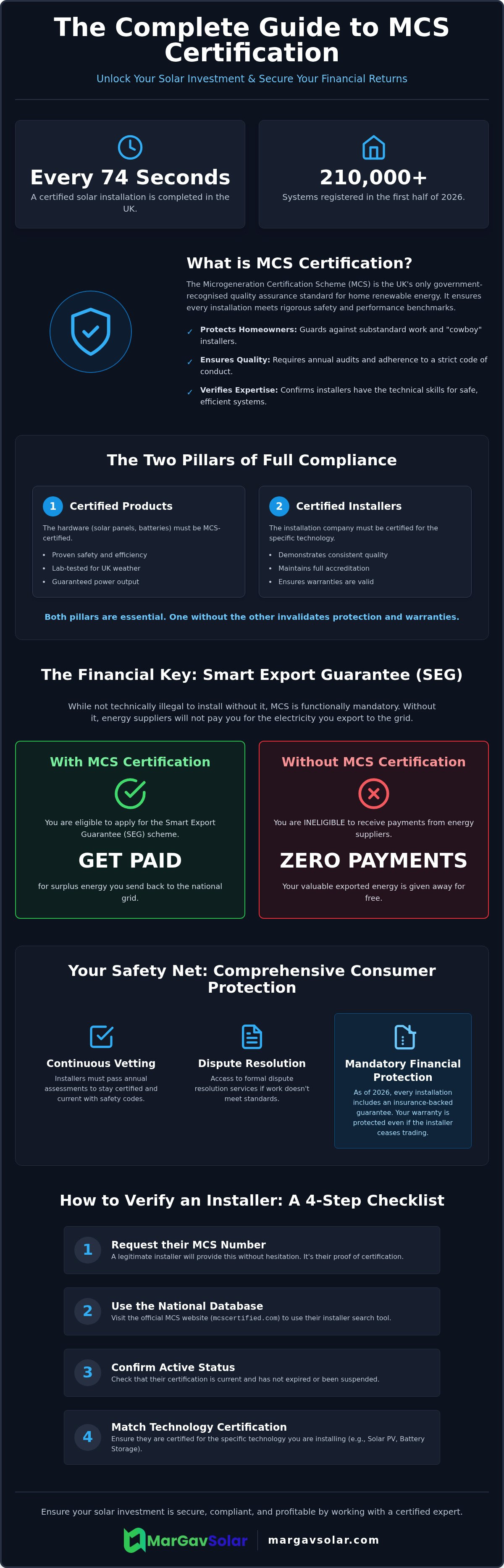
Did you know that every 74 seconds, a UK homeowner completes a certified solar installation? With over 210,000 systems registered in the first half of 2026, the shift to renewable energy is moving at a record pace. However, as the market grows, many people are still left asking: what does MCS certification mean for my own home? It's more than just a badge on a website; it's the financial key to your entire solar investment.
We understand the anxiety of making a major home upgrade. You've likely heard stories about unreliable installers or felt confused about how to qualify for grid payments. You want to know that your hardware is dependable and that your investment is protected for years to come. It's a lot to manage, but getting the certification piece right solves these concerns by ensuring quality and legal eligibility from day one.
This guide will unlock the mystery of MCS certification and explain why it's the most critical factor for your financial returns. You'll discover how to claim the Smart Export Guarantee (SEG) and learn about the 2026 scheme updates that affect every homeowner. We also provide a specific checklist to verify experts in Staffordshire, ensuring your transition to solar is both seamless and secure.
Key Takeaways
- Discover why this government-recognised quality mark is the essential safety and performance standard for any home renewable energy system.
- Learn what does MCS certification mean for your financial returns and why energy suppliers won't pay you for exported power without it.
- Understand the consumer protection benefits, including the mandatory financial protection products introduced in the 2026 scheme update.
- Get a simple, step-by-step checklist to verify an installer's credentials and technology-specific certifications on the national database.
- Find out how working with a local Staffordshire expert ensures your paperwork is handled correctly for long-term peace of mind.
What is MCS Certification? Defining the UK Standard
MCS stands for the Microgeneration Certification Scheme, a standards organisation established in 2008 to bring order to the rapidly expanding renewables market. To put it simply, MCS is the UK’s only government-recognised quality assurance scheme for renewable energy. It serves as a seal of approval that protects homeowners from substandard work. In the early days of the solar boom, the industry was plagued by "cowboy" installers who lacked the technical skills to build safe, efficient systems. The government created this standard to ensure that every solar PV or battery storage setup meets rigorous safety and performance benchmarks.
When asking what does MCS certification mean, you're looking at a framework that evaluates the entire lifecycle of an installation. It isn't just about technical ability; it's about consumer trust. The scheme requires installers to demonstrate consistent quality through annual audits and adherence to a strict code of conduct. This prevents a "fit and forget" mentality that can lead to system failures or roof damage just a few years after installation. By choosing a certified provider, you're ensuring that your home's energy future is built on a foundation of verified expertise.
The Two Pillars: Product vs. Installer Certification
A common misconception is that buying certified panels is enough. In reality, the scheme rests on two essential pillars that must work in tandem. First, the hardware, such as your solar panels or battery units, must be MCS-certified to prove they are safe and efficient. These products undergo laboratory testing to ensure they can withstand the UK's weather conditions and deliver the power promised. Second, the installation company must be certified to fit that specific technology.
Having a high-quality panel installed by an uncertified person often voids your manufacturer warranties and leaves you without legal protection. At MarGav Solar, we manage both sides of this equation for our Staffordshire clients. We only use certified components and our team maintains full accreditation, ensuring your system is compliant from the moment it’s switched on. This dual-layer protection is what separates a professional installation from a risky DIY-style project.
Is MCS Certification a Legal Requirement in 2026?
Technically, it isn't illegal to have an uncertified person bolt panels to your roof, but it is functionally mandatory for any modern home. Without an MCS certificate, you'll find it nearly impossible to connect your system to the national grid or access the Smart Export Guarantee (SEG). Energy suppliers require this documentation before they'll pay you for the electricity you send back to the grid.
Additionally, local building regulations in Staffordshire often require proof of competency for electrical and structural changes. Choosing an uncertified route means you lose access to insurance-backed guarantees and dispute resolution services, turning a smart investment into a significant risk. For a detailed look at the process, you can read our guide on solar panel installation in Staffordshire. Ultimately, while you won't face a fine for skipping certification, you will face significant financial and operational hurdles that make the "savings" of a non-certified installer vanish almost immediately.
Why MCS Certification Matters for Your Home Security
Security starts with who you let onto your roof. The Microgeneration Certification Scheme isn't a one-time test; it's a continuous vetting process. Installers must pass annual assessments to maintain their status, ensuring they stay current with evolving safety codes. In 2026, this has evolved into a risk-based assessment model that prioritises high-quality outcomes. When you ask what does MCS certification mean for your safety, it means your installer has proven they won't cut corners on electrical wiring or structural roof integrity. This rigorous oversight prevents the technical failures that often plague uncertified installations.
Things can go wrong with any home project, but MCS-certified installers provide a safety net that "cowboy" contractors simply can't offer. You get direct access to formal dispute resolution services if the work doesn't meet the required standards. More importantly, as of early 2026, every domestic installation must include a mandatory financial protection product. This insurance-backed guarantee ensures that even if an installer stops trading, your system's warranty remains valid. It's a non-negotiable layer of protection for any homeowner making a significant investment in their property.
Quality Assurance and Performance Standards
Precision is the hallmark of a certified system. MCS standards dictate exactly how energy "yield" or output calculations must be performed. Uncertified quotes often over-promise by ignoring complex factors like local weather patterns or precise shading analysis. A certified installer must use specific, approved methodology to account for every tree, chimney, or neighbouring building that might cast a shadow. This prevents the disappointment of a system that fails to meet its promised financial returns. By following these strict guidelines, we ensure the data you receive is realistic and reliable.
Home Insurance and Property Value
Your solar investment affects your home's legal and financial standing. Many UK mortgage lenders and insurers now insist on seeing an MCS certificate before they'll approve a loan or provide coverage for a solar-equipped home. Without it, your property could be flagged during a survey, potentially making it harder to sell or remortgage. The certificate also directly supports a better EPC rating, which is increasingly vital for property valuations in 2026. With over 20 years of expertise, MarGav Solar ensures your installation adds genuine, documented value to your home. If you're ready to secure your property's future, you can explore our certified solutions to find the right fit for your roof.
The Financial Impact: MCS and the Smart Export Guarantee (SEG)
When homeowners ask what does MCS certification mean for their bank account, the answer is usually "thousands of pounds." In 2026, the primary way to generate a return on your solar investment is through the Smart Export Guarantee (SEG). This scheme requires energy suppliers to pay you for every kilowatt-hour of green electricity you send back to the grid. However, major suppliers like Octopus Energy, OVO, and British Gas have a strict "no certificate, no payment" policy. Without a valid certificate from the Microgeneration Certification Scheme, you're effectively giving your excess energy away for free.
The financial loss of skipping certification is staggering. For example, with current 2026 export rates reaching as high as 25p/kWh from suppliers like Good Energy or 20p/kWh from OVO, a typical semi-detached home could easily export 1,800 kWh per year. At a 20p rate, that's £360 in annual income. Over a ten-year period, an uncertified system costs you £3,600 in lost revenue. This doesn't even account for the 0% VAT relief available until March 2027 or grants like the Boiler Upgrade Scheme, which provides up to £9,000 for heat pumps but requires MCS-equivalent standards for the home's overall energy setup.
How to Claim Your SEG Payments
Claiming your money involves more than just a phone call. You must provide your energy supplier with your MCS certificate and proof that your Distribution Network Operator (DNO) has been notified of the installation. This DNO notification confirms the local grid can handle your exported power. Because this paperwork can be daunting, MarGav Solar handles both the DNO and MCS registrations for our clients. We ensure all documents are filed correctly so you can start earning from your export tariff the moment your system goes live.
Battery Storage and the MCS Standard
The role of storage has changed significantly. In the first half of 2026 alone, the UK saw 36,000 certified battery installations, nearly double the previous year. While solar panels were once the sole focus, modern solar battery storage systems are now frequently integrated into the MCS framework. This is vital because many "Smart Tariffs" that allow you to sell battery power during peak times require certified hardware. By ensuring your battery meets these standards, you unlock the ability to trade energy dynamically, significantly shortening your system's payback period.
How to Verify an MCS Certificate and Installer
Verification is the only way to ensure you aren't being misled by a quote. Start by visiting the official "Find an Installer" tool on the national database at mcscertified.com. You simply enter the company name or their registration number to see their current status. It's vital to check for the specific technology they are installing. A company might be certified for heat pumps but lack the necessary accreditation for solar PV. When you ask what does MCS certification mean for your specific project, it means the installer has been specifically audited for the exact hardware they are putting on your roof.
Next, look at the hardware itself. Every panel and inverter in your quote should appear on the MCS Certified Product list to ensure safety and efficiency. Finally, cross-reference their credentials with other industry bodies. A truly professional team will often hold NICEIC certification to prove their general electrical competency alongside their renewable energy specialisms. This multi-layered verification ensures that your local Staffordshire installer is fully qualified to handle both the structural and electrical complexities of your system.
Red Flags: Spotting Uncertified "Solar Cowboys"
Fake logos are a common tactic for "solar cowboys" looking to exploit the growing demand for renewables. Many uncertified companies place the MCS logo on their website without including a valid registration number. You should never pay a deposit or sign a contract until you've verified their status on the central database and confirmed their membership in a consumer code like HIES or RECC. Another major risk is "sub-contracted" installs. Some companies sell the system but hire uncertified labourers to fit it. If the person doing the actual work isn't the one holding the accreditation, you won't receive a valid certificate, leaving your investment unprotected.
What to Do if You Lost Your MCS Certificate
If you've moved into a solar-equipped home or simply misplaced your paperwork, don't panic. You can verify a specific installation using the MCS Installations Database (MID). If you need a physical copy and your original installer is no longer trading, the MCS helpdesk can provide a duplicate for a £36 admin fee. This process is straightforward but essential for any homeowner planning to sell their property. Solicitors will require this document to prove the system's safety and its eligibility for grid export payments. If you want to ensure your installation is handled by a fully accredited local team from the start, book a consultation with MarGav Solar to secure your home's energy future.
MarGav Solar: Certified Excellence in Staffordshire
When local residents ask what does MCS certification mean for their specific property, the answer is found in our two decades of local service. MarGav Solar has been a fixture in the Midlands for over 20 years, providing a level of expertise that goes beyond simple hardware fitting. We've built our reputation on a strict commitment to MCS standards, ensuring that every residential solar PV and battery storage system we install is safe, efficient, and fully compliant with national regulations. This isn't just about following rules; it's about providing the peace of mind that comes with a system designed to last for the next 25 years.
Our team handles every aspect of your solar panel installation, from the initial structural survey to the final registration on the national MCS database. We provide an end-to-end service that removes the stress of paperwork for our clients. By managing the DNO notifications and certification process ourselves, we ensure you have everything you need to apply for the Smart Export Guarantee (SEG) from day one. We also focus on the long-term health of your investment, offering maintenance and cleaning services to keep your certified system performing at its peak.
Our Local Expertise in Staffordshire
Staffordshire has a diverse range of housing, from historic terrace homes to modern new-builds. We tailor our MCS-compliant designs to suit these specific local roof types and structural requirements. Our deep understanding of the Midlands power grid allows us to work seamlessly with National Grid (formerly Western Power) on DNO applications. Having a local office means we're always nearby if you need technical support or inverter upgrades to maximise your system's ROI. We don't just install panels; we build energy hubs that are perfectly integrated into the Staffordshire landscape.
Start Your Certified Solar Journey Today
Your transition to renewable energy should be transparent and straightforward. We offer free, MCS-compliant solar surveys that provide realistic energy yield forecasts based on your home's unique orientation and shading. Our fixed-price installation contracts are comprehensive, meaning you won't encounter hidden fees for your MCS certificate or grid notifications. We believe in honest, data-driven advice that helps you make the best decision for your home and your wallet. If you're ready to secure your energy future with a team you can trust, contact MarGav Solar for an MCS-certified quote and discover the difference that 20 years of local expertise can make.
Secure Your Home’s Energy Future Today
Choosing the right installer is the most important decision you'll make for your renewable energy project. By now, it's clear that understanding what does MCS certification mean is the most important step in your solar journey. It is your guarantee of technical excellence, consumer protection, and the legal key to unlocking your financial returns through the Smart Export Guarantee. Without this certification, your system is an unprotected risk; with it, it's a high-performing asset that adds genuine value to your property.
MarGav Solar brings 20+ years of Staffordshire experience to your project as an MCS Certified Installer and NICEIC Approved Contractor. We handle all the complex registrations and grid notifications so you don't have to. Take the first step toward a secure, high-yield solar investment by booking a professional consultation with our local experts.
Book Your MCS-Certified Solar Survey with MarGav Solar
Your journey to energy independence is just a click away. We look forward to helping you power your home with confidence and clarity.
Frequently Asked Questions
Is MCS certification a legal requirement for solar panels?
Technically, it isn't a criminal legal requirement to install solar without it, but it is functionally mandatory for most UK homeowners. Without this certification, you cannot connect your system to the national grid or access export payments. In Staffordshire, local building regulations also require proof of competency for electrical and structural changes. Choosing a non-certified route often voids your home insurance and makes the property difficult to sell or remortgage in the future.
Can I get the Smart Export Guarantee (SEG) without an MCS certificate?
No, you cannot access the SEG without a valid certificate. Energy suppliers like Octopus or British Gas require this documentation to prove your system meets safety and efficiency standards before they pay you for exported power. Since export rates in 2026 can reach 25p/kWh, missing out on these payments could cost you hundreds of pounds every year. We ensure all Staffordshire clients receive the necessary paperwork to claim these financial returns immediately.
How much does an MCS certificate cost for a homeowner?
Homeowners don't typically pay a standalone fee for the certificate; it's included within your fixed-price installation contract. The installer pays a small registration fee for each system they list on the national database. If you have misplaced an existing certificate and the original installer is no longer trading, the MCS helpdesk can provide a duplicate for a £36 admin fee. We handle all these administrative costs as part of our end-to-end service.
Does MCS certification cover battery storage installations?
Yes, there is a specific standard for battery storage within the scheme. In 2026, certified battery installations have nearly doubled as more homeowners move toward integrated energy hubs. Having a certified battery is often a requirement for accessing advanced "Smart Tariffs" that allow you to sell stored energy back to the grid during peak demand. We provide fully accredited battery storage solutions across Staffordshire to ensure your entire system is safe and financially optimised.
How do I check if my solar installer is MCS certified?
You can verify any company by using the "Find an Installer" tool on the official MCS website. Simply enter the business name or their registration number to see their current status and the specific technologies they are accredited to install. When asking what does MCS certification mean for your project, it means the company has passed rigorous annual audits. As a Staffordshire-based team with 20 years of experience, we always encourage clients to verify our credentials online.
What is the difference between MCS and NICEIC?
NICEIC is a broader certification that proves a contractor's general electrical competency and safety. MCS is a specialist scheme specifically for renewable energy technologies like solar PV and battery storage. While NICEIC ensures your home's wiring is safe, MCS ensures your solar system is designed for maximum efficiency and qualifies for government-backed financial schemes. MarGav Solar holds both certifications, providing a multi-layered guarantee of quality for every Staffordshire home we serve. For readers in the Hertfordshire area who require these same high standards for general domestic or commercial work, ALElectrical provides professional electrical services throughout the region.
Yes, it acts as a "logbook" for your solar system that reassures potential buyers and mortgage lenders. A certified installation improves your property's EPC rating and proves the system is eligible for ongoing SEG payments. In the Staffordshire property market, solicitors now routinely ask for this certificate during the conveyancing process. Without it, a solar installation can be viewed as a liability rather than an asset, potentially complicating your home sale or remortgage application.
What happens to my MCS warranty if the installer goes out of business?
Your investment is protected by a mandatory financial protection product introduced in early 2026. This insurance-backed guarantee ensures that your workmanship warranty remains valid even if the installation company stops trading. This layer of consumer protection is one of the primary reasons to avoid uncertified "cowboy" installers who cannot offer these safeguards. With over 20 years of expertise in the Midlands, we provide the long-term stability and maintenance support that Staffordshire homeowners expect.


