
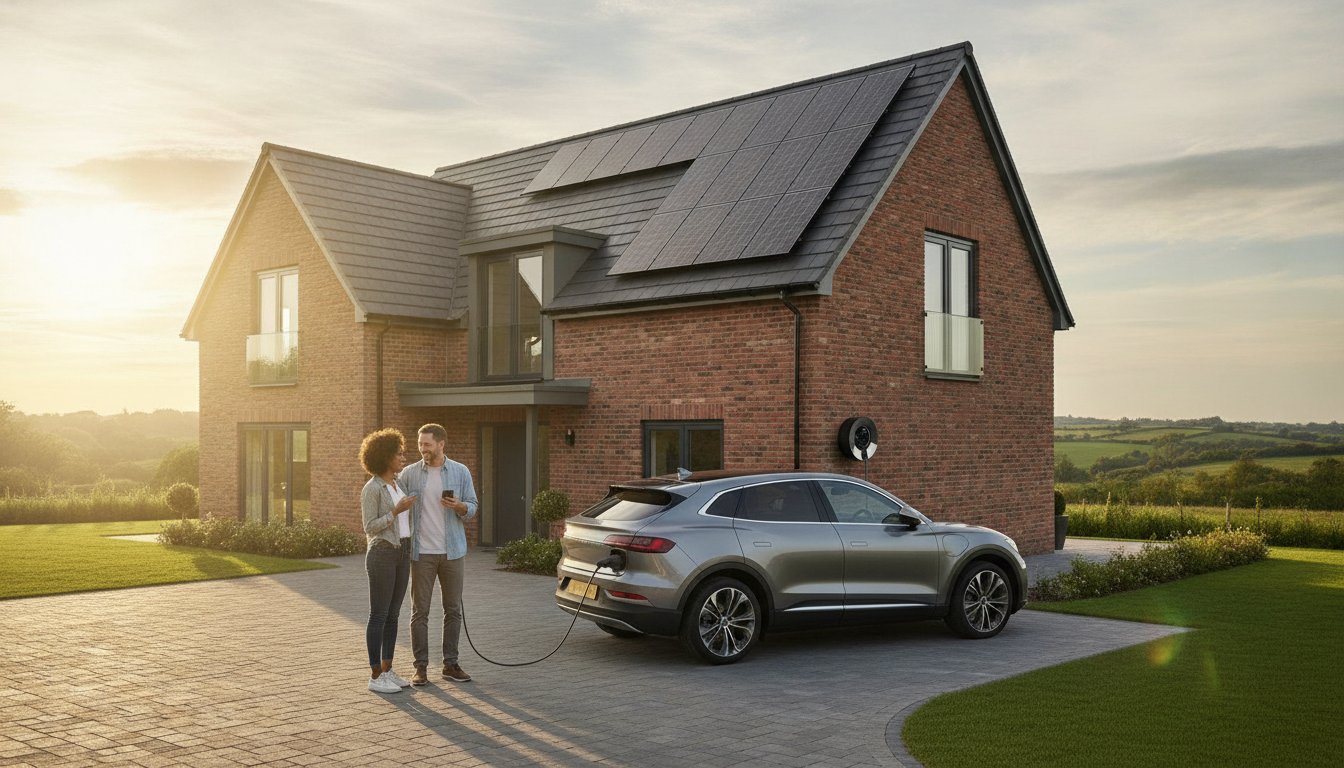
What if you could fill your car's "tank" every morning without paying a single penny to an energy supplier? While it sounds like a dream, solar powered EV charging at home is now a practical reality for thousands of UK households. You might worry that our famously grey weather isn't enough to power a vehicle, or feel overwhelmed by the technical jargon of smart versus dumb chargers. It's a common concern, especially as electricity prices remain volatile and the pressure to lower your pence-per-mile cost grows.
We understand the desire for true energy independence. This guide explains how to integrate your solar panels with a smart charging system to achieve zero-emission motoring. You'll learn how to take advantage of the 0% VAT on installations available until March 2027 and the updated £500 OZEV grant for eligible residents. We'll also break down how the intelligent handshake between your panels, battery storage, and charger creates a future-proofed energy ecosystem. You'll even discover why 1.44kW of surplus power is the "magic number" for charging your car using nothing but the sun.
Key Takeaways
- Discover how to set up solar powered EV charging at home by coordinating your PV panels, inverter, and smart charger for a seamless "solar handshake."
- Learn why choosing high-efficiency Tier 1 panels and solar-aware chargers is essential for meeting the high energy demands of modern electric vehicles.
- Master the "Miles per kWh" formula to calculate exactly how many panels your specific car needs based on your annual mileage and regional sunlight yields.
- Understand why using your generated energy to power your car offers a better return on investment than selling it back to the grid via the Smart Export Guarantee.
- Explore the benefits of a professional end-to-end installation that integrates solar PV, battery storage, and EV charge points to maximize your household energy independence.
How Solar-Powered EV Charging Works at Home
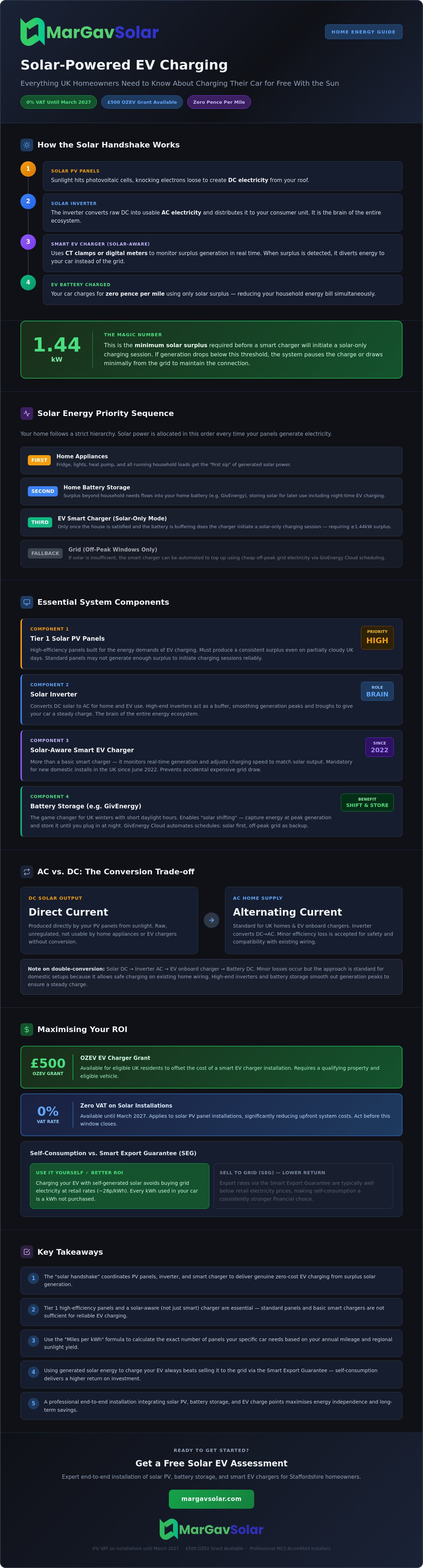
The process begins on your roof. When sunlight hits your photovoltaic (PV) cells, it knocks electrons loose to create direct current (DC) electricity. However, your home and your car's onboard charger operate on alternating current (AC). This is where your solar inverter steps in. It converts that raw DC energy into usable AC power, sending it toward your consumer unit to be distributed where it's needed most.
Implementing solar powered EV charging at home requires more than just panels and a plug. It relies on a "solar handshake." This is a digital communication between your smart EV charger and your solar inverter. Smart chargers use CT clamps or digital meters to monitor exactly how much energy your home is exporting to the grid. When they detect a surplus, they divert that energy into your car's battery instead of letting it leave your property. While Solar vehicle technology often focuses on panels built directly onto cars, stationary residential systems are far more efficient for daily driving needs.
The Priority Sequence of Solar Energy
Your home follows a strict hierarchy for energy consumption. Your fridge, lights, and heat pump always get the "first sip" of any solar power generated. If your panels produce more than your appliances need, the surplus typically moves to your home battery storage. Only once the house is satisfied and the battery is buffering does the smart charger initiate the "solar-only" mode. Most chargers require a minimum surplus of 1.44kW to start a session. If the clouds roll in and generation drops below this level, the system either pauses the charge or draws a small amount from the grid to maintain the connection.
AC vs. DC Charging in a Solar Context
It might seem counterintuitive to convert DC solar power into AC, only for your car to convert it back into DC for the battery. This "double conversion" does lead to minor efficiency losses, but it's the standard for domestic setups because it allows the car to charge safely using existing home wiring. High-end inverters and battery storage solutions act as a buffer, smoothing out the peaks and troughs of generation to ensure your car receives a steady flow. This makes solar powered EV charging at home a dynamic process that balances efficiency with safety. The inverter acts as the brain of the solar EV ecosystem, managing the complex flow of energy between your roof, your home, and your driveway.
Essential Components for a Solar-Integrated EV System
To build a reliable system for solar powered EV charging at home, you need hardware that does more than just generate power. It must communicate. Tier 1 solar PV panels are the foundation for any EV-heavy household. These panels offer the high-efficiency ratings and long-term durability required to meet the significant energy draw of an electric vehicle. While standard panels might suffice for running a few appliances, charging a car requires a robust array that can produce a consistent surplus even on partially cloudy days.
Smart EV charge points are the second piece of the puzzle. Since June 2022, UK regulations have mandated that all new domestic chargers must be "smart." However, there's a big difference between a basic smart charger and a "solar-aware" one. A solar-aware charger monitors your real-time generation and adjusts the charging speed to match your solar output. This prevents you from accidentally drawing expensive electricity from the grid. When calculating your setup's value, it's helpful to see how global incentives like federal tax credits for EV chargers have shaped the market, making advanced features like these more accessible for everyone.
To source hardware that meets these advanced requirements, Charging Shop provides a variety of high-performance options, including the V2C Trydan and DENKA DC wallboxes, which are specifically designed for intelligent energy management.
The Role of Battery Storage (GivEnergy)
Directly charging an EV from panels is difficult during a UK winter when daylight hours are short and generation is lower. This is where integrating solar battery storage in Staffordshire becomes a game changer. A battery acts as a bridge, allowing for "solar shifting." You capture energy during the peak of the day and store it until you plug your car in at night. By using the GivEnergy Cloud, you can automate your charging schedules to ensure your car uses stored solar first, only switching to the grid during cheap off-peak windows.
Choosing a Solar-Compatible Charger
When selecting your charger, look for specific modes that maximise your investment. Most solar-compatible models offer three main settings:
- Eco: Uses a mix of solar and grid power to maintain a minimum charge rate.
- Eco+: Only charges when your home has a 100% solar surplus, effectively giving you "free" miles.
- Fast: Ignores solar generation to charge the vehicle as quickly as possible using all available power.
Finally, modern energy monitoring apps tie everything together. They allow you to visualise your "pence-per-mile" savings in real-time, showing exactly how much of your driving is powered by the sun. If you're ready to see which hardware fits your home, you can explore our range of EV charging points designed for high-performance solar integration.
Calculating Your Needs: How Many Panels to Charge an EV?
Determining the right system size starts with the "Miles per kWh" formula. Most modern electric vehicles average around 3.5 miles per kilowatt-hour of energy. If you cover 9,000 miles annually, your car requires roughly 2,570 kWh of electricity. To achieve true solar powered EV charging at home, you need to generate this amount on top of your standard household consumption. In Staffordshire, a well-positioned 4kWp solar array typically generates between 3,400 and 3,700 kWh per year. While a 4kW system covers the car's annual total, a 6kW system is often the better choice to ensure you have enough surplus energy during the shoulder months of spring and autumn.
Roof orientation plays a massive role in your charging window. While South-facing roofs generate the highest total yield, East/West orientations are often more practical for EV owners. These setups produce power earlier in the morning and later into the evening, aligning better with when cars are typically parked on the driveway. Over-specifying your solar array is a smart move to combat the "Winter Dip." By installing more panels than you think you need, you're more likely to hit the 1.44kW threshold required to trigger your smart charger even on overcast days.
The "Typical" UK Setup
A 4kW to 6kW array has become the sweet spot for most UK drivers. It provides enough capacity to power the home while leaving a significant "overflow" for the vehicle. A typical 30-mile daily commute requires approximately 8 to 10 kWh of energy depending on your vehicle's efficiency. Pairing this with a correctly sized battery is essential. If your commute uses 10kWh, having a battery with at least that much usable capacity ensures you can "solar shift" your daytime generation to your car at night without relying on the grid.
Seasonal Expectations and Reality
You must prepare for the stark difference between June and December. In the height of summer, a 4kW system can easily produce 25kWh in a single day, which is more than enough for most daily drivers. In mid-winter, that same system might only produce 2 or 3kWh. During these low-light months, most owners supplement their solar yield by using off-peak electricity tariffs. Maximising every photon is critical when daylight is scarce. Investing in professional solar panel maintenance in Staffordshire prevents dirt and debris from further reducing your winter yield, ensuring your system remains as efficient as possible year-round.
Maximising Your ROI: Grants, SEG, and Smart Charging
The financial case for solar powered EV charging at home has never been stronger. As of July 2026, homeowners can still benefit from 0% VAT on solar and battery installations, a policy set to remain until March 2027. This tax relief can save you thousands on a complete system installation. For renters or flat owners with off-street parking, the OZEV EV Chargepoint Grant provides up to £500 toward installation costs, following its increase from £350 in April 2026. These incentives significantly lower the initial barrier to entry for clean motoring.
Beyond the initial setup, the long-term ROI of solar powered EV charging at home is driven by the Smart Export Guarantee (SEG). While some suppliers offer up to 25p per kWh for exported energy, many standard rates hover around 5p to 15p. When you compare this to a grid import cost of approximately 30p per kWh, the logic is clear. It's far more profitable to use your solar energy to power your car than it is to sell it back to the grid.
Financial Comparison: Exporting vs. Self-Consuming
Think of your electric vehicle as a giant mobile battery. By prioritising self-consumption, you're effectively "locking in" the value of your solar energy at the current grid price. If you export 10kWh of energy, you might earn £1.50 in SEG payments. However, if you use those same 10kWh to charge your car, you've saved yourself £3.00 in grid costs. Over a typical year of driving, this doubling of value dramatically shortens your system's payback period.
Local Staffordshire Grid Considerations
Installing a high-power charger alongside a solar array requires careful coordination with the District Network Operator (DNO). In Staffordshire, this is National Grid (formerly Western Power Distribution). Most domestic setups fall under G98 regulations for systems under 16A per phase, but larger arrays or multiple chargers may require a G99 application. This process ensures your local grid can handle the energy flow without issues.
Working with an installer who holds NICEIC certification is vital during this stage. It guarantees that your installation meets the highest safety standards, which is often a prerequisite for insurance coverage and equipment warranties. If you're ready to start saving, you can book a solar and EV consultation with our Staffordshire-based team today.
Professional Solar EV Installation in Staffordshire
MarGav Solar brings 20 years of experience to every energy project in the region. We understand that solar powered EV charging at home is an investment in your future, which is why we prioritise a tailored approach. Designing these systems isn't about guesswork or "one-size-fits-all" bundles. Instead, we use custom energy modelling to calculate exactly how your specific car and home consumption will interact with your roof's generation potential. This data-driven method ensures your system is perfectly sized to meet your mileage needs without over-investing in unnecessary hardware.
Our end-to-end service simplifies the transition to sustainable driving. We handle every stage of the process, from the initial solar design and DNO applications to professional EV charging point installation. Once your system is live, our commitment continues with dedicated maintenance and cleaning services. Keeping your panels clear of debris is essential for maintaining the high-yield performance discussed earlier in this guide, ensuring your "free fuel" flows consistently for decades.
Why Local Expertise Matters
Staffordshire’s housing stock presents unique electrical challenges. Whether you live in a traditional terrace or a modern detached home, our team understands the local grid requirements and structural nuances. We provide a fixed-price installation contract, giving you peace of mind that the price you're quoted is the price you pay. Choosing a local specialist also means you have direct access to long-term equipment warranties and support from engineers who are never more than a short drive away.
Next Steps: Your Journey to Sustainable Driving
Achieving total energy independence starts with a technical consultation. During this survey, we assess your property’s orientation, your current electrical capacity, and your typical driving habits. To prepare, it's helpful to have your recent electricity bills and your vehicle's approximate annual mileage ready. This information allows us to build the most accurate model for your solar powered EV charging at home. When you're ready to take control of your energy costs, request your personalised solar EV charging quote from MarGav Solar today.
Take Control of Your Home Energy Future
Transitioning to solar powered EV charging at home is no longer just a futuristic concept. It's a practical financial strategy for 2026. By combining high-efficiency panels with smart battery storage and a solar-aware charger, you create a self-sustaining ecosystem that protects you from rising energy costs. You've seen how the 0% VAT status and available grants lower your initial investment, making the switch more accessible than ever before.
Success depends on a system designed specifically for your property and driving habits. As a Staffordshire-based family business with over 20 years of renewable energy expertise, MarGav Solar provides the technical precision required for these complex installations. Our NICEIC Certified Installers ensure your system is safe, efficient, and fully compliant with all grid regulations. We take the guesswork out of energy modelling so you can focus on the savings.
Don't leave your energy independence to chance. Book Your Free Staffordshire Solar & EV Consultation to discover how much you could save by switching to clean, sun-powered motoring. It's time to turn your driveway into a private power station and enjoy the freedom of zero-emission driving.
Frequently Asked Questions
Can I charge my EV with solar panels without a home battery?
Yes, you can charge your vehicle directly from the panels, but you must do it while the sun is shining. Without a battery to store the energy, any surplus generated while the car isn't plugged in will be exported to the grid. To make this work, you need a smart charger that can detect when your panels are producing enough power to meet the minimum charging threshold.
How long does it take to charge an electric car using solar power?
Charging time depends entirely on the size of your solar array and the available sunlight. A typical 4kW system might provide 2.5kW of surplus power on a bright day, adding roughly 10 miles of range per hour. While this is slower than a dedicated 7kW grid charge, it's often sufficient to cover a daily commute if the car is parked during peak daylight hours.
Will solar panels work with my existing EV charger?
Most standard EV chargers will work with solar panels, but they won't automatically prioritise solar energy. A "dumb" charger will simply pull whatever power it needs from both the panels and the grid. To ensure you are specifically using solar powered EV charging at home, you may need to upgrade to a smart, solar-aware charger or use a compatible energy management system to bridge the gap.
What happens to my EV charging if it is a cloudy day in Staffordshire?
On cloudy days, your solar generation will drop and your smart charger will respond accordingly. If the surplus falls below the 1.44kW minimum required for most chargers, the session will either pause or start drawing supplementary power from the grid. This is where a home battery is invaluable, as it can smooth out these fluctuations by providing the necessary buffer energy.
Do I need planning permission for solar panels or an EV charger in the UK?
Planning permission is generally not required for standard solar panels or EV chargers as they fall under Permitted Development. However, exceptions apply if you live in a listed building or a conservation area. It's always best to check with your local authority in Staffordshire before starting work, especially if you're installing a solar carport or a ground-mounted array.
Is it worth adding more solar panels specifically for my electric vehicle?
Adding extra panels is usually a wise investment if you have the roof space. Since an electric vehicle significantly increases your household's annual electricity demand, a larger array ensures you hit the charging threshold more often, even in winter. Over-specifying your system helps you achieve true energy independence and lowers your overall pence-per-mile cost more effectively than a smaller, standard setup.
Can I use solar power to charge a Tesla or other high-capacity EVs?
What is the Smart Export Guarantee (SEG) and how does it affect EV owners?
The Smart Export Guarantee (SEG) is a government-backed initiative that pays you for the surplus solar energy you send to the grid. For EV owners, the SEG acts as a secondary benefit. While it's more cost-effective to use your solar powered EV charging at home to power your car, the SEG ensures that any energy you can't store or use still generates a financial return.


