

In 2026, a commercial roof in Staffordshire isn't just a structural necessity; it's an untapped financial asset that can shield your business from the next decade of energy price shocks. You're likely feeling the weight of volatile commercial tariffs and the mounting pressure to hit ambitious Net Zero targets. It's natural to worry about the complexity of grid permissions or the potential for operational downtime during a major project. However, staying tethered to an unpredictable grid is often the riskier long-term choice for your bottom line.
This guide shows you how a professional commercial solar panel installation Staffordshire project can lock in predictable energy costs for over 25 years. You'll discover how to leverage current tax benefits like the Annual Investment Allowance and Staffordshire-specific interest-free loans to accelerate your ROI. We'll break down the latest 2026 regulations, grid connection timelines, and how MarGav Solar's 20 years of expertise ensures your transition to energy independence is handled with professional precision and minimal disruption to your daily operations.
Key Takeaways
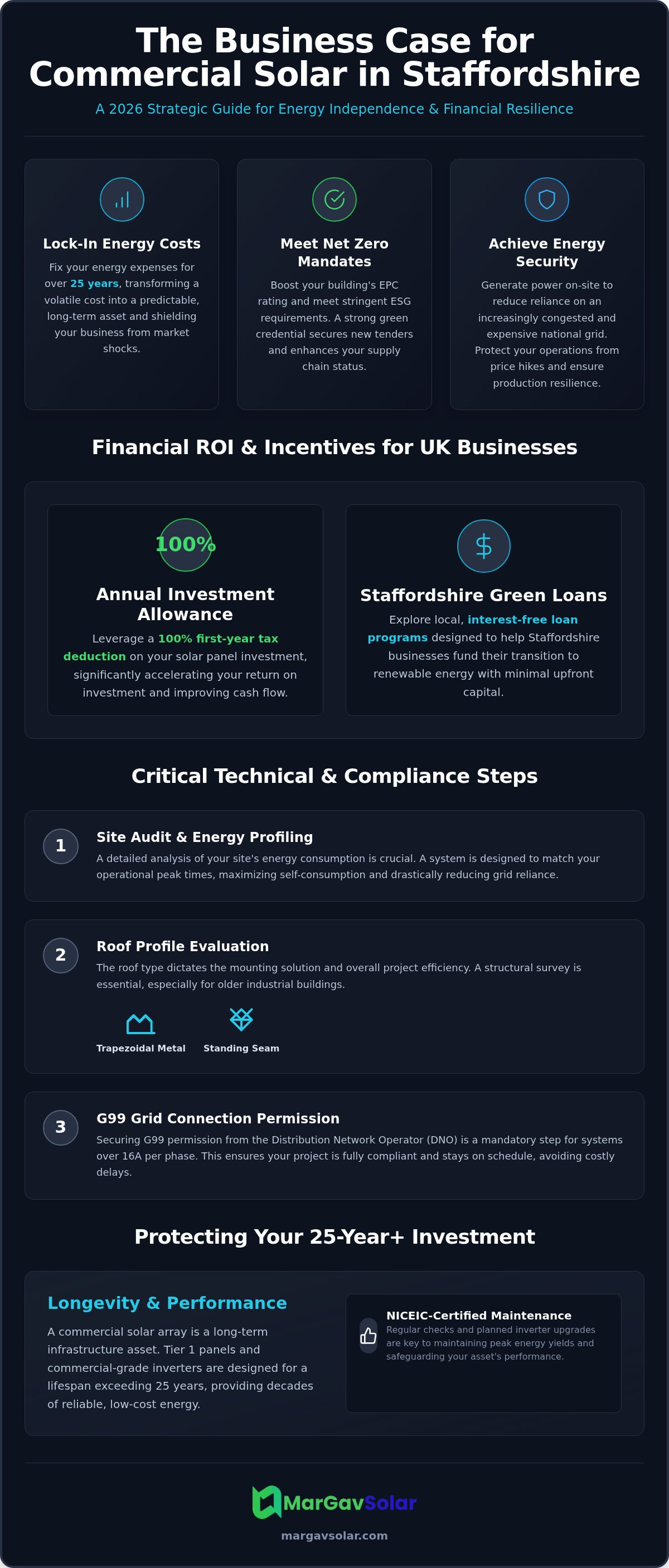
- Leverage 100% tax deductions through the Annual Investment Allowance and explore interest-free Staffordshire Green Loans to fund your transition with minimal upfront capital.
- Evaluate how specific roof profiles, like trapezoidal metal or standing seam, impact the design and long-term efficiency of your solar PV array.
- Understand the critical steps for securing G99 grid connection permissions to ensure your commercial solar panel installation Staffordshire project stays on schedule and fully compliant.
- Learn how detailed site audits and energy profiling allow for a system that matches your operational peak times, maximizing self-consumption and reducing reliance on the grid.
- Protect your 25-year infrastructure investment with NICEIC-certified maintenance packages and planned inverter upgrades to maintain peak energy yields.
The Strategic Case for Commercial Solar in Staffordshire
For businesses across the Potteries and the wider county, commercial solar PV is no longer just a "green" project. It's a strategic infrastructure investment. Staffordshire’s manufacturing and warehousing sectors are particularly exposed to energy market volatility. High-energy processes in local ceramics or heavy engineering mean that even minor shifts in grid prices can erode profit margins. By choosing a commercial solar panel installation Staffordshire firms can effectively fix their energy costs, turning a variable expense into a predictable asset. A well-executed commercial solar panel installation Staffordshire allows local businesses to bypass the uncertainty of national energy fluctuations while making use of expansive roof spaces.
As Solar power in the United Kingdom continues to expand, local businesses that adopt early gain a significant edge in the West Midlands market. This isn't just about saving money; it's about operational resilience. In an era where energy security is paramount, generating your own electricity provides a buffer against external shocks that could otherwise halt production or delay distribution.
Meeting Net Zero and ESG Mandates
The pressure to decarbonise is coming from all angles. From 2026, many commercial landlords and tenants are prioritising buildings with higher Energy Performance Certificate (EPC) ratings. Solar installations are one of the most effective ways to boost these ratings, making properties more attractive for long-term leases and future sales. Carbon reporting is also becoming a standard requirement for Staffordshire supply chains, especially for those bidding on larger contracts or working with public sector bodies.
Environmental, Social, and Governance (ESG) compliance for UK SMEs in 2026 is a structured commitment to sustainable operations that proves a business's long-term viability to stakeholders. Achieving these targets often determines whether a firm can secure new tenders or maintain its status as a preferred supplier in a competitive landscape.
Energy Security in the West Midlands
Relying solely on the national grid during peak industrial hours is increasingly risky and expensive. Staffordshire’s geographical position offers excellent solar potential, providing high yields that can cover a substantial portion of a facility's daytime demand. By generating power on-site, you reduce the impact of grid congestion and protect your operations from future carbon taxes or unexpected price hikes.
Energy independence is the ultimate goal for any forward-thinking CFO. When your competitors are struggling with sudden tariff increases, your fixed-price energy source keeps your overheads stable. It's a proactive move that safeguards your business against the inevitable transition toward a high-cost, low-carbon economy, ensuring your Staffordshire site remains profitable for decades to come. Even beyond the UK, firms seeking inspiration for how bespoke PV design can be leveraged as a strategic asset can learn more about Sonalis and their specialized solutions for commercial enterprises and capital investors.
Technical Considerations for Commercial Solar PV Systems
A commercial solar panel installation Staffordshire project differs significantly from residential setups in both scale and electrical complexity. While domestic systems usually operate on single-phase power, industrial sites in areas like Stoke-on-Trent or Cannock require three-phase synchronisation to handle higher voltage outputs. The hardware must be robust. Commercial-grade Tier 1 panels are designed for longevity and high efficiency, ensuring that even limited roof space provides maximum yield. Before any hardware is fixed, a structural survey is vital. Many of Staffordshire’s heritage industrial buildings, such as former pottery mills, may require internal reinforcement to support the dead load of a large solar array over its 25-year lifespan.
Your technical choices directly influence the long-term Financial ROI, Grants, and Tax Incentives available to your business. For instance, the way you meter your export can change your eligibility for the Smart Export Guarantee (SEG). It is often worth scheduling a professional technical audit to determine if your existing infrastructure can support the weight and electrical load of a modern PV system.
Commercial Roof Types and Mounting Solutions
Modern industrial sheds often feature trapezoidal metal or standing seam roofs. These are ideal for solar because the mounting rails can often be clamped directly to the seams, avoiding the need for roof penetrations. For flat-roofed office blocks or warehouses, ballasted systems are the preferred choice. These use heavy weights to secure the panels in place without piercing the waterproof membrane. If your site has north-facing sections or significant shading from neighbouring structures, high-efficiency panels and specific mounting angles can still make these areas viable for energy production.
Inverters and Power Optimisation
Inverters are the heart of your system, converting DC power from the panels into usable AC electricity. In large-scale Staffordshire installations, you might choose between a central inverter or a series of string inverters. String inverters offer better redundancy; if one fails, the rest of the array keeps working. For complex rooflines with varied shading, power optimisers can be installed to ensure that a single shaded panel doesn't drag down the performance of the entire string.
Commercial inverter sizing focuses on balancing peak load demands and three-phase grid stability, whereas domestic setups prioritise simple single-phase synchronisation for lower total outputs. As technology evolves, planning for future inverter upgrades ensures your system remains compatible with the latest battery storage solutions and grid requirements. This modular approach allows your energy infrastructure to grow alongside your business.
Financial ROI, Grants, and Tax Incentives for UK Businesses
Investing in a commercial solar panel installation Staffordshire project is now primarily a financial decision rather than just an environmental one. The UK government's "Full Expensing" capital allowance is a game changer for 2026. It allows companies to deduct 100% of the cost of qualifying solar equipment from their taxable profits in the year of purchase. With the current corporation tax rate at 25%, this provides a significant immediate tax saving that effectively reduces the net cost of the system from day one. While the local benefits are clear, global market dynamics highlighted in The Strategic Case for Commercial Solar show that falling component costs have significantly shortened the time it takes for a system to pay for itself.
The financial return is further bolstered by the Smart Export Guarantee (SEG). This scheme ensures that any excess electricity your system generates but doesn't use can be sold back to the grid. In 2026, typical payback periods for a 50kWp to 100kWp system in the Midlands range from 4 to 6 years after tax incentives are applied. Beyond the immediate cash flow, solar creates a "Green Premium" for your property. Commercial buildings with high-yield renewable energy systems are increasingly valued higher than their fossil-fuel-dependent counterparts, making the installation a dual-purpose investment in both energy and real estate.
Tax Benefits and Capital Allowances
For smaller commercial enterprises or satellite offices looking for more compact solutions, Sky High Solar and Electrical provides expertise in 6.6kw and 10kw systems, demonstrating how high-efficiency setups can be scaled for diverse business needs.
The Annual Investment Allowance (AIA) remains a cornerstone of UK solar finance. It covers up to £1 million in qualifying plant and machinery, which includes solar PV arrays and battery storage. This allows for a first-year tax deduction that can drastically improve your project's initial cash position. It's also vital to note that eligible on-site renewable energy installations are exempt from business rates in England until 31st March 2035. You should consult with your accountant to determine how to treat the system as an appreciating asset that reduces operational overheads while providing long-term depreciation benefits.
Local Staffordshire Grants and Funding
Staffordshire businesses have access to some of the most proactive regional support in the UK. The Staffordshire Green Loan Scheme offers interest-free loans between £5,000 and £100,000, providing 100% upfront funding for energy-efficient improvements with no administration fees. For SMEs in Stoke-on-Trent and the Staffordshire Moorlands, programs like Scale Up Staffordshire can cover up to 80% of project costs through interest-free capital. Organizations such as the Staffordshire Business Environment Network (SBEN) offer essential consultancy to help firms navigate these applications. If capital expenditure is not an option, a Power Purchase Agreement (PPA) allows a third-party investor to fund the installation, selling you the generated electricity at a fixed, discounted rate without any upfront cost to your business.
The Commercial Installation Process: Minimising Disruption
A successful commercial solar panel installation Staffordshire project requires a structured approach to ensure your business stays operational while the transition occurs. It begins with a detailed site audit and energy profile analysis. We don't just look at your roof; we look at your half-hourly meter data to match generation with your peak demand. This ensures the system is sized to maximise self-consumption rather than just filling space. This data driven approach is essential for justifying the investment to stakeholders.
The next phase involves securing grid permissions. Systems exceeding 3.68kW per phase require a G99 application to the Distribution Network Operator (DNO). In Staffordshire, this typically means working with National Grid, formerly Western Power Distribution. This process can take several weeks, so it must be initiated early to avoid project delays. Once approved, the system design and procurement phase follows NICEIC standards to guarantee that all electrical work meets the highest UK safety regulations. To get started with a professional site assessment, you can book a commercial solar audit with our specialist team.
Installation is phased to protect your business continuity. Instead of a total shutdown, work is cordoned off, allowing your staff to continue their duties safely. Finally, the system undergoes rigorous commissioning and handover, providing you with MCS certification and all necessary operation and maintenance (O&M) documentation.
Navigating Grid Permissions (G99)
Grid connection is often the most complex part of a commercial project. Because industrial systems inject significant power back into the local network, the DNO must assess if the local infrastructure can handle the load. In some constrained zones within the West Midlands, the National Grid may impose export limitations. This means your system might be restricted on how much excess energy it can send back during peak generation. Expert installers manage these G99 and G100 compliance requirements on your behalf, negotiating the best possible connection terms to protect your ROI.
Operational Continuity During Install
Maintaining your daily workflow is a priority. Noisy works like drilling or heavy lifting are scheduled around your specific business hours or during shift changes. Health and safety are non-negotiable; we utilise comprehensive edge protection, scaffolding, and detailed Risk Assessment Method Statements (RAMS) to secure the site. Using certified solar panel installers ensures that these protocols are strictly followed, preventing accidents and protecting your liability. This professional oversight allows you to focus on running your firm while your energy infrastructure is modernised.
MarGav Solar: Your Partner for Industrial Energy Independence
MarGav Solar brings over 20 years of renewable energy expertise specifically tailored to the West Midlands business community. A commercial solar panel installation Staffordshire project represents a significant capital commitment, and our role is to ensure that every kilowatt-peak delivers maximum value. We operate as a local specialist with national-level technical capabilities. This means we understand the nuances of the Staffordshire grid, from the industrial hubs of Tamworth to the manufacturing centres of Stoke-on-Trent, while applying industry-leading installation standards. Our fixed-price contracts provide the financial certainty that CFOs and business owners need, ensuring that the project budget agreed at the start remains the budget at completion.
Our consultancy phase involves more than a cursory glance at your roof. We dive into your half-hourly data to ensure the system is perfectly scaled for your specific operational needs. This local knowledge is vital when navigating the requirements of National Grid in Staffordshire, where grid constraints can sometimes limit export potential. We help you design around these hurdles, ensuring your commercial solar panel installation Staffordshire project is optimized for self-consumption. We provide a comprehensive end-to-end service that begins with strategic consultancy and extends into long-term maintenance. This focus on long-term performance is a hallmark of top-tier providers worldwide, including Bright Earth Solar, which delivers similar high-quality commercial solar outcomes for businesses in South Australia.
Industrial environments are often harsh, with dust and pollutants from manufacturing processes potentially reducing panel efficiency over time. Our comprehensive Operations and Maintenance (O&M) packages go beyond simple cleaning. We use thermal imaging to detect "hot spots" or micro-cracks that aren't visible to the naked eye but can significantly hamper your ROI. Real-time monitoring allows us to identify underperformance the moment it occurs, ensuring your system doesn't lose yield for weeks before a fault is noticed. If you have an aging system, we also specialise in inverter upgrades and replacements to bring your infrastructure up to 2026 standards.
Battery Storage and EV Integration
To truly maximise energy independence, many firms are now integrating solar battery storage. This allows you to "peak-shave" industrial loads, using stored solar energy during the most expensive times of the day when grid tariffs are at their highest. As the 2030 and 2035 bans on new petrol and diesel vehicles approach, the demand for commercial EV charging points is also surging. By installing charging infrastructure alongside your solar PV system, you provide a valuable benefit for staff and prepare your fleet for a zero-emission future. This holistic approach ensures your Staffordshire facility is not just powered for today, but fully resilient for the next three decades of energy transition.
Future-Proof Your Staffordshire Business Operations
The transition to renewable energy is no longer a choice for the distant future; it's a critical financial move for today. By investing in a commercial solar panel installation Staffordshire, you aren't just reducing your carbon footprint. You're securing your operational costs against grid volatility for the next quarter-century. With 2026 tax incentives like Full Expensing and regional interest-free loans currently available, the financial barrier to entry has never been lower for local firms.
Our team at MarGav Solar combines over 20 years of industry expertise with deep local knowledge to deliver high-yield systems. As NICEIC and MCS certified installers, we manage the entire process; this includes everything from complex G99 grid applications to long-term maintenance packages. Whether you manage a warehouse in Tamworth or a production site in Stoke, we ensure your installation is seamless and your ROI is maximised.
Ready to take control of your energy future? Book a Free Commercial Energy Audit with MarGav Solar to discover exactly how much your facility could save. Let's build a more resilient and sustainable Staffordshire business together.
Frequently Asked Questions
Do I need planning permission for commercial solar panels in Staffordshire?
Most commercial rooftop solar installations are considered permitted development and don't require full planning permission. This follows the removal of the one megawatt cap in December 2023. However, you must check for specific restrictions if your site is a listed building or located in a conservation area. Ground-mounted systems with a capacity between 1MW and 100MW always require planning permission from your local Staffordshire authority before work begins.
How long is the payback period for a commercial solar PV system in 2026?
In 2026, the typical payback period for a system between 50kWp and 100kWp is approximately 4 to 6 years. This timeline is significantly shortened by tax incentives like the Annual Investment Allowance and regional interest-free loans. Once the initial investment is recouped, your business enjoys virtually free electricity for the remainder of the system’s 25-year lifespan. This makes a commercial solar panel installation Staffordshire project a highly reliable long-term capital investment.
What is a G99 application, and why does my business need one?
A G99 application is a formal request to the Distribution Network Operator to connect a large-scale solar system to the grid. Because commercial systems generate significant power, the operator must ensure the local infrastructure can handle the load without causing instability. This process is mandatory for any system exceeding 3.68kW per phase. Our team coordinates directly with National Grid in Staffordshire to manage these applications and secure your connection agreement.
Can solar panels be installed on a flat industrial roof?
Yes, flat industrial roofs are excellent candidates for solar arrays. We typically use ballasted mounting systems that secure the panels with weighted blocks, which means we don't have to pierce the roof’s waterproof membrane. Alternatively, for certain structures, we can use fixed mechanical mounts. These systems are angled to maximize energy yield and ensure adequate wind resistance. A structural survey will determine which mounting solution is safest for your specific building.
How much maintenance do commercial solar panels require?
While solar PV is a low-maintenance technology, professional servicing is essential to protect your ROI. We recommend an annual inspection that includes professional cleaning to remove industrial dust and debris. Our maintenance packages also feature thermal imaging to identify micro-cracks or electrical faults that aren't visible to the eye. Regular monitoring ensures your system continues to perform at peak efficiency, preventing small issues from becoming costly repairs later in the system's life.
Will solar panels affect my commercial property insurance?
You must notify your insurance provider before beginning a commercial solar panel installation Staffordshire project. Most insurers view solar as a permanent building improvement that adds value, though it may slightly adjust your premium. They'll likely require proof that the installation is performed by MCS-certified professionals and meets all current fire safety regulations. Providing your insurer with the full technical specification and safety certifications usually ensures your coverage remains valid and comprehensive.
Can I install solar panels if my business is in a rented property?
You can install solar on a rented property, but you must obtain formal consent from your landlord. Many landlords are open to these improvements because solar panels increase the property’s EPC rating and overall market value. Alternatively, you might consider a Power Purchase Agreement. In this setup, a third party funds the installation and you purchase the generated electricity at a discounted rate, which can be a beneficial arrangement for both tenants and property owners.
What happens to the excess energy my business doesn’t use?
Any surplus electricity your business generates is automatically exported back to the national grid. Through the Smart Export Guarantee, your energy supplier will pay you for this excess power, creating an additional revenue stream. If you prefer to keep that energy for use during the evening or peak times, we can integrate battery storage solutions. This allows you to maximize self-consumption and further reduce your reliance on expensive grid-supplied electricity during high-tariff periods.


