
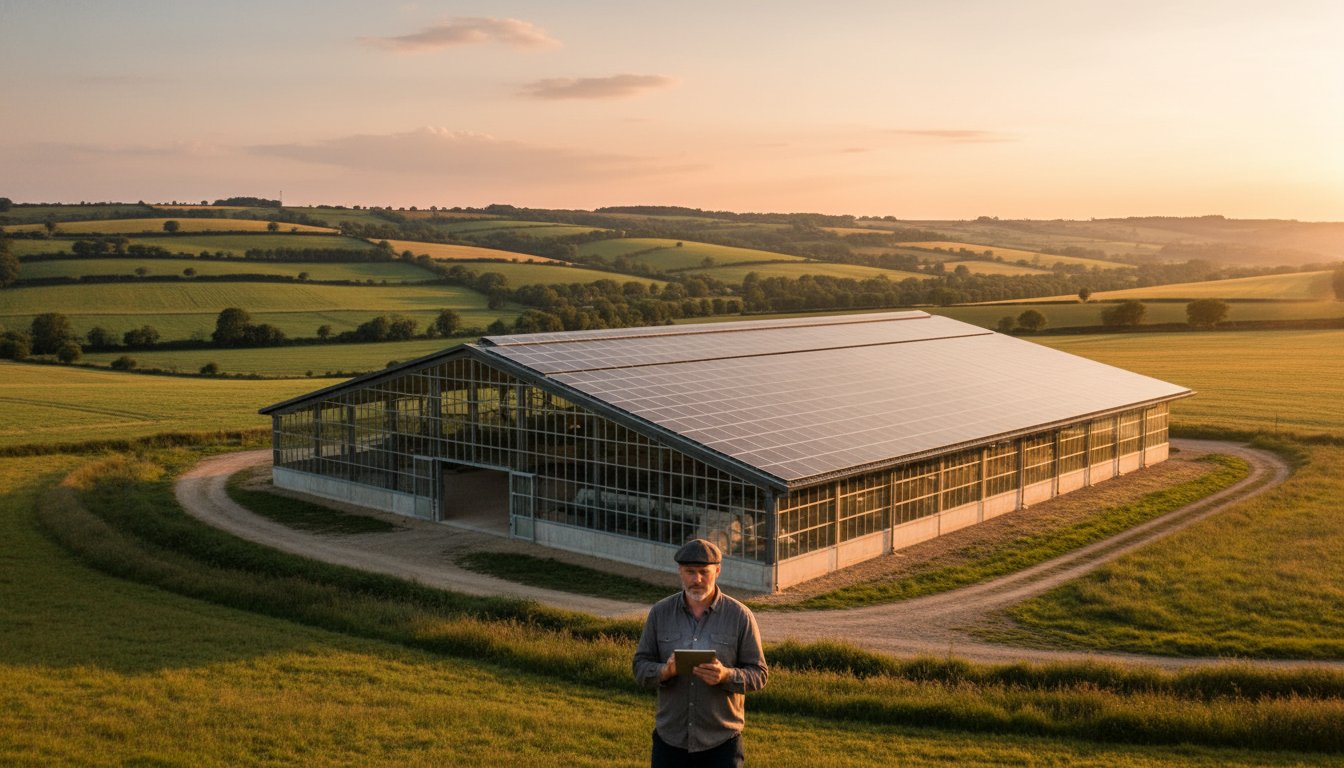
What if your farm’s most resilient yield in 2026 isn't harvested from the soil, but generated from the roofs of your existing sheds and outbuildings? It's a question many are asking as energy costs for intensive farming remain volatile and supply chain demands for Net Zero compliance intensify. You're likely already feeling the squeeze of high overheads while facing the unique challenges of the Staffordshire Green Belt and frustrating grid connection delays. This guide demonstrates how solar power for farms Staffordshire has become a strategic asset for long-term land viability rather than just a green initiative.
You'll discover how to secure your energy independence and slash operational costs using tailored solar PV and battery storage solutions. We'll explore the specific 2026 financial landscape, including current grant structures and tax reliefs available to local landowners. We will also examine how local experts help farmers evaluate their infrastructure to ensure critical systems stay powered regardless of grid instability, providing a clear roadmap for agricultural energy security in the heart of the Midlands.
Key Takeaways
- Learn how to significantly reduce operational overheads by adopting solar power for farms Staffordshire to protect your margins from energy price volatility.
- Understand why battery storage is the essential link for securing energy independence for critical systems like dairy cooling and automated feeding.
- Get clarity on Staffordshire’s specific planning hurdles, including how to use Permitted Development Rights for solar installations within the Green Belt.
- Discover how to maximize the lifespan and efficiency of your energy system through professional maintenance and timely inverter upgrades.
- Identify the specific 2026 financial incentives and grant structures that make rooftop solar a viable long-term investment for the agricultural sector.
Why Staffordshire Farms are Moving to Solar Power in 2026
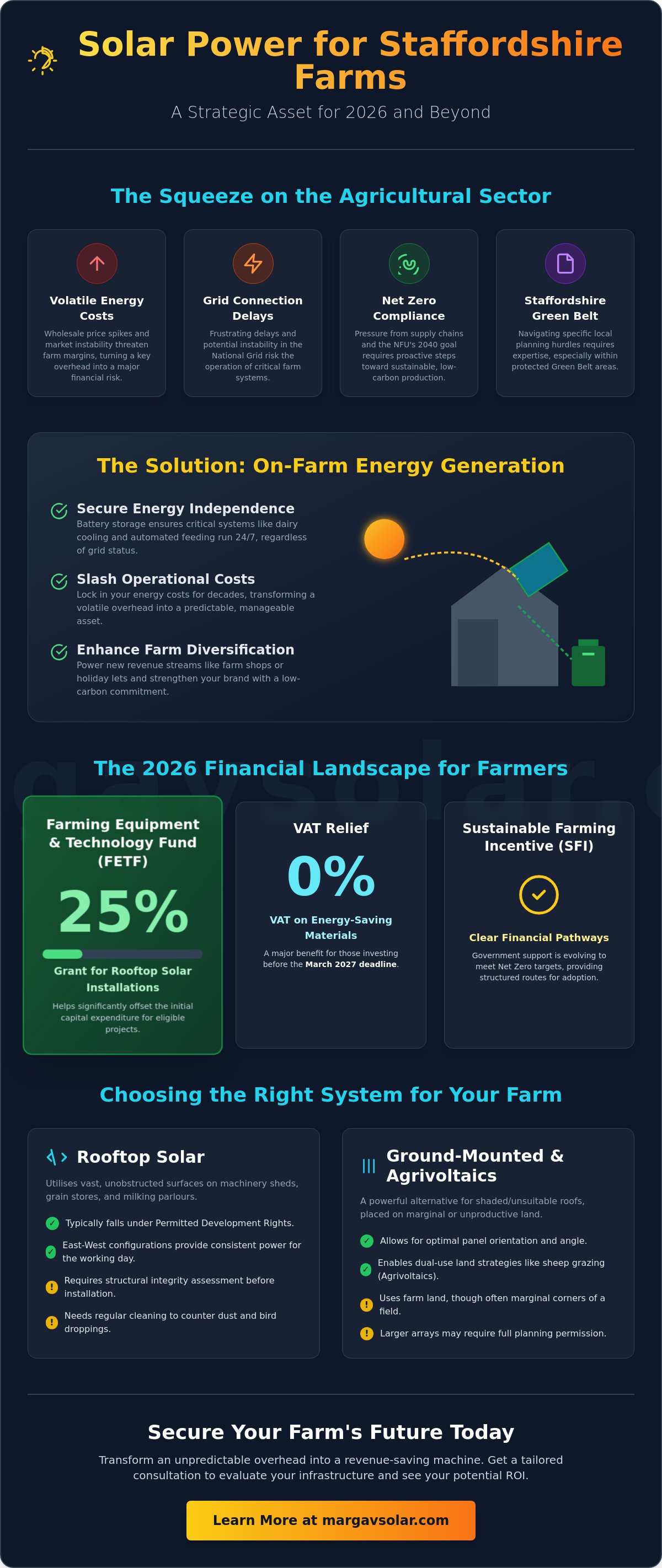
Agricultural solar PV systems are high-capacity energy solutions engineered to handle the intensive electricity loads of modern rural operations. In 2026, relying solely on the National Grid has become one of the most significant risks to farm margins. Volatile wholesale prices and potential grid instability threaten the thin profits of dairy, poultry, and arable enterprises alike. By installing solar power for farms Staffordshire owners are effectively locking in their energy costs for decades. It's a move that turns a variable overhead into a manageable, predictable resource.
This shift directly supports the National Farmers' Union (NFU) goal of reaching Net Zero across the agricultural sector by 2040. Government support is also evolving to meet these targets. The Sustainable Farming Incentive (SFI) and the Farming Equipment and Technology Fund (FETF) now provide clear financial pathways for adoption. Specifically, the FETF offers a 25% grant for rooftop solar installations, which helps offset the initial capital expenditure for eligible projects. Additionally, the 0% VAT rate on energy-saving materials remains a significant benefit for those investing before the March 2027 deadline.
Addressing the Energy Crisis in Staffordshire's Rural Economy
Staffordshire's dairy and poultry sectors are particularly vulnerable to price spikes because their operations require constant power for cooling, ventilation, and automated feeding. The county's unique geography, characterized by open plateaus and south-facing slopes, provides an ideal environment for high-yield solar harvesting. As farmers swap diesel-dependent machinery for electric alternatives, the need for on-site generation grows. Integrating solar with battery storage allows farms to capture energy during peak daylight and deploy it when it's needed most, regardless of what the external market is doing.
Solar as a Tool for Farm Diversification
Many local landowners are looking beyond traditional crops to secure their future. Powering farm shops, glamping sites, or holiday lets with on-site solar generation increases the profitability of these diversifications. It also strengthens 'Staffordshire-grown' branding by proving a commitment to low-carbon production. While large-scale ground-mounted projects are often debated, the concept of Agrivoltaics shows how land can remain productive for both food and energy. Agricultural solar in 2026 is a critical fixed-asset investment that transforms underutilised roof space into a predictable revenue-saving machine.
Choosing the Right System: Rooftop vs. Ground-Mounted Solar
Selecting the right infrastructure for solar power for farms Staffordshire requires a balance between available space and structural capacity. Most agricultural projects start with rooftop evaluations because they typically fall under Permitted Development Rights. However, farm buildings aren't always ready for the load. A grain store or milking parlour roof must be assessed for structural integrity before any solar panel installation begins. Unlike standard residential setups, agricultural systems often require 3-phase inverters to handle the heavy-duty power demands of cooling systems and automated machinery.
Rooftop Solar: Utilising Existing Farm Infrastructure
Machinery sheds and grain stores offer vast, unobstructed surface areas for generation. Orientation is key. South-facing roofs provide the highest yield, but east-west configurations can offer more consistent power throughout the working day to match operational peaks. It's often practical to combine solar deployment with planned roof repairs. If your cladding is aging, installing panels alongside a refresh ensures the substructure is sound for the next 25 years. Regular cleaning is essential in rural environments, as dust from grain handling or bird droppings can significantly impact your total energy harvest.
Ground-Mounted Solar: When Rooftops Aren't Enough
If your barn roofs are shaded or structurally unsuitable, small-scale ground-mounted arrays offer a powerful alternative. These systems are often placed on marginal land or 'unproductive' corners of a field that are difficult to crop. This approach allows for dual-use land strategies, such as sheep grazing beneath the panels, which keeps the grass short without mechanical mowing. While many small arrays don't need full planning, larger projects must navigate the complex landscape of Planning permission for solar farms, especially within the Staffordshire Green Belt or the Cannock Chase AONB.
Security is a primary concern for ground arrays in isolated rural areas. High-quality perimeter fencing and bird-proofing are standard requirements to protect your investment from both intruders and local wildlife. Whether you choose the roof or the ground, the goal remains the same: maximizing every kilowatt-hour generated on-site. If you have an existing system that isn't performing as expected, considering professional maintenance or inverter upgrades can often boost your current yield without needing extra space. This technical oversight ensures your farm remains energy independent regardless of the season.
Maximising ROI with Battery Storage and Smart Management
Solar panels harvest energy when the sun shines, but farm operations don't stop when it sets. For those implementing solar power for farms Staffordshire, battery storage is the bridge between generation and 24/7 demand. Dairy farms, for instance, need consistent power for evening milkings and overnight cooling. Without storage, you're forced to sell excess energy back to the grid at lower Smart Export Guarantee (SEG) rates, which currently range between 4p and 15p per kWh, while buying it back at much higher retail prices later. Integrating a robust battery system ensures you use every kilowatt you generate on-site.
Smart management platforms like GivEnergy Cloud allow you to track this flow in real-time. You can see exactly how much your grain dryers are pulling or when your storage is at capacity. This level of transparency is vital for meeting the requirements of the Farming Equipment and Technology Fund (FETF). As of 2026, the FETF provides a 25% grant for eligible rooftop solar projects, with a minimum grant of £15,000. It's not just about saving energy; it's about total financial control over your farm's largest variable overheads.
Energy Independence for Critical Farm Systems
Power outages can be catastrophic for livestock ventilation or temperature-controlled storage. A high-capacity solar battery storage system provides a vital buffer, keeping critical systems running during grid instability. It also allows for strategic "peak shaving." Peak shaving allows 3-phase users to discharge stored battery power during expensive high-tariff windows, effectively flattening energy demand and lowering the overall unit cost. This prevents your farm from hitting the highest pricing tiers during peak morning or evening hours.
Smart Monitoring and Inverter Technology
The heart of any agricultural array is the inverter. If your system is several years old, inverter upgrades can significantly boost efficiency by improving the DC-to-AC conversion rate. Modern inverters handle larger loads and integrate with smart software to automate energy flow. You can program the system to divert power to high-demand equipment, like slurry separators, only when generation is at its peak.
Looking ahead, the infrastructure you install today must support the machinery of tomorrow. Many Staffordshire farms are already installing EV charging points to prepare for electric utility vehicles and tractors. This isn't just for farm use; providing charging for visitors or delivery drivers can even become a minor revenue stream for farm shops and diversification projects. By combining generation, storage, and charging, you turn your farm into a self-sustaining energy hub.
Navigating Planning Permission and Regulations in Staffordshire
Securing approval for solar power for farms Staffordshire involves a two-track process: planning permission and grid connection. For many, Permitted Development Rights (PDR) provide a streamlined path. These rights often allow for rooftop solar installations on agricultural buildings without a full planning application, provided the system stays within specific height and size limits. This is a primary reason why rooftop arrays are the most popular choice for local farmers, especially since they align with current government grant criteria. However, if your project involves ground-mounted arrays or sits within a conservation area, the regulatory landscape becomes more complex.
Staffordshire Planning: Green Belt vs. Agricultural Need
Staffordshire faces a unique challenge with approximately 5,000 acres of land currently designated for solar developments. Much of this land falls within the Green Belt or the Cannock Chase Area of Outstanding Natural Beauty (AONB). To succeed here, you must provide a robust "Agricultural Justification." This means demonstrating that the energy produced is essential for the farm's continued viability and that the environmental benefits outweigh any perceived harm to the landscape. Local district councils often decide these on a case-by-case basis, so engaging with the parish board early in the process is a smart move to mitigate local concerns about the "solar land grab."
Grid Connections and G99 Applications
Before you can generate a single kilowatt, you must deal with the Distribution Network Operator (DNO). In Staffordshire, this is usually National Grid (formerly Western Power Distribution). Any system larger than a small domestic array requires a G99 application. This technical document asks the DNO for permission to connect your system to the local grid. In some rural parts of the county, grid capacity is a known bottleneck. You might find that your export is limited, meaning you can't sell all your surplus energy back to the grid. This makes on-site battery storage even more critical, as it allows you to keep that power for your own use rather than losing it to an export cap.
Safety is the final regulatory hurdle. Every agricultural installation must comply with strict electrical standards to protect livestock and personnel. Ensuring your system meets NICEIC standards is essential for insurance purposes and long-term operational safety. If you're unsure about your farm's grid capacity or current planning status, get professional advice on your solar installation options today. A certified installer can handle the DNO bureaucracy and planning paperwork, letting you focus on the day-to-day running of your farm.
MarGav Solar: Your Local Partner for Agricultural Solar Excellence
MarGav Solar, the trading name for MarGav Renewables Ltd, is based at Kimberley Business Park in Rugeley and brings over two decades of local expertise to the region’s agricultural sector. Transitioning to solar power for farms Staffordshire is a significant capital decision that requires a partner with deep roots in the community. We provide specialist agricultural consultancy to ensure every system is tailored to the high-demand environment of a working farm. Our end-to-end support covers everything from the initial G99 grid application to long-term performance monitoring, ensuring your transition to renewable energy is seamless.
Agricultural settings are uniquely challenging for sensitive electronics. Dust, crop debris, and biological matter can quickly reduce the efficiency of an array. We provide comprehensive solar panel maintenance and professional cleaning to protect your investment. If your existing system is underperforming, our team can evaluate the need for inverter upgrades or replacements to restore your generation capacity to its full potential and ensure compatibility with modern battery storage solutions.
Why Local Expertise Matters for Staffordshire Farmers
The rural grid in Staffordshire has specific limitations that national installers might overlook. Whether your operation is based in Lichfield, Stafford, or Uttoxeter, the distance from the nearest substation and the capacity of existing lines dictate your system's design. Our Rugeley-based team understands these local nuances. We have a proven track record of helping farmers navigate the specific requirements of the local National Grid infrastructure for solar power for farms Staffordshire. Being local means we can offer rapid response times for system repairs, which is essential when your energy independence directly impacts livestock welfare or crop storage.
Get Your Bespoke Farm Energy Audit
Every farm has a different energy profile. A MarGav Solar agricultural consultation involves a detailed analysis of your seasonal and daily power usage. We help you calculate a precise ROI by looking at your current energy bills alongside the latest 2026 financial incentives. This includes the 0% VAT relief on energy-saving materials available until March 2027 and the 25% FETF grants for rooftop installations. With typical UK payback periods ranging from 8 to 12 years, we ensure you have all the data needed to make an informed choice for your business. Book your Staffordshire farm solar audit today to discover how on-site generation can transform your farm's financial resilience.
Securing Your Farm's Energy Future in 2026
Adopting renewable technology is no longer just a sustainability goal. It's a vital strategy for protecting your margins against unpredictable energy markets. By utilizing underused roof space and integrating smart battery storage, you can transform your farm into a self-sufficient energy hub. The 2026 landscape offers unique financial advantages, from the 25% FETF rooftop grants to the 0% VAT relief on installations. However, the window for these incentives is limited, and navigating the grid connection process requires specialized local knowledge to avoid costly delays.
Success with solar power for farms Staffordshire depends on choosing a partner who understands both the technology and the local landscape. MarGav Solar provides the stability of over 20 years of renewable expertise and a dedicated local support team. Our NICEIC certified installers ensure your system is safe, compliant, and optimized for long-term performance. Whether you need a new installation, an inverter upgrade, or professional maintenance, we're here to help your rural business thrive. Request a Bespoke Agricultural Solar Quote today to start your journey toward energy independence. Investing in your infrastructure now ensures your farm remains competitive for decades to come.
Frequently Asked Questions
Do I need planning permission for solar panels on my barn in Staffordshire?
Most rooftop installations on existing agricultural buildings don't require full planning permission because they fall under Permitted Development Rights. You'll usually need to go through a "prior approval" process with your local council to confirm the design. If your farm is within the Cannock Chase AONB or a conservation area, stricter rules apply. It's best to check with a specialist to ensure your specific site meets the 2026 criteria for these rights.
Can agricultural solar panels power a dairy farm's cooling system?
Yes, solar PV can significantly offset the high energy demands of dairy cooling. Because cooling is a 24/7 requirement, pairing your panels with battery storage is essential to maintain power during early morning or late evening milkings. This setup allows you to use stored solar energy when the sun isn't shining. It's a reliable way to reduce reliance on expensive grid electricity during peak operational hours.
How much does a typical agricultural solar installation cost in 2026?
Costs for solar power for farms Staffordshire vary based on system size and infrastructure. Industry data for 2026 suggests a 50kW system averages around £30,000, while a larger 200kW array can reach approximately £180,000. These figures are benchmarks for equipment and installation. Remember that the 0% VAT rate on energy-saving materials remains in effect until March 2027, providing a substantial upfront saving for eligible agricultural businesses.
What is the lifespan of solar panels in a farm environment?
Modern solar panels are designed to last between 25 and 30 years. While the panels themselves are highly durable, the inverter typically requires an upgrade or replacement after 10 to 15 years. In a farm environment, durability remains high provided the system is kept clear of debris. Regular inspections help ensure the mounting hardware remains secure against the high winds often found in open Staffordshire landscapes.
Are there specific grants for solar power for farms in Staffordshire?
The primary incentive in 2026 is the Farming Equipment and Technology Fund (FETF), which provides 25% of eligible costs for rooftop solar installations. The minimum grant is £15,000, which applies to projects costing £60,000 or more. It's important to note that ground-mounted systems currently don't qualify for this specific fund. Farmers should check the Rural Payments Agency (RPA) portal for the latest application windows and eligibility criteria.
How do I maintain solar panels on a dusty farm site?
Dust from grain processing or livestock housing can create a film on panels that reduces energy yield by up to 30%. Professional cleaning and maintenance are the best ways to manage this in a rural setting. You should avoid using abrasive chemicals or high-pressure washers that could damage the specialized coating on the glass. Scheduling a professional service once or twice a year ensures your system continues to operate at maximum efficiency.
Can I install solar panels in the Staffordshire Green Belt?
Installing solar power for farms Staffordshire within the Green Belt is possible, but rooftop installations are much more likely to receive approval. Planning authorities generally prefer using existing building footprints to minimize the impact on the rural landscape. For ground-mounted arrays, you'll need to provide a strong agricultural justification. This might include showing how the project supports farm diversification or how the land maintains a dual-purpose use.
What happens to my solar power during a power cut?
Most standard solar systems automatically shut down during a power cut for safety reasons to prevent electricity from feeding back into the grid. However, if your farm has a battery storage system with a dedicated backup function, you can continue to power critical circuits. This is a vital feature for farms that rely on automated systems for animal welfare. It's important to verify that your specific inverter and battery configuration support this functionality.


