

If your solar system was installed over a decade ago, your inverter isn't just an old component; it's likely the single biggest bottleneck strangling your household's energy independence. It is frustrating to watch your generation numbers drop or face sudden system downtime, especially when you aren't sure if you are being quoted a fair price for a replacement. You might feel torn between a simple like-for-like swap and the leap to a hybrid system that's ready for battery storage. We understand the fear of being overcharged for what feels like a simple fix while trying to keep your home running efficiently.
This guide clarifies the real-world solar inverter upgrade cost UK residents can expect in 2026. You'll discover how the latest conversion technology can significantly lower your energy bills and which setups offer the best long-term warranty peace of mind. We will preview the current pricing for string and hybrid units, explain the impact of 2026's zero-rated VAT status, and show you how to choose a system that turns your roof back into a high-performance asset. Whether you are looking for a quick replacement or a future-proof battery upgrade, the right information ensures you don't pay more than necessary for peak performance.
Key Takeaways
- Learn the current 2026 price benchmarks for string and hybrid replacements to ensure you pay a fair market rate for your equipment.
- Understand why upgrading to a hybrid inverter is the essential first step for homeowners wanting to integrate battery storage.
- Identify the specific performance drops and physical warning signs that indicate your system's "brain" is nearing its 10-year lifespan.
- Discover how the total solar inverter upgrade cost UK homeowners invest can be reduced through zero-rated VAT and improved conversion efficiency.
- See how choosing a certified Staffordshire specialist ensures your upgrade remains compliant with DNO regulations while securing your export payments.
Understanding Solar Inverter Upgrade Costs in the UK
Your solar inverter is the hardest working component in your entire energy system. While panels sit quietly on the roof, the inverter acts as the "brain," constantly converting DC power into usable AC electricity for your home. You can learn more about what a solar inverter does to understand its critical role in energy management. Most of these units have a typical lifespan of 10 to 12 years. If your system was installed during the early feed-in tariff boom, your inverter is likely approaching the end of its reliable service life.
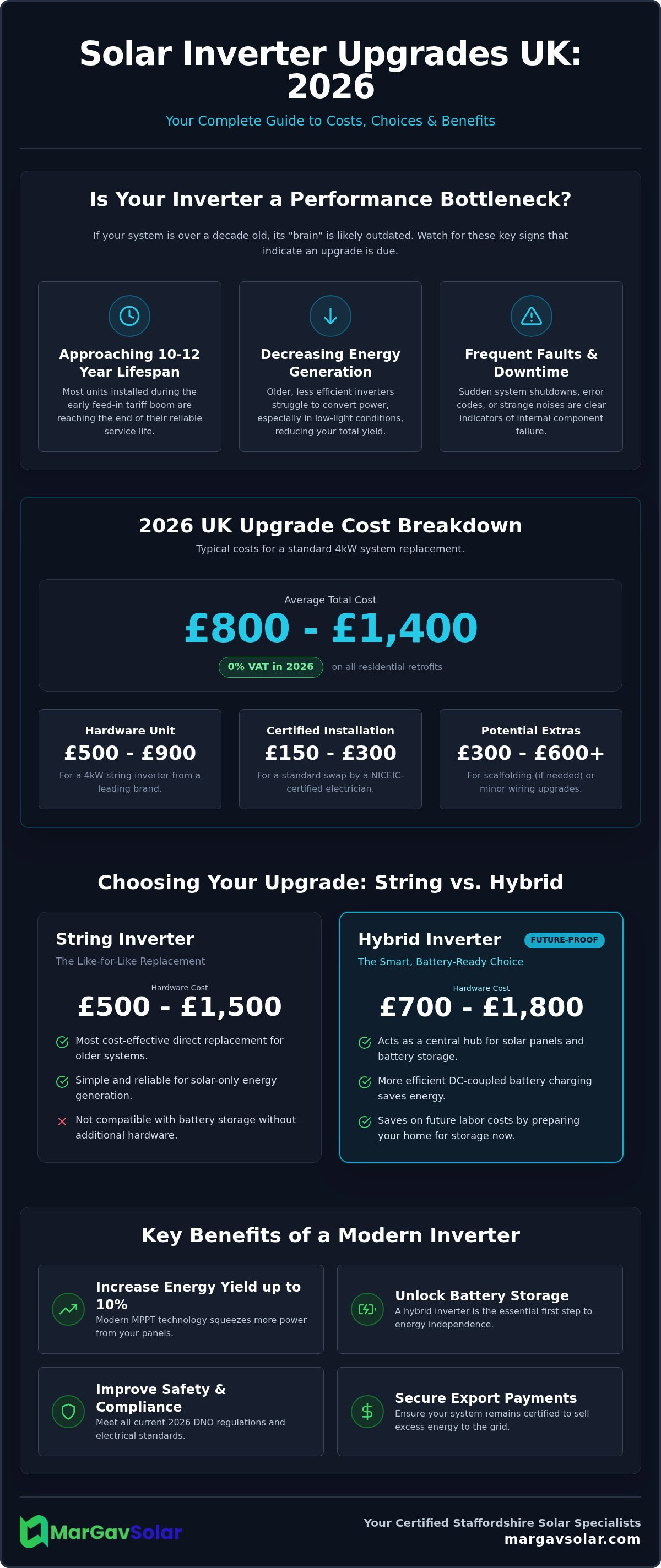
Investing in a solar inverter upgrade cost UK homeowners often find surprising is not just about fixing a broken part. It's a performance play. Older inverters from a decade ago often operate at lower efficiency levels compared to modern units. By swapping a functional but dated inverter for a high-efficiency 2026 model, you can increase your total energy yield by up to 10%. This happens because modern electronics have better "Maximum Power Point Tracking" (MPPT), which squeezes more energy out of your panels during low-light conditions or partial shading. The total investment breaks down into three main pillars: the hardware itself, the skilled labor for the swap, and the essential safety certifications.
Hardware vs. Installation Labor Costs
The hardware is usually the largest portion of your bill. Leading brands like GivEnergy or SMA offer 4kW string inverters that typically range from £500 to £900 for the unit alone. If you choose a premium brand with a longer 20-year warranty, expect to pay toward the higher end of that scale. Labor rates in Staffordshire and the wider UK for NICEIC-certified electricians generally fall between £150 and £300 for a standard swap. Larger systems require physically bigger units and more complex wiring, which can push both the hardware price and the time on site upward.
Hidden Costs: Scaffolding and Wiring
Not every inverter swap is a simple "plug and play" job. If your current inverter is mounted on an external wall at height, you might need scaffolding, which can add £300 to £600 to your total. Most UK installs are in lofts or garages where scaffolding isn't required, but accessibility is key. We also find that older systems often need their DC isolators or cabling upgraded to meet 2026 safety standards. These small components don't cost much individually, but they ensure your system remains compliant and safe for another decade of use. In 2026, the average total cost for a 4kW system inverter upgrade in the UK typically ranges from £800 to £1,400 depending on the chosen hardware and site accessibility.
String vs. Hybrid vs. Micro: Comparing Upgrade Options
Choosing the right hardware is the most significant factor affecting your solar inverter upgrade cost UK. Most original residential systems were built using string inverters, which remain the most cost-effective "like-for-like" replacement option today. A standard replacement unit typically costs between £500 and £1,500. While this is the budget-friendly route, it keeps your system locked to solar-only generation. If you want to stop sending your excess energy back to the grid for minimal returns, you'll need to consider a more versatile unit.
Hybrid inverters have quickly become the industry standard for 2026 upgrades. These units act as a central hub for both your solar panels and a future battery. Although a typical 5kW hybrid unit costs between £700 and £1,800, paying the £200 to £300 premium now saves you from having to replace the inverter again later. It's a strategic move that future-proofs your home for solar battery storage. Investing in the right technology today prevents redundant labor costs tomorrow.
The Hybrid Advantage for Battery Readiness
Hybrid models manage DC power from your roof and AC power for your home simultaneously. They allow for DC-coupled battery storage, which is more efficient than older AC-coupled methods because it reduces the number of power conversions. Modern units often integrate with smart monitoring like the GivEnergy Cloud, giving you granular control over how you use or sell your energy. All residential installations currently benefit from zero-rated VAT, making 2026 an ideal time to upgrade. You can review the latest UK solar installation regulations to see how these safety standards protect your investment.
Optimisers and Microinverters for Shaded Roofs
If your roof suffers from shading or has multiple orientations, microinverters are the high-performance alternative. Unlike a string system where one shaded panel slows down the whole line, microinverters allow every panel to work independently. A full microinverter retrofit is a larger investment. For an average 14-panel system, costs can exceed £2,500. Alternatively, adding power optimisers to a standard string inverter can provide a middle ground for performance gains in low-light UK conditions. If you aren't sure which technology fits your roof, our team can provide a professional assessment of your current system to find the best fit.
Signs Your Inverter Needs an Upgrade
Identifying when your system's "brain" is failing isn't always as simple as a total blackout. While a dead unit is an obvious trigger to investigate the solar inverter upgrade cost UK homeowners face, many systems suffer from "silent failure." This is where the hardware still technically works, but its conversion efficiency has degraded so much that you're losing money every day. If your system was installed before 2016, it's likely already passed its prime. Most original 5-year or 10-year warranties on early systems have now expired. If a unit fails in mid-summer, you lose your peak earning months while waiting for a quote and installation. Proactively addressing the upgrade before a total breakdown ensures you stay in control of the timeline and the price.
Performance drops are another major red flag. You should regularly compare your current yield to historical data in your monitoring app. If you notice a steady decline in generation on sunny days compared to previous years, your inverter is likely the culprit. Modern units are far more resilient, but older electronics eventually succumb to heat stress and component wear. Taking action now prevents the frustration of unexpected downtime and ensures your system continues to provide the maximum possible offset against rising energy prices.
Interpreting Error Codes and Faults
Older units from brands like Mastervolt, ABB, or Fronius often display cryptic codes when internal components fatigue. A persistent red light or unusual humming noise usually signals that the unit is struggling. Sometimes, a professional solar panel maintenance check can reveal that your system's lag is actually an inverter failing to manage the DC load. This helps you distinguish between a fixable wiring issue and a terminal hardware failure.
Technological Obsolescence vs. Physical Failure
Many pre-2016 units are physically functional but technologically obsolete. They often lack WiFi monitoring, making it impossible to track ROI without checking the physical meter. Older inverters typically peak at 92% efficiency, whereas modern 2026 models reach 98% or higher. Modern Maximum Power Point Tracking (MPPT) technology also reacts faster to UK weather changes, squeezing more energy out of every cloudy afternoon than older hardware ever could. Upgrading to the latest solar inverter upgrade cost UK standards means capturing that extra 6% of energy that was previously wasted.
The Installation Process and UK Regulations
When planning your solar inverter upgrade cost UK project, the administrative and regulatory side is just as important as the hardware selection. A professional installation follows a strict four-step process to ensure safety and legal compliance. First, a site survey assesses your existing DC and AC infrastructure. This check confirms if your current cabling and isolators can handle the output of a modern, high-efficiency unit. It's also the time to decide if the new inverter will stay in the loft or be relocated to a cooler, more accessible area like a garage.
The second stage involves hardware selection and managing the Distribution Network Operator (DNO) paperwork. Following this, the physical installation is carried out by an NICEIC-certified installer. This ensures the work meets BS 7671 wiring standards. Finally, the engineer commissions the monitoring software and hands over the new warranties. Modern 2026 systems often include cloud-based tracking that requires a stable connection to your home network to provide accurate ROI data. If you are ready to modernise your system, you can request a professional inverter survey from our Staffordshire team.
Grid Compliance: G98 vs. G99 Applications
UK regulations dictate how your inverter interacts with the National Grid. If your new inverter has a rated capacity of 3.68kW or less per phase, it falls under the G98 "connect and notify" process. Your installer simply notifies the DNO within 28 days of the commissioning. However, if you upgrade to a larger unit, such as a 5kW hybrid model, you must submit a G99 application and receive prior approval before the installation begins. Our team handles these complex applications for Staffordshire homeowners to prevent any legal issues with the grid. Ensuring your installation is MCS and NICEIC certified is vital for maintaining your insurance coverage and protecting your eligibility for Feed-in Tariff (FiT) or Smart Export Guarantee (SEG) payments.
Testing and Certification
The final part of the upgrade is the safety testing phase. Every professional inverter swap must conclude with the issuance of an Electrical Installation Certificate (EIC). This document is your proof that the system is safe and complies with all UK building regulations. The installer will also perform final safety checks on your DC isolators and system earthing. Once the hardware is verified, they will update your monitoring portal. This step is critical because it ensures your historical generation data is preserved while accurately tracking the improved efficiency of your new unit.
Maximising ROI: Why MarGav Solar for Your Upgrade?
MarGav Solar has spent over 20 years refining the process of solar panel installation in Staffordshire. We've seen every type of inverter failure and technological shift since the early days of the industry. While national firms might send a subcontracted team from across the country, we provide dedicated local support from our base in Staffordshire. This ensures that if you have a question about your monitoring app or need a quick check-up, you're talking to a local expert who knows your system's history. We specialize in high-efficiency hybrid systems, particularly GivEnergy, which are essential for those looking to maximize their energy independence through battery storage. Our deep understanding of these specific platforms means we can optimize your system for the best possible self-consumption rates.
One of the biggest worries with any home improvement is the "hidden extra." A cheap initial quote for your solar inverter upgrade cost UK can quickly spiral if the installer discovers old wiring or difficult access halfway through the job. We eliminate this stress with fixed-price installation contracts that provide total transparency from day one. Our fee covers everything from the initial design and hardware selection to the labor, DNO applications, and final NICEIC certification. Because we've been in business for two decades, we have the stability to stand by our equipment warranties and provide long-term maintenance support that national call centers simply can't match. This local expertise significantly reduces the "solar cowboy" risk, ensuring your upgrade is safe, compliant, and built to last.
The MarGav Fixed-Price Guarantee
Our fixed-price approach isn't just about the final number; it's about the value included in that price. We don't just swap the box; we evaluate your entire DC string and AC connection to ensure the new hardware can perform at its theoretical peak. This comprehensive fee includes the management of all grid notifications, which is a legal requirement many DIY-focused guides overlook. By choosing a local Staffordshire specialist, you're investing in a partner who will be there to support your system's performance for the next decade, not just until the invoice is paid. We focus on high-quality components that offer the best balance of upfront cost and long-term reliability.
Next Steps for Your Inverter Upgrade
Upgrading your system shouldn't be a complicated ordeal that leaves you without power for days. The process begins with a comprehensive technical inspection of your current setup to determine the best hardware for your specific roof orientation and energy goals. From the initial consultation to a fully commissioned and upgraded system, the timeline is typically efficient and transparent. You'll receive a clear breakdown of the performance gains you can expect, especially if you're moving from an old string inverter to a modern hybrid unit capable of managing battery storage. Ready to boost your system's ROI and secure your energy future? Request a professional inverter upgrade quote from MarGav Solar today to ensure your solar investment is ready for the next decade.
Secure Your Energy Future with a Smarter Inverter
Your solar journey doesn't end when the panels are installed; it evolves with the technology that manages them. Upgrading an aging inverter isn't just about avoiding a breakdown. It's a strategic move to unlock up to 10% more energy from your existing roof and prepare your home for battery storage. While the solar inverter upgrade cost UK homeowners pay varies based on technology, the long-term savings from improved efficiency and zero-rated VAT make 2026 a perfect time to act.
Choosing a local partner ensures your system remains compliant with DNO regulations while securing your export payments. MarGav Solar brings over 20 years of industry expertise to every project. As NICEIC-certified Staffordshire local experts, we specialise in high-efficiency hybrid systems that turn your home into a powerhouse. Don't let an outdated "brain" hold your system back from its true potential.
Get a fixed-price quote for your solar inverter upgrade today and enjoy the peace of mind that comes with a high-performance energy system. Your path to a more efficient, battery-ready home is just one click away.
Frequently Asked Questions
How much does a solar inverter replacement cost in the UK in 2026?
A standard solar inverter upgrade cost UK homeowners typically pay ranges between £800 and £1,400 for a full professional installation. This price includes the hardware, labor, and necessary safety certifications. While basic string inverters sit at the lower end of this scale, hybrid models carry a £200 to £300 premium. Your final bill depends on the brand's warranty length and whether your existing wiring requires modern safety updates.
Can I upgrade my string inverter to a hybrid inverter for battery storage?
Yes, you can swap your existing string inverter for a hybrid model to make your system battery-ready. This is a common upgrade path for homeowners wanting to store excess energy rather than exporting it to the grid. A hybrid unit manages both your panels and a battery simultaneously. It's a strategic move that saves you from paying for a second installation when you eventually add storage later.
How long should a solar inverter last before needing an upgrade?
Most residential solar inverters have a reliable lifespan of 10 to 12 years. Unlike solar panels, which can last 25 years, the internal electronics in an inverter work under constant heat and stress. If your system was installed before 2016, it's likely approaching the end of its efficient life. Upgrading before a total failure prevents lost generation and ensures you aren't left without power during peak summer months.
Will a new inverter increase the electricity my solar panels produce?
A new inverter can increase your usable energy yield by up to 10% through improved conversion efficiency. Modern 2026 models often reach 98% efficiency, compared to older units that peaked around 92%. Better Maximum Power Point Tracking (MPPT) technology also allows the system to react faster to changing UK weather. This means you capture more electricity during cloudy spells or low-light conditions than your old hardware could manage.
Do I need a new MCS certificate if I replace my solar inverter?
You don't usually need a completely new MCS certificate for the entire system, but the replacement work must be certified by an accredited professional. You'll receive an Electrical Installation Certificate (EIC) to prove the work meets current safety standards. It's also vital to ensure your installer handles the DNO notification. This protects your legal standing with the grid and ensures you remain eligible for export payments.
Is it worth upgrading a working inverter to a smart model with WiFi?
Upgrading to a smart model is often worth the investment for the granular data it provides. Older units without WiFi make it difficult to spot performance drops until you see a high energy bill. Smart inverters allow you to track your ROI in real-time via smartphone apps. This visibility helps you adjust your energy usage patterns to maximize self-consumption and allows for instant detection of any technical faults.
How long does the physical installation of a new inverter take?
A standard inverter replacement typically takes between two and four hours to complete. Most of this time is spent mounting the new hardware, testing the DC strings, and commissioning the monitoring software. If your system requires significant wiring upgrades or scaffolding for access, the process might take a full day. Your power will only be switched off for a short portion of the actual installation window.
Does a new inverter come with a fresh warranty?
Yes, every new inverter comes with a fresh manufacturer's warranty, typically ranging from 5 to 10 years as standard. Some premium brands offer extensions up to 20 or 25 years for an additional fee. This is one of the biggest benefits of a proactive upgrade. It replaces an out-of-warranty risk with long-term peace of mind and professional support if a technical fault ever occurs.


