

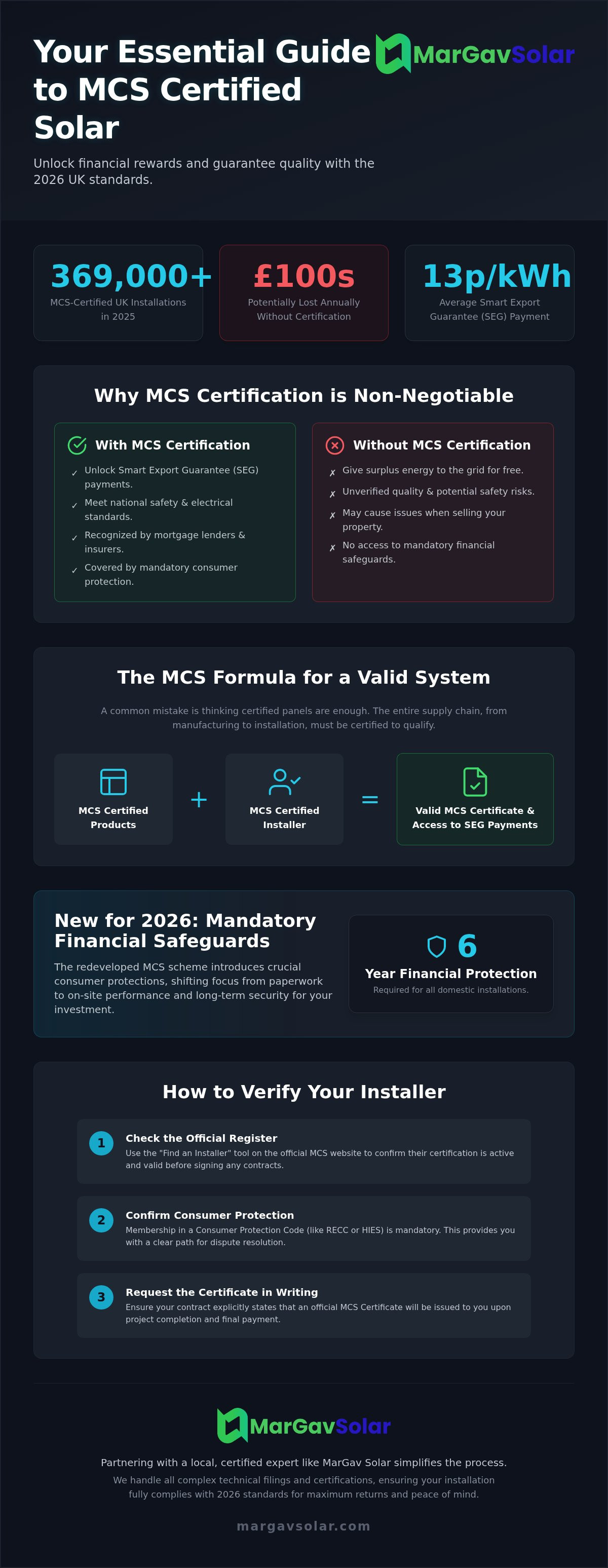
Did you know that skipping a single accreditation could cost your household hundreds of pounds in lost income every year? While the UK saw a record 369,000 renewable installations in 2025, many homeowners still struggle to distinguish between genuine quality and clever marketing. It's natural to worry about poor workmanship or missing out on financial incentives after spending your hard-earned money. That's why choosing mcs certified solar installers is the most critical step in your renewable journey, ensuring your system is both a technical success and a legal passport to energy payments.
The redeveloped MCS scheme went live in early 2026, shifting the focus from office paperwork to actual on-site performance. This guide simplifies these changes so you can invest with confidence. You'll learn how to secure the mandatory six year financial protection now required for all domestic installs and why the average SEG payment of 13p per kWh is only accessible with the right certification. We'll also show you how partnering with a Staffordshire expert like MarGav Solar ensures your installation meets these 2026 standards while we handle the complex technical filings for you.
Key Takeaways
- Understand why an MCS certificate is the only way to unlock Smart Export Guarantee (SEG) payments and stop giving your surplus energy to the grid for free.
- Discover the specific technical standards mcs certified solar installers must follow to guarantee the structural integrity and electrical safety of your Staffordshire home.
- Learn how to use official verification tools to spot "solar cowboys" and ensure your contractor is backed by mandatory consumer protection codes.
- See how the 2026 scheme updates provide a mandatory six-year financial safeguard for your investment, even if an installer stops trading.
- Find out how partnering with a local expert like MarGav Solar simplifies the process by handling all the complex technical paperwork and certifications for you.
What is an MCS Certified Solar Installer?
Choosing to install solar panels is a significant financial commitment. To protect homeowners, the UK uses a robust quality assurance framework. The Microgeneration Certification Scheme (MCS) serves as the primary standard for small-scale renewable energy technologies. At its core, an MCS certified installer is a contractor vetted for technical competence and adherence to national safety standards. Without this specific accreditation, your solar PV system is essentially an unverified electrical appliance rather than a government-recognised power plant. It's a mark of quality that separates professional engineers from "cowboy" builders who might lack the specific training required for high-voltage DC electrical work.
The scheme doesn't just look at the tools in the van. It evaluates the entire business operation, from how they design your system to how they handle your data and complaints. In 2025, the UK saw a record 369,000 MCS-certified installations. This surge highlights how homeowners increasingly rely on mcs certified solar installers to ensure their transition to green energy is both safe and legally compliant. By following rigorous technical standards, these installers guarantee that your system will perform as promised for decades.
The Role of the Microgeneration Certification Scheme
The scheme was established to regulate the rapid growth of the UK solar market. It works closely with the Department for Energy Security and Net Zero to ensure that renewable energy targets are met with high-quality engineering. MCS maintains a public register of approved contractors, allowing you to verify a company's credentials before signing any contracts. This oversight is vital because it provides a clear path for consumer protection. If an installer fails to meet the required standards, the scheme has the power to remove their certification, effectively barring them from the professional market.
Certified Products vs. Certified Installers
A common misconception is that buying high-quality, certified solar panels is enough. However, the certification is a two-part process. You must use MCS-approved products, but they must also be fitted by mcs certified solar installers. If a certified panel is installed by an uncertified person, the entire system fails to meet the national standard. This failure means you won't receive your MCS Certificate, which is a legal document often required when selling your property or applying for insurance. This two-part protection ensures the entire system lifecycle, from manufacturing to the final bolt in your roof, meets the highest safety benchmarks. Staffordshire experts like MarGav Solar simplify this by providing fixed-price contracts that include all necessary MCS certifications, handling the complex technical filings so you don't have to.
Why MCS Certification is Mandatory for Financial Incentives in 2026
Investing in solar technology is as much a financial decision as an environmental one. In 2026, the financial viability of your system depends almost entirely on your paperwork. Without a valid certificate from mcs certified solar installers, you are essentially gifting your surplus electricity to the National Grid. While your panels will still generate power, you'll have no legal way to get paid for the energy you don't use. This oversight can turn a high-yield investment into a missed opportunity, especially as energy export rates have become more competitive.
The requirement for certification extends beyond energy payments. Most major UK mortgage providers and home insurance companies now view solar panels as a material change to the property. They often insist on seeing MCS documentation to prove the work meets national safety standards. Before you sign a contract, it's vital to verify MCS credentials of your chosen firm to ensure they are authorised to issue these essential documents. If you're looking for a local partner who manages these technical hurdles, you can consult with the MarGav Solar team to see how we streamline the process.
Unlocking the Smart Export Guarantee (SEG)
The Smart Export Guarantee (SEG) is the primary way UK households earn money from their solar arrays. To apply for a SEG tariff, energy suppliers require your unique MCS certificate number. In 2024-25, households earned an average of 13p per kWh for their exported energy, with some peak tariffs reaching as high as 25p per kWh. For a standard 4kWp system in Stafford, which typically generates between 3,200 and 3,600 kWh annually, missing out on these payments could cost you hundreds of pounds each year. Energy suppliers simply refuse to offer export contracts to non-MCS systems, meaning your "off-grid" savings are the only benefit you'll see.
Impact on Property Value and Resale
Selling a home with solar panels requires transparency. During the conveyancing process, solicitors will ask for the MCS certificate as part of the standard property information form. A certified solar panel installation in Staffordshire adds verified value to your Energy Performance Certificate (EPC) rating, making the home more attractive to buyers. Conversely, an uncertified system is often flagged as "unauthorised" electrical work during a survey. This can lead to buyers demanding the system be removed or requiring expensive retrospective inspections before the sale can proceed. By using mcs certified solar installers, you ensure the system is a documented asset rather than a legal liability.
Beyond resale, certification is a prerequisite for any remaining 2026 government grants or local Staffordshire energy schemes. Whether it's the 0% VAT rate on installations (available until 31 March 2027) or local council initiatives, the MCS mark is the universal "passport" for eligibility. MarGav Solar specialises in these regulations, providing fixed-price contracts that include all necessary MCS filings so your investment is protected from day one.
Technical Standards: How MCS Protects Your Staffordshire Home
Technical excellence isn't just about the panels on your roof; it's about the invisible engineering that keeps your home safe. All mcs certified solar installers must strictly adhere to the MIS 3002 standards, which dictate every aspect of solar PV design and installation. These rules ensure that your system is more than just functional. It must be resilient against the UK's specific weather conditions, from high winds in the Staffordshire Moorlands to heavy snow loads. By following these standards, installers guarantee that the electrical components won't overheat and that the mounting system won't compromise your roof's waterproofing.
Safety is the primary driver behind these regulations. Before a single bolt is tightened, a certified installer must perform a rigorous assessment of your roof's structural integrity. They calculate whether your rafters can support the additional weight of the panels, which typically adds 15 to 20kg per square metre. Electrical fire safety is also a non-negotiable priority. MCS standards require specific DC isolators and cabling that prevent "arcing," a common cause of fires in non-certified, low-quality installations. This technical rigour ensures that your solar battery storage is integrated safely with the mains grid, preventing dangerous power surges or feedback loops.
Safety and Performance Audits
The redeveloped MCS scheme, which went live in early 2026, has shifted its focus from office-based paperwork to real-world, on-site quality. Installers are now audited more frequently on the actual performance of their systems rather than just their filing systems. These audits verify that the yield shading analysis provided to you during the sales process is accurate. It prevents "system underperformance" by ensuring that even minor shadows from a chimney or nearby tree are accounted for in your generation estimates. This level of scrutiny means that when you choose mcs certified solar installers, you're getting a system designed for the specific geography of your Stafford property.
Integrated Technology Standards
As homes become smarter, the complexity of the electrical load increases. MCS standards now cover the seamless integration of EV charging points to ensure your home's main fuse isn't overwhelmed when you're charging your car and running the dishwasher simultaneously. Your inverter must be capable of handling these competing demands while maintaining a steady flow of green energy. At MarGav Solar, we've spent over 20 years refining these integrations. We use only MCS-approved components, from the mounting rails to the battery management systems, ensuring long-term reliability. This holistic approach means your inverter upgrade or new battery solution will work in perfect harmony with your existing electrical infrastructure, backed by the latest 2026 safety protocols.
How to Verify MCS Credentials and Avoid "Solar Cowboys"
Identifying legitimate mcs certified solar installers is the only way to prevent your green energy dream from becoming a financial nightmare. While many companies display accreditation logos on their websites, these graphics can be easily faked. The first step for any Staffordshire homeowner is to use the official MCS Find an Installer tool. This database is the single source of truth for active certifications. If a company isn't listed there, they cannot issue the certificate you need for your Smart Export Guarantee (SEG) payments or your property's legal documentation.
Beyond the badge, you must look for membership in a Consumer Code like RECC or HIES. This is a mandatory requirement for any MCS-registered firm. These codes protect your deposit and provide an independent path for dispute resolution. Before you sign a contract, always ask for a "Performance Estimate" based on standard MCS calculation methods. This prevents sales teams from over-promising how much energy your roof will generate. Be wary of high-pressure sales tactics or claims of "limited time" government subsidies that sound too good to be true. In 2026, the primary financial benefits are the 0% VAT rate and energy export payments, both of which are stable and well-documented.
The "Check the Badge" Checklist
- Step 1: Search the MCS public register to confirm the company’s registration status is active and covers "Solar PV."
- Step 2: Verify the company holds NICEIC certification. This ensures they are qualified for general domestic electrical safety beyond just the solar panels.
- Step 3: Confirm they provide an insurance-backed workmanship guarantee. Under the redeveloped 2026 MCS scheme, every domestic installation must include an MCS-approved financial protection product with at least six years of cover.
Local Verification in Staffordshire
Choosing a local installer with a physical presence in Staffordshire offers a layer of accountability that national "lead generation" companies can't match. Many large firms use uncertified local subcontractors to save on travel costs, which can lead to a disconnect between the sales promise and the final installation quality. By hiring a local expert, you ensure the person on your roof is directly employed and vetted by the company you hired. You should also ask for local references who have used the firm for solar panel maintenance in Staffordshire. This proves the company is committed to long-term support rather than just a quick sale. If you want to ensure your system is installed by a verified local expert who handles all the paperwork, book a consultation with MarGav Solar today.
Choosing a Local Expert: MarGav Solar’s MCS-Certified Excellence
Selecting from the pool of mcs certified solar installers involves more than just comparing quotes. It's about finding a partner who understands the long-term technical requirements of your property. MarGav Solar stands out by combining over 20 years of electrical expertise with deep local knowledge of Staffordshire's specific housing stock. Whether you're retrofitting a traditional home in Stafford or equipping a modern property in Cannock, we design high-efficiency energy ecosystems tailored to your roof's orientation and your family's consumption patterns. This includes everything from the initial PV array to precision inverter upgrades that ensure your system delivers maximum ROI as your energy needs grow.
As mcs certified solar installers, we recognise that the paperwork is often the most daunting part of the transition. We handle the entire MCS registration process on your behalf, ensuring every technical detail is filed correctly with the national database. Once your system is commissioned, we provide your official certificate immediately. This document is your key to unlocking the 2026 export tariffs and ensuring your home remains compliant with building standards and mortgage requirements. We don't just install hardware; we provide the administrative security that protects your investment for decades.
End-to-End Support for Staffordshire Homeowners
Our commitment to your project begins with a detailed consultancy and extends through to long-term maintenance. We help you navigate the complexities of the SEG application process by providing the exact technical data your energy supplier requires. Because we are local, our team is always nearby to provide warranty support or system health checks. We operate under the strict standards of the Renewable Energy Consumer Code, which means your deposit is protected and your consumer rights are upheld at every stage of the installation. This end-to-end approach ensures that your transition to renewable energy is smooth, transparent, and professionally managed.
The MarGav Fixed-Price Guarantee
Budgeting for solar shouldn't involve guesswork. Our fixed-price contracts are truly comprehensive, meaning the price you see includes all necessary MCS certifications, structural assessments, and electrical safety upgrades. There are no hidden fees for the technical filings required to secure your financial incentives. To help you master your new energy system, we prioritise smart technology integrations like the GivEnergy cloud. This allows you to monitor your generation and battery storage levels from your smartphone, giving you total control over your home's efficiency. With 20 years of local experience, we provide the stability and technical excellence that Staffordshire homeowners trust for their solar journey.
Secure Your Staffordshire Energy Future Today
Choosing the right contractor is the most significant decision you'll make for your home's energy efficiency. As the 2026 standards shift toward stricter on-site performance audits, the role of mcs certified solar installers has never been more vital. You now understand that certification isn't just about high-quality panels. It's the legal key to unlocking export payments and ensuring your system is a documented asset during any future property sale. By prioritising technical rigour and mandatory financial protections, you're shielding your home from the risks of poor workmanship.
MarGav Solar makes this transition effortless by handling every technical filing and certification on your behalf. With 20+ years of Staffordshire solar expertise, our fully MCS and NICEIC accredited team provides fixed-price contracts with no hidden fees. You get the peace of mind that comes with a high-yield, safe solar system designed specifically for your local needs. Get a free quote from MarGav Solar’s MCS-certified experts today and start generating your own clean, profitable energy. It's time to take control of your bills.
Frequently Asked Questions
Is it a legal requirement to use an MCS certified installer in the UK?
It isn't a criminal offence to use a non-certified person, but it's practically essential for legal property compliance. Most District Network Operators (DNOs) and all Smart Export Guarantee providers require certification to approve your grid connection. Without an MCS certificate, you won't qualify for the 0% VAT rate on installations or be able to prove the work meets building regulations during a home sale.
Can I get the Smart Export Guarantee (SEG) without an MCS certificate?
No, you cannot access SEG payments without a valid MCS certificate. Energy suppliers require your unique certificate number as proof that your system meets national safety and performance standards. If you use uncertified installers, you'll be forced to export your surplus green energy to the grid for free, losing out on an average of 13p per kWh in 2024-25.
How do I check if my solar installer is actually MCS registered?
You should use the official MCS website's "Find an Installer" search tool to verify a company's status. Enter the company name or your postcode to see if they appear in the public register. Legitimate mcs certified solar installers will have an active registration number that covers "Solar PV" specifically, ensuring they are vetted for the 2026 technical standards.
What is the difference between MCS and NICEIC?
MCS specifically certifies the design and installation quality of renewable technologies like solar PV and heat pumps. NICEIC is a broader body that certifies general electrical competence and safety for domestic wiring. A reputable firm should hold both accreditations to ensure that your solar panels and your home's main consumer unit are handled by qualified professionals.
Does MCS certification cover battery storage and EV chargers?
Yes, MCS has specific standards for battery storage (MIS 3012) to ensure safe integration with the grid. While EV chargers fall under separate electrical regulations, mcs certified solar installers are trained to manage the combined electrical load of these technologies. This prevents your home's main fuse from blowing when you're charging your car and running high-power appliances simultaneously.
What happens if my MCS certified installer goes out of business?
You are protected by a mandatory insurance-backed guarantee that lasts for at least six years. Under the redeveloped scheme that went live in early 2026, every domestic installation must include this financial protection product. If your original installer ceases trading, this cover ensures that another certified firm can resolve any workmanship issues without you facing a massive bill.
Can I get an MCS certificate retrospectively for an existing system?
It's almost impossible to secure a retrospective certificate for a system fitted by an uncertified person. The scheme requires the installer to take full responsibility for the design, components, and commissioning at the time of the build. You would likely need to pay a certified firm to fully inspect, potentially rewire, and re-commission the system, which often costs more than the original installation.
How much extra does an MCS certified installation cost?
The cost of certification is typically included in the fixed-price quote provided by professional firms. While uncertified "cowboy" traders might offer a lower initial price, the long-term financial loss is significant. You'll lose the 0% VAT benefit, which is available until 31 March 2027, and you'll be barred from earning hundreds of pounds a year through energy export tariffs.


