

A charger in the car park won’t automatically make tenants happier. If it’s often unavailable, confusing to pay for or poorly explained, it can quickly become a source of frustration. Increasing tenant satisfaction with EV chargers starts with the experience around the equipment: tenants need to know how to access it, what charging will cost and where to turn when something goes wrong.
That takes more than choosing a charger. It means understanding who may use it, planning fair access across the property and setting out a clear approach to installation and ongoing management. For landlords and property managers in Staffordshire, these decisions can feel complicated, particularly when tenant demand is uncertain. This guide explains how to assess residents’ needs, compare access options and introduce charging with clear communication and reliable support. It also covers how EV chargers can fit into a wider property energy plan, including solar PV or battery storage where they suit the building.
Key Takeaways
- Find out which tenants need charging and how they expect to use it before settling on a setup.
- Increasing tenant satisfaction with EV chargers depends on dependable access, clear payment arrangements and simple guidance when issues arise.
- Compare shared, assigned and phased charging options against the property’s layout, management capacity and residents’ needs.
- Keep tenants informed about installation disruption, changes to access and the steps they’ll need to take to get started.
- Consider EV charging as part of a wider property energy plan, incorporating solar PV or battery storage when it suits the building.
How EV chargers can improve tenant satisfaction in rental properties
A well-planned EV charging amenity can make a rental property more convenient for residents who drive electric vehicles. It can also help prospective tenants understand how the building supports changing travel needs. But the charger’s presence alone doesn’t guarantee a better experience. If residents can’t tell who may use it, how payment works or what to do when it stops working, the amenity can create uncertainty rather than remove it.
Tenant-centred EV charging means providing dependable, fair and easy-to-understand access that fits residents’ everyday routines. This puts the focus on how the system works for its users, not simply how many charge points are installed. Adding more units won’t necessarily resolve peak-time clashes, unclear rules or payment confusion. A smaller, thoughtfully managed setup may work better if tenants know how to access it and what to expect.
What tenants need from an EV charging amenity
Current EV drivers need charging access that fits their parking patterns, straightforward instructions, understandable payment and a clear route for reporting problems. Residents who don’t yet own an EV may still value knowing what provision exists and how they could use it if their needs change. Put the essentials in places tenants can easily find, such as welcome materials and shared property communications. Cover who can use the chargers, how to start a session, any payment steps and how to report a fault.
For a primer on charging terminology and equipment, see this overview of electric vehicle supply equipment (EVSE). Understanding the basic terms makes it easier to explain the specific access and payment arrangements at the property.
How to understand tenant demand before planning
Start with a short survey rather than assuming every resident parks or charges in the same way. Ask whether tenants currently drive an EV, whether they expect to consider one in the near term, and what would make shared charging practical. Include questions about parking routines, likely charging times, how long vehicles are usually parked and concerns such as availability, cost clarity or ease of use.
Look for patterns in the responses rather than treating one person’s preference as everyone’s requirement. For example, tenants who leave early for work may need different arrangements from residents whose cars remain parked during the day. Share what you learn and explain how it will inform planning. For foundational charger context, read the EV charging points guide for Staffordshire homeowners.
Good demand discovery gives property teams a clearer basis for decisions and shows tenants their everyday needs are part of the plan. That’s a more credible route to increasing tenant satisfaction with EV chargers than treating installation as a box-ticking exercise.
Design EV charger access around reliability, fairness and ease of use
Once tenant needs are clearer, decide how residents will share access and what happens during a typical charging session. A fair system doesn’t have to give everyone identical arrangements, but its rules should be consistent, visible and easy to follow. This practical focus also supports the wider infrastructure ambitions set out in the official UK government EV strategy.
Shared chargers or assigned charging spaces?
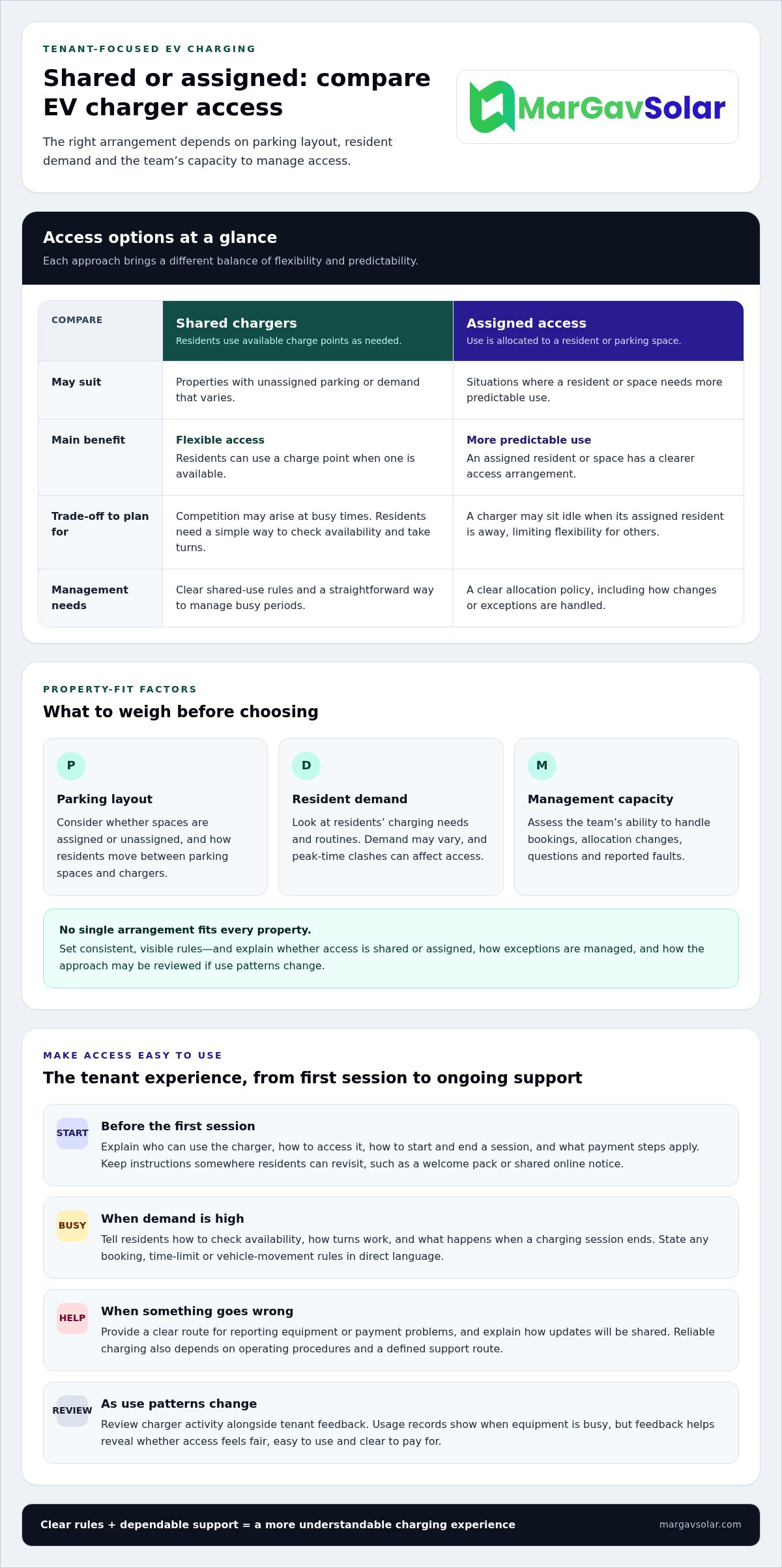
Shared chargers let residents use available charge points as needed, which can suit properties where parking spaces are unassigned or demand varies. The trade-off is possible competition at busy times, so tenants need a straightforward way to understand availability and take turns. Assigned access can give a resident or space more predictable use, but may leave a charger idle when that person is away and limit flexibility for others.
Neither arrangement is right for every property. Consider the parking layout, resident demand and the management team’s capacity to handle bookings or allocation changes. A clear policy should explain whether access is shared or assigned, how exceptions are managed and how the approach may be reviewed if use patterns change.
Make access, payment and support easy to understand
Before a tenant’s first session, they should be able to find out how to access the charger, start and end a session, understand payment steps and report a problem with the equipment or payment process. Put these instructions somewhere residents can easily revisit, such as a welcome pack or shared online notice. Use direct wording, and explain any booking, time-limit or vehicle-movement rules without relying on technical jargon.
Clear expectations prevent avoidable disputes. If there’s a queue, tenants should know how to check availability and what happens when a session ends. If a fault is reported, tell them where to send the report and how updates will be shared. Reliable charging depends on more than suitable equipment: operating procedures and a defined support route matter too.
Review charger activity alongside tenant feedback. Usage records may show when the equipment is busy, but they can’t explain whether residents find the system fair, easy to use or difficult to pay for. Invite comments through a simple feedback channel, look for recurring issues and use both kinds of information to adjust guidance or access arrangements. This helps keep increasing tenant satisfaction with EV chargers a practical goal as residents’ needs evolve.
For property-focused EV charging point planning in Staffordshire, explore MarGav Solar’s EV charging solutions.
Compare EV charging approaches by tenant experience and property fit
The right setup depends on more than charger hardware. A shared car park with unassigned spaces calls for different arrangements from a block where parking bays belong to individual flats. Compare each option against the same practical questions: who can charge, how payment is explained, how much administration is involved, whether provision can grow and how easy the system is for tenants to use.
Which access model fits a rental property?
Shared charging lets residents use available points, offering flexibility where parking is communal. It can also mean more coordination at busy times. Individually assigned provision gives a tenant more predictable access, but may be less flexible if the allocated space or charger sits unused. Tenancy terms, parking rights and the physical layout all shape what is workable, so neither model is automatically fairest for every building.
| Approach | Access and payment clarity | Management and growth | Tenant usability |
|---|---|---|---|
| Shared charging | Make availability, turn-taking and payment steps explicit. | May need booking or usage rules; additional provision can be considered as demand becomes clearer. | Flexible for residents, but access can feel uncertain at busy times. |
| Individually assigned | Access is tied to a designated resident or parking space; explain how payment is handled. | Allocation changes may need managing; expansion can involve further assigned spaces. | Predictable for the assigned user, with less flexibility for other residents. |
| Phased expansion | Set out who can use the initial provision and how arrangements may change. | Allows provision to develop in stages as site needs and demand are reviewed. | Can help match provision to observed use, but tenants need clear updates at each stage. |
What to compare beyond charger hardware
A charger’s rated capability doesn’t tell you how much electrical capacity the property can supply, especially if several vehicles may charge at the same time. Site conditions and expected simultaneous demand should inform the design and any phased plan. The property and the vehicles residents use should also be considered when assessing technical specifications and compatibility.
Compare the complete user experience, not headline power alone. Consider whether instructions are easy to find, payment steps are understandable, usage information helps property teams spot patterns and tenants have a clear route to report faults. Consistent criteria make trade-offs easier to explain and support increasing tenant satisfaction with EV chargers without assuming that one arrangement suits every resident.
For landlords exploring whether support may apply to a project, GOV.UK provides guidance on the EV chargepoint grant for landlords, including eligibility and the application process. Treat grant considerations as one part of planning, alongside access, site capacity and the ongoing experience tenants will have.
How to roll out EV chargers while keeping tenants informed
A well-managed rollout gives residents time to understand what’s changing and how it affects their parking and daily routines. Work through the steps in order, and keep tenants updated before decisions become changes on site.
A tenant-centred rollout in practical stages
- Discover resident needs. Gather feedback on current and likely EV use, parking arrangements, preferred charging times and concerns. This gives you a practical starting point instead of relying on assumptions.
- Review the property. Consider the car park layout, access arrangements, site constraints and the building’s energy context. If you’re also exploring solar as part of a wider property plan, see this solar panel installation guide for Staffordshire.
- Plan the work and explain the impact. Before installation begins, tell tenants what areas may be affected, whether parking or access will change, and what the next steps are. Give updates if arrangements change, rather than leaving residents to discover disruption for themselves.
- Prepare tenants to use the chargers. Share simple instructions covering access, starting and ending a session, payment and where to report a fault. Make the information easy to find again after the initial announcement, such as in a welcome pack or shared online notice.
- Review and refine. After launch, invite residents to share what’s working and where they’re getting stuck. Use that feedback to improve instructions, access arrangements or operating rules.
Measure whether the charging experience is improving
Usage data can show when chargers are busy or quiet, but it can’t tell you on its own whether tenants find access fair or the process clear. Review activity alongside complaints, support requests and direct feedback. Look for recurring barriers such as unclear payment steps, conflicts over shared access or reports that a charger isn’t working.
Set a regular point to review these signals with the team responsible for the property. If the same question keeps coming up, clarify the guidance. If access conflicts recur, revisit the operating arrangements and explain any changes to residents before they take effect. This feedback loop makes increasing tenant satisfaction with EV chargers a practical management goal, not just an installation milestone.
For a Staffordshire property, MarGav Solar provides EV charging points as part of a considered energy approach. Discuss EV charging for your property.
Plan a tenant-focused EV charging solution with MarGav Solar
Increasing tenant satisfaction with EV chargers starts before installation. Landlords and property managers need to bring together what residents need, how parking is organised, which access arrangement suits the building and how information will be maintained after the chargers are in use. A considered plan makes it easier to align the charging setup with tenant experience and the property’s practical requirements.
When EV charging belongs in a wider energy plan
EV charging can be planned as a standalone property improvement or considered alongside solar PV and battery storage. Whether these technologies fit together depends on the site’s energy needs and project design. The decision should follow an assessment of the property rather than an assumption that every building needs an integrated system. For background on solar planning in the area, see the Staffordshire solar panel installation guide.
MarGav Solar provides EV charging points, solar PV and battery storage, with more than 20 years of industry experience in renewable energy projects. Its consultancy and professional installation services help property owners consider how a solution fits the site and its energy needs, rather than treating charger hardware as the only decision.
Next steps for landlords and property managers
Before moving toward implementation, gather the information that will shape the project. A concise planning brief can help keep tenant priorities and property constraints in view:
- Summarise current and anticipated tenant charging needs.
- Record parking arrangements, site constraints and any access requirements.
- Set out the preferred access model and how tenants should receive updates.
- Note whether solar PV or battery storage merits consideration as part of the wider property energy plan.
With these details in hand, consultation and professional installation support can help turn the brief into a solution tailored to the property. Keep communication in the plan beyond the installation date, too. Residents should know how to use the chargers, where to find operating information and how to share feedback as their needs change.
A tenant-focused charging plan is built around the whole experience: appropriate access, a good fit for the building and clear communication over time. Explore EV charging and energy solutions with MarGav Solar for a property-specific approach.
Make tenant-friendly charging part of your property plan
Increasing tenant satisfaction with EV chargers depends on more than installing equipment. Start with residents’ needs, choose an access arrangement that fits the property, and make payment, usage rules and support easy to understand. Keep tenants informed before work begins, then use their feedback alongside usage information to improve the experience over time.
For landlords in Staffordshire, it can also help to consider EV charging as part of the wider energy plan. Solar PV or battery storage may be relevant where they suit the property’s needs and project design. MarGav Solar brings more than 20 years of industry experience and provides EV charging points, solar PV and battery storage. Its support spans consultation through to long-term maintenance and equipment warranties.
Ready to take the next step? Explore EV charging and energy solutions with MarGav Solar and plan an approach tailored to your property.
Frequently Asked Questions
Can EV chargers increase tenant satisfaction in rental properties?
Yes, EV chargers can support tenant satisfaction when they meet a genuine need and are easy to use. Convenient access, understandable payment, clear operating rules and a straightforward way to report faults all contribute to the experience. For landlords increasing tenant satisfaction with EV chargers, resident feedback matters as much as installation: ask what tenants need, then review their comments and charger use after launch. Chargers alone can’t guarantee happier tenants.
How can landlords make shared EV charging fair for tenants?
Set clear rules explaining who can use each charger, how access works and how payment is handled. Choose shared or assigned access to suit the parking arrangements and residents’ needs, rather than assuming one system is fair for everyone. Tenants should also know how to raise access conflicts or report faults. Review feedback over time, and update the guidance if residents find the process confusing or their needs change.
Are shared EV chargers or dedicated chargers better for tenants?
Neither option is best for every rental property. Shared chargers can give more residents access to a smaller number of charge points, but availability may be less predictable at busy times. Dedicated arrangements can make charging more predictable for an individual tenant, while offering less flexibility to others. Consider parking layout, tenancy arrangements, demand and the team’s capacity to manage access, then explain the chosen rules clearly.
What should landlords tell tenants before installing EV chargers?
Explain why the project is happening, which areas may be affected, the expected sequence of work and any temporary changes to parking or access. Before chargers are available, share clear instructions on how to use them, understand payment and report a problem. Avoid giving exact dates unless they’re established. If plans or access arrangements change, update tenants promptly so they know what to expect and what action, if any, they need to take.
How can property managers measure tenant satisfaction with EV chargers?
Combine charger usage information with tenant feedback, support requests and reports of access or reliability problems. Usage figures can show when charge points are being used, but they can’t reveal whether residents find the arrangements fair or easy to understand. Ask focused questions after launch, look for recurring barriers such as confusing instructions or access clashes, and make practical changes to communications or operating rules. This helps landlords keep increasing tenant satisfaction with EV chargers.
Can EV chargers work with solar panels in rental properties?
Yes, EV charging can be considered alongside solar PV or battery storage as part of a wider property energy plan. The right design depends on the site’s energy system, electrical capacity, charging demand and how those needs fit together. Solar generation won’t necessarily match the times tenants want to charge, so assess the whole setup rather than assuming the two will automatically align. Staffordshire landlords can explore these options as part of a property-specific plan.


