

A 22kW charger won’t necessarily charge your EV faster at home. In the 7kW vs 22kW home EV charger comparison, the useful charging speed depends on two things beyond the unit itself: your home’s electricity supply and the maximum AC charging rate your vehicle can accept.
It’s understandable to focus on the higher number when you want quicker charging. But a 22kW unit can’t deliver its full speed without a three-phase supply and a vehicle able to accept that rate. For many households, a 7kW charger can provide practical overnight charging without adding capacity they won’t use.
This guide compares real-world charging speeds, vehicle compatibility and single-phase versus three-phase supplies. It also explains how solar panels and battery storage may fit into your charging plans, so you can consider a charger as part of your home energy system.
If you’re a Staffordshire homeowner, you’ll also learn which vehicle and property details to have ready for a home EV charger consultation. MarGav Solar can consider EV charging alongside residential solar PV and battery storage, helping you weigh up what suits your home and driving habits.
Key Takeaways
- The 7kW vs 22kW home EV charger decision comes down to usable charging power, not the number printed on the unit.
- Check your vehicle’s onboard AC charging limit before assuming a higher-rated charger will cut charging time.
- Compare your usual parking routine and daily charging needs, then consider how battery size and starting charge affect timing.
- Establish what your home’s electrical supply and installation conditions can support before settling on a charger rating.
- Bring your vehicle and property details to a Staffordshire consultation, and consider how charging could fit with solar PV or battery storage.
7KW vs 22kW Home EV Charger: What Does the Difference Mean?
The kilowatt (kW) rating describes a charger’s maximum power output under suitable conditions. It isn’t a promise that your car will always receive that amount. The power available at any moment is limited by the charger, the vehicle’s onboard AC charging capability and the home’s electrical supply. The electric vehicle charging station overview explains the role of AC charging and the vehicle’s onboard charger, which converts incoming power for the battery.
That’s the key to the 7kW vs 22kW home EV charger decision: compare the power your vehicle and property can actually use, rather than choosing by the higher headline rating alone. A 7kW charger is a common point of comparison for UK homes, but the right option depends on your vehicle, supply and charging routine. For a broader overview of home charging, see the EV charging points homeowner’s guide.
What does a 7kW home EV charger deliver?
A charger rated at around 7kW is generally associated with a single-phase home supply. It can add charge while your car is parked, making overnight charging practical when the vehicle stays at home for several hours. The actual rate can be lower if the car’s onboard charger accepts less power, or if the supply or charger configuration limits output. A 7kW rating is a useful comparison, not a guarantee of how quickly every EV will charge.
There’s no reliable fixed charging time without knowing the battery size, its starting charge and the car’s AC limit. For a useful estimate, check those details for your vehicle and consider how much charge you typically need before the next journey.
What does a 22kW home EV charger require?
A 22kW charger typically relies on a three-phase electricity supply and compatible charging equipment. Three-phase power is less common in UK homes than single-phase, so the property’s supply is central to assessing whether this rating is practical. Installation design and available electrical capacity also affect the usable power.
The car must be able to accept 22kW AC to benefit from the full output. If its onboard charger has a lower limit, it will charge at that lower rate even when connected to a 22kW unit. That’s why 22kW is an option to assess against your vehicle and home, not an automatic upgrade. A home charging consultation can consider these factors alongside solar PV or battery storage if you’re planning a wider home energy system.
What Determines Whether Your EV Can Use 7kW or 22kW?
A charger’s rating is only one part of the charging equation. The power your car can draw is constrained by the lowest relevant limit: the vehicle’s onboard AC charger, the charge point, the home’s electrical supply and the installation configuration. A 22kW unit cannot make a car accept 22kW if its own AC charging limit is lower.
This distinction separates a theoretical maximum from the rate you can routinely achieve at home. For a useful comparison, check your vehicle’s AC limit and establish the property’s supply before treating the charger rating as your likely charging speed.
How does your car’s onboard charger affect charging speed?
Look in the vehicle handbook or the manufacturer’s specifications for its maximum AC charging input. This is different from the peak power the car may accept at a rapid DC charger. If the onboard AC charger has a lower limit than the wall unit, charging will be capped at the vehicle’s limit. For example, a car limited to 11kW AC won’t use the full output of a 22kW charge point. Check the exact specification for your model and version rather than relying on a general claim about a vehicle range.
Does your home have the electrical supply for 22kW charging?
Single-phase and three-phase describe how electricity is supplied to a property. A single-phase supply is common in UK homes and is typically associated with charging around 7kW. A 22kW charge point generally requires three-phase supply, along with compatible equipment and a suitable installation. Don’t assume which supply your home has based on its age or appearance.
An installation assessment can establish the existing supply, available capacity, charger configuration and practical installation requirements. These factors distinguish what the equipment is rated to deliver from what your home can support in everyday use. They also help determine whether any changes are relevant, rather than assuming an upgrade is needed.
Installation planning should account for applicable building-control requirements. The Planning Portal offers general building control application guidance; requirements for a particular project depend on its circumstances.
For Staffordshire homeowners, exploring EV charging installations as part of a home energy assessment brings vehicle compatibility, electrical supply and wider plans for solar PV or battery storage into the same conversation.
7KW vs 22kW Home Charging: Compare Realistic Use, Not Just Speed
The higher rating doesn’t automatically mean a shorter charge at home. If your car can’t accept the charge point’s full AC output, or your property’s supply limits it, the extra rated capacity won’t translate into faster charging. A fair comparison looks at the vehicle, supply and the hours your car is usually parked.
| Factor | 7kW charger | 22kW charger |
|---|---|---|
| Typical supply | Generally associated with a single-phase home supply. | Typically requires a three-phase supply and suitable installation. |
| Vehicle compatibility | Usable power depends on the car’s onboard AC charging limit. | Only delivers the higher rate if the vehicle can accept it and the supply supports it. |
| Potential use case | May suit a car parked at home for longer periods between journeys. | May be worth assessing where compatible equipment, supply and shorter parking windows align. |
| Assessment needs | Check the vehicle limit, household supply and installation design. | Check all of those, with particular attention to three-phase supply and usable vehicle capacity. |
Charging time varies with battery size, starting charge and the vehicle’s maximum AC input. Comparing two charger ratings alone can’t tell you how long a specific car will take to charge.
When can a 7kW charger suit everyday home charging?
Consider how long your car is typically parked at home, how far you drive between charging sessions and how much charge you need before your next trip. If the car is parked overnight, the available charging window may matter more than choosing the highest possible rating. A 7kW charger may fit that pattern, but it isn’t automatically right for every vehicle or driver.
When might a 22kW charger be worth assessing?
A 22kW option may be relevant if your vehicle can accept higher AC power, your home supply can support it and you have shorter periods to charge between journeys. It may also be worth considering if your household’s needs could change, but don’t assume a future benefit will make the rating worthwhile. Vehicle capability and a property assessment determine whether the additional output is usable.
If you’re planning solar, charger selection can also fit into a wider home energy discussion. Explore integrating EV chargers with solar panels to consider how charging and solar generation may work together.
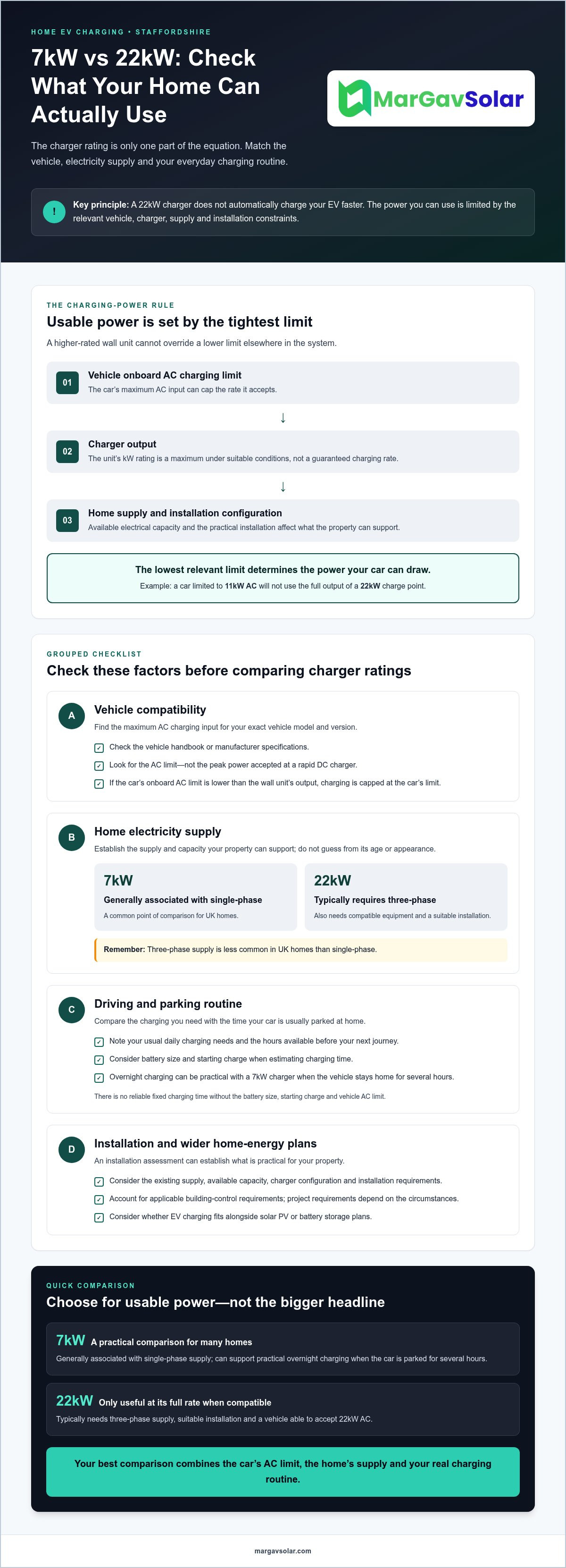
How to Choose Between a 7kW and 22kW Charger for Your Home
Make the decision in sequence. Your vehicle and day-to-day routine show how much charging you need; a property assessment establishes what the home setup can support. This keeps the 7kW vs 22kW home EV charger choice grounded in practical use, rather than selecting a rating first and hoping it fits.
Which questions should you answer before selecting a charger?
- Check your vehicle’s AC charging limit. Find the maximum AC input in the handbook or manufacturer specifications. This helps establish whether a higher-rated charge point could offer a usable benefit.
- Estimate your regular charging demand. Note your typical daily driving and how much charge you usually need before the next journey. Focus on your normal routine, not only occasional long trips.
- Record your parking pattern. Where does the car stay while charging, and how long is it usually parked there? A longer charging window may suit your routine even if you don’t need the highest possible output.
- Include energy plans where relevant. If you have solar PV or battery storage, consider whether you want EV charging to fit into a wider home energy plan. These systems may shape your goals, but they don’t replace the need to match charger power to the vehicle and property.
- Gather property details. Note the likely charger location and any practical constraints around the parking space or cable route. These details help make an assessment more useful.
How does a home assessment help settle the choice?
For Staffordshire homeowners, a consultation with MarGav Solar can bring your vehicle details, charging routine and property requirements into one discussion. The assessment considers the electrical setup and proposed charge point location, then shapes installation details around the home. That helps distinguish a charger’s rated output from a setup that makes sense for your property and routine.
If you’re planning solar PV or battery storage too, MarGav Solar can consider EV charging alongside those parts of your home energy system. That way, the charger decision reflects your wider plans where relevant, rather than treating the unit as an isolated choice.
Prepare your vehicle specifications, parking routine and property information, then arrange a home EV charging consultation to discuss a charger option suited to your requirements.
Plan a Home EV Charger Installation in Staffordshire
Once you’ve compared charger ratings, bring the key details together. Vehicle capability, parking habits and the property’s electrical setup all inform the installation plan. For Staffordshire homeowners, a consultation with MarGav Solar can consider these requirements alongside wider plans for the home’s energy system.
What information helps plan the right installation?
Gather a few details before your consultation so the discussion can focus on how charging will work in practice:
- Vehicle: Note the make and model, and bring the manufacturer’s verified maximum AC charging specification.
- Routine: Describe typical daily driving, where the car parks and the usual charging window between journeys.
- Future plans: Mention a potential vehicle change if it could affect your charging needs.
- Property: Share where you’d like the charger located and any relevant information about the electrical setup.
- Home energy: Include details of existing or planned solar PV and battery storage if you want to consider them as part of the charging plan.
These details put the 7kW vs 22kW home EV charger choice in context. The aim is to match the installation to the car you drive, the time it spends parked and the home’s requirements, rather than focusing on a rating in isolation.
How can EV charging fit with solar and battery storage?
Solar PV and battery storage may influence when you prefer to charge or how you plan household energy use. Their relevance depends on your system and goals, so consider them as part of the overall design without assuming a particular charging rate or that charging will always be solar-powered.
If you’re weighing up storage as part of an integrated setup, read the solar battery storage guide for more context.
MarGav Solar has over 20 years of industry experience, with support from consultation through installation and long-term maintenance. For Staffordshire homeowners, charger selection can be discussed alongside solar PV or battery storage where relevant to the household. Discuss a home EV charging solution and plan an installation around your vehicle, property and charging routine.
Choose a Charger That Fits Your Home
The right 7kW vs 22kW home EV charger choice depends on the power your vehicle can accept, your property’s electrical supply and how long your car is usually parked. A higher-rated charger won’t necessarily charge faster if the vehicle or home setup limits its output.
Before deciding, gather your car’s AC charging specification, typical driving needs and parking routine. If solar PV or battery storage is part of your plans, factor that into the wider home energy conversation too.
Staffordshire homeowners can plan EV charging with MarGav Solar, drawing on over 20 years of industry experience and support from consultation through installation. Charger selection can be considered alongside residential solar PV and battery storage where it suits your household.
Discuss a home EV charging solution with MarGav Solar and take the next step towards a setup shaped around your vehicle, property and everyday routine.
Frequently Asked Questions
Is a 22kW home EV charger faster than a 7kW charger?
It can be, but only if your vehicle and home electrical supply can both use the higher output. The car’s onboard AC charger may cap the rate, while the property’s supply and charger configuration can also limit it. If any part of the setup can deliver less than 22kW, the car won’t receive the charger’s full rated power. The charger rating alone doesn’t determine your actual charging speed.
Can every electric car use a 22kW home charger?
No. An electric car’s onboard AC charger sets the maximum rate it can accept from a home charge point. Some vehicles have a lower limit than 22kW, so they won’t take the unit’s full output. Check the handbook or manufacturer specifications for your exact model and version, and look specifically for its maximum AC charging rate. A car’s rapid DC charging capability doesn’t establish its AC limit.
Do I need a three-phase electricity supply for a 22kW EV charger?
Typically, yes. A 22kW home charge point generally relies on a three-phase supply, whereas a 7kW charger is commonly associated with single-phase supply. Don’t assume which type your property has; establish it as part of an assessment. Available capacity, charger configuration and installation requirements also affect the power a home setup can support.
Is a 7kW charger enough for home charging?
A 7kW charger may suit your home routine if your vehicle can use that rate and it’s parked for enough time between journeys. Consider your usual daily driving, how much charge you need and when the car is available to plug in. It isn’t automatically sufficient for every driver or vehicle, so compare your routine with the car’s AC limit and your property’s electrical setup.
How much faster is a 22kW charger than a 7kW charger?
On paper, 22kW is a little over three times 7kW, but that describes rated power, not a guaranteed reduction in charging time. The vehicle must accept the higher AC rate, and the household supply and installation must support it. Actual charging time also depends on battery size and starting charge. If the car’s AC limit is lower, a 22kW charger won’t deliver its full rated output.
Will a 22kW charger work with my home’s electrical supply?
It depends on the supply and electrical capacity at your property. A 22kW charger typically requires three-phase supply, but the installation design and other site conditions matter too. An installation assessment can review the existing electrical setup and proposed charger location to establish what’s practical. Don’t choose a 22kW unit based only on its rating or assume an upgrade is needed without a property-specific assessment.
Can I use solar panels with a 7kW or 22kW EV charger?
Solar PV can be considered alongside either charger rating, but how the systems work together depends on the home’s setup and charging goals. Your solar generation, battery storage if present, vehicle and charging routine all influence the plan. Solar doesn’t guarantee a particular charging rate or mean every charging session will use solar power. Staffordshire homeowners can discuss EV charging and residential solar PV together with MarGav Solar.


