
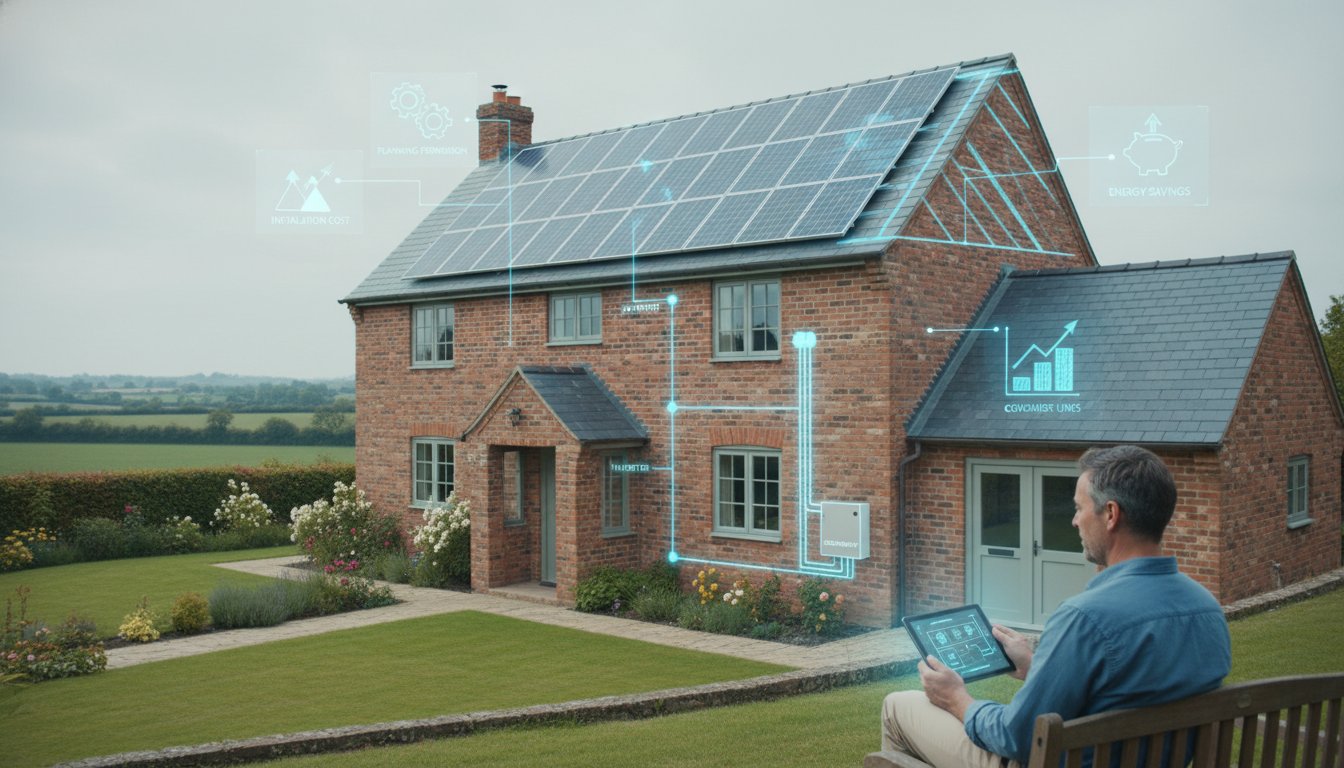
What if the most expensive part of your renewable energy transition isn't actually the panels themselves? It's a common worry for UK homeowners who feel overwhelmed by technical jargon like G99 applications or DNO approvals. You likely suspect that the initial quote you've received doesn't tell the whole story. The truth is that the hidden costs of solar panels UK residents encounter often stem from necessary site preparations and long-term component lifecycle management rather than just the hardware.
We understand that you want total transparency so you can invest with confidence and secure the best possible return on your investment. This guide reveals the often overlooked expenses, such as potential £500 G99 fees for larger systems or the £300 to £800 needed for consumer unit upgrades in older homes. We'll help you map out a clear budget for the next 25 years. You'll learn how to account for scaffolding, structural surveys, and future system care to ensure your installation remains a high-performing asset for decades.
Key Takeaways
- Identify site-specific expenses like scaffolding and structural reinforcements that are often missing from basic estimates.
- Budget for the long-term hidden costs of solar panels UK homeowners encounter, such as planned inverter replacements after 12 to 15 years.
- Protect your system's efficiency by accounting for professional maintenance, cleaning, and essential bird proofing to prevent nesting damage.
- Navigate administrative requirements, including potential planning permission fees and insurance adjustments, to ensure full regulatory compliance.
- Secure your investment's ROI by choosing transparent, fixed-price installation contracts that cover all technical and grid-related costs upfront.
The "Pre-Installation" Surprise: Roof and Grid Readiness
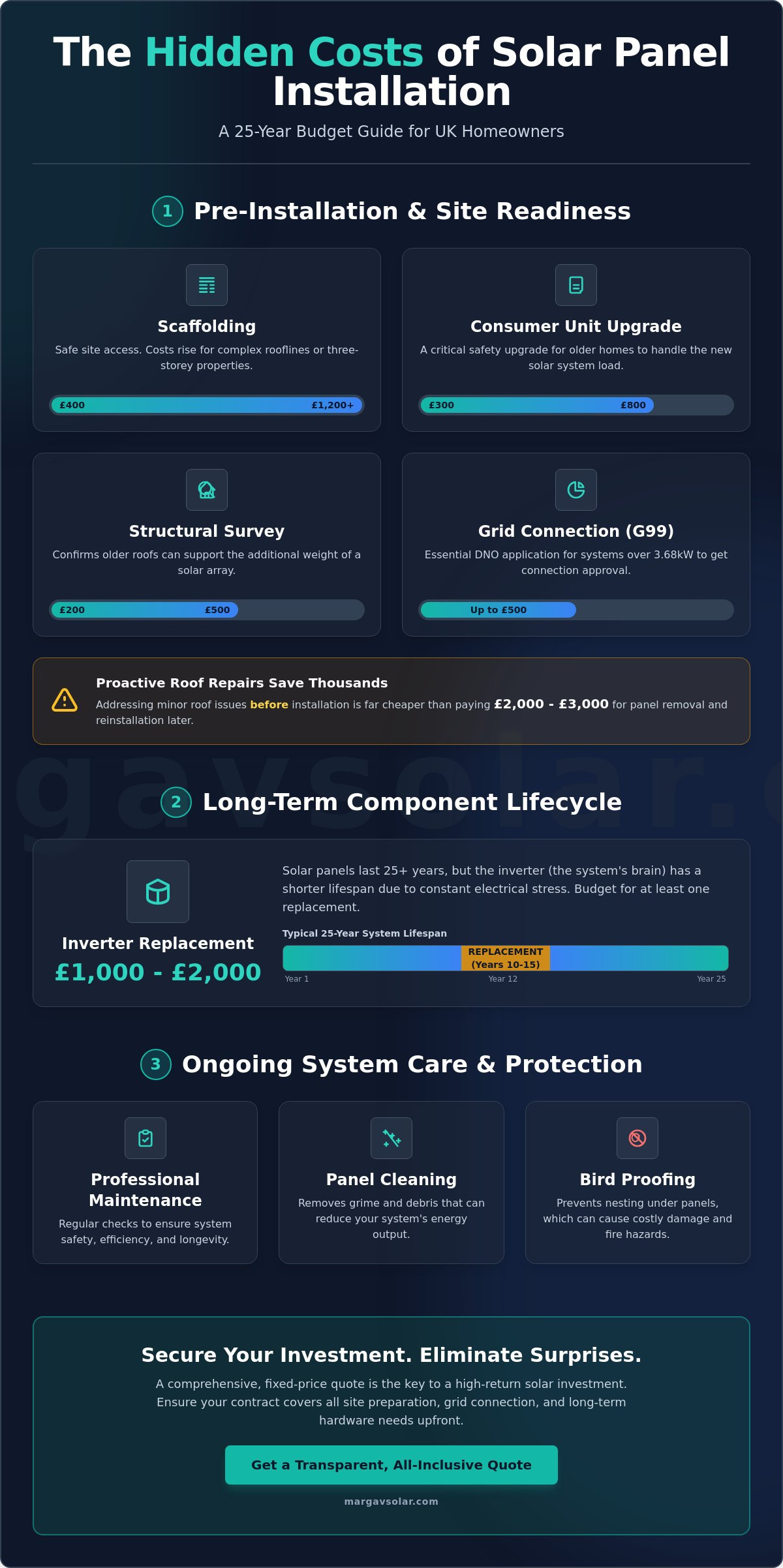
Many homeowners assume that once they've chosen their panels, the heavy lifting is over. However, the physical and electrical infrastructure of your home determines a large portion of the final investment. One of the most common hidden costs of solar panels UK buyers face is the preparation required to make a property solar-ready. This starts with the scaffolding, which provides safe access for installers. While a standard two-storey semi-detached house usually incurs predictable costs, complex rooflines or three-storey properties can see these expenses rise significantly. In 2026, standard scaffolding typically adds between £400 and £800, but difficult access or complex layouts can push this toward £1,200.
Your electrical system also needs to be up to the task. If your home hasn't had an electrical inspection in the last decade, your consumer unit might require an upgrade. Solar PV systems add a continuous electrical load that older boards aren't designed to handle safely. Upgrading to a modern, metal-clad consumer unit with appropriate surge protection often costs between £300 and £800. This is a critical safety step that ensures your home can manage the power generation and battery storage integration without risk. It's a necessary foundation for a high-ROI system.
Structural Surveys and Roof Repairs
Staffordshire is home to many beautiful older properties, but their roofs wasn't always built with the weight of modern solar arrays in mind. A structural survey, costing between £200 and £500, is often required for older homes to confirm the rafters can support the additional load. You might also find that specific tile types, such as brittle slate or Rosemary tiles, require specialist mounting brackets to prevent leaks. It's much cheaper to address minor roof repairs before the panels are installed than to pay for panel removal and reinstallation later, which can cost £2,000 to £3,000.
Grid Connection Fees and DNO Applications
Connecting your system to the local grid isn't always a simple process. In Staffordshire, the Distribution Network Operator (DNO) is National Grid, formerly known as Western Power Distribution. If you're installing a system larger than 3.68kW, you must submit a G99 application to gain permission to connect. These applications can cost up to £500 and are essential for ensuring the local grid can handle your system's export capacity. As Solar power in the United Kingdom continues to expand, some areas face grid congestion. In these cases, you might need to invest in export limitation hardware. This technology manages how much energy your system sends back to the grid, preventing local outages while still allowing you to maximise your internal energy use.
Technical "Add-ons": Inverters, Batteries, and Smart Monitoring
While the panels on your roof are designed to last for decades, the electronic components that make the system work have a different lifecycle. When calculating the hidden costs of solar panels UK homeowners often overlook the technical hardware that sits behind the scenes. This hardware is responsible for converting energy and managing your home's power flow. If you don't budget for these technical "add-ons" and their eventual replacement, your long-term ROI calculations will be inaccurate. Choosing between a standard string inverter and a system with power optimisers also changes your upfront cost. Optimisers can add between £50 and £150 per panel to your initial bill. They improve performance in shaded areas, but they represent a higher initial investment that you must weigh against potential energy gains.
The Inverter Replacement Cycle
Your solar panels might have a 25-year warranty, but the inverter is the workhorse of the system and faces constant electrical stress. The typical inverter lifespan is 10 to 15 years. This means you should budget for at least one replacement during the life of your panels. In 2026, a replacement inverter typically costs between £1,000 and £2,000. It's often more cost-effective to plan for inverter upgrades that offer better efficiency and modern monitoring features when your original unit reaches its limit. Microinverters are an alternative, but they involve a higher upfront cost since each panel requires its own unit, though they can simplify future maintenance.
Battery Storage and Future-Proofing
A battery isn't just an "extra"; it's the key to maximizing your independence from the grid. The hidden cost of not installing a battery is the money you lose by exporting energy for a low tariff and buying it back at night for a premium. You can find detailed data on solar panel costs and savings to see how storage changes the financial landscape. A 5-10 kWh battery currently costs between £4,000 and £8,000. While retrofitting solar battery storage is possible, it's usually cheaper to install it alongside your panels to save on labour and ensure hardware compatibility. Modern systems often include smart controls like the GivEnergy Cloud, which help you track performance without hidden subscription fees. If you're worried about your current system's efficiency, you might want to look into professional solar panel maintenance to ensure your technical components are still performing at their peak.
Ongoing Lifecycle Expenses: Maintenance, Cleaning, and Pests
A common misconception is that solar panels are a "fit and forget" technology. While they're incredibly durable, the hidden costs of solar panels UK homeowners encounter often relate to environmental wear and tear. If you rely on rainfall to clean your array, you're likely losing money. Rain might wash away loose dust, but it doesn't remove the sticky film of pollen, industrial soot, or agricultural grit that builds up over time. This layer of grime can reduce your system's energy output significantly. In some cases, neglected panels lose enough efficiency to extend your payback period by years. Budgeting for an annual service, which typically costs between £100 and £200, ensures your system performs at its peak.
Bird Proofing and Pest Protection
Pigeons are a major concern for Staffordshire homeowners. These birds find the warm, sheltered gap between your panels and the roof an ideal place to nest. This isn't just a noise nuisance. Nesting leads to a build-up of debris and droppings that can corrode components and block drainage. More importantly, birds can peck at exposed wiring, which creates a significant fire risk. Installing mesh skirting or specialist "spikes" is an essential upfront cost. It's far cheaper to prevent a pest problem than it is to pay for the professional removal of nests and the subsequent cleaning of the array.
Professional Maintenance and Cleaning
You might be tempted to clean your panels with a ladder and a garden hose, but DIY cleaning carries risks. Using the wrong chemicals or abrasive brushes can scratch the glass or damage the anti-reflective coating. Professional cleaners use deionised water and reach-and-wash systems to safely restore transparency. It's also worth investing in professional solar panel maintenance that includes thermal imaging. These cameras find "hot spots" that aren't visible to the naked eye. These spots indicate failing cells or loose connections that could lead to system failure if left unchecked. Depending on whether you live in a dusty rural area of Staffordshire or a more urban environment, you should schedule a professional check-up every 12 to 24 months to protect your investment.
Regular health checks don't just find faults; they validate your warranties. Many manufacturers require proof of maintenance to honour their long-term performance guarantees. By treating maintenance as a planned expense rather than an emergency repair, you maintain a high-ROI energy system for its entire 25-year lifespan. This proactive approach keeps your electricity bills low and your system's output high.
Administrative and Regulatory Costs: Insurance and Planning
Securing your home's energy future involves more than just hardware and installation. You must also account for the administrative and regulatory framework that governs property modifications in Britain. While these tasks don't always carry a high price tag, they require time and attention to detail. Ignoring them can lead to the most frustrating hidden costs of solar panels UK residents face, such as fines or voided insurance policies. Beyond the physical setup, you'll need to coordinate with your mortgage provider and energy supplier to ensure your system is fully compliant and ready to generate revenue through export tariffs.
The Smart Export Guarantee (SEG) is a vital part of your ROI, but it isn't automatic. To qualify, your system must be installed by an MCS-certified professional, and you'll need a compatible smart meter. If your home still uses an older analogue meter, you might need to wait for your energy supplier to install a smart one before you can start earning. This administrative delay doesn't cost money directly, but it represents a "hidden cost" in the form of lost export income during the first few months of operation.
Planning Permission and Conservation Areas
Most residential solar installations fall under "Permitted Development," meaning they don't require formal planning permission. However, this isn't a universal rule. If you live in a conservation area or a listed building in places like Lichfield or Stafford, the rules are stricter. You'll likely need to submit a planning application, which currently costs £206 or more. Failing to check these local rules first can result in a requirement for retrospective planning. This is often more expensive and carries the risk of being forced to remove the panels entirely. In protected heritage zones, you might also face "aesthetic" requirements, such as using specific mounting systems or all-black panels, which can carry a small price premium compared to standard equipment.
Insurance and Warranty Protection
You must notify your buildings insurance provider once your installation is complete. Most UK insurers do not significantly raise premiums for solar panel installations. They view them as permanent fixtures of the home. However, failing to disclose the installation could potentially void your policy if you ever need to make a claim for roof damage or fire. It's a simple phone call that prevents a massive future expense. You should also evaluate whether extended warranties for your battery or inverter are necessary. While some manufacturers offer 20-year extensions, these are often an unnecessary expense if you've already budgeted for a mid-life inverter replacement. If you're unsure about the regulatory requirements for your specific property, you can contact a professional installer to discuss the local standards in your area.
Finally, don't forget your mortgage lender. If you're adding solar panels to a mortgaged property, most lenders require a simple notification. This is rarely an issue for systems you own outright, but it's a critical step to ensure your property title remains clear. Keeping your paperwork in order from day one ensures that when you eventually sell your home, the solar array adds value rather than creating a legal hurdle for the buyer's solicitor.
Maximising Your ROI: How MarGav Solar Eliminates Hidden Fees
Securing a high return on investment requires more than just picking the right panels. It demands a partnership with an installer who understands that the hidden costs of solar panels UK residents worry about are best managed through transparency and planning. At MarGav Solar, we believe a quote should be a commitment, not a starting point for negotiations. We provide fixed-price installation contracts that encompass the technical and administrative hurdles discussed throughout this guide. By accounting for every detail from the outset, we help you avoid the common trap of "too good to be true" quotes that eventually balloon with added extras.
Choosing an MCS-certified installer is a critical step for your long-term financial success. Without this certification, you cannot access the Smart Export Guarantee (SEG) tariffs that allow you to sell excess energy back to the grid. We ensure all our installations meet these rigorous standards, alongside NICEIC requirements for electrical safety. This compliance protects your home insurance and ensures your mortgage lender remains satisfied with the property's modifications. It's about building a system that adds genuine value to your home without creating future legal or financial hurdles.
Transparency in Quotation
We take the guesswork out of the pre-installation phase by handling the DNO and scaffolding logistics on your behalf. Whether your property requires a standard G98 notification or a more complex G99 application for a larger system, our team manages the paperwork. This proactive approach is backed by the expertise of a 20-year industry veteran who reviews your roof's condition before you sign a contract. We also include essential protections like bird proofing and maintenance options in our initial discussions. This ensures that your solar panel installation in Staffordshire is designed for the local environment, from the rural dust of the Cannock Chase area to the urban requirements of Stafford or Lichfield.
Long-Term Partnership and Support
Our relationship with our clients doesn't end when the last panel is bolted down. We offer end-to-end support that covers the entire lifecycle of your energy system. This includes planning for inevitable hidden costs of solar panels UK homeowners eventually face, such as inverter replacements or battery upgrades. We provide professional maintenance and cleaning services to keep your system's output at its peak, preventing the efficiency losses that can quietly eat away at your ROI. By treating your solar array as a 25-year asset, we help you manage costs predictably rather than reacting to emergencies. If you're ready for a solar experience built on honesty and local expertise, Request a transparent, fixed-price quote from MarGav Solar today.
Secure Your Long-Term Energy Independence
You now have the tools to look beyond the initial price tag and understand the hidden costs of solar panels UK homeowners must plan for over a 25-year period. From factoring in a mid-life inverter replacement to ensuring your roof is structurally sound before installation begins, being proactive is the key to a high-ROI system. Proper maintenance and bird proofing aren't just extras. They're essential investments that protect your equipment and keep your electricity bills as low as possible.
Navigating the technical and regulatory landscape doesn't have to be overwhelming. By choosing NICEIC and MCS certified installers, you ensure your system is eligible for export payments and compliant with all safety standards. MarGav Solar brings 20+ years of local Staffordshire expertise to every project, providing fixed-price installation contracts with no hidden extras. We handle the complex logistics so you can focus on the savings. Book your free, transparent solar consultation with MarGav Solar and start your journey toward a truly cost-effective energy future today.
Frequently Asked Questions
Do solar panels increase home insurance costs in the UK?
Most UK home insurance providers don't significantly increase premiums for solar panel installations. Since panels are considered a permanent fixture of the property, they're typically covered under your standard buildings insurance policy. It's essential to notify your provider once the system is live to ensure your coverage remains valid. Failing to disclose the modification could lead to a voided policy, which is a major risk that's easily avoided with a single phone call.
How much does it cost to replace a solar inverter after 10 years?
You should plan for an inverter replacement every 10 to 15 years. While the solar panels themselves often have a 25-year performance warranty, the inverter is an electronic component that works under constant stress. It's one of the primary hidden costs of solar panels UK homeowners should include in their long-term budget. To ensure your system continues to operate at peak efficiency, check with your installer for the most current rates for modern, high-efficiency replacements.
Is bird proofing for solar panels really necessary?
Bird proofing is highly recommended for almost all UK installations. Pigeons often nest in the warm, protected space beneath the panels, which leads to a build-up of corrosive droppings and debris. This can block drainage and even damage the underside of the panels or the wiring. Nesting birds also pose a fire risk if they peck at electrical cables. Installing mesh or spikes at the start prevents these expensive and messy long-term problems.
Are there hidden fees for connecting solar panels to the UK grid?
Yes, connecting a system larger than 3.68kW usually requires a G99 application to the Distribution Network Operator (DNO). These application fees can cost up to £500, depending on your local grid requirements. In Staffordshire, National Grid manages these connections. You might also encounter costs for export limitation hardware if your local grid is congested. These regulatory fees ensure your system safely integrates with the national infrastructure without causing local outages.
Do I need to pay for planning permission for solar panels in Staffordshire?
Most solar installations are considered "Permitted Development," but you'll need to pay for planning permission in specific cases. If you live in a conservation area or a listed building in Staffordshire, a formal application is required, typically costing £206 or more. Local authorities in Lichfield and Stafford are strict about heritage zones. It's always best to check with your local planning office before starting work to avoid the risk of expensive retrospective planning or removal orders.
How much does professional solar panel cleaning cost per year?
Professional cleaning is recommended at least once a year to maintain optimal energy yields. While rain washes away some loose dust, it doesn't remove the sticky film of pollen, soot, or agricultural grit that accumulates over time. This build-up can reduce your system's efficiency by a notable percentage. Regular cleaning ensures you're getting the maximum possible return on your investment. You should consult with a specialist maintenance team to get a quote based on your specific roof access.
What happens if my roof needs repairs after the panels are installed?
If your roof requires work after installation, the panels must be professionally removed and then reinstalled. This is a significant expense because it involves multiple visits from both scaffolders and solar technicians. To avoid this, we strongly recommend having a structural survey or a roof inspection before the panels go up. Addressing minor repairs or replacing old tiles during the initial installation is far more cost-effective than dealing with a full system removal a few years later.
Can I get a Smart Export Guarantee (SEG) without a smart meter?
No, you cannot access the Smart Export Guarantee (SEG) without a smart meter. The SEG requires a meter capable of recording half-hourly export data to ensure you're paid accurately for the energy you send back to the grid. You also need an MCS certificate to prove your system was installed to professional standards. If you don't have a smart meter yet, you should contact your energy supplier to arrange an installation before applying for a SEG tariff.


