

The workplace charging scheme grant can cover up to 75% of eligible chargepoint purchase and installation costs, including VAT. For installations completed from 1 April 2026, support is capped at £500 per socket, with a maximum of 40 sockets across an organisation’s sites. It’s a voucher scheme for eligible organisations, not an automatic discount.
For employers, the headline percentage is only one part of the decision. Eligibility depends on organisation type, suitable off-street parking and whether the proposed installation meets the scheme conditions. Businesses, charities and public sector organisations may qualify, but the voucher must be issued before the chargepoints are installed.
This guide explains who can apply, what the scheme covers and how its voucher process works. It also compares the Workplace Charging Scheme with other EV charging support, helping you identify the route that may suit your organisation’s plans.
Key Takeaways
- Understand which employers and organisations may qualify, and how parking arrangements and the organisation’s purpose can affect eligibility.
- See how the scheme’s socket allowance and support are structured across an organisation’s sites.
- Learn what must happen before an installation can qualify, including the required technical standard and installer involvement.
- Compare workplace support with other EV charging grant routes, then consider how charging points can fit into your organisation’s wider energy plans.
What EV grants can employers get?
In Staffordshire, employers can explore the UK Workplace Charging Scheme (WCS) to support workplace chargepoints. Eligibility depends on organisation type, off-street parking and whether installation is already required.
Eligible Employers and Organisations
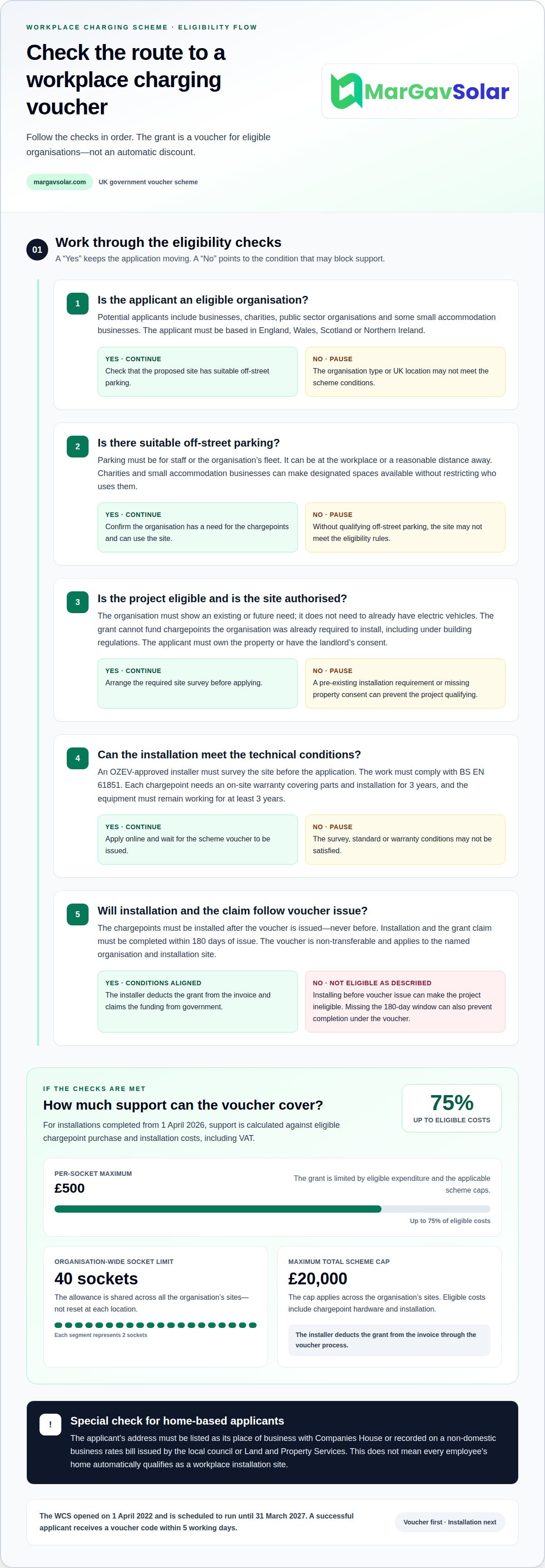
Businesses, charities, public sector organisations and some small accommodation businesses may qualify for the WCS. Applicants must be based in England, Wales, Scotland or Northern Ireland and have off-street parking for staff or their fleet. The parking can be at the workplace or a reasonable distance away. Charities and small accommodation businesses can make designated spaces available without restricting who uses them.
Grant Amount and Eligible Costs
The WCS covers up to 75% of eligible chargepoint purchase and installation costs, including VAT. For installations completed from 1 April 2026, the maximum is £500 per socket, across up to 40 sockets at all sites. That makes the overall cap £20,000. Eligible costs include chargepoint hardware and installation, with the grant deducted from the invoice through the voucher process.
A workplace charging scheme grant cannot fund chargepoints an organisation was already required to install, including under building regulations. Businesses don’t need existing electric vehicles, but must show an existing or future need. Applicants must own the property or have the landlord’s consent. Before applying, an OZEV-approved installer must survey the site. Installation and the grant claim must follow voucher issue and finish within 180 days.
Home-based applicants must have the address listed as their place of business with Companies House or recorded on a non-domestic business rates bill issued by the local council or Land and Property Services. Successful applicants receive a voucher code within 5 working days. The voucher is non-transferable, so the application must match the organisation and installation site. These conditions help determine whether an application can proceed.
What is the Workplace Charging Scheme (WCS)?
The WCS is a UK government voucher scheme that helps eligible organisations install workplace chargepoints. It opened on 1 April 2022 and is scheduled to run until 31 March 2027. The grant supports chargepoint hardware and installation, including at sites with suitable off-street parking. Organisations apply online, then use an issued voucher for an eligible installation.
For installations completed from 1 April 2026, the grant covers up to 75% of eligible purchase and installation costs, including VAT. The maximum is £500 per socket. An organisation can claim support for up to 40 sockets across all its sites, giving a total scheme cap of £20,000. These limits apply across the organisation, rather than separately at each location. For example, sockets split between two sites count towards the same 40-socket allowance.
The maximum-value subsidy definition was revised to “minimal financial assistance” to align with the Subsidy Control Act 2022. This is the scheme’s subsidy-control basis; it sits alongside the per-socket and overall WCS limits. The grant amount is therefore shaped by eligible costs, the socket count and the organisation-wide cap. A claim cannot exceed the eligible expenditure or the scheme’s applicable limits.
The voucher has its own deadline, separate from the programme’s closing date. It remains valid for 180 days from issue, and installation and the grant claim must be completed within that period. The voucher code is issued after a successful application and cannot be transferred. The applicant therefore needs to plan the installation at the named site within the voucher window. The installer deducts the grant from the invoice and claims the funding back from government. This keeps the grant tied to the approved installation and its eligible costs.
Can a business get a grant for EV charging points?
Eligible organisations can apply, but the installation must meet the scheme’s technical and process requirements. An OZEV-approved installer must survey the site before the application. Chargepoints must be installed after the voucher is issued, never before. This sequence matters: installing first can make the project ineligible for grant support.
The installer’s survey establishes whether the proposed infrastructure and chargepoint installation are suitable for the site. The work must comply with BS EN 61851, according to the British Standards Institution. Each chargepoint must also have an on-site warranty covering parts and installation for 3 years. The equipment must remain working for at least three years, so the grant supports infrastructure intended for continued use.
For employers with staff working from home, the scheme’s rule for home-based applicants is specific. The applicant’s address must be listed as its place of business with Companies House or recorded on a non-domestic business rates bill issued by the local council or Land and Property Services. This rule applies to the applicant organisation’s business address. It does not mean that every employee’s home automatically qualifies as a workplace installation site.
This distinction helps employers separate a workplace project from individual home-charging plans. An authorised installer surveys the eligible site and installs the chargepoint after the voucher is issued. The scheme applies its socket allowance across all sites belonging to the organisation, rather than treating each location as a separate applicant. Any proposed installation at an employee’s home must therefore meet the applicant and site conditions, not just the employee’s travel needs.
Once the installation is complete, the installer deducts the grant from the invoice and claims the funding from government on the applicant’s behalf. The voucher cannot be transferred to another organisation or installation. Keeping the application, voucher and installation aligned helps avoid problems with the claim. For a Staffordshire employer, the key checks are the site survey, post-voucher installation, technical compliance and warranty.
Workplace electric vehicle chargepoint grant
The Workplace Charging Scheme is one part of the UK’s electric vehicle funding picture. Its current end date is 31 March 2027, so employers planning an installation need to distinguish it from support with a different purpose. The WCS helps eligible organisations with workplace chargepoint hardware and installation, while other schemes have targeted particular sites or infrastructure needs.
State-funded schools have a separate chargepoint grant. It can cover up to 75% of eligible purchase and installation costs. From 1 April 2026, the rate is £2,000 per socket; vouchers issued before that date retain the previous £2,500 rate. A school installation must be completed within 180 days of voucher issue, and the scheme closes on 31 March 2027. Those dates matter when aligning funding with procurement and building work.
The former EV Infrastructure Grant for Staff and Fleets covered cabling and groundworks separately. It is a former funding route, so employers should check whether it is available before relying on it. This distinction helps employers assess what current funding can support: a chargepoint grant does not automatically cover every enabling or site-preparation cost.
Tax and business-rates measures are separate from grant funding. Businesses may potentially claim 100% of electric vehicle charging-point installation costs as a capital allowance. In England, workplace chargepoints can qualify for 100% business rates relief from 1 April 2023 to 1 April 2036. These measures have their own eligibility rules and should not be treated as extra WCS voucher money.
For Staffordshire employers, the practical takeaway is to identify the project type first: workplace sockets, a state-funded school installation, or a separate tax measure. Then match the project to its funding route and timeline. To plan chargepoint installation for your workplace, explore EV charging points.
MarGav Solar: EV Charging Points
MarGav Solar installs EV chargers for property owners planning workplace or home charging. Consider this service when assessing how chargepoints could fit your site and energy plans. If you’re applying for a grant, make sure the installation timing and project meet the scheme rules before work begins.
Charging can also be part of a wider energy setup. MarGav Solar offers solar panels and battery storage, which may be relevant when considering how a property uses and stores electricity. The right combination depends on the property and your priorities, such as adding vehicle charging or generating solar power.
For an EV charging project in Staffordshire, contact MarGav Solar to discuss your requirements.
Plan your next step towards workplace charging
Use your funding decision to shape a practical charging plan, not just a grant application. Consider how staff and fleet vehicles will use the site, where chargepoints could go, and how charging fits your wider energy priorities. A workplace charging scheme grant can support the installation, while a clear understanding of the site’s needs helps guide the project beyond the funding stage.
MarGav Solar offers EV Charging Points, Residential Solar PV Systems and Battery Storage Solutions, helping you consider charging alongside generation and storage. If you’re ready to discuss workplace charging for your organisation, contact MarGav Solar about workplace charging.
The next step is to turn a funding opportunity into a considered part of your organisation’s energy plans.
Frequently Asked Questions
How Much Funding Is Available?
For eligible installations completed from 1 April 2026, the scheme can cover up to 75% of chargepoint purchase and installation costs, including VAT, capped at £500 per socket. Your eligible costs determine the percentage calculation, while the socket cap limits the grant for each unit. For a Staffordshire project, distinguish the grant contribution from the total installation budget.
How long is the voucher valid?
A WCS voucher is valid for 180 days from its issue date. Allow enough time to complete the installation and grant claim during the voucher period. Treat the voucher date as the start of your project schedule, allowing time for site work and the installer’s claim. If the planned work cannot fit the period, the current voucher cannot simply be transferred.
How much funding can my organisation receive?
The organisation-wide limit is 40 sockets across all sites, with a maximum total claim of £20,000. For example, sockets planned at a Staffordshire workplace and another branch draw from the same allowance. The final grant depends on eligible costs and the applicable per-socket cap, so the organisation’s total is not automatically the maximum.
Is there any other help for employers?
State-funded schools have a separate chargepoint grant, while some businesses may be able to claim installation expenditure as a capital allowance. Workplace chargepoints in England can also qualify for business rates relief. These options are separate from a WCS voucher and have their own eligibility conditions. The former EV Infrastructure Grant for Staff and Fleets is closed to new applications.
What Documentation Is Required?
Have your organisation’s company registration number or VAT identification number ready for the online application. A home-based applicant needs its business address listed with Companies House or recorded on a non-domestic business rates bill. If you don’t own the property where the installation will take place, you need landlord consent. The approved installer’s site survey is also part of preparing an eligible project.
What Is The Process?
First, arrange a site survey with an OZEV-approved installer, then submit the online application. Once approved, use the issued voucher for the installation, which must take place after the voucher is issued. The installer deducts the grant from the invoice and claims it back from government. In Staffordshire, coordinate the work with the voucher’s expiry date so installation and the claim are completed in time.


