

Home EV charger installation is available in Tamworth, and a typical installation is completed in one visit. Choosing local EV charger fitters in Tamworth means planning a setup around your parking space, electrical supply and charging routine. The right charger can also work alongside your energy tariff and any solar panels or battery storage at home.
It’s natural to want a clear idea of what installation involves before choosing a charger. Your fuse board and available electrical capacity can affect the setup, while your tariff and energy use help determine when it makes sense to charge.
This guide explains how home installation works in Tamworth, what to consider when choosing a charger, and how tariffs, electrical capacity and solar fit into the decision. It also outlines how MarGav Solar’s EV charging points, solar PV systems and battery storage can support a home energy setup, so you can see the practical next steps.
Key Takeaways
- Home charger installation covers Tamworth and nearby communities, including Amington, Glascote, Wilnecote and Fazeley.
- Match charger choice with your vehicle and energy tariff to make home charging fit your routine.
- Your fuse board, electrical supply and household demand help determine the installation setup and whether load management is needed.
- Solar and battery storage can be part of a home charging plan; according to the Office for Zero Emission Vehicles (OZEV), eligible landlords and property management companies can receive up to £500 per socket through the Landlord Chargepoint Grant.
Do you also install home chargers in Tamworth?
Yes, home EV charger installation is available in Tamworth, with nearby coverage including Amington, Glascote, Wilnecote, Fazeley, Dosthill, Polesworth and Hopwas. A typical home installation takes one visit, though the property, charger position and electrical setup determine the work involved.
Tamworth and Surrounding-Area Coverage
Local EV charger fitters in Tamworth serve the town and surrounding communities, including Polesworth and Hopwas. Installer listings can help owners identify coverage, but ratings describe listing feedback rather than installation suitability: a Tamworth directory has a 4.95 out of 5 rating, while a separate local sample reports 10 out of 10 from 202 reviews.
Included Home Installation Work
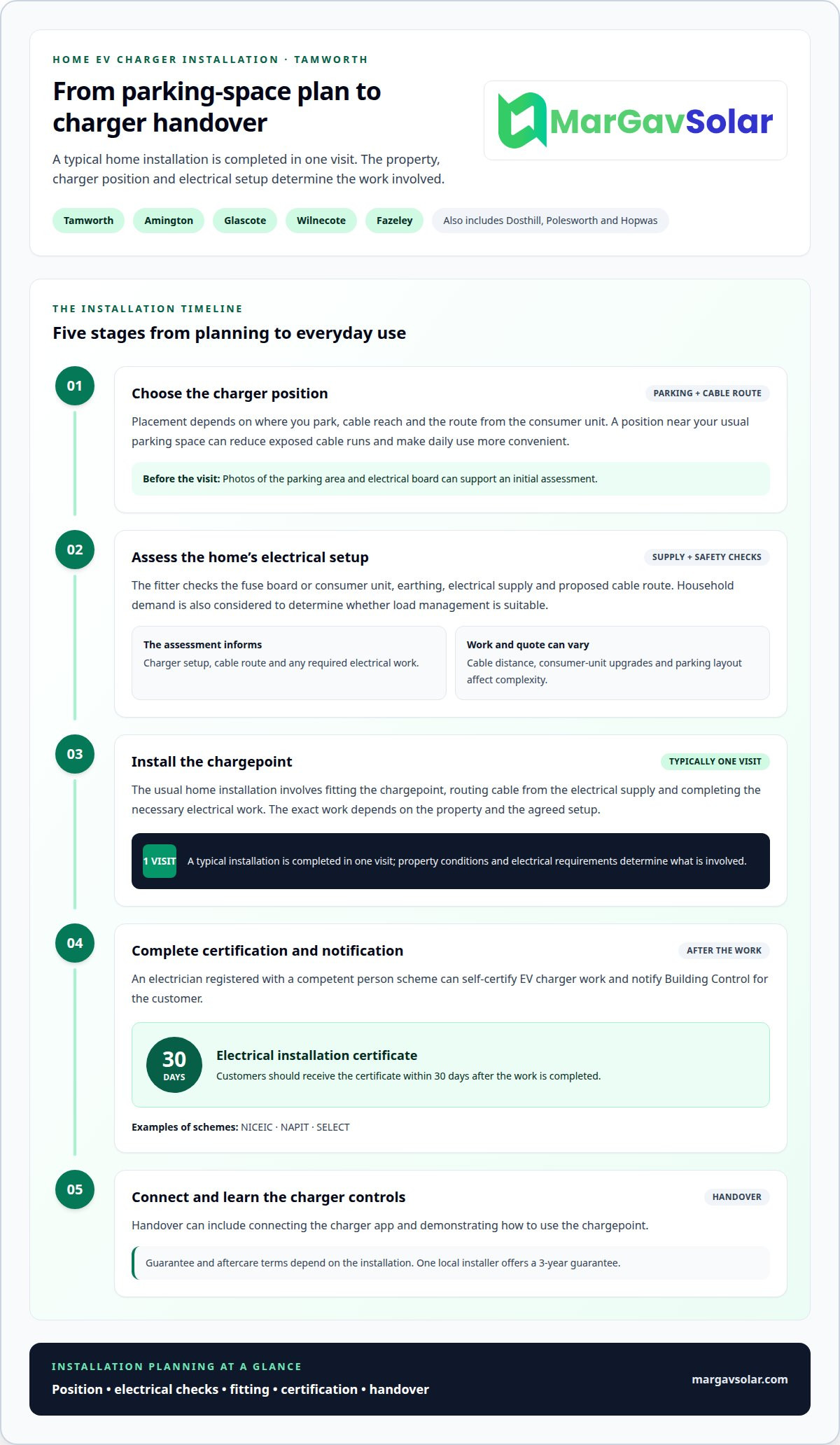
A home installation typically involves fitting the chargepoint, routing cable from the electrical supply and completing the necessary electrical work. Cable distance, consumer-unit upgrades and parking layout affect the work and quote. A longer route or board upgrade adds complexity, while a suitable position near off-street parking can simplify cable routing. Tamworth installers also undertake workplace, commercial and public charging installations.
Renters and people who own and live in a flat may be eligible for up to £500 towards a home chargepoint if they have private off-street parking. Grant eligibility and application requirements depend on the applicant and property.
Charger Placement and Preparation
Positioning depends on where you park, cable reach and the route from the consumer unit. Placing a charger near your usual parking space can reduce exposed cable runs and make daily use more convenient. Before installation, the fitter assesses the fuse board, earthing and proposed cable route. Photos of the parking area and board can support an initial assessment.
Installation, Certification and Handover
An electrician registered with a competent person scheme, such as NICEIC, NAPIT or SELECT, can self-certify EV charger work and notify Building Control for the customer. Customers should receive an electrical installation certificate within 30 days after the work is completed. Handover can include connecting the charger app and demonstrating its use. One local installer offers a 3-year guarantee; coverage and aftercare depend on the installation terms.
Charger brands and smart tariff compatibility
Charger choice depends on your vehicle, charging routine and energy tariff. In Tamworth, Zappi and Project EV are examples of brands available with installation. Compare their smart functions and energy controls with the way you plan to charge, rather than choosing by brand name alone. The charger should suit your parking arrangement, household supply and preferred charging schedule.
Tariff compatibility matters because when you charge can affect your electricity costs. Check whether a charger’s smart functions can follow the cheaper periods in your chosen tariff. Review the tariff terms and charger controls together, since the charger cannot make an unsuitable tariff cheaper.
Smart charging solutions can help coordinate charging with lower-cost periods, but the right setup depends on the charger and tariff features. Consider whether you want to schedule charging manually or use connected controls. A household that regularly charges overnight may prioritise scheduling, while someone with variable routines may prefer flexible controls. Compatibility depends on the specific tariff and charger working together, not simply on a “smart” label.
For a workplace, commercial site or industrial estate near Amington, charging needs may differ from a single-home setup. Consider how many vehicles need chargepoints, when they are parked and whether charging must fit staff or visitor routines. Those details influence suitable charger types and how the site manages its tariff.
MarGav Solar’s EV charging points can form part of a home charging plan. Bringing charger choice and tariff requirements into the installation discussion helps shape a solution around your vehicle and charging habits.
Electrical supply checks and load management
Before fitting an electric car charger, the installer assesses the home’s electrical supply and consumer unit. Most UK houses have a single-phase supply, which limits home charging to about 7kW. A typical UK home can handle a 7kW charger, but the existing installation still needs assessment. In Wilnecote, as elsewhere in Tamworth, the property’s supply helps determine a suitable charger rating.
A 22kW charger needs three-phase power, so it isn’t a straightforward upgrade for a home with single-phase supply. The installer considers the supply type before agreeing the charger specification. A 7kW unit can suit typical home charging; choosing a higher rating without the required supply won’t deliver the intended charging speed.
Charging speed also depends on the vehicle. A 7kW home chargepoint typically adds around 20-28 miles of range per hour, depending on the car. It can top up a vehicle roughly twice as fast as a 3kW unit. These figures help owners compare charger ratings with their driving needs, but the car’s charging capability also affects the result.
Load management helps coordinate charger demand with other electrical use in the home. If several high-demand appliances run while an electric car charges, the system’s available capacity matters. The installer assesses household demand and the electrical setup to determine whether load management suits the installation. This means considering the charger alongside the home’s other electrical loads.
During assessment, the fitter reviews the consumer unit, earthing and supply before finalising the installation plan. They match the charger rating to the property’s capacity and intended use, then carry out the approved work. For a home near Wilnecote, the same checks apply whether the owner chooses a 3kW or 7kW charger. The vehicle, supply and household demand together shape a practical setup.
Solar, battery storage and EV charging
Solar panels, battery storage and an EV chargepoint can work together as part of a home energy setup. In Glascote, for example, daytime solar generation can supply household use, while a battery stores surplus energy for later. Charging a car from stored or available solar energy depends on when generation, household demand and charging coincide. Plan the charger alongside the home’s existing energy equipment.
A joined-up installation needs a clear view of the property’s electrical system and intended use. A certified installer can consider how the solar, battery and chargepoint connect, including the equipment already at home. For an industrial or workplace site, expected vehicle use and charging times also shape the system. Smart chargepoints installed in the UK are subject to the Electric Vehicles (Smart Charge Points) Regulations 2021.
Grant support varies by property and organisation. According to the Office for Zero Emission Vehicles (OZEV), private and social landlords and property management companies can receive up to £500 per socket through the Landlord Chargepoint Grant, for up to 200 sockets across all properties. State-funded schools, academies and education institutions can receive up to £2,000 per socket through the education workplace charging scheme, with a maximum of 40 sockets across all sites, according to OZEV.
According to the Office for Zero Emission Vehicles (OZEV), the Workplace Charging Scheme offers eligible businesses, charities and public sector organisations up to £500 per socket for workplace chargepoints, with a maximum of 40 sockets across all sites. These are distinct schemes, so the applicant’s organisation and property type matter. Homeowners in Dosthill considering solar and EV charging should focus on how generation, storage and charging fit their routine.
For a coordinated home setup, plan your solar and EV charging system around your property’s energy needs.
MarGav Solar
MarGav Solar can help plan home charging around your property’s electrical setup and wider energy needs. If you’re considering an EV chargepoint alongside solar generation or battery storage, bringing these elements into one plan can help you understand how they may work together. The company provides EV Charging Points, Residential Solar PV Systems and Battery Storage Solutions, plus Solar Panel Maintenance & Cleaning for existing systems. This is a useful next step if you’re weighing charger installation alongside solar or storage, or planning how to use energy at home. Contact MarGav Solar to discuss your home charging plans.
Plan a charging setup that fits what comes next
Choosing local EV charger fitters in Tamworth is a chance to plan beyond your first charge. Consider how your household’s energy use may change as your driving habits, vehicle or home equipment change. A setup planned around those needs can make the next decision clearer, whether you’re starting with a chargepoint or considering how it fits into wider home energy plans.
MarGav Solar offers EV Charging Points alongside Residential Solar PV Systems and Battery Storage Solutions. This combination is relevant if you want to consider charging as part of your home’s broader energy use, rather than as a standalone change. Discuss what you want your home setup to do and what equipment you already have in place.
Contact MarGav Solar about home charging to talk through your plans and find a practical way forward.
Frequently Asked Questions
Are you based in Tamworth?
MarGav Solar is a UK-based renewable energy company focused locally on Staffordshire, rather than a Tamworth-based business. For Tamworth homeowners, the relevant point is that the company serves Staffordshire. Its work covers residential and commercial energy projects, so you can discuss your property type as part of your enquiry.
Need help finding the right charger?
MarGav Solar can help match an EV charger to your vehicle and charging routine. Its chargers offer fast charging capabilities and smart charging technology. If you usually charge overnight, for example, your preferred schedule matters; if your routine changes, flexible charging controls may be more useful. Your car’s charging capability is also a factor when choosing a suitable setup.
Will my electricity supply cope with EV chargers?
Assessing your electrical setup helps determine a suitable charger and installation plan. The installer considers the consumer unit, earthing, existing electrical demand and the charger you want. If you charge while several high-demand appliances are running, for example, household load matters. Your property’s supply and the vehicle’s charging capability both influence how the setup will work.
Will you advise me on the best place to install my EV charger?
Yes, placement can be planned as part of the installation. The position should suit where you park and where your vehicle’s charge port sits. Parking nose-in rather than reversing onto a drive, for example, may change which wall position is most practical. Cable routing and access to the chosen spot also help determine the final location.
Which EV charger installers serve Tamworth, Staffordshire?
MarGav Solar provides EV charging point installations, with a local focus on Staffordshire. If you’re looking for local EV charger fitters in Tamworth, discuss your property and charging needs with the company. Its work includes residential and commercial properties, so the installation plan can reflect whether the chargepoint is for a home, workplace or other site.
What do local EV charger fitters in Tamworth charge for supply and installation?
The price depends on the property and installation requirements, and is provided after a quote request. Factors include the cable route and distance, the consumer unit and any required electrical upgrades, as well as the parking layout and chargepoint position. These details affect the work involved, so a quote should reflect your specific home rather than a general market figure.


