

Adding battery storage to existing solar can lift annual savings by an estimated £300-£500 compared with solar alone. For a home battery retrofit in Stoke-on-Trent, inverter compatibility matters: an AC-coupled battery can work alongside an existing solar inverter, while other systems may require a compatible inverter setup. The right approach depends on how your current system is configured.
Before committing to a home battery retrofit in Stoke-on-Trent, it’s reasonable to ask whether storage could make a noticeable difference to your electricity bills. This guide explains how a battery can change the way you use solar power, what affects retrofit costs and how AC coupling can work with an existing system. You’ll also learn which details about your home and solar equipment matter when deciding whether storage is a good fit.
Key Takeaways
- A technical survey helps establish how your existing solar setup, wiring and inverter affect battery installation.
- Choose battery capacity around your household’s electricity use and when you use the most power, rather than simply opting for the largest system.
- Retrofit costs depend on the battery and the work needed to connect it to your existing system; compare the full installation scope when budgeting.
- According to HM Revenue & Customs, domestic solar and battery storage is zero-rated for VAT until 31 March 2027.
How much can I save by installing solar panels and battery storage?
A battery stores surplus solar energy for use later, which can reduce how much electricity you buy from the grid. Potential savings depend on your household’s energy use, solar generation, battery capacity and electricity tariff.
Battery Packages and Installation Prices
Battery packages differ by storage capacity, brands and how they connect to existing solar equipment. A smaller household may need a different design from a home with high evening demand or an electric vehicle. The installation price depends on the equipment, system design and any electrical work required. A price depends on the case and is given after a quote request, taking capacity, compatibility and installation work into account.
Review the installation scope as well as the battery itself. It should explain the connection and electrical work involved, and identify any changes needed to existing equipment. If the current system needs modifications before it can work with storage, those should be included in the proposed plan.
Survey and Installation Process
A technical assessment establishes how your existing solar system is configured and where a battery could be installed. It considers the inverter, wiring, available space and household energy use. These details help determine the system design, suitable battery capacity and whether any equipment changes are needed for compatibility.
Installation then follows the agreed design: the battery is positioned, connected to the system and tested. A survey can also identify work outside the battery installation, such as changes to existing electrical equipment. A free survey can help clarify the proposed scope, but the survey itself does not establish that all additional work is included.
Grants, VAT Relief and Incentives
According to HM Revenue & Customs, domestic solar and battery storage is zero-rated for VAT until 31 March 2027. Eligible lower-income households in Stoke-on-Trent may qualify for ECO4 funding for solar-plus-battery packages. Battery storage alone does not currently qualify for a standalone grant.
For an incentive assessment, distinguish a combined solar-and-battery installation from a battery-only retrofit. ECO4 eligibility applies to qualifying households and packages, so it should not be treated as a universal discount. A tariff can also affect savings: using stored solar electricity later can reduce grid purchases, while the result depends on when the home generates and uses energy.
How Much Can a Home Battery Save on My Energy Bills?
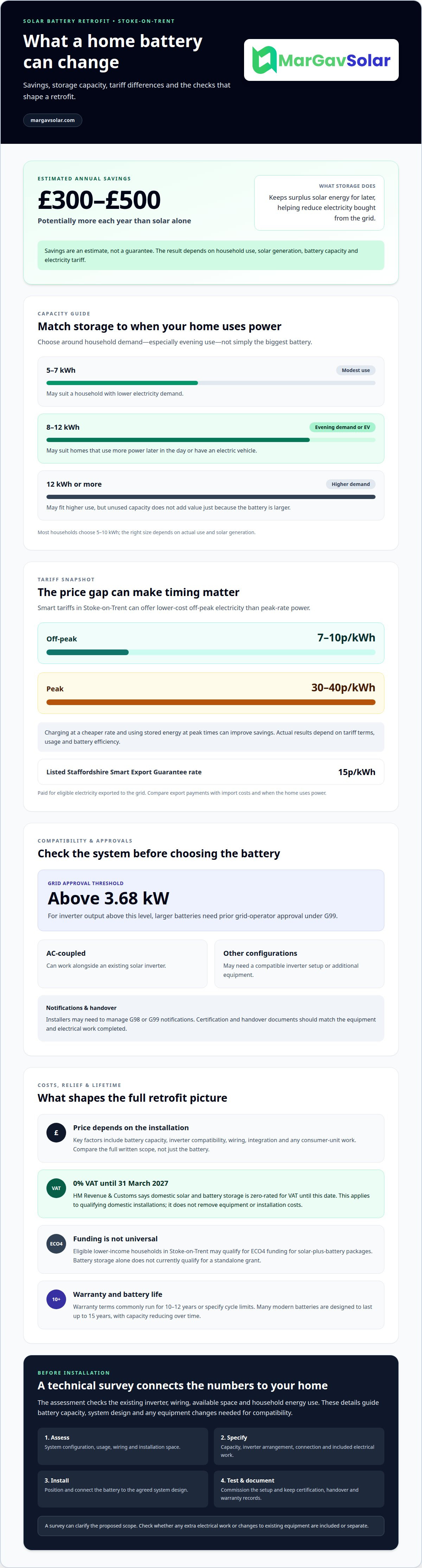
Battery size affects how much solar energy you can store and use later. Match capacity to household electricity use, especially evening demand, rather than choosing solely by headline storage size. Most households choose 5-10 kWh; a 5-7 kWh battery may suit modest use, while homes with evening demand or an electric vehicle may need 8-12 kWh.
In Stoke-on-Trent, smart tariffs can offer off-peak electricity at 7-10p/kWh, compared with peak rates of 30-40p/kWh. Charging from cheaper electricity and using stored energy during peak periods can improve savings, though the result depends on tariff terms, usage and battery efficiency. A battery with 12 kWh or more may suit higher demand, but unused capacity won’t add value simply because it is larger.
For inverter output above 3.68 kW, larger batteries need prior grid-operator approval under G99; installers may also need to manage G98 or G99 notifications. The applicable route depends on system configuration. Certification and handover documents should correspond to the equipment and electrical work completed.
Retrofitting risks include an incompatible system design or installation work that doesn’t meet the battery manufacturer’s requirements. Warranty terms commonly run for 10-12 years or specify cycle limits; many modern batteries are designed to last up to 15 years, with capacity reducing over time. Keep the manufacturer’s maintenance and warranty conditions with the system records.
Consider household usage, solar generation and tariff periods together when choosing battery capacity. For example, a home that uses most of its electricity in the evening may benefit from more storage than one whose demand falls after daytime solar generation. This helps you compare capacity with practical needs and potential bill savings.
Battery retrofit costs and system pricing
For a battery retrofit in Stoke-on-Trent, the main cost drivers are storage capacity, inverter compatibility and installation work. A system integrated with existing solar equipment may need different components from one requiring an inverter change. The price depends on the case and is given after a quote request; key factors include battery capacity, wiring, integration and any consumer-unit work.
According to HM Revenue & Customs, domestic solar and battery storage in the UK is zero-rated for VAT until 31 March 2027. This applies to qualifying domestic installations, so a quote should show how VAT treatment affects the proposed work. It does not remove equipment or installation costs.
Tariffs also affect the financial value of stored energy. Staffordshire’s listed Smart Export Guarantee rate is 15p/kWh, paid for eligible electricity exported to the grid. Import tariffs set the price of electricity bought from the grid; compare the export payment with your import costs and when your home uses power.
A battery installation proposal should explain the battery, inverter arrangement, electrical connection and commissioning. A hybrid inverter may manage solar generation and storage together, while an existing system may need additional equipment. The system design and work included determine the overall scope, not battery capacity alone.
A consumer-unit upgrade can add work if the existing board or electrical arrangement needs alteration for the installation. Its cost depends on the changes required, so the survey and written scope should explain whether that work is included or separate. The same applies to wiring changes and inverter adjustments.
Look for an itemised installation scope that names the battery, its capacity, the inverter approach and the electrical work included. It should explain commissioning, handover information and any relevant grid notification steps. These details make it clear what the installation covers and whether any changes fall outside the proposed work.
Ask for the design to explain how solar generation, battery storage and export tariffs work together. Comparing these factors helps you assess whether an integrated battery system suits your household’s energy-use pattern.
AC-coupled batteries and inverter compatibility
An AC-coupled battery connects to a home’s alternating-current electrical system alongside the existing solar inverter. The solar panels can therefore continue using their current inverter, while a separate battery inverter manages storage and charging. This arrangement can suit a retrofit where replacing a working solar inverter is not part of the upgrade.
In a typical setup, the solar inverter converts electricity from the panels for household use. Surplus energy can then be directed through the battery inverter into storage for later, including overnight. When the battery supplies power, its inverter converts the stored energy for household use. The system design determines how these components work together.
Compatibility involves more than whether a battery can connect to an AC supply. An assessment should record the existing inverter make and model, solar system layout, electrical setup and proposed battery controls. This allows the system designer to consider how energy will be measured and managed, and whether the battery system suits the installed equipment.
AC coupling is not automatically the best option for every home. A DC-coupled design connects storage on the solar system’s direct-current side, which may suit a different system layout. For an existing installation, the decision depends on the inverter’s condition, whether it needs replacing, the available equipment and how your household plans to use stored solar energy.
A useful technical proposal explains the connection route, how solar charging and battery discharge will work, and which existing equipment will remain in place. It should identify any inverter or wiring changes needed before installation. This makes it easier to see how the retrofit will work with your current solar panels, rather than treating the battery as a standalone purchase.
For an assessment of your existing system and battery compatibility, discuss a battery storage installation.
MarGav Solar: Battery Storage Solutions
MarGav Solar provides battery storage solutions for homeowners considering a retrofit or looking to make better use of solar generation. The team can design a system around your existing solar panels, household energy use and inverter setup. If you’re planning a broader renewable energy upgrade, MarGav Solar also provides Solar Panels and EV Chargers. Solar Panel Maintenance & Cleaning can help maintain your panels alongside a storage system.
When you’re ready to discuss how battery storage could work with your home’s equipment and energy needs, contact MarGav Solar to talk through your project.
Make your next energy decision with confidence
A home battery retrofit in Stoke-on-Trent is an opportunity to plan around how your household wants to use energy, not just the equipment already installed. Consider your priorities: making better use of daytime solar generation, shifting more electricity use to the evening or preparing for future changes at home. These priorities help shape a system around your needs rather than a one-size-fits-all design.
Your results depend on household energy use, system design and tariff. Discussing these factors can help you decide whether storage suits your plans now or whether another upgrade should come first. A practical next step is to talk through your home’s setup and what you want the system to achieve.
Contact MarGav Solar to discuss your retrofit, and take a practical step towards a home energy plan that works for you.
Frequently Asked Questions
Why Battery Storage in Stoke-on-Trent?
Battery storage lets households keep surplus solar electricity for use when the panels aren’t generating, such as after sunset. This can be useful if your home uses more electricity in the evening or you want to make greater use of your own solar generation instead of exporting it. The value of stored energy depends on your tariff and household usage.
What Makes a Complete Solar Battery System?
A complete system brings together solar panels, an inverter, battery storage and the electrical connections that let them work together. An existing solar setup may keep its current inverter if the battery design supports that arrangement. Suitable controls manage charging and household use, while the final equipment is selected to suit the property and its energy requirements.
What Size Battery Do I Need?
Choose capacity around your household’s electricity use and when demand occurs. A 5-7 kWh battery may suit modest use, while 8-12 kWh can suit homes with greater evening demand or an electric vehicle. These are sizing guides, not fixed rules: a household that uses little power after sunset may not benefit from a larger battery.
What Does a Home Battery Retrofit Involve in Stoke-on-Trent?
A retrofit adds storage to an existing solar setup, with the design accounting for its inverter and electrical arrangement. For a home battery retrofit in Stoke-on-Trent, the process includes assessing existing equipment, planning the battery connection and testing the completed system. Any grid notification requirements depend on the system configuration and inverter output.
How Much Does a Home Battery Retrofit Cost in Stoke-on-Trent, Including Installation?
The price depends on the case and is given after a quote request. Factors include battery capacity, the existing inverter, wiring, connection work and any required electrical upgrades. Ask for a written scope that separates the battery and installation work from additional changes, so you can understand what the proposed price covers without assuming every home needs the same work.
Which Battery Sizes and Brands Are Available from Installers in Stoke-on-Trent?
Solar batteries on the market range from 2.5 kWh to 15 kWh. Stoke-on-Trent listings include SolaX systems with capacities of 3.1-11.6 kWh, while Fox ESS and SolaX lithium batteries are rated for more than 6,000 charge cycles. The suitable capacity and system depend on household demand and compatibility with existing equipment.


