

The time a solar consultation takes can vary depending on whether it’s an initial discussion or an in-person survey. What happens during a solar consultation depends on the appointment: it can cover your energy goals and roof suitability, while a site assessment may include measurements and an inspection of your electrical system. Whether it’s free depends on the appointment’s terms, so an initial discussion and an in-person survey shouldn’t be assumed to be the same thing.
It’s understandable to want to know what you’re agreeing to before arranging a visit. A solar consultation is a chance to discuss whether solar suits your home, not simply to look at the roof or push a standard system.
You’ll learn what the conversation and home assessment can cover, how roof angle, shading and available space affect the design, and what the electrical checks are for. We’ll also explain the typical timings, how to prepare useful household energy information, and what to expect when solar panels are considered with or without battery storage.
Key Takeaways
- Roof direction, pitch, shade and usable space all shape whether a solar design suits your home.
- Discuss how the proposal accounts for your energy use, installation needs and any potential changes to the property.
- Consultation length varies by appointment type; clarify what the visit covers and whether a fee applies.
- An on-site assessment can include roof measurements and checks of shading and existing electrical equipment.
Roof orientation, tilt, shading and available space
The assessment considers whether the roof can support a suitable layout and how its features may affect generation. It can begin remotely, but physical access helps clarify details a model cannot show.
Roof and Property Assessment
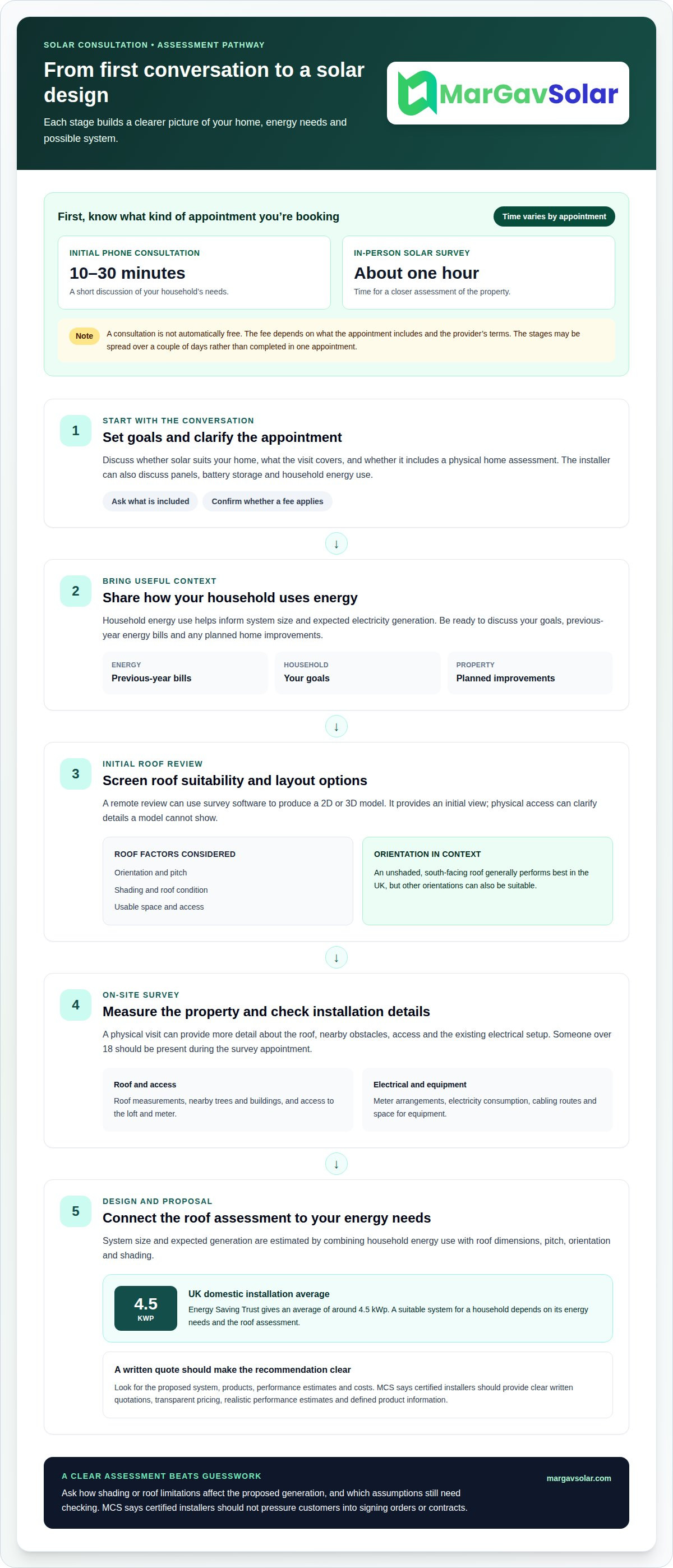
A roof and property assessment reviews orientation, pitch, shading, condition, usable space and access. These details shape the panel layout and help identify obstacles before a design is developed. An unshaded, south-facing roof generally performs best in the UK, but other orientations can also be suitable. Remote survey software can produce 2D or 3D models; an on-site visit can assess roof measurements, nearby trees and buildings, and access to the loft and meter.
System size and expected electricity generation are estimated by combining household energy use with roof dimensions, pitch, orientation and shading. The installer may ask about your goals, previous-year energy bills and planned home improvements. Energy Saving Trust gives an average UK domestic installation size of around 4.5 kWp, but a household’s suitable system depends on its energy needs and the roof assessment.
Questions About Roof Impact and Maintenance
Questions about roof impact and maintenance help establish whether the proposed layout fits your property and expectations. The installer may ask about the roof’s condition, previous repairs, access and any concerns about fitting panels. They can explain how the roof area is assessed, what access is needed, and the maintenance involved. Solar panels are generally low maintenance and usually need only occasional cleaning.
Ask how shading or roof limitations affect the proposed generation, and which assumptions still need assessment. A remote model is useful for an initial review, but measurements and electrical checks on site provide more detail. MCS says certified installers should not pressure customers into signing orders or contracts, so a high-pressure sales approach should never replace a clear explanation of options and assumptions.
Addressing concerns about cost, installation and property changes
A consultation connects the proposed system with practical installation details, household electricity use and your property’s requirements. It also gives you a chance to understand the quote and likely work before deciding.
Costs and VAT
A written quote sets out the proposed system, its products, performance estimates and costs, so you can understand what the recommendation includes. MCS says certified installers should provide clear written quotations, transparent pricing, realistic performance estimates and defined product information.
Qualifying UK installations of energy-saving materials, including solar panels, are zero-rated for VAT until 31 March 2027. The consultation can explain how the quote reflects the system design and any project-specific factors, such as roof complexity, battery storage or electrical work, without treating a general estimate as your final price.
Electrical and Installation Constraints
This discussion identifies electrical or access requirements that could affect installation. The assessment may consider meter arrangements, household electricity consumption, cabling routes and space for equipment. These details clarify how the system connects with your property and whether installation needs additional planning.
In Great Britain, an inverter larger than 3.68 kW will usually require permission from the Distribution Network Operator through a G99 application before it can connect to the grid. The consultation should distinguish that grid-connection requirement from property planning considerations.
Timelines, Quotes and Requirements
A timeline explains the likely sequence from design to installation and handover. Most solar installations take between 1 and 3 days, depending on system size. Commissioning and handover then cover the completed installation and relevant system information.
To compare consultations and quotes, assess whether each recommendation matches your energy needs, explains assumptions, and identifies product details and installation requirements. For planning, the assessment considers requirements relevant to the property; grid connection may require a G99 application under the conditions above. For a project tailored to your home, explore residential solar PV systems.
Consultation duration and whether it is free
An initial phone consultation typically takes 10-30 minutes; an in-person solar survey usually takes about one hour. The appointment type determines whether discussion alone or a physical home assessment is included.
A home survey may form part of the consultation process, but a consultation is not automatically free. Whether there’s a charge depends on the appointment and the provider’s terms, so distinguish an initial conversation from an on-site assessment.
Consultation and Survey Duration
The initial consultation is a short discussion of your household’s needs, while the survey allows time for a closer property assessment. A typical initial call takes 10-30 minutes, and an in-person survey usually takes about one hour. The stages may be spread over a couple of days, rather than completed in one appointment.
That distinction helps you plan time for the visit. Someone over 18 should be present during the solar survey appointment. The installer can discuss panels, storage and household energy use, then use the visit to assess property details that affect the proposed system.
Whether the Consultation Is Free
“Consultation” can describe an initial conversation or a visit that includes a home survey, and those are different appointment types. A free initial discussion does not automatically mean an in-person assessment is free too. The fee arrangement depends on what the appointment includes and the provider’s terms.
Before accepting an appointment, establish whether it is a phone consultation, a remote assessment or an on-site survey, and what work it covers. That helps you understand the commitment and prepare. A survey gives the installer a fuller view of your property, while an initial call focuses on your interests and household requirements.
Consultation time is separate from installation scheduling. The survey and initial discussion can be arranged across a couple of days, while the installation date follows later planning. This gives the installer time to consider the property assessment and system design before work is scheduled.
Use the discussion to clarify which stage comes next: a remote review, an in-person survey or a proposal. Knowing the sequence makes it easier to prepare energy information and arrange property access, without confusing a short call with a full home assessment.
On-site measurements and electrical-system inspection
An in-person assessment adds measurements and electrical checks to the initial roof review. The installer can observe shading patterns, measure relevant roof areas and inspect existing electrical equipment. These findings help shape the technical design around your actual property, rather than relying only on a remote model.
Measurements help establish how much usable roof space is available and where panels could fit. The installer considers roof dimensions alongside pitch, orientation and shading from nearby trees or buildings. For example, a roof section shaded by a neighbouring building may affect the system layout and expected generation. On-site observations can refine the assumptions used in a proposed design.
The electrical inspection considers your home’s existing system and how a proposed solar installation could connect to it. The assessment may include meter access, electrical equipment and potential cabling routes. These checks matter because the system design must account for both the roof and the property’s electrical setup. Battery storage can also affect the equipment being considered.
- Roof measurements: record dimensions and identify usable areas for a panel layout.
- Shading observations: note trees, buildings and other obstacles affecting sunlight.
- Electrical inspection: examine existing equipment and access relevant to the proposed connection.
- Design assumptions: distinguish observed details from points requiring further technical assessment.
These observations give the installer a stronger basis for explaining the proposed system and its estimated generation. They also help identify what informs expected savings, including shading and the choice between solar panels alone or panels with a battery. A remote assessment can support early planning, but an in-person visit adds direct measurements and observations of your home’s electrical equipment.
For a home-specific assessment of solar panels and battery storage, arrange a solar consultation and discuss the property’s technical requirements.
MarGav Solar
MarGav Solar helps homeowners explore whether solar suits their property through consultancy and professional installation. The assessment connects roof and electrical findings with household energy needs, helping you understand the system options under consideration and the factors behind the design.
Depending on your plans, the discussion may include Residential Solar PV Systems, Battery Storage Solutions or EV Charging Points. MarGav Solar also provides Solar Panel Maintenance & Cleaning for homeowners considering ongoing care. A consultation is a useful next step if you want to discuss how your home, energy use and future plans relate to a solar system.
For guidance on a residential solar project, contact MarGav Solar.
Take the Next Step Towards a Clear Solar Plan
Understanding what happens during a solar consultation can help you approach the decision with clearer priorities. Before moving ahead, consider what you want your home energy system to achieve, such as using more of your own electricity or planning for future household needs. Those priorities can guide a useful conversation about options for your Staffordshire property.
A consultation is also a chance to turn technical details into a decision you can weigh carefully. Focus on whether the proposed design fits your aims, how its assumptions are explained, and what the next stage involves. You don’t need to decide on the spot; take time to consider the information and how it fits your plans.
When you’re ready to discuss a residential solar project, contact MarGav Solar. A considered conversation can help you decide on a practical next step for your home.
Frequently Asked Questions
Quick Answer: What Happens During a Solar Panel Installation Consultation?
What happens during a solar consultation is a discussion of your household’s needs and whether a solar project could suit them. Explain your priorities, such as reducing grid electricity use or planning for an electric vehicle. This helps focus the conversation on relevant options rather than treating every home as the same project. Bring questions about your plans and what you want the system to achieve.
Do I need an in-person visit before getting a solar quote?
Not always. A remote review can help establish basic project details. What happens during a solar consultation may include an in-person visit, which lets the installer assess features photographs or remote tools may not capture. The next step depends on how much property information is available and what is needed to prepare a tailored proposal for your Staffordshire home.
How accurate are solar savings estimates?
Estimates are only as useful as the assumptions behind them. Household electricity use, expected generation, how much power you use while panels are producing, and whether you include a battery all influence the calculation. For example, a household that uses more electricity during daylight may use more of its solar generation directly. Treat the estimate as a planning tool based on your stated circumstances.
Should I have 12 months of electricity bills available?
Yes. Having the previous year’s electricity bills helps show how your household’s consumption changes over time, rather than relying on one month. MCS guidance recommends providing accurate energy-use information and planned improvements so a proposed system can better reflect your needs. For example, mention a planned home extension or a change in household routines alongside the bills.
Should a solar consultation include battery storage?
It’s useful to discuss battery storage if you want to consider storing solar electricity for later use. Whether it suits your plans depends on your household’s electricity use and when you need power. A consultation can compare solar alone with solar and a battery, so the discussion reflects your priorities rather than assuming every home needs storage.
What Happens When You Contact Us?
MarGav Solar offers a free, no-obligation consultation, followed by a property assessment and quotation if you want to explore a project. The process can then move to a tailored energy plan, professional installation and after-care support. Homeowners in Staffordshire can explain their aims and discuss Residential Solar PV Systems, battery storage or EV charging. Contact MarGav Solar to start the conversation.


