

The cheapest-looking upgrade isn’t always the one that offers the best long-term value. If you’re focused on securing your home’s energy future, financial support may be available through government and local energy-efficiency schemes, while solar panels and battery storage can help you make more use of the electricity your home generates. The right route starts with understanding what each option can do.
It’s understandable to want help with upfront costs and a home that is less exposed to changing energy prices. This guide explains the types of support to explore, how solar and battery storage can fit into a home energy plan, and what to consider before choosing an improvement.
You’ll find an overview of funding schemes, practical guidance on solar and batteries, and ways to match improvements to your priorities. This can help you identify a sensible next step for your home.
Key Takeaways
- Explore which financial support and energy-efficiency schemes may fit your home and circumstances.
- Understand how battery storage can help you use more of the electricity your solar panels generate.
- Learn the key considerations for exporting surplus electricity and receiving payment through the Smart Export Guarantee.
- See how the MEES rules affect landlords in England and Wales, and when solar or battery improvements may be a useful next step.
1. Financial support for home energy improvements
First, distinguish support for energy efficiency from support for renewable energy. Grants or funded programmes may cover measures such as insulation or boiler replacement, while solar and battery upgrades have different costs and benefits. Eligibility and the work covered depend on the scheme and property. Identify the improvement you want, then look for current national or local support that applies to it.
For example, a draughty home might benefit more from insulation before a new heating system. A well-insulated loft should have around 300mm of insulation, and roof heat loss can account for up to 25% of a home’s total. Reducing heat loss can lower energy bills and the carbon associated with heating, although the right sequence depends on the building.
Solar panels generate electricity, batteries store surplus for later use, heat pumps provide heating and hot water, and smart tariffs vary electricity costs by time of use. The value of each depends on household demand, property suitability and when electricity is used. Compare potential bill savings alongside how each option could support your energy needs.
Since 1 April 2020, according to the UK Government, landlords in England and Wales cannot let properties covered by the Minimum Energy Efficiency Standards (MEES) Regulations if the EPC rating is below E, unless they have a valid exemption. This makes the property’s EPC rating a practical starting point for landlords planning upgrades.
Energy costs and suitable upgrades vary by region, property type and supplier tariff. A detached home, flat and older property can differ in roof space, heating needs and installation constraints. Local weather and a tariff’s import and export rates also affect the value of different options.
When comparing UK installers, review written proposals, stated qualifications and warranty terms. Check qualifications against the issuing body’s register, and read what each warranty covers, how long it lasts and whether maintenance conditions apply before agreeing to work.
2. Battery storage
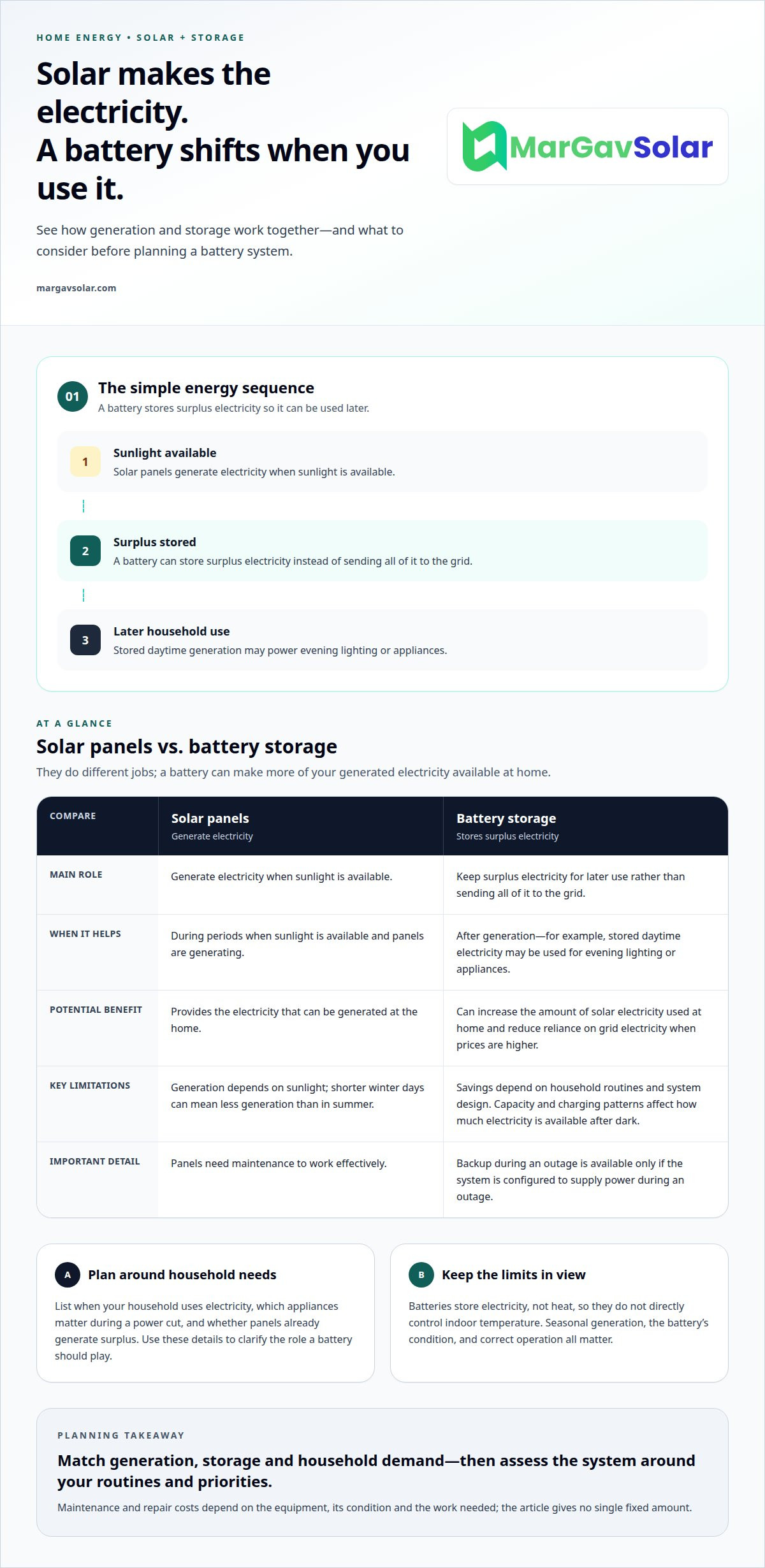
Solar panels generate electricity when sunlight is available, while household demand continues after sunset. A battery stores surplus electricity for later use instead of sending all of it to the grid. For example, stored daytime generation may power evening lighting or appliances. This can increase the amount of solar electricity you use at home, though the savings depend on household routines and system design.
For greater resilience, start by listing essential electrical needs, such as lighting, refrigeration and communications. Then plan a solar and battery system around those priorities and the home’s electricity use. A battery can provide backup only if the system is configured to supply power during an outage. Storage can also reduce reliance on grid electricity when prices are higher.
Battery capacity and charging patterns affect how much solar electricity is available after dark. Seasonal conditions matter too: shorter winter days can mean less generation than in summer. Insulation also affects energy planning because a home that retains warmth may need less energy for heating. Batteries store electricity, not heat, so they do not directly control indoor temperature.
Upkeep varies by technology. A battery’s performance depends on its condition and correct operation, while solar panels depend on sunlight and need maintenance to work effectively. Heat pumps rely on the home’s heating system and insulation. Maintenance and repair costs depend on the equipment, its condition and the work needed, rather than a single fixed amount.
For a practical review, list when your household uses electricity, which appliances matter during a power cut, and whether panels already generate surplus. This helps clarify the role a battery should play before making a decision. A battery system plan can bring generation, storage and household demand into one considered approach.
3. Government incentives and funding schemes
Funding schemes target different households and improvements, so match the scheme to the work before planning an upgrade. Energy-efficiency support may focus on reducing heating consumption through measures such as insulation or replacement windows. Renewable-energy incentives have different aims, and heat-pump support may have separate eligibility rules. A scheme’s current status, qualifying households and approved improvements determine whether it fits your plans.
Earlier UK proposals show why dates and wording matter. The proposed next phase of the Energy Company Obligation programme aimed to upgrade 450,000 fuel-poor homes over three years. Some proposed funding schemes were intended to support households with energy-efficiency improvements. These were proposals, not a guarantee that funding is currently open or available to every household.
Renewable heating support has also changed over time. The Domestic Renewable Heat Incentive was due to end on 31 March 2022, and the Clean Heat Grant was due to replace it in April 2022. Treat those dates as historical scheme information, not proof of a present-day application route. For a heat-pump project, distinguish grants from other forms of financial support, then establish which measures and properties qualify under the active programme.
To assess an offer, note the proposed work, property type, tenure and household circumstances. Compare these details with the scheme’s eligibility criteria, including whether it covers labour, equipment or both. A programme focused on fuel poverty may have different rules from a renewable-heating incentive. Do not base a budget on an old announcement or assume a proposed allocation guarantees an individual award.
For example, a household considering new windows to reduce heat loss should look for support that specifically covers energy-efficiency improvements. Someone planning renewable heating should check the scheme’s heat-pump conditions. Keep application dates, required evidence and approval steps together before committing to work. This helps distinguish available support from historic proposals and plan an upgrade around an applicable funding route.
4. What are the UK rules for exporting home-generated electricity and getting paid under the Smart Export Guarantee?
The Smart Export Guarantee (SEG) concerns payment for eligible electricity exported to the grid. It is separate from the electricity you import for household use. Exporting surplus generation may provide additional income, but payment depends on the tariff, the amount exported and the supplier’s terms. Do not assume export payments will cover the cost of generating or storing electricity.
First, identify how your home generates electricity and whether it exports surplus. A solar system may meet household demand first, leaving electricity to export when generation exceeds use. A battery changes this pattern by storing some surplus for later. The amount exported can therefore depend on panel output, household consumption, battery settings and when electricity is used.
Before choosing an SEG tariff, compare the supplier’s export rate, payment method, contract conditions and metering requirements. Distinguish the export tariff from your import tariff: one applies to electricity sent to the grid, the other to electricity drawn from it. A higher export payment may not suit a household that exports little electricity or imports heavily at other times.
Keep your system details, export readings and supplier terms together. A smart meter or other suitable metering arrangement can help record electricity flows, while clear bills make imported and exported units easier to distinguish. Ask the supplier how it calculates payments, how often it pays and what happens if readings are missing. Understanding these details helps you assess the tariff before relying on export income in your household budget.
For a useful comparison, estimate when your home uses electricity, when panels are likely to generate surplus, and whether battery storage changes the export pattern. Then assess the SEG terms against those patterns rather than choosing on the headline rate alone. Discuss a solar export setup to consider how generation and storage can work together.
MarGav Solar
MarGav Solar helps homeowners put energy plans into practice with residential solar PV systems and battery storage solutions. Consider these options if you want to generate electricity at home, store surplus for later use or explore how solar could suit your property and household needs.
If you already have panels, MarGav Solar also provides solar panel maintenance and cleaning to support ongoing system care. If you plan to charge an electric vehicle at home, EV charging points can be considered alongside solar generation and storage. The right combination depends on your energy use, property and priorities. Start with the outcome you want, such as using more self-generated electricity or planning for home charging.
Contact MarGav Solar to discuss home energy improvements that suit your plans.
Turn your plans into a practical next step
Securing your home’s energy future does not require changing everything at once. Start by deciding what you want your home to do better: generate electricity, make use of stored energy or support electric vehicle charging. That priority can guide a plan shaped around your property and everyday needs.
MarGav Solar offers Residential Solar PV Systems, Battery Storage Solutions and EV Charging Points. You can consider these individually or as part of a wider home energy plan, guided by how you want to use energy at home. Starting with your priorities gives the conversation a clear focus without requiring you to settle every detail in advance.
Contact MarGav Solar for advice about the improvements you’re considering. A considered first step can help you move towards a home that better reflects your energy goals.
Frequently Asked Questions
Can I get help with costs?
Yes, some UK energy-efficiency programmes support eligible households and improvements. Funding may depend on household circumstances, property type and the proposed work. For example, support aimed at fuel-poor households may use different criteria from a renewable-heating scheme. Treat past announcements as historical unless they describe an active programme, and base your plans on the scheme’s current rules.
How does it work?
Home energy improvements change how a property generates, stores or uses energy. Solar panels generate electricity, while a battery can store surplus for later household use. Insulation reduces heat loss, and heating upgrades can change how warmth is supplied. For example, a household might identify high energy use first, then decide whether its priority is reducing heat loss or generating electricity.
Not sure where to start?
Start with one clear household priority, such as reducing wasted heat, generating electricity or preparing for an electric vehicle. In Staffordshire, a homeowner could list frequently used appliances and note when they are needed. This gives discussions about suitable improvements a practical focus. Consider the property, household routines and desired outcome before choosing equipment.
What does securing my home's energy future mean in the UK?
It means making considered choices to help a UK home meet its energy needs over time. For a Staffordshire household, that could involve improving energy efficiency, adding renewable generation or storing electricity for later use. The right approach depends on the property and how people use energy there. It is a planning goal, not a single product or a guaranteed reduction in bills.
What UK grants, schemes, and tax incentives help homeowners upgrade energy systems?
Support can include targeted energy-efficiency programmes, but eligibility and covered work vary. ECO and ECO Plus announcements included proposals for household upgrades; they should not be treated as proof of a current offer. The Domestic Renewable Heat Incentive was due to end on 31 March 2022. Check the rules and status of any programme before building it into an upgrade budget, and distinguish grants from tax incentives.


