
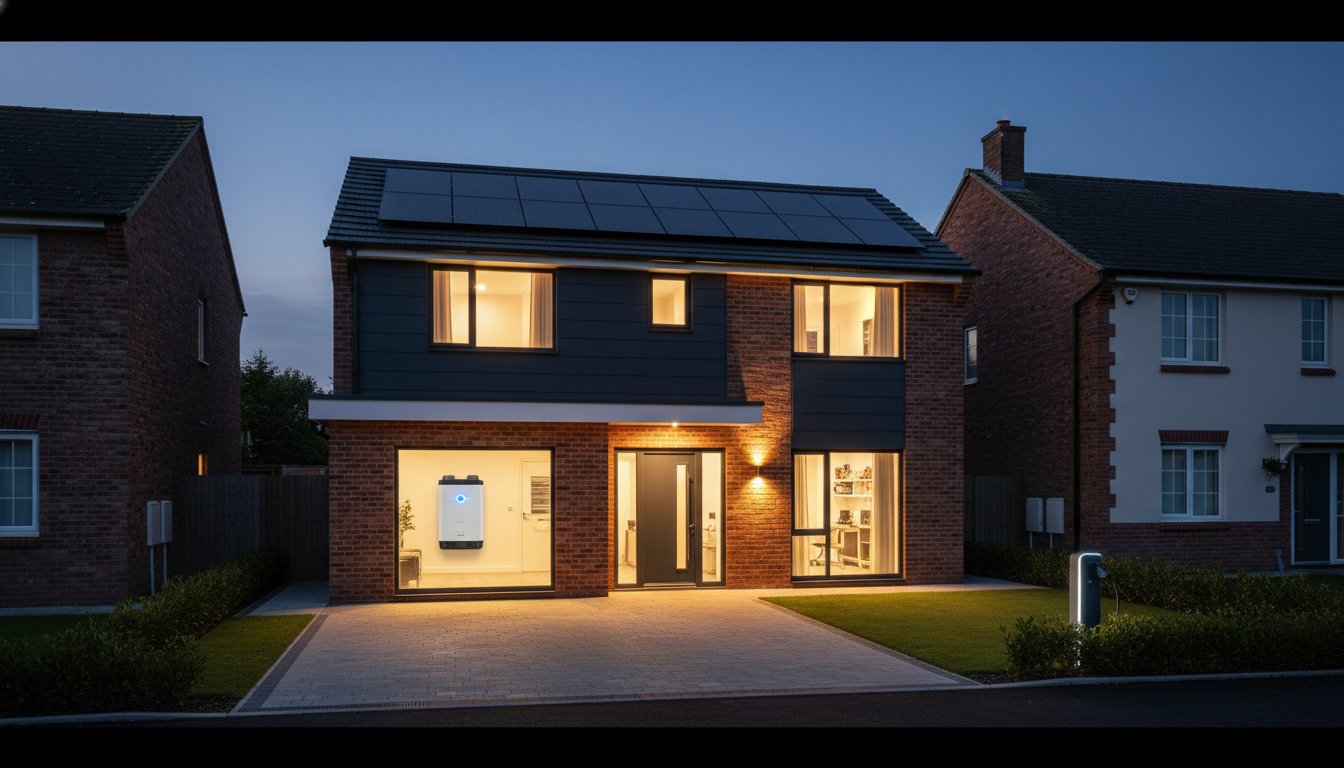
According to 2024 energy usage data, Staffordshire homeowners without battery storage often export up to 50% of their generated solar power back to the grid for a fraction of the cost they pay to buy it back at night. You didn't install solar panels just to keep subsidising the big energy companies; you did it to gain genuine control over your monthly outgoings. It's exhausting to deal with the complex technical jargon of depth of discharge and local grid compatibility while your electricity bills remain much higher than you expected.
This guide provides the clarity you need to choose a system that reduces your grid reliance to under 20% and keeps your home office running during local outages. We'll explore the latest 2026 warranty standards for the UK market, explain how to integrate new hardware with your existing solar array, and show you exactly how to maximise your return on investment in the West Midlands.
Key Takeaways
- Understand why Staffordshire’s specific solar yields make local energy storage essential to prevent wasting generated power back to the grid.
- Learn how to evaluate battery storage systems by prioritising 100% Depth of Discharge (DoD) to ensure you use every kilowatt you pay for.
- Discover how to leverage modern Time-of-Use tariffs and grid arbitrage to slash bills by charging your system at rates as low as 7p per kWh.
- Navigate essential UK compliance requirements, including MCS certification and G99 notifications, to secure your insurance and SEG payments.
- Explore how a unified GivEnergy ecosystem creates a seamless, future-proof link between your solar panels, home storage, and EV charger.
Why Battery Storage is Essential for Staffordshire Homes in 2026
By 2026, the energy landscape in the West Midlands has evolved into a model of decentralised power. For homeowners in towns like Cannock or Newcastle-under-Lyme, battery storage is no longer a luxury add-on but the vital bridge between generating energy and actually using it. While Staffordshire receives an average of 1,400 to 1,500 hours of sunshine annually, much of this potential is wasted without a way to capture it. Modern home energy storage systems allow residents to store surplus electricity instead of "spilling" it back to the National Grid for a fraction of its value. This shift is driven by the transition from old Feed-in Tariffs to a self-consumption model, where the highest ROI comes from avoiding high grid prices. Local authorities, including Staffordshire County Council, have set 2050 net-zero targets, making domestic storage a key pillar in reducing the county's carbon footprint.
The Problem: Why Solar Alone Isn’t Enough
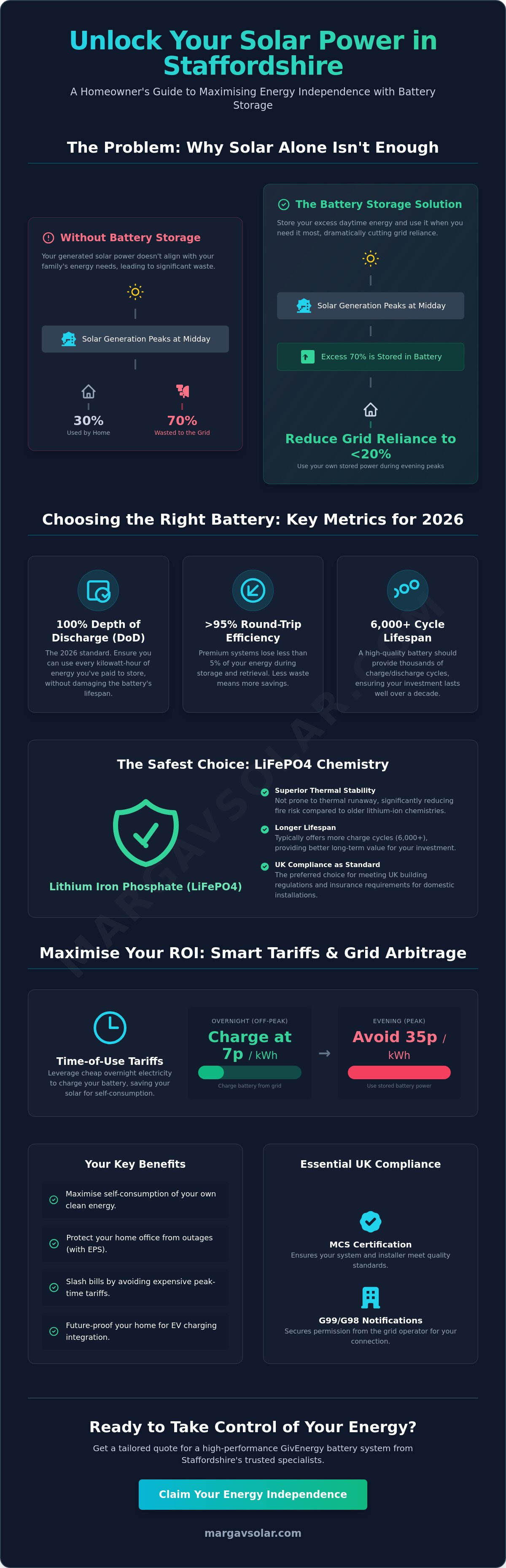
Household energy demand rarely aligns with the sun's schedule. This creates the "duck curve," where solar production peaks at midday while demand spikes in the morning and evening. Statistics show that typical Staffordshire families miss out on 60% to 70% of their solar generation because they aren't home to use it during peak sunlight hours. Battery storage is the mechanism for shifting daytime solar abundance to evening peak demand. Without this capacity, you're effectively donating your green energy to the grid and buying it back at a premium later that night. By capturing that 70% of lost energy, households can significantly reduce their reliance on external suppliers.
Energy Security in the West Midlands
Reliability is a growing concern as the UK grid undergoes significant upgrades. Homeowners in rural areas or historic centres like Lichfield and Stafford are increasingly prioritising backup power to protect against local maintenance outages. Modern battery storage units often feature an Emergency Power Supply (EPS). This function ensures that critical circuits, such as Wi-Fi routers, fridge-freezers, and home office equipment, remain operational during a blackout. For the 32% of Staffordshire residents who now work from home at least part-time, this level of energy security is a non-negotiable requirement for professional stability. It provides peace of mind that a local grid failure won't result in a lost day of productivity or spoiled food.
- Protects against rising peak-time electricity tariffs.
- Maximises the utility of every kWh generated by rooftop solar.
- Reduces the carbon intensity of your home by using clean energy at night.
- Provides a failsafe for home offices in areas prone to grid fluctuations.
Choosing the Right Battery: Capacity, Chemistry, and Compatibility
Selecting the right battery storage system involves more than just picking a brand. You must distinguish between nominal capacity, which is the total energy the unit can hold, and usable capacity, the actual amount of energy you can draw. By 2026, the industry standard has shifted toward a 100% Depth of Discharge (DoD). While older lead-acid or early lithium models required leaving 10% to 20% of the charge untouched to avoid damage, modern units allow you to utilise every kilowatt-hour you paid for without degrading the cells prematurely.
Round-trip efficiency is another critical metric for Staffordshire homeowners. This percentage represents the energy lost during the chemical conversion from DC to AC and back again. Premium systems now achieve over 95% efficiency, meaning very little of your generated solar power is wasted as heat. Physical footprint also dictates your choice. Many properties in Stafford or Stone have limited indoor space, making IP65-rated outdoor units or slimline garage-mounted systems the preferred option over bulky, indoor-only cabinets.
LiFePO4 vs. Traditional Lithium-ion
Lithium Iron Phosphate (LiFePO4) is now the safest choice for UK domestic installations. These batteries offer superior thermal stability compared to traditional cobalt-based lithium-ion cells. They don't suffer from thermal runaway, which significantly reduces fire risks in garage or loft conversions. A high-quality LiFePO4 battery should provide a benchmark of 6,000 cycles or more. This ensures your 10-year investment remains functional well into the 2030s. Always verify that your installer adheres to the latest safety standards for battery installation to meet current UK building regulations and insurance requirements.
AC-Coupled vs. DC-Coupled Systems
Your choice depends on whether you're adding to an existing solar array or starting a fresh installation. AC-coupled systems are the standard for retrofitting because they sit separately from your existing solar inverter. DC-coupled systems are more efficient for new builds. They use a hybrid inverter to manage both panels and storage, which removes an entire stage of power conversion. If you're looking to optimise an older setup, exploring Inverter Upgrades in Staffordshire can help you decide which coupling method provides the best return on investment for your specific roof orientation.
Staffordshire's varied housing stock, from rural barn conversions to urban semis, requires a tailored approach to battery storage. You can consult with a local specialist to determine which capacity best fits your peak evening energy loads.
Calculating ROI: How Battery Storage Pays for Itself
In 2026, the financial case for battery storage hinges on Time-of-Use (ToU) tariffs like Octopus Flux or Agile. These schemes reward homeowners for their flexibility. You can charge your system from the grid during off-peak windows at roughly 7p per kWh. During the 4pm to 7pm peak, when rates often hit 30p per kWh, your battery powers the home instead. This price gap, known as energy arbitrage, effectively slashes your daily running costs by shifting consumption away from expensive periods.
The Smart Export Guarantee (SEG) adds another revenue stream to the calculation. By 2026, export rates have stabilised, allowing you to sell excess power back when the grid needs it most. For a typical 4-bedroom home in Staffordshire using 4,500 kWh annually, combining arbitrage with SEG payments can result in yearly savings exceeding £850. This makes the system a proactive financial asset rather than just a backup tool.
Maximising Self-Consumption
Without a battery, most Staffordshire homes only use about 30% of the energy their panels generate. The rest gets sent to the grid for a low return while you're at work. Adding battery storage pushes this self-consumption rate to over 80%. This shift typically reduces the payback period of the entire solar PV system by 3 to 5 years. Modern smart batteries automatically trade energy by analyzing weather forecasts and grid pricing to ensure you always use the cheapest power available.
Maintenance and Longevity
Homeowners often worry about battery degradation over time. An 80% capacity guarantee after 10 years means that after a decade of daily cycles, a 10kWh battery will still hold at least 8kWh. The unit doesn't stop working; it simply becomes slightly less efficient at storing a full charge. To maintain this performance, following the UK government guidance on battery storage safety is essential, as it highlights the need for proper ventilation and professional installation standards.
Professional monitoring ensures your system stays healthy and identifies software updates that can improve efficiency. For more details on keeping your entire setup in top condition, read our guide on Solar Panel Maintenance in Staffordshire. Consistent check-ups prevent small calibration issues from turning into performance drops, protecting your investment for the full 15 to 20-year lifespan of the hardware.
Professional Installation and Compliance in Staffordshire
Installing battery storage isn't a simple weekend project. It's a complex electrical integration that must meet strict UK safety standards. In Staffordshire, the National Grid Electricity Distribution (formerly Western Power Distribution) manages the local network. You must follow their notification protocols. For systems under 3.68kW per phase, your installer uses the G98 process to notify the grid after the work is done. If your system is larger, you require G99 prior permission. This application can take up to 45 days to process, and skipping it risks your connection being disconnected by the network operator.
Safety regulations have tightened significantly for 2026. The latest IET wiring standards now dictate specific placement for lithium-ion units to mitigate fire risks. Systems shouldn't be installed in escape routes or certain loft spaces without enhanced fire-rated enclosures. If you live in an older Staffordshire cottage, structural integrity is a major factor. A 10kWh battery stack can weigh over 120kg. Placing this on 150-year-old timber floor joists without reinforcement is a recipe for disaster. Professional installers assess the floor loading capacity and often recommend ground-floor or wall-mounted solutions with specific masonry anchors.
The Importance of NICEIC and MCS Accreditation
You'll find cheap DIY battery kits on marketplaces like Fogstar, but these "bargains" come with high risks. Without MCS (Microgeneration Certification Scheme) accreditation, you won't be eligible for Smart Export Guarantee (SEG) payments. This means you can't get paid for the excess energy you send back to the grid. Most home insurance providers in the UK now refuse to cover properties with non-certified energy storage systems. Using a certified professional ensures your equipment warranties remain valid. For a deeper look at why these badges matter, read our NICEIC Certification Guide. Certified installers provide the EIC (Electrical Installation Certificate) you need to sell your home in the future.
The Local Staffordshire Advantage
Staffordshire's geography presents unique challenges for battery storage performance. Local voltage profiles in rural areas like the Peak District fringes often fluctuate. A Stafford-based team understands these local grid quirks and can commission your inverter to handle voltage spikes without tripping. If you live in one of the 66 conservation areas in the Stafford borough, you face stricter planning constraints. Local experts know which systems meet the aesthetic requirements of planning officers. Choosing a local team also slashes lead times. Instead of waiting weeks for a national firm to send a van from London, a local crew can provide rapid on-site support if your system needs a firmware update or physical check.
The MarGav Solution: GivEnergy Specialists in Staffordshire
MarGav Solar has spent 20 years refining renewable energy solutions for homeowners across Staffordshire. We prioritise GivEnergy for residential projects because their hardware is specifically engineered to meet the demands of the UK power grid and variable weather patterns. Whether you live in a traditional terrace in Stoke-on-Trent or a modern detached home in Stafford, a reliable battery storage system must be robust enough to handle high demand while remaining easy to manage. GivEnergy provides this through a unified ecosystem. Your solar panels, storage unit, and EV charger all communicate through a single interface, ensuring you don't waste a single kilowatt-hour of generated power.
Our team provides end-to-end support that goes far beyond a simple installation. We act as consultants first, assessing your property's specific orientation and your household's peak consumption times. This local expertise ensures your system is sized correctly for your needs in 2026 and beyond. We also provide long-term maintenance and system health checks to ensure your investment continues to perform at its peak efficiency for decades.
GivEnergy Batteries: Built for the UK Climate
The GivEnergy All-in-One system is a market leader for a reason. It features a 13.5kWh usable capacity and a 6kW peak power rating, which allows it to power heavy appliances like heat pumps or electric ovens without drawing from the grid. When paired with the GivEnergy Gateway, your home gains total backup protection. If a power cut hits Staffordshire, your battery storage system kicks in automatically to keep your lights and essential circuits running. You can track this performance in real-time using the GivEnergy Cloud Guide, which helps you identify the best times to charge from the grid at cheaper off-peak rates.
Next Steps: Your Path to Energy Independence
Achieving true energy independence requires a bespoke strategy rather than a one-size-fits-all product. The MarGav process is designed to be transparent and stress-free for local residents. It starts with a detailed site survey where we examine your existing electrical setup and roof capacity. We provide fixed-price contracts for every project, so you won't encounter hidden fees or surprise costs halfway through the build. Our technicians handle all the complex paperwork, including DNO applications and commissioning. If you're ready to take control of your rising utility costs, you can Book your Staffordshire battery storage consultation to receive a tailored performance estimate for your home.
Take Control of Your Staffordshire Energy Future
Achieving true energy independence in Staffordshire isn't a distant dream; it's a practical reality for 2026. Integrating battery storage allows you to capture every kilowatt of solar energy that would otherwise return to the grid. This technology protects your household from unpredictable market shifts and the rising costs of traditional utilities. Current industry data suggests that well-optimised systems can reduce grid reliance by up to 80% for the average UK home. You aren't just buying hardware. You're investing in a sophisticated system that delivers a measurable return through smart tariff management and peak-shaving strategies. MarGav brings over 20 years of renewable energy expertise to every local project. Our NICEIC and MCS Certified installers provide the dedicated support and maintenance Staffordshire residents need for long-term performance. It's time to stop overpaying for electricity and start generating your own security. Your journey toward a more sustainable, low-cost home starts today.
Get a Fixed-Price Battery Storage Quote in Staffordshire
Frequently Asked Questions
Do I need solar panels to have a battery storage system?
No, you don't need solar panels to benefit from a battery storage system. You can install a standalone battery to load shift by charging from the grid during off-peak windows when electricity rates drop as low as 7.5p per kWh. This stored energy then powers your home during peak evening hours when standard rates often exceed 25p per kWh.
How long does a typical home battery last in the UK?
A typical lithium-ion home battery lasts between 10 and 15 years. Most manufacturers, including Tesla and GivEnergy, provide warranties covering 10 years or a specific throughput of 6,000 to 10,000 charge cycles. Performance usually stays above 70% of the original capacity at the end of this period. Regular software updates and indoor installation help maintain this longevity.
Can I add a battery to my existing solar panel system?
Yes, you can add a battery to almost any existing solar array using an AC-coupled inverter. This setup allows the battery to work independently of your current solar inverter, making it a popular retrofit option for Staffordshire homes installed before 2024. It's a straightforward process that doesn't require replacing your original panels or their existing wiring.
What happens to my battery storage during a power cut?
Your battery storage system will only provide power during a blackout if it has an Emergency Power Supply (EPS) or gateway function installed. Standard grid-tied systems shut down during power cuts to protect utility workers. If you have an EPS, the system creates an island that powers essential circuits like lighting and fridges within 20 milliseconds of a grid failure.
Is battery storage a fire risk in residential homes?
Modern residential batteries carry an extremely low fire risk, especially those using Lithium Iron Phosphate (LiFePO4) chemistry. These units are more thermally stable than the lithium-ion batteries found in older laptops. UK installations must follow BS 7671 standards, which include mandatory fire-resistant backing and specific clearance distances to ensure safety in domestic settings.
How much space do I need for a battery installation in my garage?
You'll need an area approximately 1 meter high by 60 centimeters wide for a standard 5kWh to 10kWh unit. Most systems are wall-mounted and sit about 20 centimeters deep, similar to a modern combi boiler. You must also leave 30 centimeters of clear space around the unit for ventilation and maintenance access as required by manufacturer guidelines.
Will battery storage work with my EV charging point?
Yes, your battery works alongside an EV charger, but they don't usually charge the car directly. A home battery's 5kW output is often lower than a 7kW EV charger's demand, so the car pulls from both the battery and the grid. Smart integration software ensures your car uses surplus solar energy first, which helps homeowners avoid drawing expensive peak-rate power.
Are there any government grants for battery storage in 2026?
The primary financial incentive in 2026 is the 0% VAT rate on battery installations, which the UK government extended in early 2024. This tax relief applies to both standalone batteries and those installed with solar panels. While the Smart Export Guarantee (SEG) pays you for exporting energy, there aren't currently any direct upfront cash grants available for private residential installations.


