
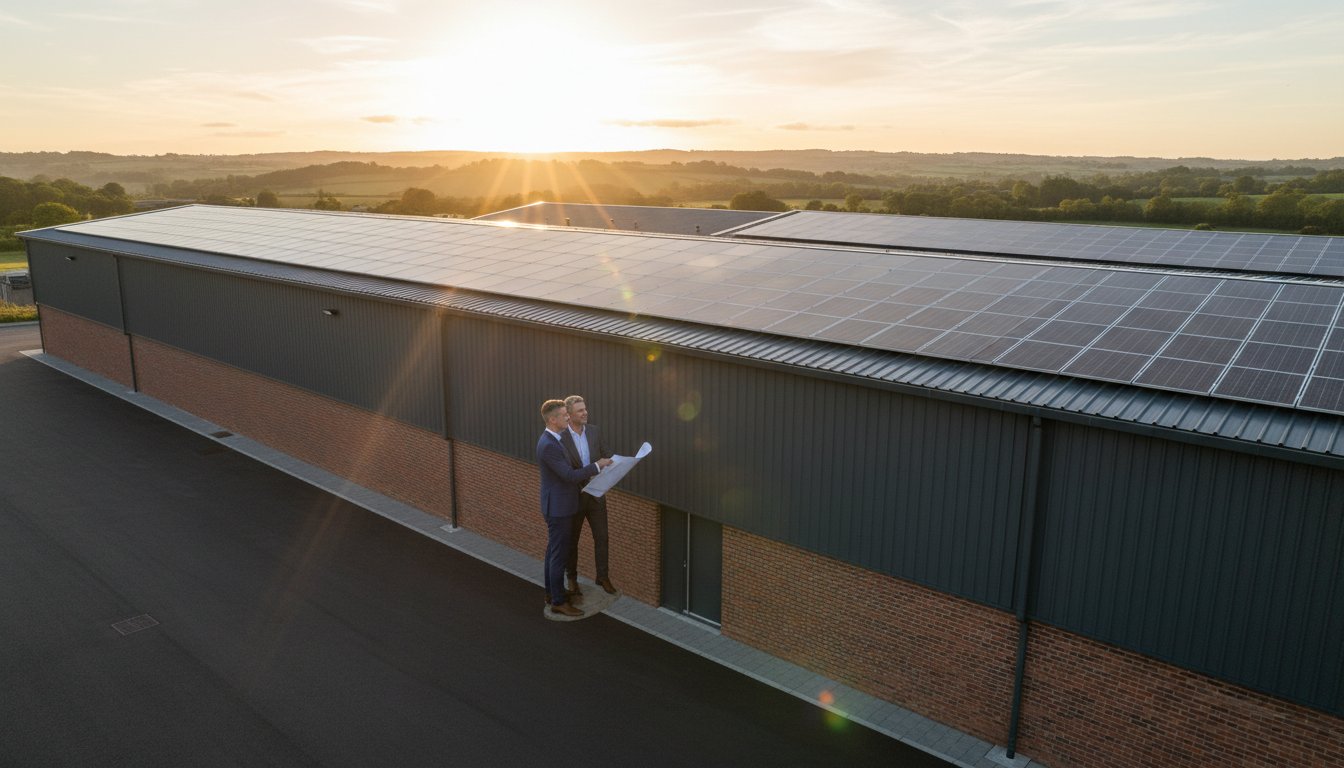
What if your Staffordshire commercial premises could generate its own revenue while your competitors remain at the mercy of the next National Grid price hike? Since 2021, UK business energy costs have seen unprecedented volatility, with some local firms reporting a 60% increase in operational expenditure. You've likely felt the pressure of these rising costs and felt overwhelmed by the technical jargon of G99 grid applications or the fear of roof damage. Investing in solar panels for business shouldn't feel like a gamble, yet the confusion surrounding West Midlands planning permissions and grid constraints often makes it feel that way.
You deserve a clear path to energy independence that doesn't involve guesswork. This guide provides a definitive roadmap for Staffordshire business owners to slash overheads and achieve net-zero targets by 2026. We'll explore how tailored commercial solar solutions bypass grid volatility, simplify complex application processes, and include robust pest protection to keep your assets secure. From securing green credentials for lucrative tenders to understanding the latest local installation standards, here's everything you need to know to future proof your enterprise.
Key Takeaways
- Learn why 2026 is the definitive year for Staffordshire firms to transition to solar to combat grid volatility and rising overheads.
- Discover how high-efficiency Tier 1 technology has reduced the average payback period for solar panels for business to a record 4-6 years.
- Understand how to leverage the Smart Export Guarantee (SEG) to transform surplus energy into a predictable revenue stream for your enterprise.
- Navigate UK planning regulations and Permitted Development Rights, including specific considerations for listed buildings in Stafford and Lichfield.
- Explore how maintenance-led design from industry experts ensures your commercial installation remains a high-performing asset for over 20 years.
Understanding Commercial Solar PV for Staffordshire Businesses
Commercial solar PV is a scalable energy generation asset that converts business premises from passive cost centers into active power plants. For Staffordshire enterprises, 2026 is the definitive tipping point. Grid volatility and the shift toward decentralized power mean that energy independence is now a core business strategy. The technology has evolved from basic Rooftop solar power systems into sophisticated energy hubs. These modern installations integrate high-capacity panels with smart battery storage to manage peak demand and ensure operational continuity.
Local companies in Stoke-on-Trent and Stafford are using this infrastructure to gain an advantage in public sector procurement. Since many government contracts now require a demonstrated commitment to carbon reduction, installing solar panels for business has become a vital tool for winning new work. It proves your company is ready for the low-carbon economy while providing the data needed for "Social Value" reporting in tender applications.
The Economic Case for Business Solar
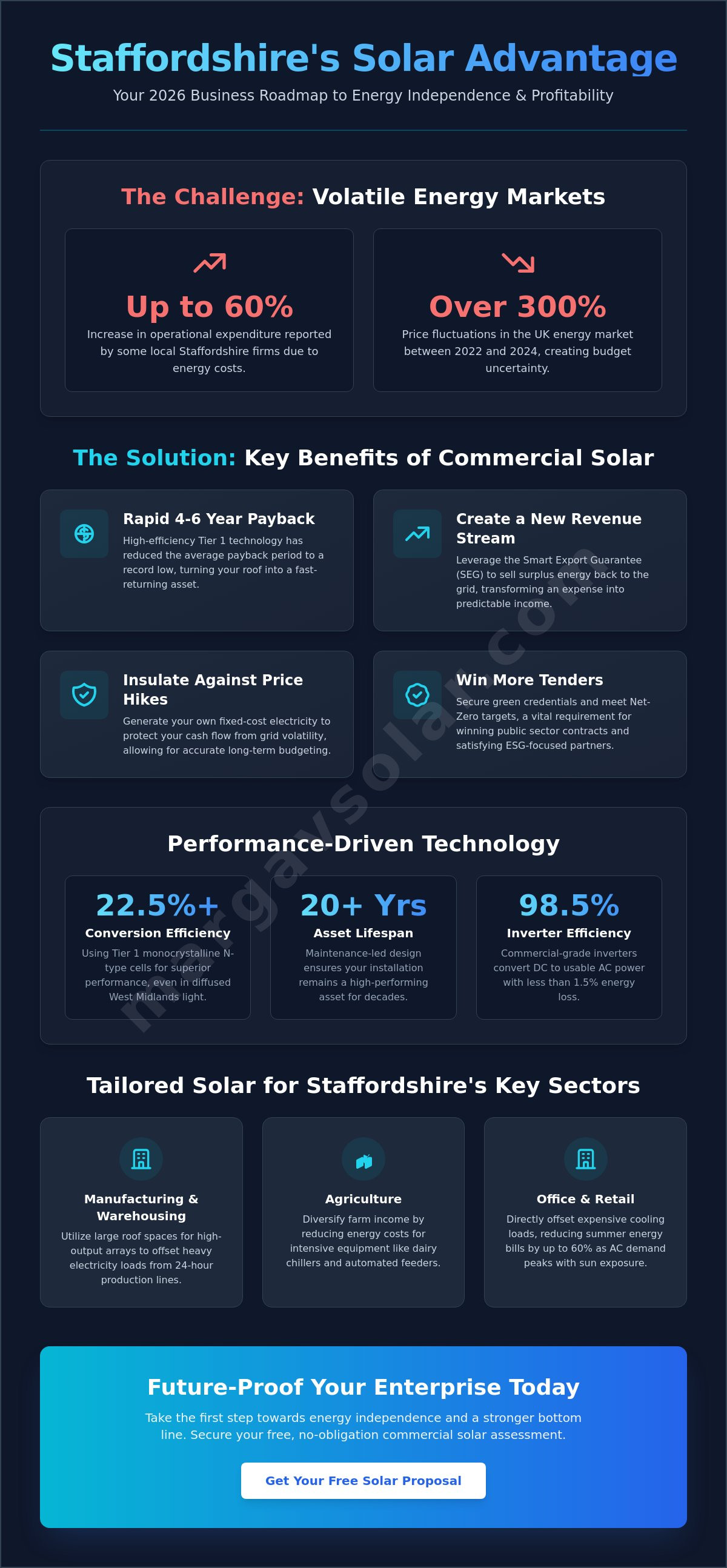
The primary driver for solar adoption is protection against the UK’s volatile energy market. UK energy markets saw price fluctuations of over 300% between 2022 and 2024, which makes fixed-cost generation a priority for 2026. By generating your own electricity, you insulate your cash flow from future price spikes. This stability allows for more accurate long-term budgeting and improved competitive pricing for your services. Beyond the balance sheet, the marketing value of being a "Net Zero" Staffordshire business is significant. It builds brand loyalty among environmentally conscious consumers and satisfies the ESG (Environmental, Social, and Governance) requirements of corporate partners.
Solar for Different Business Sectors
Staffordshire’s diverse economy offers various applications for solar technology. In manufacturing and warehousing hubs like Cannock and Tamworth, large-scale roof spaces provide the perfect footprint for high-output arrays. These systems offset the heavy electricity loads required for 24-hour production lines. In the agricultural sector, solar helps farmers diversify their income by reducing the cost of running energy-intensive equipment like dairy chillers or automated feeders. For office and retail sectors, solar panels for business are particularly effective at mitigating cooling costs. Because air conditioning demand peaks during the sunniest parts of the day, solar energy provides a direct, real-time offset for these expensive cooling loads, often reducing summer energy bills by up to 60%.
The Technical Mechanics of Business Solar Installations
Engineering a commercial solar array in 2026 requires more than just bolting panels to a roof. Modern solar panels for business utilize Tier 1 monocrystalline N-type cells, which currently achieve conversion efficiencies exceeding 22.5%. These panels perform significantly better in the diffused light conditions common in the West Midlands compared to older P-type models. To manage these high-output arrays, commercial-grade string inverters handle high-voltage DC loads, converting them into usable AC power with less than 1.5% energy loss. Many Staffordshire firms now pair these systems with EV charging points in Staffordshire to soak up excess generation during peak daylight hours, turning a parking lot into a profit centre.Grid Connection and DNO Compliance
National Grid Electricity Distribution (formerly WPD) acts as the gatekeeper for all Staffordshire projects. Any system larger than 3.68kW per phase requires a G99 application, a formal process where the DNO assesses if the local grid can handle your capacity. If the grid is constrained, we implement G100 export limitation schemes. These smart controllers ensure you don't push more power back than the local cables can handle, while still allowing you to claim the Smart Export Guarantee (SEG) for any permitted surplus. Applying early is vital; DNO approval typically takes between 45 and 90 days depending on local infrastructure density in areas like Stoke-on-Trent or Stafford.Mounting Systems and Roof Integrity
Staffordshire’s industrial landscape features diverse architecture, from traditional masonry warehouses to modern steel-frame units. For flat-roofed facilities, we utilize ballasted mounting systems. These use heavy concrete blocks to secure the array without piercing the roof membrane, which protects your 25-year structural warranty. On pitched metal roofs, trapezoidal clamps provide a lightweight, secure alternative. Every project begins with a structural weight load assessment. A typical commercial array adds 15kg to 25kg per square metre. We ensure your building's portal frame can support this additional stress before a single bolt is tightened.- Tier 1 Monocrystalline: High-density cells designed for 30+ years of operational life.
- G99 Applications: Mandatory for large-scale solar panels for business to ensure grid stability.
- Non-Penetrative Mounting: Essential for maintaining the integrity of modern industrial roof warranties.
Calculating the ROI: Payback Periods for Local Commercial Solar
By 2026, the financial logic for solar panels for business has shifted from a long-term sustainability goal to an immediate fiscal necessity. Efficiency gains in photovoltaic technology and stabilized supply chains have compressed average payback periods to between 4 and 6 years. This accelerated return matches the IEA renewable energy forecast, which identifies solar as the most cost-effective source of new electricity generation globally. For a Staffordshire-based manufacturer, this means a system installed today will likely pay for itself before the end of the decade, providing at least 20 years of essentially free energy thereafter.
The "opportunity cost" of delay is now the biggest threat to commercial competitiveness. With grid electricity prices for UK businesses remaining significantly higher than pre-2022 levels, every month without solar is a month of avoidable overhead. A typical warehouse in Stafford or Cannock using 100,000 kWh annually could be losing over £1,200 every month in potential savings by relying solely on the grid.
Revenue Streams from Excess Energy
The Smart Export Guarantee (SEG) has evolved into a meaningful contributor to business cash flow. In 2026, export rates for West Midlands businesses often range between 12p and 15p per kWh, allowing companies to monetize weekend or holiday overproduction. For firms preferring to avoid upfront capital expenditure, Power Purchase Agreements (PPAs) remain a viable route, where a third party funds the installation in exchange for a fixed, lower-than-grid energy rate. Smart businesses are also integrating battery storage to facilitate "peak shaving," which involves discharging stored power during high-tariff periods to avoid expensive red-band DUoS charges.
Tax Incentives and Grants in Staffordshire
Local support through the West Midlands Combined Authority (WMCA) provides targeted energy efficiency grants that can often offset the initial costs of structural surveys or grid connection fees. Furthermore, the UK government has protected businesses from tax hikes by maintaining business rate exemptions for renewable energy plant and machinery. This ensures that improving your property's energy profile doesn't lead to an increased rateable value.
Full Expensing allows companies to deduct 100% of the cost of qualifying solar panels for business from their taxable profits in the year the expenditure is incurred.
- 4-6 Years: The current average ROI for a well-optimized commercial system.
- 100% Tax Relief: Available through the permanent Full Expensing capital allowance.
- Zero Business Rate Hikes: Statutory exemptions apply to solar installations until at least 2035.
Navigating Planning and Installation in the West Midlands
Most Staffordshire firms benefit from Permitted Development Rights (PDR). These rights allow you to install solar panels for business on rooftops without a full planning application. However, restrictions apply if your premises are in the 17 conservation areas of Stafford or the historic heart of Lichfield. If your building is Grade I or II listed, you'll need Listed Building Consent before any work begins. It's a common hurdle for older textile mills or heritage sites in the region, but it's manageable with the right paperwork.
Staffordshire's climate requires specific engineering. We design systems to withstand wind loads exceeding 20 metres per second, especially for exposed sites near Cannock Chase or the Staffordshire Moorlands. Modern monocrystalline panels remain highly effective in overcast conditions. They capture diffuse light, which accounts for about 50% of total UK solar radiation annually. You don't need constant direct sunlight to generate a high ROI.
Before the first panel arrives, we complete a rigorous pre-installation checklist:
- Structural survey: Ensuring the roof can handle an extra 15kg to 25kg per square metre.
- EPC Rating: Checking your current Energy Performance Certificate to ensure the building meets efficiency standards.
- Asbestos check: Essential for older industrial units in Stoke-on-Trent or Tamworth to ensure safe mounting.
Local Planning Considerations
For ground-mounted systems, you need full planning permission if the array exceeds 9 square metres. When planning large-scale installations, we engage with Staffordshire County Council early to ensure compliance with local biodiversity standards. Local community buy-in is vital for projects visible from public rights of way. Transparency about carbon reduction often helps secure local support, especially for projects near residential zones.
The Installation Timeline
A typical project takes 12 weeks from the initial site audit to the final "Switch On." MarGav schedules the most disruptive electrical work during your quiet periods or weekends to ensure zero operational downtime. You'll receive a full handover pack including MCS, NICEIC, and DNO (Distribution Network Operator) completion certificates. These documents prove your system meets UK safety standards and allow you to register for Export Tariff payments. This ensures you're paid for any excess energy you send back to the grid.
Ready to secure your energy future? Book your Staffordshire site survey today to see how solar panels for business can transform your operational costs.
Future-Proofing Your Enterprise with MarGav Solar Expertise
MarGav Solar brings over 20 years of specialized experience to the local market. This depth of knowledge is essential for a complex solar panel installation on a commercial scale. Unlike residential setups, business systems face unique structural and electrical demands. Our approach centers on maintenance-led design. We don't just install hardware; we engineer systems to resist long-term degradation from the very first day. By integrating the GivEnergy Cloud, we empower you to monitor commercial performance with granular precision. You'll see exactly how your solar panels for business are performing every minute of the day.
The Importance of Post-Install Maintenance
System efficiency depends heavily on environmental factors. Industrial dust, soot, and bird droppings can reduce a commercial system's yield by 25% if left unmanaged. In Staffordshire's busy industrial corridors, this buildup happens much faster than most site managers realize. We protect your investment through professional bird proofing and specialized cleaning services that prevent debris from baking onto the glass. Our team also conducts annual thermal imaging audits to detect "hot spots" within the array. These are areas of high resistance that can lead to component failure if they aren't caught early. MarGav Solar offers bespoke maintenance contracts tailored to the specific atmospheric conditions of Staffordshire business parks, ensuring your ROI remains on track for the next two decades.
Scaling Your System
Your energy requirements will evolve. The UK's 2030 ban on new petrol and diesel commercial fleets means most businesses will soon need to power an entire electric delivery or service fleet. We design our systems with modularity in mind. This allows you to add more battery storage or additional panels as your operational needs grow. You won't have to rip out and replace your existing infrastructure. Instead, we build a foundation that scales with you. Taking action now secures your energy costs at a fraction of the current grid price. It's about building a system that's ready for 2030 today. Book your Staffordshire commercial solar audit with MarGav Solar today to start your journey toward true energy independence and protect your bottom line from future price shocks.
Take Control of Your Staffordshire Energy Strategy
Staffordshire enterprises are entering a new era of energy independence where volatile utility rates no longer dictate profit margins. By installing solar panels for business, your company secures a predictable energy cost for the next 25 years or more. Industry data suggests that commercial PV systems currently offer payback periods between 4 and 7 years, making this one of the most reliable capital investments available in 2026. You'll reduce your carbon footprint while simultaneously strengthening your balance sheet against future market shifts.
MarGav Solar provides the local expertise needed to navigate this transition seamlessly. With 20+ years of industry experience across the West Midlands, our NICEIC and MCS certified installers guarantee technical excellence on every project. We offer fixed-price installation contracts with no hidden fees, giving you total financial certainty from day one. It's time to transform your commercial roof into a high-performing asset that powers your growth for decades to come.
Request a Professional Commercial Solar Audit for Your Staffordshire Business
Your business deserves the stability that comes with generating its own clean power.
Frequently Asked Questions
Do I need planning permission for commercial solar panels in Staffordshire?
Most commercial solar installations in Staffordshire fall under Permitted Development Rights, so you won't need full planning permission. This rule applies as long as your system doesn't exceed 1 megawatt or protrude more than 200mm from the roof. However, if your business is in one of Staffordshire's 67 conservation areas or a Grade I or II listed building, you'll need Listed Building Consent. Always check with your local council planning department before you start any structural work.
How long do solar panels for business take to pay for themselves in 2026?
Most solar panels for business in 2026 pay for themselves within 5 to 8 years. This ROI is driven by the 25% efficiency rates of modern N-type solar cells and rising commercial electricity tariffs. By offsetting peak-time grid consumption, a typical Staffordshire SME can reduce its annual energy spend by 40% to 60%. Your specific payback period depends on your daytime energy profile and whether you integrate battery storage to capture evening usage.
Can I install solar panels if my business rents its premises?
You can install solar panels on rented premises, but you'll need a formal License to Alter from your landlord first. Many businesses now use Power Purchase Agreements (PPAs) where a third party funds the installation and sells you the power at a discounted rate. This 0-capital approach is popular in 2026 for tenants with long-term leases of 10 years or more. It increases the building's EPC rating, which helps landlords meet the UK's MEES requirements.
What is a G99 application and why does my business need one?
A G99 application is a mandatory request to National Grid Electricity Distribution to connect a system larger than 3.68kW per phase to the grid. It ensures the local Staffordshire power network can handle the electricity your system generates without causing surges. Your installer must submit this technical data before any work begins. Without an approved G99, you can't legally export excess power or receive payments through the Smart Export Guarantee (SEG) scheme.
How much maintenance do commercial solar panels actually require?
Commercial solar systems are low-maintenance because they have no moving parts to wear out. You should schedule a professional cleaning every 12 to 24 months to remove dust and bird droppings, which can reduce output by 10%. An annual electrical inspection ensures the inverters and cabling remain efficient. Most 2026 systems include 24/7 digital monitoring, so you'll receive an automated alert if any individual panel underperforms by more than 5%.
What happens to my business solar generation on cloudy days in the West Midlands?
Solar panels still generate electricity on cloudy days in the West Midlands by capturing diffused sunlight. While output might drop to 10% or 25% of its peak capacity during heavy overcast conditions, the system never stops working during daylight hours. Modern bifacial panels are particularly effective in Staffordshire's climate. They capture light reflected from the roof surface, which helps maintain a steady flow of energy even when the sun isn't directly visible.
Are there any grants for solar panels for businesses in Staffordshire?
Businesses can access the UK Government's Full Expensing tax relief, which allows you to deduct 100% of the cost of solar panels for business from taxable profits. Locally, Staffordshire County Council often runs the Low Carbon Business Evolution Programme, offering grants for energy audits and infrastructure. These schemes change frequently, so check the current availability on the Staffordshire Business Support website for 2026 funding rounds or interest-free green loans available to SMEs.
Can commercial solar panels power my entire manufacturing facility?
Commercial solar can power an entire manufacturing facility if you have sufficient roof space and integrate battery storage. A typical 500kW system covers approximately 2,500 square metres of roof and generates enough power for heavy machinery during daylight hours. If your facility operates 24/7, you'll need a Battery Energy Storage System (BESS) to store the 30% to 50% of energy usually exported during peak generation. This setup maximizes your total energy independence.


