
Did you know that by the end of 2024, the UK reached a milestone of over 1.5 million solar installations, with more than 180,000 systems added in that year alone? It's a clear sign that the shift toward renewable energy is accelerating across the country. You likely agree that while the idea of slashing your monthly bills is exciting, the actual process often feels daunting. You're probably worried about whether you need specific planning permission from your local council or if those panels will actually perform when the clouds roll over the Peak District.
We've created this guide to remove that stress and give you total confidence in your green energy investment. You'll learn exactly how to evaluate your home's potential, choose the right technology for the Staffordshire climate, and stay on the right side of UK building regulations. We're breaking down the entire journey into a simple, 2026-ready checklist that takes you from your first consultation to generating your own clean, affordable electricity.
Key Takeaways
- Learn how to evaluate your Staffordshire home’s structural readiness and environmental suitability to ensure your property is primed for a long-term energy investment.
- Navigate UK "Permitted Development" rules and the essential MCS certification requirements needed to qualify for the Smart Export Guarantee (SEG).
- Discover how to select the right hardware, from bifacial panels to battery storage, to optimize the efficiency of your solar installations in the UK’s unique light conditions.
- Prepare for a seamless installation day by understanding the typical 1-2 day timeline, scaffolding requirements, and how to minimize disruption to your home.
- Protect your 25-year investment with a targeted maintenance schedule designed to combat local Staffordshire agricultural dust and maximize your financial returns.
Property Readiness: Is Your Staffordshire Home Ready for Solar Installations?
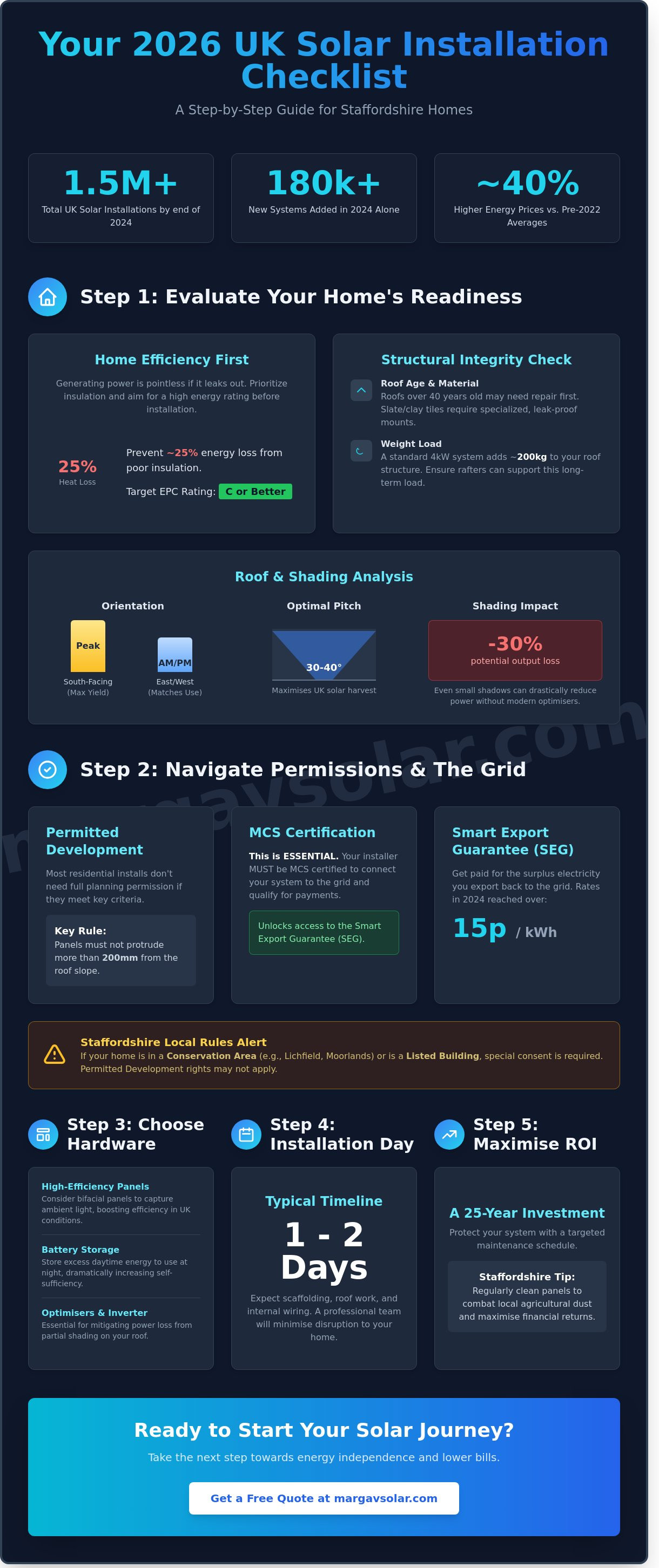
Solar installations represent a 25 year commitment to your property's infrastructure. By 2026, Staffordshire residents have seen UK energy prices remain volatile, often sitting 40% higher than pre-2022 averages. This makes local generation a financial priority rather than a luxury. Before you commit to hardware, you should understand the comprehensive overview of solar power to see how photovoltaic technology integrates with the UK national grid. A well-planned system acts as a hedge against inflation, but it requires a solid foundation.
Adopting a "home-first" strategy is the most effective way to approach this investment. Generating clean energy is pointless if 25% of that power effectively leaks out through an uninsulated loft or single-glazed windows. Aim for an EPC rating of at least a C before looking at panels. To guarantee the safety of your roof and the long-term efficiency of the system, always secure a professional solar panel installation from a provider who understands West Midlands building regulations and weather patterns.
Roof Orientation and Shading Analysis
Staffordshire's geography means south-facing roofs remain the gold standard for energy yield. However, east-west splits have become popular in 2026 because they provide a more consistent "bell curve" of energy throughout the day. This matches the typical 9-to-5 household demand better than a single southern peak. Optimal Pitch is 30-40 degrees for maximum UK solar harvest. You must also account for local shading. Tall Victorian chimneys in towns like Leek or the mature oak trees common in Cannock Chase can significantly drop your voltage. Even a small amount of shade on one corner of an array can reduce total string output by 30% without modern optimisers.
Structural Integrity and Roof Material
Modern high-efficiency panels weigh approximately 20kg each. A standard 4kW system adds roughly 200kg of dead weight to your rafters, which doesn't include the additional stress of wind uplift during winter storms. You need to ensure your home can support this load for the next three decades.
- Roof Age: If your roof tiles are over 40 years old, it's cheaper to replace or repair them now than to remove panels for repairs in five years.
- Material Compatibility: Slate and clay tiles require specialized flashing and mounting kits to prevent leaks, whereas concrete tiles are more straightforward.
- Loft Access: You'll need clear access for the inverter and potential battery storage. These units require ventilation and should be situated close to your main consumer unit.
- Cable Routing: Plan for internal cable runs to avoid unsightly external conduit on the front of your property.
Your property's readiness determines the final ROI of your solar installations. Assessing these physical constraints early prevents unexpected costs during the mounting phase and ensures the system performs at its peak from day one.
Pre-Installation Checklist: Planning, Permissions, and the Grid
Before any panels arrive at your property, you must clear two major hurdles: local planning policy and grid connection. Most residential solar installations in the UK fall under Permitted Development rights. This means you don't usually need full planning permission if the panels don't protrude more than 200mm from the roof slope. However, you must ensure your installer is MCS certified. Without an MCS certificate, you can't sign up for the Smart Export Guarantee (SEG), which is the mechanism that pays you for exporting surplus electricity. In 2024, some export rates reached over 15p per kWh, making this certification essential for your return on investment.
Staffordshire Local Authority Planning Rules
Staffordshire has a high concentration of heritage sites and Conservation Areas, from the historic streets of Lichfield to the rural villages of the Moorlands. If your home is in a Conservation Area or is an Article 4 Direction area, Permitted Development rights might be restricted. For Grade I or II listed buildings, you'll need Listed Building Consent before proceeding. You can verify your property's status by checking the interactive maps on your local council's website, such as Stafford Borough or Newcastle-under-Lyme Borough Council. If you're searching for solar energy near me, local specialists can guide you through these specific regional restrictions to avoid costly fines.
Electrical Grid Connectivity (G98 vs. G99)
Connecting to the local grid requires an application to the Distribution Network Operator (DNO). In Staffordshire, the DNO is National Grid Electricity Distribution. For standard systems with an inverter capacity of 3.68kW or less per phase (roughly 16 Amps), your installer follows the G98 process. This is a simple notification sent after the system is live. If you're planning larger solar installations with high-capacity battery storage or multiple arrays, you'll need a G99 application. This requires prior approval from the DNO, which can take up to 45 working days. Your installer must also verify that your consumer unit can handle the additional load and has adequate surge protection. According to the Energy Saving Trust's guide to solar panels, using an NICEIC-certified electrician ensures your wiring meets the latest BS 7671 safety standards. You can start your journey today by requesting a professional assessment of your roof to see which grid application fits your energy needs.
The Technical Checklist: Choosing Your Solar Hardware
Selecting the right components for solar installations in Staffordshire requires a balance between local weather patterns and 2026 technology standards. While traditional monocrystalline panels remain the industry standard due to their high space efficiency, bifacial panels are increasingly popular for UK homes. These dual-sided modules capture reflected light from roof surfaces, which is particularly effective in the UK where diffuse, overcast light accounts for approximately 50% of annual solar radiation. When comparing brands, prioritize hardware listed by the Microgeneration Certification Scheme (MCS) to ensure the equipment meets rigorous UK safety and performance benchmarks.
To maximize your return on investment, you must scrutinize the technical specifications. Look for an efficiency rating of at least 21% to 23%, which is the 2026 benchmark for premium residential modules. Equally vital is the degradation rate. Most high-quality panels now guarantee they'll maintain 87% to 92% of their original output after 25 years of service. If a manufacturer can't provide a linear performance warranty that meets these figures, the long-term yield of your system will likely underperform.
Panels and Inverters: The Powerhouse
By 2026, a standard residential installation should utilize panels with a minimum wattage of 400W, though 435W to 450W modules provide better value for limited roof spaces. Your choice of inverter depends heavily on your property's surroundings. String inverters are cost-effective for south-facing roofs with zero obstructions, but micro-inverters are better for Staffordshire homes with chimney shadows or dormer windows because they allow each panel to operate independently. Inverter clipping occurs when your panels produce more DC power than your inverter can convert to AC, which effectively caps your energy production during peak summer hours. Selecting an inverter that's slightly undersized (a DC-to-AC ratio of 1.2 or 1.25) is often intentional to maximize efficiency during the UK's many low-light days.
Battery Storage and Smart Management
For Staffordshire homeowners who spend their daylight hours at work, battery storage isn't just an add-on; it's a financial necessity. Without a battery, you might export up to 70% of your generated power to the grid for a low Feed-in rate, only to buy it back at 28p per kWh or more in the evening. Most local households find the "sweet spot" with a capacity between 5kWh and 10kWh, depending on evening appliance usage.
Modern systems offer sophisticated control through platforms like the GivEnergy Cloud, which allows you to automate your energy usage based on weather forecasts. When finalizing your hardware, use this checklist for smart features:
- Time-of-Use (ToU) Compatibility: Can the battery automatically charge from the grid at 7p per kWh during off-peak hours?
- Blackout Protection: Does the system include an Emergency Power Supply (EPS) to keep your lights on during a power cut?
- Depth of Discharge (DoD): Ensure the battery allows for 100% DoD so you can use the full advertised capacity.
Installation Day Checklist: What to Expect
For a standard three-bedroom semi-detached home in Staffordshire, most solar installations take between 24 and 48 hours to complete. Day one typically focuses on the external mounting system and rail placement. Day two involves the panel mounting, inverter wiring, and battery integration if you've opted for storage. You'll experience a brief power outage, usually lasting 1 to 2 hours, while the final AC connections are made to your consumer unit. The installers should provide a specific window for this outage so you can plan your day accordingly.
Site Preparation and Safety
Installers need clear access around the entire perimeter of your home. You should move vehicles from the driveway at least 2 hours before the team arrives to make room for the scaffolding delivery truck. Most Staffordshire properties require independent scaffolding erected to TG20:21 standards. This ensures safety for technicians working at height and protects your roofline. To protect your garden or driveway, ask the team to use ground protection mats if they're moving heavy battery units or pallets of panels across soft landscaping or block paving.
The Handover Pack and Certification
Before the crew leaves, they must provide a comprehensive handover pack. This isn't just paperwork; it's essential for insurance and future house sales. You'll need the MCS certificate, which proves the system meets UK quality standards, and the NICEIC building notice for the electrical work. You should also receive the G98 or G99 grid connection approval from the District Network Operator (DNO). These documents confirm your system is legally allowed to export energy back to the grid.
The lead technician will help you download the monitoring app. This software lets you see real-time generation data on your phone. It's the first step in learning about solar power for your home and how to shift your energy usage to peak sun hours. They'll show you how to read the LED indicators on your inverter and battery to ensure everything is operating correctly.
The Final Walkthrough Checklist:
- Check that all roof tiles are seated correctly around the mounting brackets.
- Ensure the inverter and battery area is clean and free of drill dust or cable clippings.
- Verify the emergency DC isolator switches are clearly labelled and accessible.
- Confirm you know the specific shutdown sequence for the system.
- Check that any scaffolding has a scheduled date for removal, usually within 72 hours of completion.
Ready to start your transition? Book a technical site survey to see if your roof is ready for 2026 solar installations.
Post-Installation: Maximizing ROI and Long-Term Care
Once your solar installations are live, the focus shifts to protecting your 25-year investment. Staffordshire's unique landscape, particularly the agricultural dust from the North Staffordshire moors and surrounding farmland, can significantly reduce panel efficiency if left unchecked. You need a recurring maintenance schedule to ensure your system performs at its peak. This involves more than just a quick glance at the roof; it requires a structured approach to technical health and physical cleanliness.
Registering for the Smart Export Guarantee (SEG) is a vital step for any UK homeowner. This government-backed initiative ensures energy suppliers pay you for every kilowatt-hour of green electricity you send back to the grid. Without this registration, you're essentially giving away free power. MarGav Solar acts as your long-term partner, helping you navigate these administrative hurdles and providing the necessary technical support for future battery upgrades or system expansions as your energy needs evolve.
Monitoring and Optimization
Don't wait for a high energy bill to realize something is wrong. Perform weekly checks on your monitoring app to identify performance dips early. If you notice a sudden drop on a sunny Tuesday, it could indicate a string failure or a shading issue from new foliage. You'll maximize ROI by shifting heavy appliance usage, like dishwashers or EV charging, to between 10 am and 2 pm. Be aware of Export Limiting. This happens when the District Network Operator (DNO) restricts how much power you send back to the grid. If your system is limited, using more power locally is the only way to avoid wasting your generation.
Cleaning and Bird Proofing
Staffordshire pigeons view solar panels as the perfect sheltered nesting spot. This leads to debris buildup and acidic droppings that can etch the glass surface over time. A local bird-proofing kit involving stainless steel mesh skirting is essential to prevent these pests from nesting under the array. While you might feel tempted to use a garden hose, professional cleaning can improve yield by up to 20%. Professional teams use de-ionized water and specialized telescopic brushes that won't void your manufacturer warranty or leave limescale streaks. DIY attempts often lead to micro-cracks in the cells if you apply pressure incorrectly, which permanently damages the solar installations.
Staffordshire Bird Proofing Checklist:
- Install high-grade mesh clips that don't require drilling into the panel frames.
- Clear any existing nests before sealing to prevent mites from entering the loft.
- Check for cable damage caused by squirrels or birds every six months.
- Ensure all debris is cleared from gutters to prevent water backup under the tiles.
Powering Your Staffordshire Future in 2026
Transitioning to renewable energy requires more than just panels on a roof; it's about meticulous planning and selecting hardware that meets the 2026 efficiency standards. You've learned that assessing your home's structural readiness and securing DNO grid permissions are the first vital steps to a successful project. By following this technical checklist, you ensure your solar installations deliver maximum performance from day one while protecting your long-term investment. Modern systems now integrate seamlessly with smart home tech, allowing you to track every kilowatt generated in real time.
MarGav Solar brings over 20 years of local Staffordshire expertise to every project. Our NICEIC-certified professional installers handle everything from the initial survey to full end-to-end maintenance and warranty support. Since the UK government aims for 70GW of solar capacity by 2035, starting your journey now puts you ahead of the curve. You'll benefit from the latest battery storage technology and smart export incentives that make green energy more viable than ever for local homeowners.
Book Your Free Staffordshire Solar Survey with MarGav Solar and take control of your energy bills today. Your path to a greener, more self-sufficient home is closer than you think.
Frequently Asked Questions
Do I need planning permission for solar installations in Staffordshire?
Most solar installations in Staffordshire fall under Permitted Development rights and don't require formal planning permission. You'll only need to submit an application if your property is a listed building or located within the Cannock Chase Area of Outstanding Natural Beauty. Your panels shouldn't protrude more than 200mm from the roof slope to stay within these 2026 building guidelines.
How long does a typical solar installation take for a UK home?
A standard domestic installation typically takes one to two days to complete from start to finish. Scaffolding teams usually arrive 24 hours before the technicians to set up safety platforms around your perimeter. Once the rails are fixed and wiring is routed, a three-bedroom semi-detached house can have its full array active within 48 hours of the start date.
Can I install solar panels myself to save on costs?
You shouldn't install solar panels yourself because you'll lose access to the Smart Export Guarantee payments. Only MCS certified installers can sign off on the work required to sell excess energy back to the National Grid. UK building regulations also require a qualified electrician to handle high-voltage DC connections to ensure your home insurance policy remains valid.
What happens to my solar panels when it is cloudy or raining in Staffordshire?
Your panels will still generate electricity on overcast days by utilizing diffused sunlight rather than direct radiation. While output drops to roughly 20% of its peak capacity during heavy cloud cover, modern monocrystalline cells are designed to capture a broad spectrum of light. Rain actually benefits your system by washing away dust and debris that might otherwise block the cells.
Is my roof strong enough for a full solar and battery installation?
Most UK timber-framed roofs easily support the 20kg weight of a standard solar panel without needing structural reinforcement. Your installer will perform a load-bearing calculation to ensure the rafters meet current safety standards before work begins. Since batteries often weigh over 60kg, they're typically mounted on load-bearing walls or placed on the floor in a garage or utility room.
How much can I actually save on my energy bills with solar in 2026?
Homeowners can save between £450 and £750 per year on their electricity bills based on current Energy Saving Trust data. Your total savings depend on your self-consumption rate and the current Smart Export Guarantee rates, which currently average around 5p to 15p per kWh. Adding a battery storage system can increase these savings by another 30% by capturing daytime energy for evening use.
What is the difference between MCS and NICEIC certifications?
MCS certification focuses specifically on the quality and performance of solar installations, while NICEIC verifies general electrical safety and competence. You need an MCS certificate to qualify for government-backed financial incentives and grid export payments. NICEIC ensures the wiring in your home meets the BS 7671 standards required for all domestic electrical work in the United Kingdom.


