
Waiting another year to see if energy prices stabilize could be the most expensive mistake you make this decade. With the Ofgem price cap set to rise by 13% in July 2026, the cost of doing nothing is higher than ever. You've likely felt the frustration of volatile bills and the confusion surrounding varying Smart Export Guarantee rates. It's hard to tell if the solar panel payback period UK families are facing is still a sound financial move or a moving target.
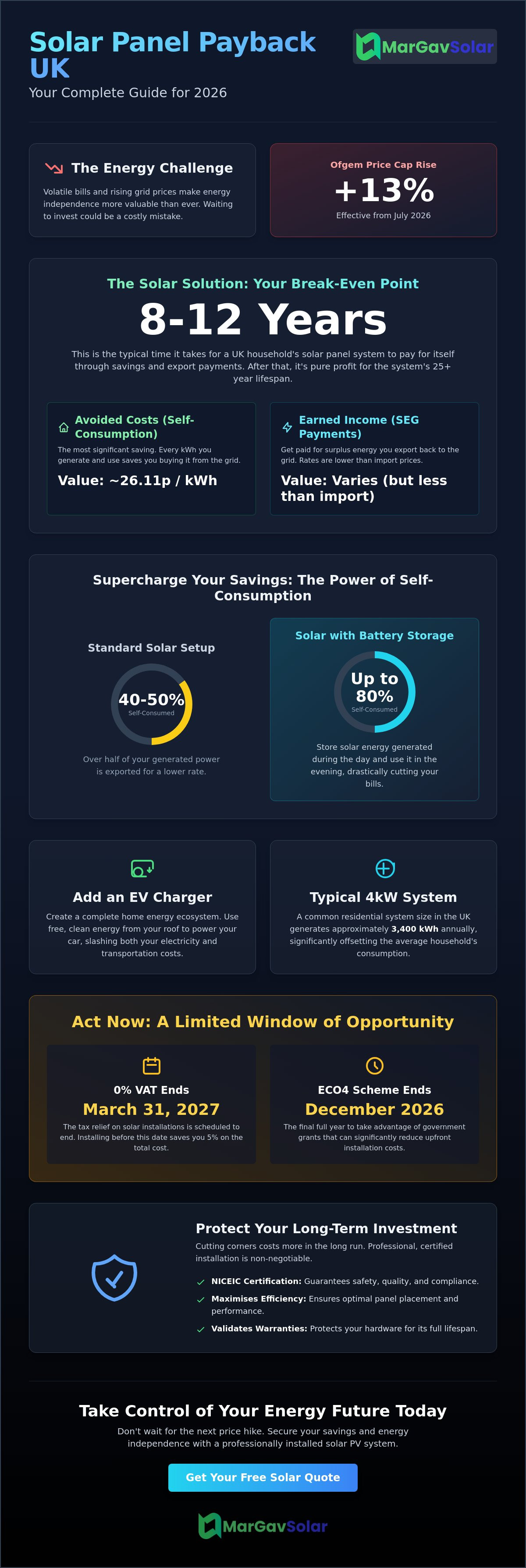
We're here to clear up that uncertainty. You'll discover exactly how long it takes for solar panels to pay for themselves in 2026 and how to accelerate your return on investment through smart usage. We'll explore why the average payback now sits between 8 and 12 years, the impact of current export payments, and how battery storage can increase your self-consumption to 80%. We'll also explain why the upcoming March 2027 VAT increase and the end of the ECO4 scheme in December 2026 create a narrow window for homeowners to secure the highest possible savings.
Key Takeaways
- Learn how current 2026 energy price caps and rising utility rates influence the average solar panel payback period UK homeowners can expect.
- Discover how integrating battery storage solutions can nearly double your self-consumption rates and significantly shorten your break-even timeline.
- Understand how combining solar PV with EV charging points creates a high-efficiency energy ecosystem that slashes both home and transport costs.
- Identify the critical regulatory deadlines for 0% VAT and ECO4 grants that make 2026 a pivotal year for your solar investment.
- See why professional installation and NICEIC certification are essential for protecting your system's long-term efficiency and warranty validity.
What is the Average Solar Panel Payback Period in the UK for 2026?
The concept of a payback period is simple. It represents the number of years it takes for the total financial benefits of your system, through bill savings and export payments, to equal the initial cost of installation. In essence, it's the moment your solar panels have paid for themselves. For a typical household, the solar panel payback period UK residents see in 2026 generally falls between 8 and 12 years. Once you hit this break-even point, every kilowatt-hour your roof produces is effectively pure profit for the remainder of the system's 25 plus year lifespan.
The financial return comes from two distinct streams. First, there's "avoided cost," which is the money you don't pay your energy supplier because you're using your own generated electricity. Second, there's "earned income" through the Smart Export Guarantee (SEG). This is where you're paid for any surplus energy sent back to the grid. Because electricity rates from the grid are significantly higher than export rates, the fastest way to break even is to use as much of your solar energy as possible within your own home.
Understanding the 2026 Energy Market Context
The value of solar has shifted. While the old "Feed-in Tariffs" are gone, the modern energy market makes self-generation highly profitable. From July 1st, 2026, the Ofgem price cap is set to rise by 13%, bringing average rates to 26.11p per kWh. This increase directly shortens the solar panel payback period UK homeowners experience because every unit of energy you generate saves you more money than it did previously. The history and growth of Solar power in the United Kingdom show that as grid prices fluctuate, the independence offered by residential PV becomes a critical financial hedge. 2026 is a pivotal year because it represents the final full year to benefit from 0% VAT on installations before the rate is scheduled to revert in March 2027.
Why Payback Varies by Household
No two homes have the exact same ROI timeline. A 4kW system might generate around 3,400 kWh annually, but its value depends on when you use that power. Families at home during the day often see a faster return than those who only use electricity in the evenings. Roof orientation also plays a massive role. While South-facing roofs are the gold standard for peak generation, East/West splits can be highly effective for capturing morning and evening sun. This spreads your generation across more of your waking hours, reducing the amount of expensive peak-rate electricity you need to buy from the grid.
The Core Variables: What Determines Your Solar ROI?
Calculating the solar panel payback period UK homeowners face involves balancing initial expenditure against decades of utility savings. It isn't just about the hardware. You have to account for professional labour, structural assessments, and the necessary certifications that validate your system for the grid. A typical 4kW system generates roughly 3,400 kWh annually in the UK. However, the true value of those units depends on whether you use them instantly or sell them back to your supplier. The financial "sweet spot" occurs when your generation aligns perfectly with your consumption habits.
Most households without storage only use 40% to 50% of the energy they generate. The rest flows back to the grid. While this provides some income, the financial gap is wide. You'll likely pay around 26.11p per kWh to buy electricity from the grid during the peak period of late 2026, but you'll only receive a fraction of that when you sell your surplus. This disparity is why maximising self-consumption is the fastest route to a positive ROI. Every unit of energy you don't buy from the grid is worth nearly double the unit you sell back to it.
Upfront Costs vs. Long-Term Value
Quality matters. Cutting corners on installation might save money today, but inefficient wiring or poor panel placement can extend your payback window by years. High-efficiency panels capture more light in the UK's overcast conditions, ensuring your system performs even on grey days. Fortunately, the 0% VAT rate on residential solar remains in effect until March 31st, 2027. This tax relief applies to both materials and labour, making 2026 a financially strategic time to commit. If you're ready to explore these options, looking into professional residential solar PV systems can help you secure these tax benefits before the rate reverts to 5%.
The Smart Export Guarantee (SEG) Explained
The SEG requires large energy suppliers to pay you for the low-carbon electricity you export. Rates vary wildly between providers. Some suppliers offer around 15p per kWh, while others might offer as little as 2p or 3p. It's vital to shop around for the best deal. According to the Energy Saving Trust, selecting a competitive export tariff can shave significant time off your total payback period. You can often choose between fixed rates or agile tariffs that pay more when the grid is under stress, rewarding you for exporting energy during peak demand hours.
Accelerating the Break-Even Point: Batteries and EV Chargers
While a standard PV system provides a solid foundation for energy independence, the real acceleration in your return on investment comes from closing the loop between generation and consumption. Relying solely on panels means you're often exporting energy during the day and buying it back at a premium in the evening. By integrating storage and transport into your home energy ecosystem, the solar panel payback period UK homeowners face can be significantly optimized. It shifts the financial focus from simply saving a few pounds on a bill to virtually eliminating your reliance on the grid.
Why Battery Storage is the ROI Game-Changer
Without a way to store what you produce, your self-consumption usually hovers around 30% to 40%. The rest is sent to the grid for a low export rate. Installing solar battery storage fundamentally changes this equation by increasing your self-consumption to 70% or even 80%. This allows for "peak shaving," where you use your stored solar energy during the 4 pm to 7 pm window when grid electricity is at its most expensive.
A home battery effectively doubles your self-consumption rate by capturing midday surplus for use during expensive evening peaks. This shift is critical as electricity price caps rise. To manage this effectively, smart platforms like GivEnergy Cloud provide real-time data to help you decide when to discharge your battery or charge from the grid during off-peak hours. While a battery increases the initial system cost, the sheer volume of avoided grid costs often leads to a more robust long-term financial outcome.
Solar and EV Charging: The Ultimate Power Couple
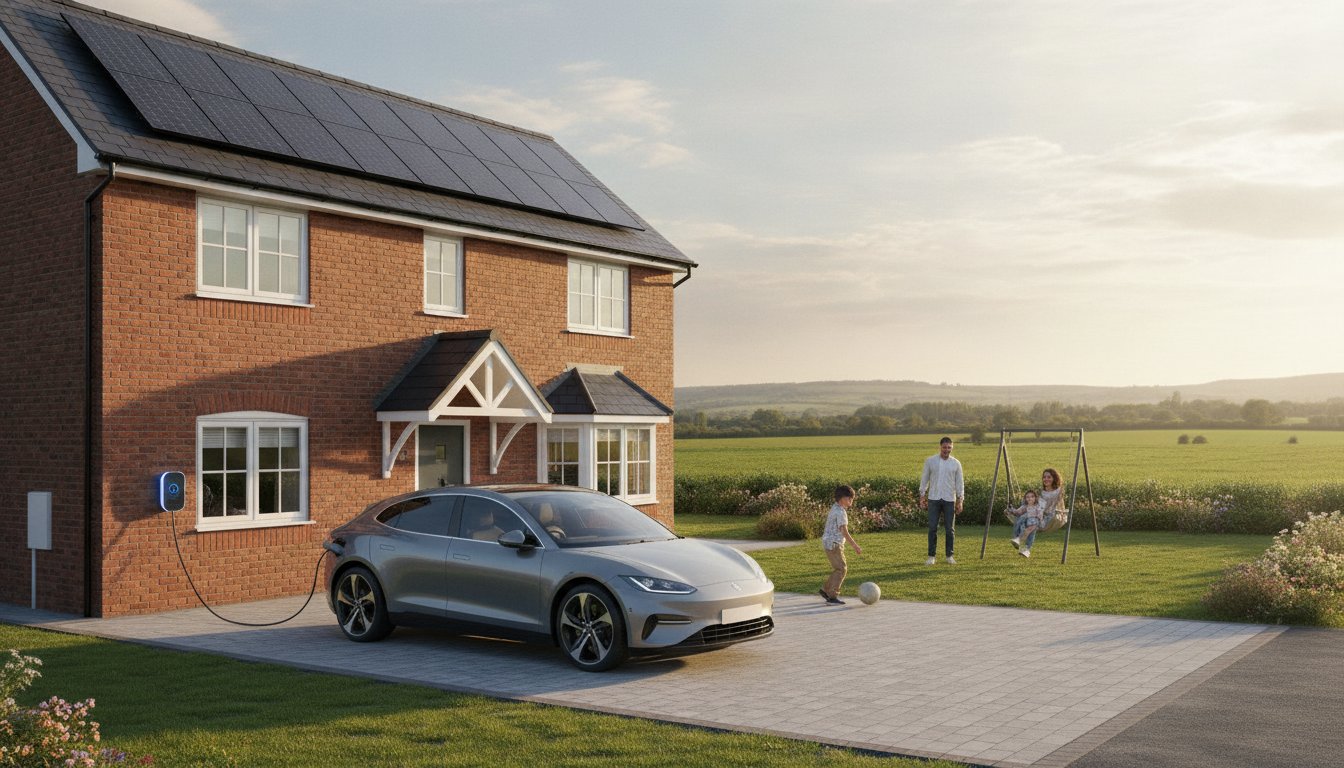
The "EV synergy" is perhaps the most powerful driver for a fast ROI in 2026. If you're a daily commuter in Staffordshire, the cost of petrol or diesel is likely one of your largest monthly expenses. By installing EV charging points alongside your solar array, you're effectively fueling your car using the sun. This replaces expensive fossil fuels with zero-cost home generation, drastically improving the household's total savings.
When you compare the different setups, the financial picture becomes clear:
- Solar Only: Relies heavily on export rates and daytime usage, resulting in a steady but slower return.
- Solar + Battery: Shortens the timeline by maximizing high-value evening self-consumption and avoiding peak grid rates.
- Solar + Battery + EV: Offers the fastest combined "energy and transport" payback by slashing fuel bills and utility costs simultaneously.
For those working from home, the ability to charge an EV directly from the panels during the day provides an immediate boost to the system's value. This multi-layered approach ensures that the solar panel payback period UK residents experience is no longer just about lighting their homes, but about powering their entire lifestyle more affordably.
Calculating your own solar panel payback period UK timeline doesn't have to be complex. It's essentially a balance sheet where you weigh the initial investment against the monthly reductions in your utility bills and the quarterly payments from your energy supplier. To get a precise figure, you need to look beyond national averages and focus on your specific property's potential in Staffordshire. The math involves comparing your total out-of-pocket costs with the cumulative value of every kilowatt-hour your system generates.
- Step 1: Determine Net Cost. Start with your total installation price. Subtract any applicable grants, such as the ECO4 scheme if you qualify before the December 2026 deadline.
- Step 2: Estimate Generation. A typical 4kW system in the Midlands produces roughly 3,400 kWh per year. This varies slightly based on your roof's pitch and shading.
- Step 3: Calculate Annual Value. Multiply the energy you'll use (self-consumption) by your current unit rate. Then, multiply the remaining exported energy by your chosen SEG rate.
- Step 4: Final Division. Divide your net cost by the sum of these annual savings and earnings to find the total years to break even.
A Realistic Example Calculation
Consider a typical three-bedroom semi-detached home. If the total system cost is £8,000 and the combined annual benefit from bill savings and SEG payments is £900, the math is straightforward. £8,000 divided by £900 gives a payback period of approximately 8.8 years. This calculation provides a clear picture of the solar panel payback period UK families can expect when investing in modern, high-efficiency hardware. It's wise to factor in energy inflation too. If grid prices continue to rise, that 8.8-year window could easily shrink as each generated unit becomes more valuable.
The "Invisible" Factors: Maintenance and Degradation
A truly accurate ROI model accounts for the long term. Solar panels are incredibly durable, but they do experience a minor efficiency drop of about 0.5% each year. You should also plan for inverter upgrades after roughly a decade. This component works the hardest and usually needs replacing before the panels do. Additionally, keeping your system clear of debris through regular solar panel maintenance ensures you aren't losing 5% to 10% of your generation to simple dirt or bird droppings. To get a bespoke quote and a detailed breakdown of your potential savings, you can contact Margav Solar for expert advice tailored to your specific roof and energy needs.
Why Expert Installation and Maintenance Secure Your Investment
The mathematical models for your solar panel payback period UK depend entirely on the real-world performance of your hardware. A system that looks great on paper can fail to meet its ROI targets if it's poorly installed or neglected. "Cheap" installations often lead to issues like micro-cracks from improper handling or energy loss through undersized wiring. These technical failures don't just reduce your daily savings; they can extend your break-even point by several years. Precision in the early stages is the only way to ensure the numbers we've calculated actually manifest in your bank account.
Choosing a professional solar panel installation ensures that your array is positioned to capture every possible minute of sunlight. In Staffordshire, where overcast days are common, the difference between a standard install and an expertly calibrated one can be significant. MarGav Solar brings over 20 years of local expertise to every project, ensuring that your system is optimized for the specific challenges of the UK climate. We don't just mount panels; we engineer a system that survives and thrives in local conditions.
The Importance of Local Expertise in Staffordshire
Local knowledge is invaluable when dealing with the administrative side of solar. Every installation requires coordination with the local Distribution Network Operator (DNO) to ensure the grid can handle your export. A local partner understands these constraints and handles the paperwork to avoid frustrating delays. Additionally, having NICEIC certification is about more than just safety. Holding NICEIC certification is a mandatory requirement for most energy suppliers to approve your SEG application and start your export payments. Without this credential, you might find yourself generating power but unable to claim the earnings that help shorten your payback period.
Protecting Your ROI for 25+ Years
Maintenance is the most overlooked variable in the solar panel payback period UK equation. While panels are low-maintenance, they aren't no-maintenance. Environmental factors like bird droppings, lichen, or industrial dust can create "hot spots" or simply block light. Professional cleaning can increase your system's yield by up to 20%, ensuring you're always hitting your peak generation targets. It's the difference between a system that barely covers its costs and one that generates a significant surplus.
We use advanced monitoring software to track your system's health in real-time. This allows us to identify performance drops before they impact your quarterly savings. MarGav Solar remains committed to end-to-end support, providing the maintenance and cleaning services necessary to protect your investment for the next 25 years. By combining expert installation with a proactive care plan, you ensure that the financial promises of 2026 become a reality for decades to come.
Take Control of Your Energy Future in 2026
The landscape of home energy has changed. It's no longer just about putting panels on a roof; it's about building a smart ecosystem that works for your specific lifestyle. By combining high-efficiency PV with battery storage and EV charging, you can effectively shrink the solar panel payback period UK homeowners usually face. With the scheduled VAT increase in March 2027 and the rising cost of grid electricity, the current window to maximize your return on investment is both narrow and highly rewarding.
Expertise is the final piece of the ROI puzzle. Choosing a partner with 20+ years of industry expertise ensures your system is built to last and certified to earn. Our NICEIC-certified installers provide fixed-price installation contracts, allowing you to plan your financial future with total confidence. Get Your Personalised Solar ROI Quote from MarGav Solar and take the first step toward predictable, low-cost power. Start your journey toward energy independence today and enjoy the lasting peace of mind that comes with generating your own clean power.
Frequently Asked Questions
Do solar panels actually work in the UK grey weather?
Yes, solar panels work effectively in typical UK overcast conditions because they generate electricity from daylight rather than just direct heat or intense sun. Modern high-efficiency panels are designed to capture diffuse light. While generation is highest on clear summer days, a typical 4kW system still produces a consistent yield throughout the year, even during the greyest Staffordshire winters.
Is the Smart Export Guarantee (SEG) worth it in 2026?
The Smart Export Guarantee is definitely worth securing as it provides a guaranteed income stream for the energy you don't use. As of May 2026, widely available rates from major suppliers range from 12p to 15.1p per kWh. This earned income is a vital component of the solar panel payback period UK homeowners calculate to determine their total return on investment.
Will adding a battery storage unit shorten my payback period?
Adding a battery storage unit increases your initial investment but can significantly improve your long-term financial outcome. By increasing your self-consumption from roughly 40% to 80%, you avoid buying grid electricity at the 26.11p per kWh rate. While the higher hardware cost might not always shorten the technical payback timeline in years, it dramatically increases your total lifetime savings.
How much does solar panel maintenance cost per year?
Maintenance costs are generally low but should be factored into your long-term budget. Regular professional cleaning helps maintain maximum yield by removing debris that can block light. You should also prepare for an inverter upgrade after approximately 10 to 12 years. Keeping your system well-maintained prevents efficiency drops and ensures your return on investment remains on track.
Does solar installation increase the value of my UK home?
Most industry research suggests that solar panels and improved EPC ratings can increase a property's market value. Buyers in 2026 are increasingly looking for energy-efficient homes with lower running costs. A professionally installed system with all the necessary certifications provides a tangible selling point that distinguishes your home from others on the market during a sale.
Can I get a grant for solar panels in Staffordshire in 2026?
Qualifying Staffordshire households can access the ECO4 scheme until it closes on 31st December 2026. This grant is specifically targeted at low-income households or those with low EPC ratings. For those who don't qualify, the 0% VAT rate on installations remains the most significant financial incentive, though this is currently scheduled to end on 31st March 2027.
How long do solar panels last before they need replacing?
Most modern solar panels are designed to last for 25 to 30 years. They don't simply stop working after this time; instead, they experience a gradual degradation in efficiency of about 0.5% per year. Even after three decades, your system will likely still produce a significant portion of its original output, providing free electricity long after the initial costs are cleared.
What happens to my payback period if energy prices go down?
If electricity prices decrease, the value of the energy you generate also drops, which naturally extends the solar panel payback period UK residents experience. However, with the Ofgem price cap set to rise by 13% in July 2026, the current trend makes solar generation more valuable. Generating your own power provides a permanent hedge against the inherent volatility of the global energy market.


