
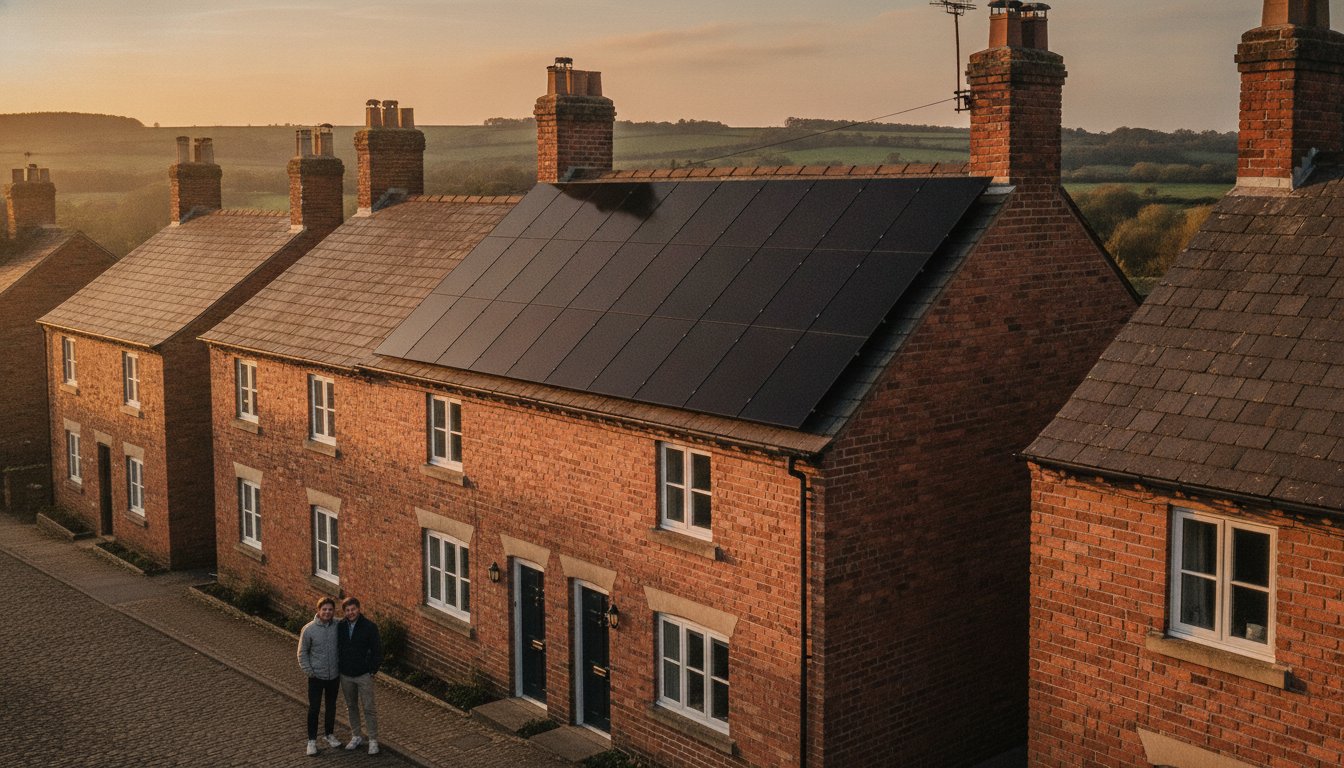
Is your terraced roof actually too small to make solar power a reality? It's a common concern for homeowners considering solar panels for terraced house Staffordshire installations, especially when faced with limited square footage and shading from neighbouring chimney stacks. You might worry that narrow streets make scaffolding access impossible or that shared party walls will create a legal headache before you even begin.
We understand these hurdles, but a small roof doesn't mean you have to miss out on significantly lower electricity bills. This 2026 guide reveals how to maximise energy production on limited roof spaces using a "density-first" design approach. You'll learn about high-efficiency systems that work for small footprints, current Staffordshire planning regulations, and how the 0% VAT rate remains in effect until March 2027. We also explain how local initiatives like the Staffordshire Warmer Homes grant can support households with an income of £36,000 or less, ensuring your transition to clean energy is both practical and affordable.
Key Takeaways
- Learn how to assess your roof's energy potential and determine the minimum requirements for a viable installation on mid or end-terrace homes.
- Discover how high-wattage N-Type panels and micro-inverters can maximise your power output, even when dealing with shading from neighbouring chimneys.
- Navigate the local planning landscape by understanding Permitted Development rights and how Article 4 Directions affect solar panels for terraced house Staffordshire installations.
- Find out how to integrate space-saving battery storage and EV charging points into your home's layout, from lofts to outdoor cabinets.
- Identify the essential certifications and local expertise needed to manage the unique scaffolding and party wall logistics of terraced street projects.
Are Solar Panels Feasible for Terraced Houses in Staffordshire?
Many homeowners in towns like Stafford or Newcastle-under-Lyme worry their properties are too small for renewable energy. It's a valid concern. Terraced houses often have narrow roof profiles and multiple chimney stacks that complicate layouts. However, installing solar panels for terraced house Staffordshire projects is not only possible but increasingly profitable in 2026. While a detached home might have sprawling roof space, a well-designed terraced system focuses on quality over quantity. You don't need a massive array to see a significant return on your investment.
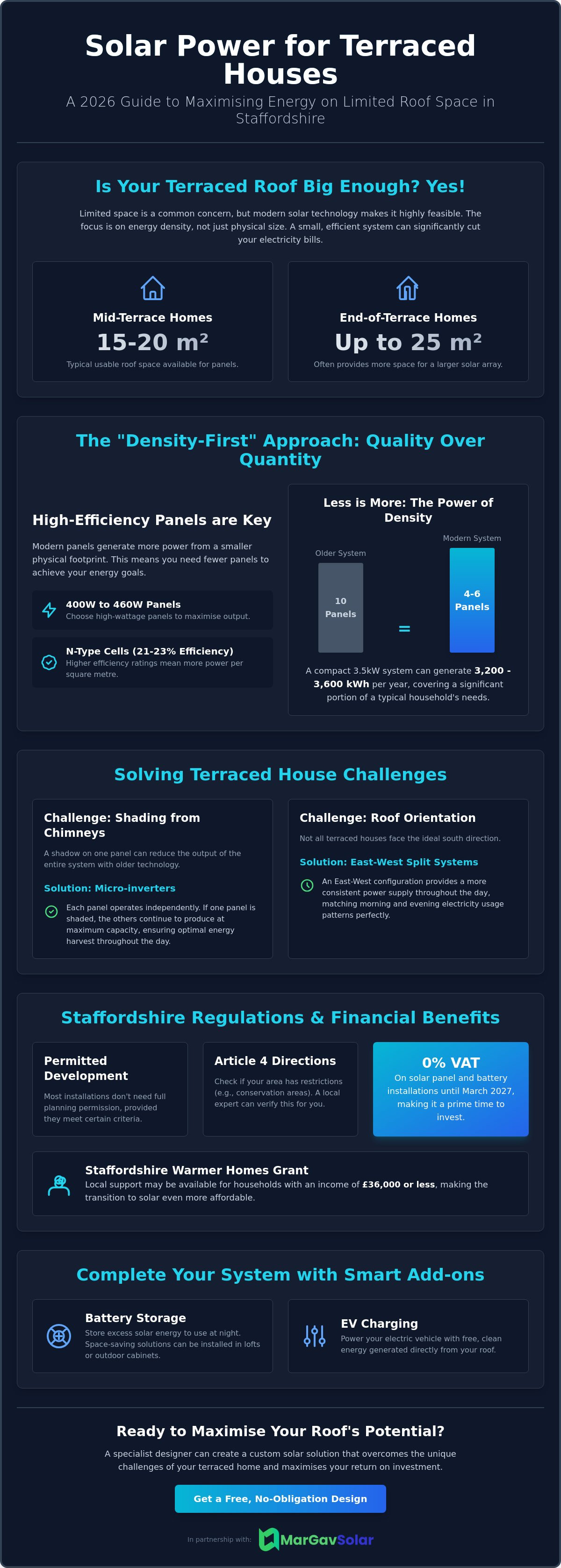
Mid-terrace properties typically offer 15 to 20 square metres of usable roof, while end-of-terrace homes can provide up to 25 square metres. Even with these smaller footprints, modern high-efficiency panels ensure every inch counts. Staffordshire receives enough average daylight to make even a 3kW system a smart investment, especially when paired with 2026's competitive export rates. The key lies in precise system design and selecting components that thrive in compact environments.
Assessing Your Roof Space in Staffordshire
Measuring your roof involves more than just looking at the total area. You have to account for "dead zones" created by chimney stacks, vents, and the shadows they cast. A professional survey is vital for older brick-and-slate terraces common across the Potteries. These roofs are sturdy, but their age means installers must verify the structural integrity before adding the weight of a mounting system. Key factors to consider during an assessment include:
- Usable square footage: The actual space available after subtracting margins required for wind loading and safety.
- Shading analysis: Identifying how neighbouring chimneys or taller buildings impact light levels throughout the day.
- Roof orientation: Determining if your roof faces South, East, or West.
Orientation dictates your total yield. While a south-facing roof is the gold standard for rooftop solar power, many Staffordshire terraces are built on East-West grids. This isn't a dealbreaker. An East-West split can actually provide more consistent power throughout the day, helping you run appliances in the morning and evening when you're actually at home.
The "Small Roof" Efficiency Myth
You don't need a dozen panels to make an impact. In 2026, four to six high-efficiency monocrystalline panels can often out-produce a bulky ten-panel array from five years ago. This is due to improvements in panel density. Panel density refers to the amount of electrical power generated per square metre of roof space. By using N-Type cells with efficiency ratings between 21% and 23%, you can generate more power from a smaller physical footprint.
For a typical two-bedroom terrace in Stafford, a compact 3.5kW system can generate between 3,200 and 3,600 kWh per year. That's enough to cover a significant portion of a standard household's electricity needs. Because you're working with less space, choosing 400W to 460W panels is essential. It's about squeezing every possible watt from the limited square footage you have available on your Staffordshire home.
Maximising Energy Yield on Limited Terraced Roofs
Terraced roofs in Staffordshire present unique architectural challenges. Unlike detached properties, your solar footprint is constrained by neighbours and traditional building features. To get the most out of solar panels for terraced house Staffordshire projects, you have to prioritize power density. This means selecting panels with the highest wattage possible for their physical size. In 2026, the focus has shifted from how many panels you can fit to how much energy each individual square metre can generate.
Optimising your layout involves avoiding dead zones near roof edges and valleys where wind loading or water runoff might be an issue. Smart monitoring software now allows you to track this performance in real-time on your phone. You can see exactly how much each panel contributes, making it easier to spot if a specific area of your roof isn't pulling its weight. If you're unsure how many modules will fit around your chimney, consulting with a specialist designer can help you visualize the most efficient configuration for your specific roof.
Overcoming Shading from Chimneys and Gables
Standard string inverters treat an entire row of panels as one unit. If a chimney casts a shadow over just one panel, the output of the whole string often drops to match that weakest link. For terraced homes, micro-inverters are essential. These small devices allow each panel to operate independently. If your neighbour's gable end shades your lower row at 3 pm, the rest of your system keeps pumping out power at maximum capacity.
A recent project on a Stafford terrace demonstrated this perfectly. A taller neighbouring property blocked direct light for two hours every afternoon. By using micro-inverters, the homeowner maintained 85% of their expected yield. A traditional system would have lost nearly half its daily production in the same conditions. This technology turns "unsuitable" roofs into viable energy plants.
High-Efficiency Hardware for 2026
In 2026, N-Type monocrystalline panels are the gold standard for small-roof installations. These panels offer efficiency ratings between 21% and 23%, allowing for a 450W+ output from a standard-sized frame. This is crucial for Staffordshire terraces where you might only have room for six to eight panels total. You need that extra punch to make the system worth the initial setup.
Aesthetics also play a role in tight-knit communities. All-black panels provide a sleek, uniform look that often receives faster approval in sensitive local streetscapes. When you combine these with solar battery storage, you can capture the high-yield midday energy for use during peak evening hours. This synergy is particularly effective for terraced homes where daytime occupancy might be low, but evening energy demands are high.
Navigating Planning Permission and Staffordshire Regulations
Installing solar panels for terraced house Staffordshire projects is usually a straightforward process due to Permitted Development rights. For the vast majority of homeowners, formal planning permission isn't required. You simply need to ensure the panels don't protrude more than 200mm from the roof slope and aren't installed on a wall that fronts a highway. However, the unique layout of terraced streets means you must consider more than just the panels. Shared party walls and narrow access routes require careful management before the first bracket is fixed.
Shared party walls are a frequent concern in Staffordshire's traditional rows. While your panels sit on your own roof tiles, the mounting system may be fixed near the boundary line. If your installation involves drilling into a shared chimney stack or structural wall, you might need a Party Wall Agreement. It's a simple notification process, but addressing it early keeps your project on track and maintains good relations with your neighbours. Clear communication is often the best tool for a smooth installation.
Staffordshire Conservation Areas and Listed Buildings
Restrictions tighten if you live in a conservation area, such as parts of Lichfield, Stafford town centre, or the fringes of the Peak District. Local authorities may have an "Article 4 Direction" in place. This removes your Permitted Development rights to preserve the historic character of the street. In these cases, you'll need to submit a full planning application. Choosing an installer registered with the Microgeneration Certification Scheme (MCS) is vital. They provide the technical drawings and specifications often required by planning officers to prove the system won't negatively impact the heritage of the building.
Logistics: Scaffolding on Narrow Terraced Streets
Staffordshire's narrow "back-to-back" streets and terraced rows present a specific logistical challenge. Unlike a detached home with a private driveway, a terraced house often requires scaffolding to be erected on a public footpath. You can't just put it up and start work. You or your installer must coordinate with Staffordshire County Council to secure a pavement licence. This permit ensures the structure is safe for pedestrians and meets local highways standards.
Safety is paramount when working in these high-traffic public areas. The scaffolding must be properly lit at night and include protective measures for passers-by. Verifying that your chosen team holds NICEIC certification provides peace of mind that they follow strict safety protocols. They'll manage the tight access for delivery vehicles and ensure that the installation of solar panels for terraced house Staffordshire homes doesn't cause a neighborhood gridlock.
Smart Additions: Battery Storage and EV Charging
Because solar panels for terraced house Staffordshire installations often involve smaller arrays, maximizing the energy you do capture is critical. Without a battery, you might export up to 50% of your generated power back to the grid during the day when you're at work. In June 2026, the Smart Export Guarantee (SEG) offers competitive rates, with some suppliers like Good Energy offering up to 25p/kWh for their customers. However, you'll still save more by using that power yourself. Pairing your panels with battery storage can increase your annual savings to as much as £950, making the most of every watt produced by your roof. The 0% VAT rate on battery storage also remains in effect until March 31, 2027, making this an ideal window for investment.
Adding storage isn't just about the financial return. It provides a level of energy independence that is particularly valuable in densely populated terraced streets. By storing your own clean energy, you protect yourself against fluctuating grid prices and ensure that your home runs on renewable power even after the sun sets over the Staffordshire moorlands.
Compact Battery Solutions for Terraced Homes
Space is the biggest hurdle for terraced residents. Traditional bulky batteries aren't practical in a narrow hallway or a small kitchen. Fortunately, 2026 technology has delivered slimline, modular units designed for tight spots. The GivEnergy range is particularly popular for Staffordshire homes because of its compact footprint and high performance. These units can be tucked away under stairs, mounted in a loft, or even housed in weather-proof outdoor cabinets. Using the GivEnergy Cloud guide, you can manage your energy flow remotely to ensure you're charging from the sun and discharging when prices are highest.
Safety remains a priority for indoor installations. Any battery placed inside a dwelling must meet specific ventilation and fire safety standards. Installers must ensure the location is dry, accessible for maintenance, and separated from living areas by appropriate fire-rated materials. Modern lithium iron phosphate (LFP) batteries are significantly safer and more durable than older technologies, making them ideal for the integrated nature of terraced housing.
EV Charging Solutions for On-Street Parking
Navigating the "cable across the pavement" dilemma is a common hurdle in Staffordshire. While you cannot simply run a loose lead across a public walkway, local councils are increasingly trialling gully systems and kerbside charging points. There are also specific government grants available for terraced residents and those in rented accommodation to help offset the cost of installing EV Charging Points in Staffordshire. These grants can significantly reduce the initial outlay for homeowners without private driveways.
By integrating your car charger with your solar system, you can "dump" excess solar energy directly into your vehicle's battery. This effectively turns your car into a secondary storage unit for your home's clean energy. If you're ready to upgrade your home's energy infrastructure, get a professional assessment of your property today to see which storage and charging solutions fit your specific layout.
Choosing the Right Staffordshire Solar Partner
Selecting an installer for a terraced project requires more than just a competitive price. Because of the logistical hurdles we've discussed, such as shared party walls and narrow street access, local knowledge isn't just a bonus. It's a requirement. A local Staffordshire installer will already be familiar with the specific pavement licensing requirements of the County Council and the nuances of conservation areas in places like Lichfield or Stafford. When installing solar panels for terraced house Staffordshire systems, you need a team that understands how to manage scaffolding in tight spaces without causing a neighbourhood dispute.
Before signing any contract, verify that your chosen partner holds the necessary industry credentials. You should look for MCS certification, which is mandatory if you want to access Smart Export Guarantee (SEG) payments. Additionally, NICEIC certification ensures the electrical work meets high safety standards, while HIES membership provides you with essential consumer protection. These certifications prove that the company follows rigorous codes of practice and uses high-quality components that will stand the test of time on your roof.
What to Look for in a Quote
A "one-size-fits-all" estimate is a major red flag for a terraced property. Every terrace is different, and your quote should reflect a bespoke design based on a physical site survey, not just a satellite image. A comprehensive Solar Panel Installation in Staffordshire quote must be transparent and include all associated costs. Look for these specific inclusions:
- Scaffolding and Access: Detailed plans for safe access, including any necessary pavement permits.
- Bird Proofing: Essential for urban terraced rows to prevent pigeons from nesting under your panels.
- Certification Fees: All costs for MCS registration and grid connection notifications (G98 or G99).
- Structural Assessment: Confirmation that your older brick-and-slate roof can safely support the system weight.
Why MarGav Solar Specialises in Terraced Installations
We've spent 20 years navigating the unique architectural landscape of Staffordshire. We don't believe in guesswork, which is why we focus on high-efficiency hardware and provide fixed-price installation contracts. This transparency ensures that the price you're quoted is the price you pay, with no hidden "narrow street" surcharges added later. Beyond the initial setup, we provide ongoing support through solar panel maintenance and cleaning, along with inverter upgrades to keep your system performing at its peak for decades.
Our goal is to turn your limited roof space into a high-yield power plant that delivers a genuine return on investment. If you're ready to see how much energy your roof can produce, book your free terraced house solar survey with MarGav Solar today. We'll provide a detailed shading analysis and a custom system design that respects both your property's heritage and your energy goals.
Start Your Journey Toward Energy Independence
We've explored how 2026 technology turns even the narrowest roof into a powerful energy asset. By choosing high-density panels and smart micro-inverters, you can overcome common shading issues and generate significant savings. Navigating local regulations and the specific scaffolding needs of terraced streets is much simpler when you have a local partner who understands the Staffordshire landscape. It's clear that limited square footage is no longer a barrier to clean, affordable power.
Investing in solar panels for terraced house Staffordshire installations is a proven way to shield your household from rising energy costs while contributing to a cleaner local environment. Ready to take the next step? Get a Fixed-Price Solar Quote for Your Staffordshire Home and benefit from our over 20 years of renewable energy expertise. As NICEIC and MCS Certified Installers, we're specialists in Staffordshire terraced house logistics and are here to ensure your project is seamless from start to finish. Your roof might be small, but its potential for energy independence is massive.
Frequently Asked Questions
Do I need my neighbour’s permission to install solar panels on a terraced house?
You don't usually need formal permission from your neighbour because solar panels fall under Permitted Development rights. However, if your installer needs to fix mounting brackets into a shared chimney stack or structural wall, you should discuss a Party Wall Agreement. It's also helpful to inform them about scaffolding access, especially if your street is narrow, to ensure the installation of solar panels for terraced house Staffordshire projects goes smoothly for everyone.
Can I install solar panels if I live in a Staffordshire conservation area?
Yes, but you'll likely need to apply for planning permission rather than relying on Permitted Development. Conservation areas in places like Lichfield, Stafford, or the Peak District often have "Article 4 Directions" to protect the historic look of the street. In these cases, you'll need to demonstrate that the panels are low-profile and won't negatively impact the character of the building. A professional installer can provide the technical drawings required for your local council application.
How many solar panels can fit on a typical mid-terrace roof?
A typical mid-terrace roof in Staffordshire usually has enough space for 6 to 8 high-efficiency panels. While the total roof area is often between 15 and 20 square metres, usable space is reduced by chimney stacks, vents, and safety margins. By using 2026's high-wattage N-Type panels, you can still achieve a system size of 3kW to 3.5kW, which is sufficient to cover a significant portion of a standard household's electricity needs.
Will shading from my neighbour’s chimney affect my solar generation?
Shading can significantly reduce your output if you use a traditional system where all panels are linked together. If a neighbour's chimney casts a shadow on just one panel, it can drop the performance of the entire row. To prevent this, we use micro-inverters or power optimisers that allow each panel to work independently. This technology ensures that even if one section is shaded, the rest of your solar panels for terraced house Staffordshire system will continue to generate power at maximum capacity.
What is the best solar battery for a small terraced house in Staffordshire?
Slimline, wall-mounted battery systems are the best choice for terraced homes where floor space is at a premium. Modular units like the GivEnergy range are popular because they can be tucked away in lofts, under stairs, or even in weather-proof outdoor cabinets. These compact solutions allow you to store your excess solar energy for evening use without requiring a dedicated plant room or taking up valuable living space in a smaller property.
Is it possible to have solar panels on a terraced house with a flat roof extension?
Yes, flat roof extensions are excellent locations for additional solar panels. Installers use specialized "A-frame" mounting systems to tilt the panels at the perfect angle for energy generation. This can be a great way to increase your total system size if your main pitched roof is too small or heavily shaded. You just need to ensure the extension's structure is rated to handle the weight and that the panels meet Permitted Development height limits.
How much does solar panel installation cost for a terraced house in 2026?
The cost of installation depends on your specific roof layout, the number of panels required, and the scaffolding logistics of your street. While every project is unique, the 0% VAT rate on solar and battery storage remains in effect until March 31, 2027, which helps keep the transition affordable. You should always request a bespoke, fixed-price quote that includes a full structural survey and all necessary grid connection fees to avoid unexpected costs later.
Can I get an EV charger if I only have on-street parking at my terraced home?
It's possible, though it requires more planning than a home with a private driveway. You aren't allowed to run loose cables across a public pavement, but you can explore local council trials for kerbside charging or pavement gullies. There are also specific government grants available for terraced residents to help with the cost of installing EV Charging Points in Staffordshire, making electric vehicle ownership more accessible even without a dedicated driveway.


