
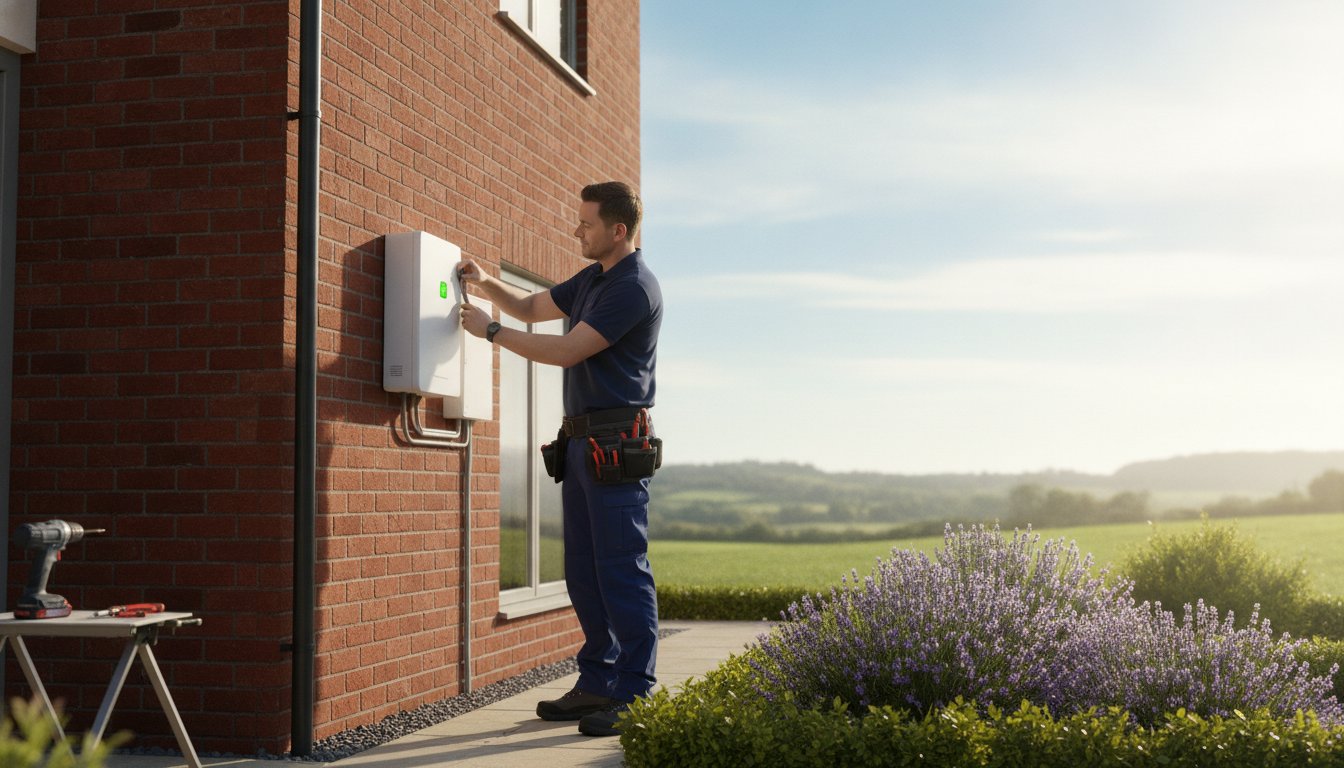
What if your solar system's sudden silence isn't a disaster, but actually your best chance to slash your energy bills even further? It's incredibly frustrating when you notice your generation meter has stopped or your monitoring app shows zero activity. You're likely worried about the solar inverter replacement cost UK engineers will quote you, especially while you're losing out on daily Smart Export Guarantee (SEG) payments. Every day of downtime is money straight out of your pocket.
We understand that an unexpected repair bill is the last thing any homeowner wants to deal with. However, 2026 is a unique year for renewable energy in Britain. With 0% VAT still in effect on professional installations until March 2027, the timing for a fix might be better than you think. This guide breaks down the real-world costs of hardware and local UK labour rates to give you total clarity. You'll discover whether a like-for-like swap is the best path or if upgrading to a hybrid system is the smarter financial move for your Staffordshire home.
Key Takeaways
- Understand the current solar inverter replacement cost UK homeowners face in 2026, covering both standard string and high-efficiency hybrid hardware.
- Explore how the 0% VAT rate on renewable energy installations can significantly reduce your total bill if you act before the March 2027 deadline.
- Learn why a failed inverter is the most cost-effective opportunity to upgrade to a battery-ready hybrid system and future-proof your home energy.
- Get a clear breakdown of the professional replacement process, from initial fault diagnosis to safe isolation and grid reconnection.
- See why working with a Staffordshire-based specialist ensures fixed-price certainty and a faster return to earning Smart Export Guarantee payments.
Average Solar Inverter Replacement Cost UK (2026)
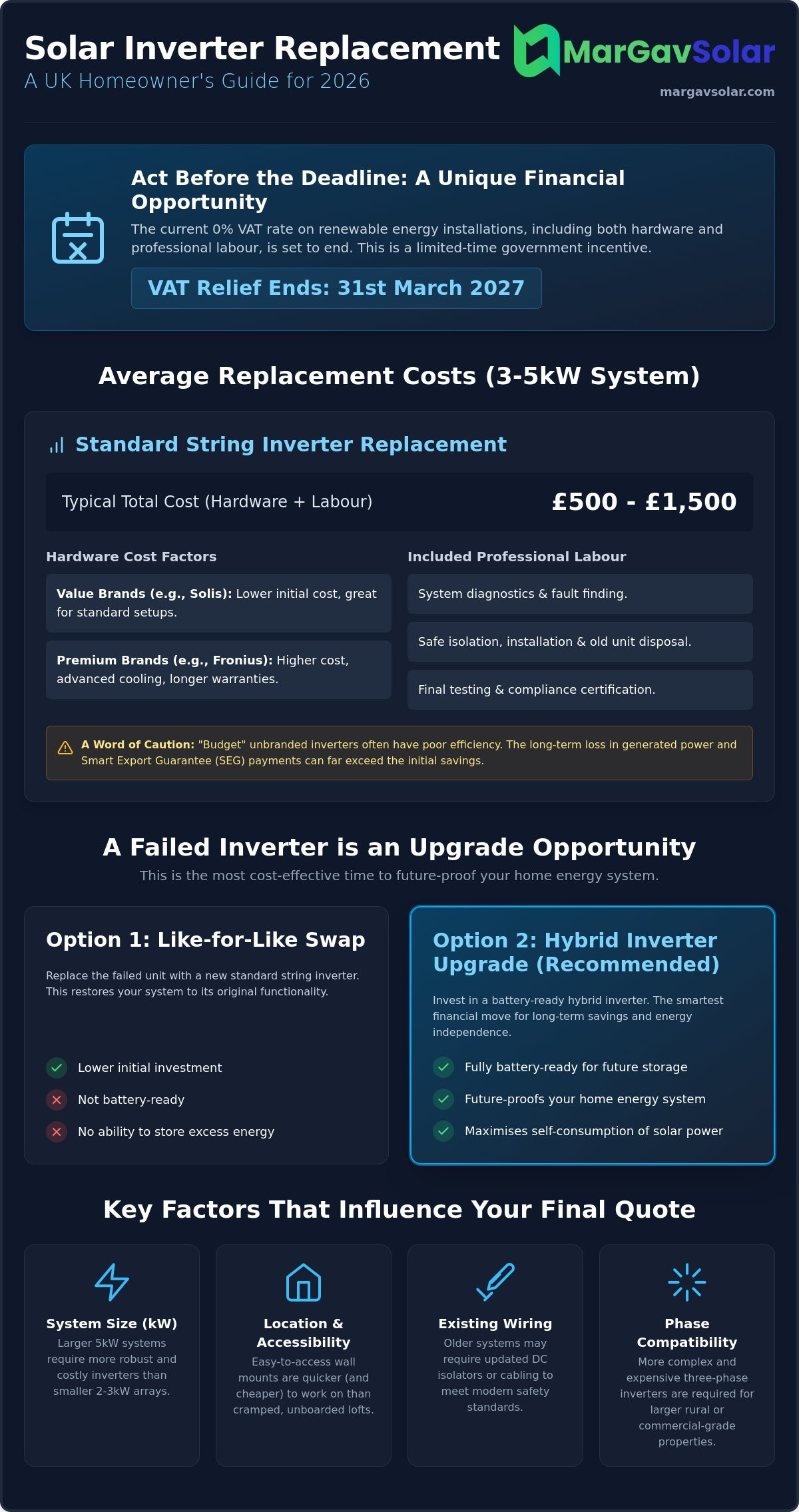
The 2026 price landscape has seen hardware costs finally stabilise as global supply chains matured, yet the total solar inverter replacement cost UK homeowners pay is now more heavily influenced by skilled labour rates. While the hardware itself is more reliable than a decade ago, the complexity of modern smart grids means installation requires more technical expertise. It's also vital to remember that the 0% VAT rate on residential energy saving equipment remains in effect until 31st March 2027. This tax relief applies to both the inverter hardware and the professional labour required to install it, offering a significant saving for those acting now.
To understand why these components are priced differently, it helps to look at what a solar inverter does within your system. It's the "brain" that converts the raw DC energy from your panels into usable AC electricity. If this brain fails, your entire investment sits idle. For a standard 3kW to 5kW system, the industry average for a string inverter replacement typically ranges from £500 to £1,500 depending on the brand and warranty length.
String Inverter Price Breakdown
The price you'll pay often depends on the balance between entry-level and premium technology. Brands like Solis offer excellent value for standard setups, while premium manufacturers like Fronius command a higher price for advanced cooling and longer standard warranties. Most 2026 models now include dual MPPT (Maximum Power Point Tracking) as standard. This technology is essential if your panels are split across two different roof sections, as it ensures each "string" performs at its peak regardless of shading on the other. You should expect a quality replacement unit to last between 10 and 15 years.
Labour and Consultation Fees
In Staffordshire, local labour rates are generally more accessible than those in London or the South East, but expertise still carries a premium. A professional replacement isn't just a "plug and play" job. It requires a full system diagnostic to ensure the inverter was the actual point of failure and not a wiring fault. We always recommend looking for fixed-price contracts. A transparent quote should include the initial consultation, the safe isolation of your DC and AC circuits, the physical installation, and the responsible disposal of your old unit. It must also cover the final testing and certification to keep your system compliant with UK building regulations.
Opting for "budget" or unbranded inverters is often a false economy. Lower-quality units frequently have inferior conversion efficiency, meaning you lose a higher percentage of your generated power. Over a decade of operation, the loss in generation and the resulting drop in Smart Export Guarantee (SEG) payments can easily exceed the few hundred pounds saved on the initial purchase. Investing in a high-efficiency unit ensures your system stays productive and profitable for years to come.
Key Factors That Influence Your Final Quote
Calculating the solar inverter replacement cost UK homeowners can expect involves looking at more than just the price tag on the hardware. Every solar installation is unique, and the environment where your inverter lives plays a massive role in the final quote. A 5kW system, for example, handles significantly higher currents than a 2kW array, requiring a larger, more robust unit with superior heat dissipation. This physical size difference directly impacts the manufacturing cost and the complexity of the installation.
Location and accessibility are often overlooked but are critical for labour estimates. If your current inverter is tucked away in a cramped, unboarded loft, the installation will take longer and require more safety precautions than a unit mounted on an accessible external wall. We also have to consider your existing wiring compatibility. Older systems might have DC isolators or cabling that no longer meets modern safety standards. Upgrading these components during an inverter swap isn't just about compliance; it's about protecting your home from electrical faults. For broader advice on maintaining system safety and efficiency, the Energy Saving Trust provides excellent resources for UK consumers.
Phase Compatibility: Single Phase vs. Three Phase
Most residential properties in Staffordshire operate on a single-phase electrical supply, which is standard for the typical UK home. However, larger rural properties or homes with high energy demands might have a three-phase supply. Three-phase inverters are essentially commercial-grade domestic units. They're more expensive because they balance the solar load across three separate live wires rather than one. MPPT stands for Maximum Power Point Tracking; it's a technology that constantly adjusts the electrical load to extract the maximum available power from your panels, which is vital if your roof suffers from partial shading.
Monitoring and Software Integration
Modern inverters do much more than convert power; they provide the data you need to manage your energy. If your old system lacked smart features, a replacement is the perfect time to add Wi-Fi or app-based tracking. Platforms like the GivEnergy Cloud allow you to see exactly how much you're generating and exporting in real-time. While some premium brands offer free lifetime monitoring, others may require a subscription for advanced analytics. This data is essential for proving your generation levels for SEG payments and ensuring your system is actually performing as promised. If you aren't sure which platform fits your existing setup, our team can provide a professional diagnostic review to help you choose the right path forward.
The Replacement Process: What to Expect from a Professional Install
Once you've decided to proceed, the actual installation day is a streamlined process designed to minimise your system's downtime. While some generic advice suggests a swap takes just an hour, a thorough professional installation involves much more than simply unbolting one box and mounting another. A comprehensive service ensures that the underlying cause of the failure is addressed, preventing a repeat of the issue. This technical rigour is a core part of the solar inverter replacement cost UK homeowners pay for long-term peace of mind.
The process begins with a final diagnostic check. Your engineer will verify that the inverter is indeed the true point of failure rather than a faulty DC isolator or a tripped breaker in your consumer unit. After confirming the fault, they'll perform safe isolation of both the high-voltage DC strings and the AC mains supply. This step is critical for protecting your home's electrical circuit and the technician. Only after the system is fully de-energised will the physical swap begin, often involving updates to the mounting brackets and cable terminations to suit the new hardware.
Step-by-Step: The Day of Installation
Preparation makes the day go much smoother. Ensure your technician has clear, safe access to the inverter location, especially if it's located in a loft or a high-up garage shelf. Before connecting your new unit, the engineer must check the DC string voltages coming from your panels. This ensures the roof-side of the system is healthy; if a surge or short-circuit on the roof caused the original failure, connecting a new inverter without fixing that fault could destroy the replacement immediately. Once the hardware is live, the system is commissioned, and the engineer will notify the local Distribution Network Operator (DNO) under G98 or G99 regulations to ensure your grid connection remains legal and compliant.
Why NICEIC Certification is Non-Negotiable
Using a non-certified 'handyman' for high-voltage DC work is a risk that simply isn't worth taking. Solar electricity is unforgiving. Poorly crimped connectors or incorrect isolation can lead to arc flashes or even house fires. A professional NICEIC certification acts as your shield, proving the work meets strict UK safety standards. It also protects your home insurance; most insurers require a certificate of compliance for any significant electrical modifications. Without this paperwork, you might find a future claim rejected. Furthermore, manufacturers like GivEnergy or Solis often require proof of professional installation to keep your 10-year warranty valid. Working with a certified expert ensures your investment is protected from every angle.
Hybrid Inverter Upgrades: Is It Worth the Extra Cost?
When your current system stops generating, you're faced with a choice: replace like-for-like or upgrade to a hybrid model. A hybrid inverter acts as the essential bridge between your solar panels and a storage system. Unlike a standard string inverter, it manages both the electricity coming from your roof and the flow of energy to and from a battery. If you've been considering Solar Battery Storage, this system failure is actually a strategic opportunity.
Choosing a hybrid unit now is what we call the 'Failure Opportunity'. Because you're already covering the labour and consultation fees for a technician to visit your home, upgrading the hardware now can save you over £500 in future installation costs. If you install a string inverter today and decide to add a battery in two years, you'll likely need to replace that new inverter again or pay for a separate AC-coupled battery inverter. By making the switch now, you consolidate two jobs into one. While the solar inverter replacement cost UK homeowners pay for hybrid hardware is typically higher, ranging between £1,000 and £2,000, the long-term savings are clear.
Future-Proofing Your Home Energy
The energy market in 2026 is dominated by time-of-use tariffs. With export rates fluctuating between 1p and 25p per kWh depending on your supplier, having a battery-ready system is no longer a luxury; it's a financial necessity. Hybrid inverters allow your home to store cheap or free solar energy for use during peak evening hours when grid prices soar. They also integrate seamlessly with modern EV charging points and smart home ecosystems. Investing in a hybrid unit today yields a faster return on investment by eliminating future upgrade labour costs and enabling immediate battery readiness.
GivEnergy Hybrid Solutions
GivEnergy has emerged as a frontrunner for UK homeowners in 2026 due to its robust build quality and sophisticated software. By integrating a GivEnergy hybrid unit into your home, you gain access to a platform that uses AI to predict your energy usage and optimise when your system charges or discharges. It's a seamless path from a simple repair to a fully sustainable home energy network. If you're ready to see how a hybrid upgrade fits your budget, you can request a fixed-price quote from our Staffordshire team to get your system back online.
Choosing a Local Staffordshire Expert for Your Replacement
Selecting a local specialist isn't just about supporting local business; it's a practical decision to protect your system's uptime. When your inverter fails, you're losing money every hour the sun is shining. National firms often struggle with response times or apply heavy travel surcharges for areas outside their primary hubs. By choosing a team deeply rooted in the Midlands, you benefit from engineers who understand the regional grid and can arrive on-site quickly. MarGav Solar brings over 20 years of experience in Staffordshire solar installations, ensuring your replacement is handled by experts who've seen every system configuration imaginable.
Transparency is vital when discussing the solar inverter replacement cost UK residents face. We advocate for fixed-price contracts to eliminate the fear of hidden fees or complexity surcharges that often appear on final invoices from national call centres. A local expert provides a clear, upfront quote that covers everything from the initial fault find to the final commissioning. This end-to-end support means you aren't left juggling manufacturers' warranty claims or technical paperwork alone.
The MarGav Difference
Our approach goes beyond a simple hardware swap. We manage the entire technical ecosystem for you. This includes the mandatory DNO notifications and ensuring your new 10-year warranty is correctly registered with manufacturers like GivEnergy or Solis. We also believe that prevention is better than a cure. Routine solar panel maintenance is the best way to spot heat stress or component wear before it leads to a total system shutdown. Being NICEIC certified, we maintain professional standards that protect your home and your insurance policy.
Book Your Inverter Health Check
Before you commit to buying new hardware, a professional inspection is essential. Sometimes, what looks like a terminal inverter failure is actually a simple wiring issue or a faulty isolator. A health check provides a definitive diagnosis, saving you from spending money on parts you might not need. If a replacement is necessary, we'll provide a bespoke quote tailored to your system's specific voltage and mounting requirements. Don't let your solar investment sit idle while the 0% VAT incentive is still available. Contact MarGav Solar for a fixed-price inverter replacement quote and get your energy generation back on track today.
Restore Your Energy Independence Today
Navigating the solar inverter replacement cost UK market in 2026 doesn't have to be a stressful experience. By acting before the 0% VAT incentive ends in March 2027, you can secure a high-efficiency replacement while keeping your costs manageable. Whether you choose a standard string unit or use this failure as an opportunity to upgrade to a battery-ready hybrid system, the key is professional installation. A certified expert ensures your system is safe, compliant, and ready to maximise your Smart Export Guarantee (SEG) payments for the next decade.
With over 20 years of local expertise in Staffordshire, our NICEIC certified team is here to help you return to full generation. We specialise in premium brands like GivEnergy, providing the technical support you need from the initial fault find through to long-term warranty management. Don't let a silent inverter drain your savings. You can Get a Fixed-Price Inverter Replacement Quote from MarGav Solar today and regain control over your home's energy future. Your solar system is a valuable asset; we're here to make sure it stays that way.
Frequently Asked Questions
How long does a solar inverter typically last before needing replacement?
A standard solar inverter usually lasts between 10 and 15 years. While your solar panels might continue generating for 25 years or more, the internal electronic components in the inverter are under constant thermal stress. Most modern 2026 models from brands like GivEnergy or Solis come with 5 to 10-year warranties as standard, reflecting their expected operational lifespan in a typical UK home.
Can I replace my own solar inverter to save on costs?
No, you should never attempt to replace a solar inverter yourself. These units handle high-voltage DC electricity from the panels and 230V AC from the grid, making them extremely dangerous for unqualified individuals. To maintain your home insurance and ensure your system remains eligible for Smart Export Guarantee (SEG) payments, the work must be completed by a certified professional who can provide the necessary safety certification.
Will a new inverter increase the amount of electricity my panels produce?
A new inverter won't change the physical output of your panels, but it can increase the amount of usable electricity you harvest. Modern 2026 units often have higher conversion efficiency and better MPPT technology than older models. This means less energy is lost as heat during the conversion process, resulting in more power being sent to your home or the grid for higher SEG returns.
Is it better to repair a faulty inverter or replace it entirely?
In most cases, replacing the unit entirely is the more cost-effective choice. Finding spare parts for older, discontinued models is difficult and labour-intensive. A total replacement provides you with a brand-new warranty and updated technology. When you consider the total solar inverter replacement cost UK homeowners pay, a new unit offers much better long-term value than a temporary repair on an aging component.
Does my home insurance cover the cost of a solar inverter replacement?
Most home insurance policies only cover inverter replacement if the failure was caused by a specific insured peril like a lightning strike, fire, or flood. Standard mechanical failure or general wear and tear is rarely covered. It's best to check your specific policy wording, but you should generally budget for replacement as a planned maintenance expense rather than an insurance claim.
How do I know for sure that my inverter has failed?
The most obvious signs are a red fault light on the unit or an error code displayed on the screen. You should also check your generation meter or monitoring app; if the sun is shining but your generation is at zero, the inverter is likely the culprit. A professional health check can confirm if the issue is the unit itself or a problem with the DC strings on your roof.
What is the difference in cost between a string and a hybrid inverter in 2026?
Hybrid inverters generally cost between £1,000 and £2,000 for the hardware, which is roughly £500 more than a standard string inverter. However, this extra investment allows you to add battery storage without needing a second, separate battery inverter later. Choosing a hybrid model during a replacement event often saves you significant labour costs in the long run by making your home battery-ready immediately.
Do I need to notify my energy supplier or the DNO when I replace my inverter?
Yes, you must notify your local Distribution Network Operator (DNO) when a major component like an inverter is replaced. This ensures your system remains compliant with grid safety regulations. While you don't always need to tell your energy supplier, keeping them informed can prevent issues with your SEG payments. Professional installers like MarGav Solar will usually handle the G98 or G99 paperwork on your behalf.


