

The four solar battery charging stages are bulk, absorption and float, with equalisation for applicable flooded batteries. Solar-only charging is a separate setting: it lets the inverter charge the battery from solar power alone, not mains electricity. With solar battery charging modes explained in plain English, it’s easier to distinguish how a battery charges from which power source the system prioritises.
These distinctions can be easy to miss when comparing inverter settings. You may want to know whether your battery can charge from solar alone and what happens when sunlight is limited. This guide explains the charging stages, solar-only charging, and how battery and priority modes affect the energy your home uses.
You’ll also see how the settings relate to everyday needs, such as storing surplus daytime solar for later or prioritising mains power. By the end, you’ll have a clearer basis for understanding settings in a home solar and battery system.
Key Takeaways
- Separate battery charging stages from inverter priority settings: one governs how the battery fills, the other determines which source powers your home.
- Compare solar, hybrid and mains priority according to how you want your system to use available power.
- Solar-only charging keeps mains electricity from charging the battery, so consider how that choice affects charging when sunlight is limited.
- Self-consumption, time-based and backup modes serve different household priorities; understanding the trade-offs helps you choose a better fit.
Choosing a priority mode for grid-connected or off-grid-leaning homes
Priority settings determine whether solar power, the battery or the grid supplies charging and household demand first. The right combination depends on whether you prioritise backup, solar use or mains supply.
Managing Solar, Battery, and Grid Power
An inverter’s operating mode determines how solar, battery and grid electricity are allocated between charging and household loads. Charging priority and load priority are separate choices. For example, SNU prioritises solar for battery charging, with mains power supplementing it when solar is insufficient. SBU prioritises solar for household loads, then uses the battery, switching to utility power if the battery charge falls too low. A charging setting alone doesn’t tell you which source will power your appliances.
Supplementing Solar Charging with Grid Power
Grid supplementation allows mains electricity to charge a battery when solar power can’t meet the selected charging priority. In SNU mode, mains power can supplement insufficient solar; in CSO mode, solar is prioritised and mains charging begins when solar is unavailable. By contrast, OSO charges from photovoltaic power only. These settings show whether the battery can recharge without sunlight, which affects how much backup charge it may retain.
Choosing a Priority for Your Home
For a grid-connected home that wants to use stored solar before mains electricity, SBU prioritises solar for household loads, then the battery, with utility power supporting the system if charge falls too low. SUB gives utility power priority over the battery when solar can’t meet household demand. UTI also prioritises mains supply for loads. SOL prioritises photovoltaic power for loads, with the battery supplementing it when solar is insufficient. A household focused on solar and battery use may favour one setting, while a home that prioritises grid backup may prefer utility support sooner.
Considering Tariffs and Carbon Impact
Grid charging can help when solar generation is insufficient, but its cost depends on the tariff at the time. If your tariff varies by time, compare the charging rate with the value of keeping stored solar for later. Using solar power directly or from the battery reduces reliance on grid electricity. The carbon impact of grid charging depends on how that electricity is generated, while solar charging uses your panels’ output.
What are the 4 Solar Battery Charging Stages?
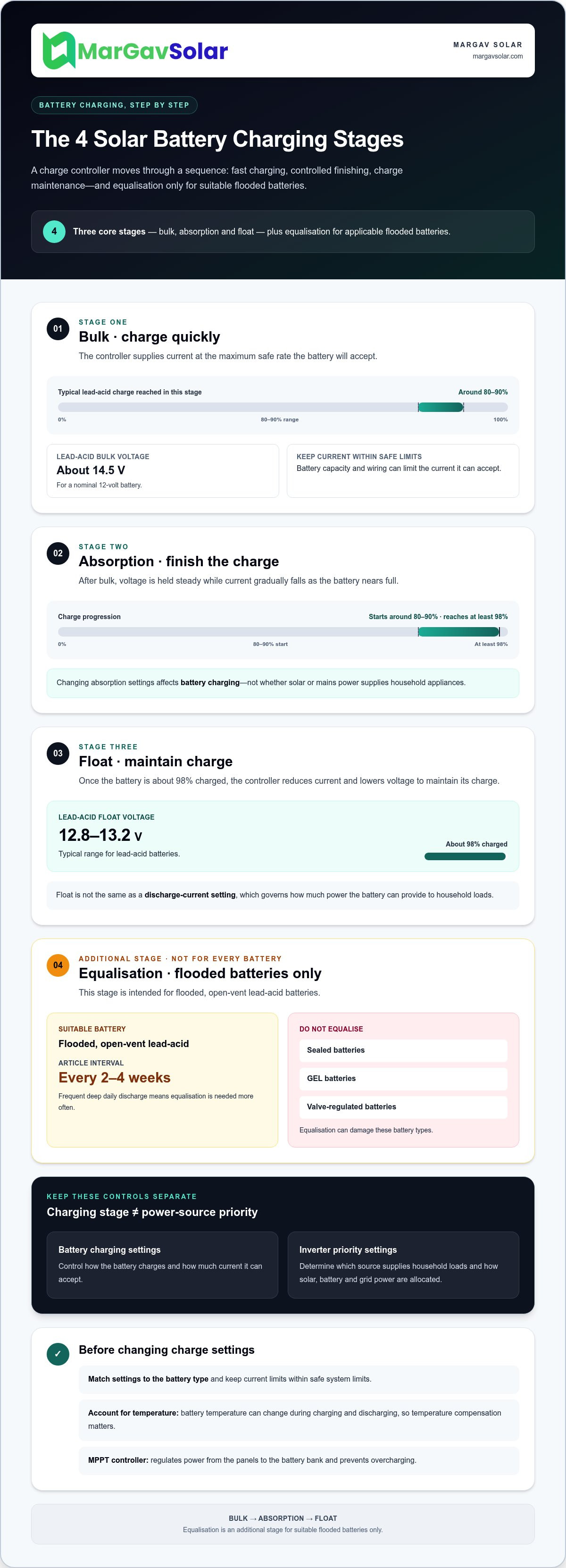
Solar charge controllers use bulk, absorption and float charging, with equalisation as an additional stage for suitable batteries. These stages describe how a battery charges. Current settings control how much power it can accept or provide, while inverter priority settings determine which source supplies household loads.
During bulk charging, the controller supplies current at the maximum safe rate the battery accepts. A lead-acid battery typically reaches around 80% to 90% charge during this stage. For a nominal 12-volt lead-acid battery, bulk voltage can reach about 14.5 volts. Battery capacity and wiring can limit the current, so a setting shouldn’t exceed the system’s safe limits.
Absorption follows bulk. The charger holds voltage steady while current gradually falls as the battery nears full charge. This stage begins at roughly 80% to 90% charge, and the battery typically reaches at least 98% by its end. Changing absorption settings affects charging, not whether solar or mains power supplies appliances.
Float charging follows absorption when the battery is about 98% charged. The controller reduces current and lowers voltage to maintain the battery’s charge. For lead-acid batteries, float voltage is typically 12.8 to 13.2 volts. This differs from discharge-current settings, which govern how much power the battery can provide to household loads.
Equalisation is intended for flooded, open-vent lead-acid batteries. It isn’t suitable for sealed, GEL or valve-regulated batteries, which can be damaged by this stage. Flooded batteries are equalised every 2 to 4 weeks; frequent deep daily discharge means equalisation is needed more often.
An MPPT solar charge controller regulates the power from panels to the battery bank and prevents overcharging. Before changing settings, match the charging stages and current limits to the battery type. Temperature compensation matters because battery temperature can change during charging and discharging. Keep charge-current settings separate from inverter output-source priority: one controls battery charging, while the other chooses the power source for household loads.
What are the battery modes (self-consumption, time-based, backup) and which should I use?
Battery modes determine when storage charges and discharges, and which household needs it serves. Self-consumption focuses on using more of your own solar generation. Time-based operation follows selected periods, while backup mode prioritises keeping stored energy available for a power cut. The right choice depends on whether everyday solar use, timed charging or reserve power matters most.
In self-consumption mode, surplus daytime solar charges the battery instead of being used immediately. The battery can then supply household demand in the evening, when panels produce less or no solar power. For example, a home with daytime generation and evening demand can store surplus energy for later. This shifts some solar use to another part of the day.
Self-use charging and discharging follow a cycle: solar generation serves current demand, surplus charges the battery, and stored energy supports later consumption. The balance depends on household demand and available solar power. If daytime appliances use most of the generation, less surplus remains for storage. If demand is lower, more energy may be available to charge the battery for evening use.
A time-based mode suits households that want charging or discharging to follow selected periods. The aim might be to store energy for a time when household demand is higher or to make use of a particular tariff period. Its value depends on the schedule, tariff structure and energy available to charge the battery. Unlike self-consumption, the focus is on timing rather than simply storing surplus solar for later.
Backup mode reserves stored energy instead of treating every available unit as everyday supply. This can suit a household that prioritises power availability during an outage. The trade-off is that energy held in reserve may not be used for normal consumption. Choose self-consumption for routine solar use, time-based operation for scheduled energy use, or backup when retaining charge is the priority.
Solar-only battery charging
Solar-only charging, labelled OSO on some inverters, charges the battery from photovoltaic power alone. Mains electricity won’t charge the battery in this mode. To understand solar battery charging modes in practice, start with this distinction: OSO limits the battery’s charging source, while other inverter settings may allow grid support. The key point is that charging depends on available solar generation, not the grid.
Consider a home where solar generation changes throughout the day. If the panels provide enough power for the inverter to charge the battery, charging can proceed. If solar power is unavailable, OSO won’t switch to mains charging. The battery may therefore receive less charge during periods of limited generation. The amount stored depends on available solar power and the system’s charging settings.
Solar-only charging can suit someone who wants to keep grid electricity out of battery charging. But if solar generation hasn’t charged the battery sufficiently, less energy may be stored for later. The inverter’s load priority still matters: the setting that decides which source powers household appliances is separate from OSO’s battery-charging rule.
Before selecting OSO, consider when your home uses electricity, how much solar generation is available, and whether you want grid charging as a backup. For example, a household with evening demand may value daytime solar charging, while limited generation can mean less energy is stored. To understand solar battery charging modes in practical terms, distinguish the charging-source setting from the load-priority setting. Solar-only is a source choice, not a guarantee of a full battery.
For a home solar and battery system, the practical choice is how to balance solar charging with the stored energy you want available. Explore residential solar and battery solutions to plan a setup around that priority.
MarGav Solar: Residential Solar PV Systems
MarGav Solar can help you plan residential solar PV and battery storage around how your household uses electricity. If you’re weighing solar-only charging against grid-supported charging, the system design needs to account for your generation, consumption and preference for stored backup power. Battery settings work best when they suit the panels and storage in your home, rather than being chosen in isolation. MarGav Solar also provides EV charging points and solar panel maintenance and cleaning, which may be relevant as your home energy needs change. For guidance on a solar PV and battery system for your home, contact MarGav Solar.
Make your next energy choice with confidence
The next step is to match your preferred settings to how your household uses electricity. Consider what matters most: using your own generation, keeping energy in reserve, or allowing mains power to support charging. Understanding solar battery charging modes clarifies the options, but the right fit depends on your home’s energy needs as a whole.
Before changing inverter settings, note what you want the system to prioritise and how you expect to use stored energy. This gives you a clear starting point for planning a solar and battery setup, including how it could work alongside other home energy needs. MarGav Solar can help you explore those choices through its residential solar, battery storage and EV charging solutions in Staffordshire.
Ready to talk through your options? Contact MarGav Solar about battery modes and take the next step towards a setup that suits your home.
Frequently Asked Questions
Which should I use?
Choose a mode that matches your main priority: using solar generation, keeping energy in reserve or scheduling battery use. For example, a household that’s usually out during sunny hours may benefit from storing daytime generation for evening use. If retaining charge for outages matters more, reserve-focused operation may suit better. Base your choice on when electricity is used, not just when panels generate it.
What are the main solar battery charging modes?
The main options include solar-only charging, which uses photovoltaic power, and hybrid or mains-supported charging, which can also use grid electricity. Inverter menus may label these OSO, SNU or CSO. Load-priority labels such as SBU, SOL and UTI describe how power reaches appliances, rather than how the battery charges. Read what the setting does, not just its abbreviation.
How do self-consumption, time-of-use and backup charging modes work?
Self-consumption stores surplus solar for later household use. Time-of-use operation schedules charging or discharging around selected periods, which can suit a tariff with different rates at different times. Backup operation retains stored energy for use during an outage instead of making all available charge part of everyday consumption. Compare these modes by deciding whether routine solar use, timing or reserve power matters most.
What do solar battery charge, discharge and reserve settings mean?
Charge-current settings govern how quickly the battery accepts power; discharge-current settings limit how much it supplies to household loads. A reserve setting keeps some stored energy back instead of using it during normal operation. In SBU mode, the inverter can switch to utility power when the battery reaches its configured low-voltage or state-of-charge protection point. These controls affect different parts of system operation.
How do I choose a solar battery charging mode for my home?
Start with your household’s daily pattern: when solar generation is available, when appliances use electricity, and whether backup matters. For a Staffordshire home with most demand in the evening, storing daytime surplus may be useful. A household that prioritises outage reserve may prefer to keep more charge available. Then consider whether grid charging fits your tariff and the system’s operating settings.
How does a solar battery charge from solar panels, the grid and off-peak electricity?
Solar panels produce photovoltaic power, which a charge controller regulates before it reaches the battery. Grid charging depends on the inverter’s selected mode: SNU can supplement solar, while OSO restricts battery charging to photovoltaic power. Off-peak electricity can charge a battery only if the system supports grid charging and its schedule allows it. The tariff’s time periods determine when that electricity costs less.


