

A south-facing 4kW solar system in Stoke-on-Trent, mounted at a 35° tilt, is estimated to generate 3,598 kWh a year. Expert solar advice in Stoke-on-Trent can help make sense of what those figures mean for your home.
It’s natural to focus on potential savings, but solar generation varies with roof direction, tilt and how much of the electricity you use at home. A battery can store surplus power for later, changing how the system fits your household’s routine.
This guide explains how solar generation and savings are estimated locally, what a 4kW system may be worth, and how panels and batteries can work together. You’ll also learn which property details shape the estimate, so you can assess the likely value of solar for your home.
Key Takeaways
- Estimate savings by considering how much solar electricity your household uses and how much surplus it can export.
- Eligible tenants and landlords can claim up to £500 through the Office for Zero Emission Vehicles grant for an EV charger.
- Match system size to your property type and roof, rather than assuming one setup suits every home.
- Consider when you use electricity to understand whether adding battery storage could make solar work better for your household.
What is 4kW of solar worth to a Stoke-on-Trent household?
A 4kW solar system in Stoke-on-Trent is estimated to save £700-£1,100 per year, based on 2024 electricity rates. These figures differ because household electricity use, export payments and system assumptions vary. A photovoltaic system’s value depends most on using generated electricity at home, rather than exporting it.
Local directories can help explain the shape of the market: one Stoke-on-Trent installer listing is at Blythe Business Park in Creswell, 7.19 miles away. A directory entry shows a location, not the quality or suitability of a system. Compare proposals by their roof survey, estimated generation, panel layout, battery options and aftercare arrangements. Look at how each installer explains the design and who handles registration and ongoing maintenance.
A useful survey records roof orientation, shading, available space and the household’s electricity use. The system design should show how panels fit the roof and how the inverter connects them. Ask for a clear explanation of expected generation and the export arrangement. These steps help you compare like with like, rather than judging a proposal by panel count alone.
In Stoke-on-Trent conservation areas, road-facing roof slopes can require planning permission for solar panels. Listed buildings require listed building consent for solar panel work. A typical residential solar installation takes 1-2 days. Eligible tenants and landlords can claim up to £500 through the Office for Zero Emission Vehicles grant for an EV charger.
Solar panels need inspection and cleaning according to roof exposure and manufacturer warranty requirements; recommended servicing intervals are 12-24 months. MarGav Solar offers Solar Panel Maintenance & Cleaning to help address performance issues such as visible damage or reduced output. A household planning an EV charger can also consider how charging would work alongside solar, while a boiler remains a separate part of home heating. Solar PV can reduce reliance on grid electricity and associated carbon emissions, but it doesn’t replace all household energy needs.
Solar panels, batteries and other renewable technologies
The right solar panels and battery storage for a Stoke-on-Trent home depend on roof space, electricity use and when the household needs power. Solar panels generate electricity during daylight; a battery can store surplus for later. A suitable setup reflects those patterns rather than relying on an average household profile.
A solar and battery system combines generation and storage in one design. Compare proposals by checking how the battery works alongside the panels, what the system is designed to do and how its operation is explained. Ask for a detailed design showing panel placement and how electricity flows between the panels, battery and home.
Battery storage options are best assessed against your daily routine:
- Consider whether electricity use is concentrated during daylight or later in the day.
- Think about whether you want stored solar power available after generation falls.
- Review how a battery would fit with other equipment, such as an EV charger.
These steps help clarify whether storage could be useful. A battery doesn’t generate renewable energy; it stores electricity produced by solar panels. Its usefulness depends on when generation and household demand occur, so a system designed around evening use may suit a different home than one used mainly during daylight.
Solar panels and batteries in the UK are subject to 0% VAT until at least 31 March 2027. That affects VAT treatment, not the system’s suitability or performance. For a Stoke-on-Trent home, roof orientation, shading and available space remain central to the design. A regional estimate is only a starting point, not a substitute for matching equipment to the property.
To explore how solar generation and storage can work together, review solar PV and battery storage options and consider which pattern of electricity use your household wants to support.
There is no single best setup for every Stoke-on-Trent home. Choose panels and battery storage based on roof orientation, shading, available space, electricity use and when power is needed. Compare detailed designs that explain panel placement and how the system will serve your household’s routine.
Does a solar energy system provide electricity?
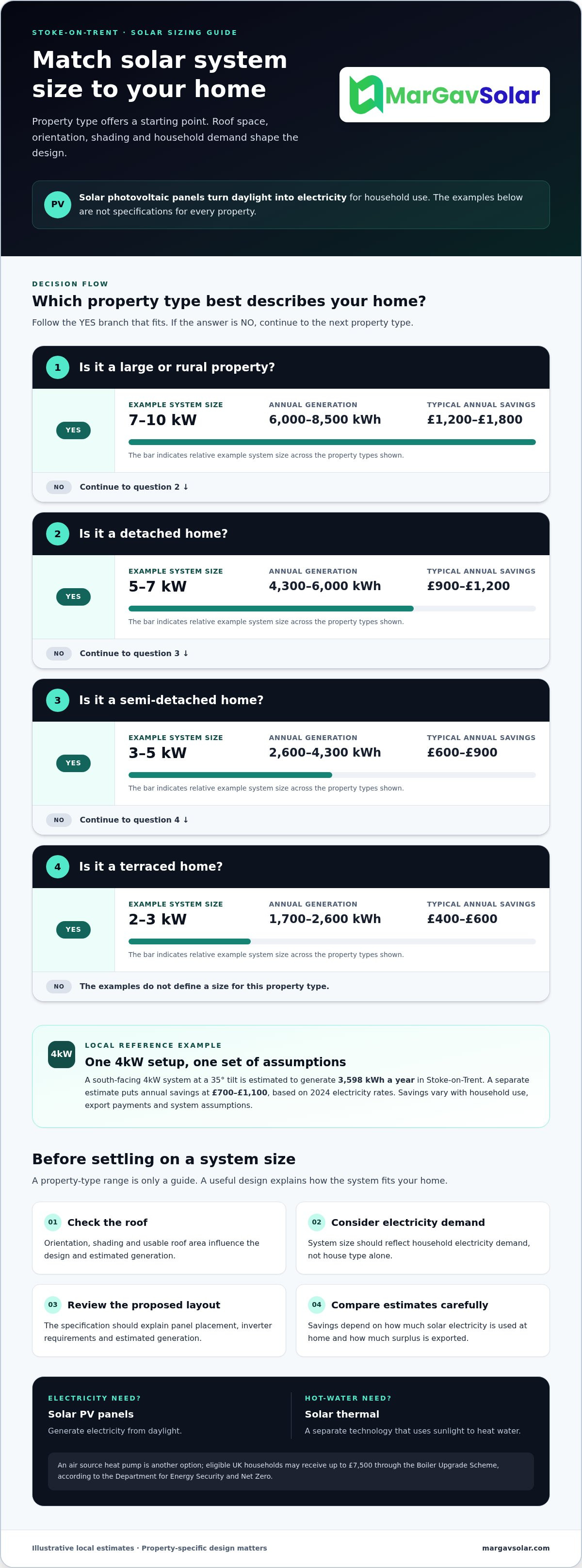
Yes. Solar photovoltaic (PV) panels convert daylight into electricity for household use. System size should reflect roof space and demand, not house type alone. Stoke-on-Trent estimates illustrate the differences: a terraced house may suit 2-3 kW, generating 1,700-2,600 kWh annually, with typical savings of £400-£600 per year. A semi-detached home may suit 3-5 kW, generating 2,600-4,300 kWh annually, with typical savings of £600-£900 per year.
A detached home may suit 5-7 kW, generating 4,300-6,000 kWh annually, with typical savings of £900-£1,200 per year. Large or rural properties may suit 7-10 kW, generating 6,000-8,500 kWh annually, with typical savings of £1,200-£1,800 per year. These are examples, not a specification for every property in Staffordshire.
Good system design starts with roof orientation, shading, usable area and household electricity demand. The specification should explain panel placement, inverter requirements and estimated generation. For a solar installation, it is worth checking the installer’s qualifications and experience. A household with daytime EV charging, for example, may use solar electricity differently from one whose main demand comes later.
Solar thermal is a separate technology: collectors use sunlight to heat water, while PV panels generate electricity. A homeowner comparing both should first identify whether the priority is household electrical demand or hot water. An air source heat pump is another option; eligible UK households may receive up to £7,500 through the Boiler Upgrade Scheme, according to the Department for Energy Security and Net Zero.
Advertised system prices need context. The price depends on system size, roof access, electrical requirements and whether battery storage is included, and is given after a quote request. Compare the same design details across proposals, rather than headline prices alone, to judge the likely benefit for your home.
Estimated solar generation in Stoke-on-Trent
Stoke-on-Trent receives approximately 1,360 sunshine hours per year, but sunshine hours alone don’t determine a system’s electricity generation. A south-facing, roof-mounted 4kW system at a 35° tilt is estimated to generate 3,598 kWh per year. That figure offers a local reference point, not a prediction for every roof. Expert solar advice in Stoke-on-Trent can help interpret an estimate against your property’s conditions.
Seasonality makes a clear difference. The same south-facing 4kW system is estimated to generate 452 kWh in May and 112 kWh in December. This affects when solar electricity is available: spring and summer typically provide stronger generation, while winter output is lower. Household demand can still be high during colder months, particularly for lighting and heating.
For a useful estimate, start with three details: roof direction, tilt and shading. Then compare predicted generation with household electricity use and the times you use power. A shaded roof section can produce a different result from an unobstructed one, even within the same property. Ask for the estimate to show annual generation and how it varies across the year. This is a practical starting point for expert solar advice in Stoke-on-Trent.
Local comparisons offer context. Stoke-on-Trent’s estimated annual solar generation is about 3% lower than Nantwich’s and about 2.5% lower than Crewe’s. These differences are modest; the specific roof and system design remain central to a household estimate. Generation also isn’t the same as bill savings: the benefit depends on how much electricity you use directly and how much surplus you export.
Solar electricity can reduce the amount a home draws from the grid, while a battery can store some daytime generation for later use. Solar panels can prevent 1 tonne of CO₂ emissions per year. Treat generation as the starting point for understanding potential savings and carbon impact, rather than a guarantee of a fixed bill reduction.
To discuss how your roof’s direction, tilt and shading shape its potential, request a solar generation assessment.
MarGav Solar: Residential Solar PV Systems
MarGav Solar provides residential solar panel systems for households looking to generate electricity from their roofs. Its professional installation service turns your roof conditions and electricity needs into a system designed for your home.
If you want to use more of your solar electricity at home, MarGav Solar also provides battery storage. If you’re planning to charge an electric vehicle at home, EV chargers can form part of your wider energy setup. For an existing system, MarGav Solar’s solar panel maintenance and cleaning service can help with upkeep.
MarGav Solar is a natural next step when you’re ready to discuss a residential solar system, storage, charging or panel maintenance. Contact MarGav Solar to talk about your home’s solar requirements.
Turn your solar plans into a practical next step
Before deciding on a system, note when your household uses electricity and what you want solar to support. This gives you a useful starting point for discussing your home’s needs, whether you’re considering generation, storage or charging an electric vehicle. Expert solar advice in Stoke-on-Trent can help you move from broad estimates to choices shaped around your property and routine.
MarGav Solar provides solar panels, battery storage and EV chargers. You can consider these options together when planning how electricity is generated, stored and used at home. Discuss your household’s priorities with MarGav Solar to explore how a solar setup could meet them.
Contact MarGav Solar to talk through your solar plans and take the next step towards a setup suited to your home.
Frequently Asked Questions
How much can I save with solar panels?
The balance between these benefits depends on how much generated electricity the household uses directly and how much surplus it exports. For example, running appliances during daylight uses solar electricity at home instead of drawing that power from the grid.
How will switching to solar reduce my carbon footprint?
Solar panels generate electricity from sunlight, reducing how much power a home draws from the grid. This changes the source of some household electricity and can lower emissions associated with energy use. A practical step is to schedule flexible electricity use, such as running appliances, during solar generation. Pairing solar with electric heating also changes how household energy is supplied.
Is solar energy worth the investment?
Solar is worth considering when the value of electricity used at home and exported aligns with the installation’s expected payback. A local estimate places payback for a typical installation at 8.8-10.0 years. To assess the investment, compare the predicted generation with your household’s use, roof suitability and expected time in the property, then consider how a battery could affect self-use.
Which reputable solar panel installers serve Stoke-on-Trent?
MarGav Solar serves Staffordshire and provides consultancy and professional solar panel installation for homes. For a Stoke-on-Trent property, compare the written system design, generation estimate, installation scope and aftercare arrangements. The research also recommends choosing an MCS-certified engineer for solar PV. Check that the proposal explains how the design suits your roof, rather than relying on a standard package description.
What do solar panels and battery storage cost in Stoke-on-Trent in 2026?
The cost of a home system depends on its design and installation requirements. Key factors include the number of panels, roof access, electrical work and whether battery storage is included. A proposal based on your property can set out the actual project requirements. Compare proposals by checking that they cover equivalent equipment, installation work and any storage you want.
How much electricity can a typical Stoke-on-Trent home generate from solar panels?
A useful local benchmark is 3,598 kWh per year from a south-facing, roof-mounted 4kW system at a 35° tilt. That example gives a household a basis for comparing predicted output with its electricity use. For instance, note which appliances run during daylight, then assess how much generated power they could use directly and how much would remain surplus.


