

The quickest-payback system isn’t automatically the best commercial solar investment. In the UK, commercial solar installations typically recover their upfront cost within 4 to 8 years, while the return on investment for commercial solar depends heavily on how much of the electricity your business uses on site. Energy tariffs, system design, export income and financing also shape the result.
It’s sensible to look beyond a single payback figure. A system that reduces electricity purchases can deliver ongoing savings, while batteries or finance can change the balance between upfront costs and cash flow. This guide explains how to assess energy bill savings and payback, which site and business factors affect returns, and how buying, leasing or using a Power Purchase Agreement (PPA) changes the investment. You’ll have a clearer framework for assessing what commercial solar could mean for your business in Staffordshire.
Key Takeaways
- Compare expected solar generation with your business’s energy use patterns to understand how system design can influence savings and returns.
- Surplus electricity may provide export income through the Smart Export Guarantee, while the value depends on the supplier’s tariff and terms.
- HM Revenue & Customs says businesses can claim 100% capital allowances on qualifying solar panels and other qualifying plant and machinery.
- Compare purchasing with a loan, lease or Power Purchase Agreement to see how each option affects upfront spending, ownership and cash flow.
What Is The Payback Period For Commercial Solar Panels?
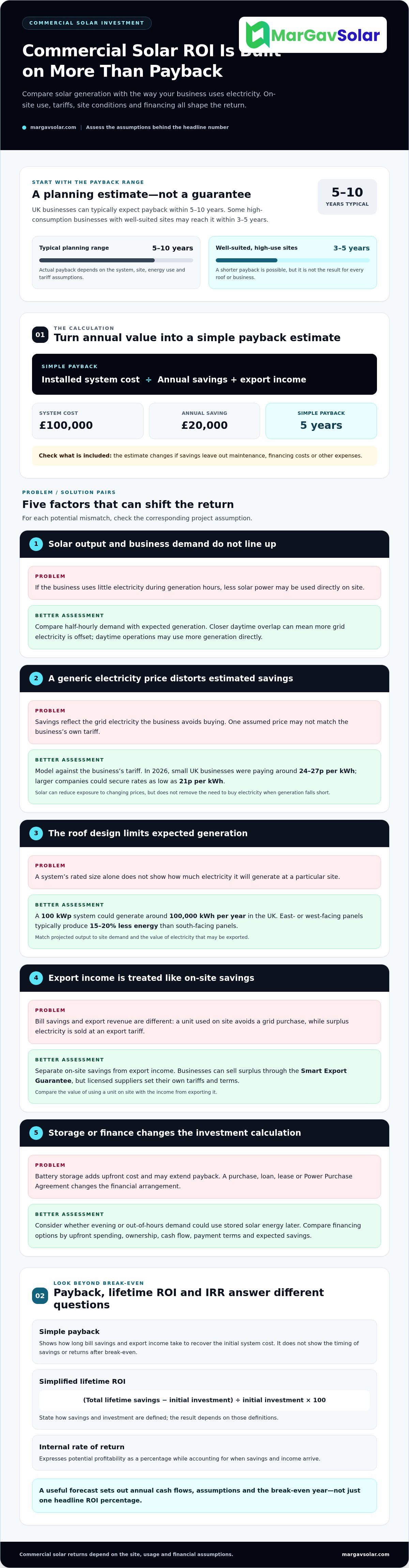
A commercial solar payback period is the time it takes for bill savings and export income to recover the system’s initial cost. UK businesses can typically expect payback within 5 to 10 years, while some high-consumption businesses with well-suited sites may reach payback within 3 to 5 years. Treat these as planning ranges, not a result that applies equally to every roof or tariff.
To calculate a simple estimate, divide the installed system cost by annual savings and export income. For example, a £100,000 system saving £20,000 annually has a simple five-year payback. The calculation changes if those savings exclude maintenance, financing costs or other expenses. Higher on-site use can shorten payback because each unit consumed offsets electricity bought from the supplier; exporting surplus adds income, but at a different tariff.
Payback and return on investment measure different things. A simplified lifetime ROI formula is (total lifetime savings minus initial investment) divided by initial investment, multiplied by 100. The lifetime ROI result depends on how savings and investment are defined, so state the formula used. Internal rate of return expresses potential profitability as a percentage while accounting for when savings and income arrive. A simple payback figure doesn’t show that timing or the system’s returns after break-even.
Planning permission, building regulations and grid connection are separate considerations for a UK commercial project. Whether approvals or an export connection are needed depends on factors such as the site, installation design, roof structure and whether electricity will be exported. Include these in project planning.
System size, generation, business demand and tariff assumptions all affect the estimate. Storage adds upfront cost and may extend payback, but can help a business use generated electricity later. A PPA changes the financial arrangement, too, so compare its payment terms and expected savings with an outright purchase. A useful forecast sets out annual cash flows, assumptions and the break-even year rather than relying on a single headline ROI percentage.
Energy bill savings
UK businesses can save by using solar electricity instead of buying it from the grid.
Savings depend on consumption, energy prices and how much generated electricity is used on site. Assess these factors to estimate bill savings and potential export income.
Savings from Using Generated Electricity
Using solar electricity on site reduces the amount a business needs to buy from its supplier. The closer daytime consumption matches solar generation, the more electricity the business can use directly rather than export. Compare half-hourly demand patterns with expected generation to see when they overlap. Businesses with daytime operations may therefore offset more grid electricity than sites with little daytime demand.
Electricity Prices and Solar Savings
Solar savings reflect the price of grid electricity that a business avoids buying. In 2026, small UK businesses were paying around 24-27p per kWh, while larger companies could secure rates as low as 21p per kWh. Energy price volatility matters because solar can reduce exposure to changing prices, but it doesn’t remove the need to buy electricity when generation falls short. Model savings against the business’s own tariff.
Bill Savings and Export Revenue
Bill savings come from using solar electricity, while export revenue comes from selling surplus generation. UK businesses can sell surplus electricity through the Smart Export Guarantee. Export tariffs and terms vary because licensed suppliers set their own offers. Compare the value of using a unit on site with the income from exporting it: the difference affects the financial value of each unit generated.
Business Electricity Bill Savings
The £20,000 annual saving example illustrates potential savings, not a fixed outcome for every business. Actual results depend on system size, generation, consumption patterns and the electricity price being offset. A business can refine its estimate by matching expected solar output against its bills and operating hours. Solar system planning can help relate site generation to business electricity use and expected savings.
What Affects the ROI of a Commercial Solar Installation?
Returns depend on more than the panels. Installed cost, annual generation, on-site use and tax treatment all matter. Assess these together to understand how a renewable energy investment could support savings and sustainability.
Installation Costs and Annual Savings
Installation cost is the upfront amount to compare with the savings and export income a solar system can generate. A useful example is a 100 kWp system, which could generate around 100,000 kWh of electricity per year in the UK. The financial value of that output depends on how much the business uses, the electricity it offsets and its export rate. This comparison helps assess whether expected annual savings justify the initial outlay.
System Cost and Annual Generation
System cost and annual generation should be assessed together, because a larger array can produce more electricity while costing less per kWp. That improves the investment case only if the additional output is used on site or exported at a worthwhile rate. Roof orientation also affects generation: east- or west-facing panels typically produce 15-20% less energy than south-facing panels. Match the projected output to the site’s demand before judging returns.
Factors Shaping Installation Costs
Installation complexity affects project cost and usable generation. System size, roof layout, orientation and electrical requirements shape the design, while battery storage adds upfront cost. Storage may suit sites with evening or out-of-hours demand because it can retain excess solar energy for later use. Compare the added cost with the value of using that stored electricity rather than assuming a battery will improve ROI.
Incentives and Capital Allowances
Tax treatment can affect a business’s effective investment and cash-flow calculations. HM Revenue & Customs says businesses can claim 100% capital allowances on qualifying solar panels and other qualifying plant and machinery. Eligibility and the tax impact depend on the business’s circumstances, so include the allowance in financial modelling rather than treating it as an immediate cash saving. Grants may also be sector- or region-specific and can change, so include them only when applicable to the project.
Financing, leasing and Power Purchase Agreements
UK businesses can fund solar panels with capital, bank lending or a Power Purchase Agreement (PPA). The arrangement affects upfront spending, ownership and how solar savings flow through business accounts.
For a fair comparison, include finance payments and ongoing system costs alongside the environmental value of renewable electricity.
Solar Financing Options and Cash Flow
Solar financing spreads or transfers the initial cost instead of requiring the business to pay the full amount upfront. A business using a loan or lease may have positive cash flow from year one, even if the headline payback period stays unchanged. Compare scheduled payments with expected bill savings and export income. Include maintenance and inverter replacement in lifetime projections, as both affect net cash benefits.
Capital funding uses available business funds, while bank lending adds repayments and finance costs. Each affects cash flow differently. A battery can increase upfront spending, so weigh its cost against the value of storing surplus solar energy for later use.
Leasing and Power Purchase Agreements
A lease gives a business access to a solar installation through agreed payments, while a PPA typically lets it buy generated electricity under contract. PPAs can provide solar with minimal upfront cost, but the contract sets payment terms and the value of electricity supplied or exported. Compare the full term, expected savings and maintenance responsibilities before assessing lifetime returns.
These arrangements can also support environmental aims by increasing renewable electricity use. A business may value reduced reliance on grid power alongside the financial case, but that benefit doesn’t replace comparing contract costs with energy savings.
Budget for routine inspections, cleaning where needed, and eventual inverter replacement, as well as interest, fees or lease payments. Those costs reduce net savings, so include them in cash-flow forecasts rather than focusing only on the initial price. Explore battery storage solutions as part of assessing how stored solar energy could fit your site’s electricity use.
MarGav Solar: Residential Solar PV Systems
MarGav Solar installs solar panels for commercial properties, as well as residential solar systems, battery storage and EV chargers. Its commercial solar service is relevant to businesses assessing the returns discussed above. The figures should still be evaluated against each business’s site, energy demand and financial arrangements.
For a residential property, solar generation and storage can help shape how electricity is used; maintenance supports the system after installation. For a business weighing commercial returns, the key next step is applying the same careful assessment of energy use, generation and costs to its own circumstances. Contact MarGav Solar to discuss your solar needs.
Turn Your Solar Assessment Into a Clear Next Step
Start by deciding what your property needs from solar: lower grid dependence, better use of generated electricity or support for wider energy plans. That priority gives your financial assessment a practical direction and connects projected savings to how the site operates.
The return on investment for commercial solar depends on assumptions that reflect your business, not a generic example. Results depend on the site, energy use, system design and financial arrangement. Use the analysis to support a decision, then consider which solar options fit your property and goals.
MarGav Solar offers Residential Solar PV Systems, Battery Storage Solutions and EV Charging Points. If you’re considering solar for your property, contact MarGav Solar to discuss your project. A thoughtful assessment can help you move forward with greater clarity and confidence.
Frequently Asked Questions
Does battery storage improve commercial solar ROI?
Battery storage improves commercial solar ROI when the value of using stored electricity later outweighs the battery’s added cost. A site with substantial demand after solar generation falls, for example, may use stored energy instead of buying electricity from the grid. A business operating mainly during daylight hours may gain less from storage. Compare demand timing and battery costs in the same financial model.
Does the case for commercial solar stack up?
The case stacks up when the value of electricity used or exported over the system’s lifetime exceeds the full project and operating costs. Consider whether the roof or available site can support useful generation and whether the business can use that output. Sustainability goals may matter too, but keep environmental aims distinct from cash returns so decision-makers can assess both clearly.
How do you calculate solar ROI for a business?
Calculate net returns by subtracting the total investment from lifetime savings and income, then dividing by the investment and multiplying by 100. Build the estimate from projected generation, electricity used on site, export income, maintenance and financing costs. Use annual cash flows to show when savings occur; this reveals timing that a single lifetime percentage can hide.
How does system size affect solar ROI?
A larger system can spread fixed project costs across more generating capacity, but its extra output adds value only if the business can use or export it. Compare proposed generation with demand during sunny periods. If output regularly exceeds consumption, exporting the additional electricity may earn less than the savings from replacing purchased power.
Is self-consumption or export more valuable?
Using solar electricity on site is generally more valuable per unit when it avoids buying electricity at a higher rate than the export tariff. Export still provides income for surplus generation. Ofgem explains that Smart Export Guarantee suppliers set their own tariffs and terms, so compare the applicable offer with the business’s import rate before valuing exported electricity.
How is return on investment for commercial solar calculated in the UK?
Use the same net-return calculation, then account for UK-specific income and tax treatment. Include export payments where applicable, alongside the value of electricity used on site and project costs. HM Revenue & Customs says qualifying solar panels and other qualifying plant and machinery can receive 100% capital allowances. Model that tax treatment separately from operating savings to avoid counting it twice.


