

Presenting a solar proposal to the board is easier when decision-makers can assess the project, its financial case and the choices they need to approve in one clear document. Include the proposed system, expected benefits, key assumptions, risks, acceptance terms and a plan for stakeholder review. The proposal should make the decision clear, not leave the board to piece together technical details.
A solar project can involve different priorities, from energy performance and budget planning to operations and long-term maintenance. A board-ready proposal brings those priorities into the discussion and shows how the recommendation supports the organisation’s needs.
Here, you’ll learn what to include, how to present the system and its business case, and how to set out approval terms and review responsibilities. The result is a practical framework to help the board assess, discuss and decide.
Key Takeaways
- Start with a concise project summary, then set out the proposed system specifications and the assumptions behind them.
- Make warranties and trust signals easy to assess by clearly identifying what each covers and for how long.
- Spell out acceptance terms, who needs to sign, and what happens after approval so the decision can move forward clearly.
- Organise the proposal for stakeholder review, with the technical, financial and operational details each decision-maker needs to evaluate.
What is included in this solar proposal template?
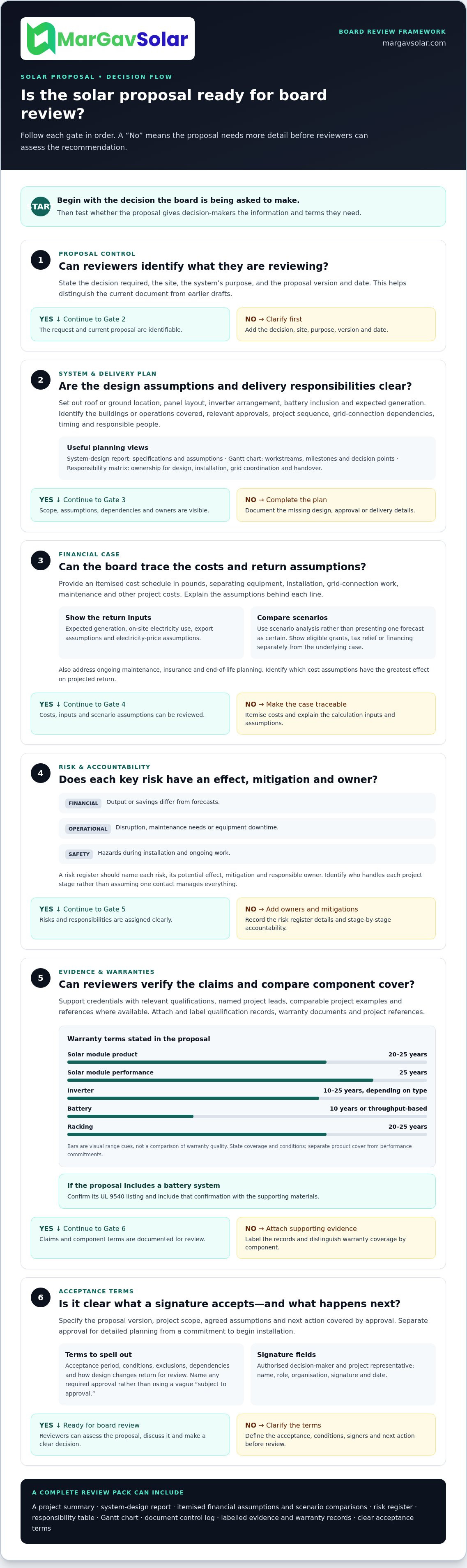
When presenting a solar proposal to the board, make the document easy to assess and approve. Include a project summary, system design, financial assumptions, delivery responsibilities, risks, warranties and acceptance terms. Identify the proposal version and date so reviewers can distinguish the current document from earlier drafts.
Commercial solar risks fall into three groups: financial risks include output or savings differing from forecasts; operational risks include disruption, maintenance needs or equipment downtime; and safety risks include hazards during installation and ongoing work. A risk register should name each risk, its potential effect, mitigation and responsible owner.
Support claims about credentials with evidence. Include relevant qualifications, named project leads, comparable project examples and references where available. Show who handles design, installation, commissioning and ongoing support. A responsibility table helps board members see who is accountable for each decision or issue, rather than assuming one contact manages every stage.
Set out warranty terms by component, including what is covered and any stated conditions. Solar module product warranties commonly last 20 to 25 years, while module performance warranties commonly last 25 years. Inverter warranties commonly last 10 to 25 years, depending on inverter type. Battery warranties commonly last 10 years or are based on throughput, and racking warranties commonly last 20 to 25 years. Separate product cover from performance commitments so the board can compare them accurately.
- Excel spreadsheet: Organise forecast assumptions, projected generation and scenario comparisons in one reviewable file.
- Risk register: Track financial, operational and safety risks alongside mitigations and owners.
- Document control log: Record proposal versions, review dates and stakeholder comments.
Create a clear evidence trail by attaching qualification records, warranty documents and project references, and labelling each item in the proposal. This helps finance, operations and facilities reviewers trace claims to supporting documents without searching through unstructured attachments.
If the proposal includes a battery system, confirm its UL 9540 listing and include that confirmation with the supporting materials. This gives reviewers a specific item to verify alongside the proposal’s other documented equipment and warranty details.
Project summary and solar system specifications
Open with the decision required, the site, and the proposed system’s purpose. Then state the design assumptions: roof or ground location, panel layout, inverter arrangement, battery inclusion, and expected generation. Identify the buildings or operations covered, and explain how the design responds to their electricity use. A one-page summary helps board members grasp the recommendation before reviewing technical schedules.
Planning permission and building regulations depend on the site and proposed design. Set out the approvals and building-control requirements relevant to the project, and show responsibility and timing in the delivery plan.
Show the project sequence, from surveys and design through installation, commissioning and grid connection. Identify any required network-operator application, who is responsible, and dependencies that could affect the programme. Avoid promising a completion date before these steps are understood. A Gantt chart can display workstreams, milestones and decision points clearly.
Present an itemised cost schedule in pounds, separating equipment, installation, grid-connection work, maintenance and other project costs. Explain the assumptions behind each line. For return on investment, describe the calculation method and inputs, including expected generation, on-site electricity use, export assumptions and electricity-price assumptions. Use scenario analysis rather than presenting one forecast as certain.
Commercial proposals should cover ongoing maintenance, insurance and end-of-life planning. Show maintenance tasks and their expected frequency as project-specific assumptions, alongside insurance considerations and provisions for removing or replacing equipment. Identify which cost assumptions have the greatest effect on the projected return.
UK grants, tax relief and financing options depend on eligibility and project circumstances. List only support that applies to the organisation, and show its effect separately from the project’s underlying financial case. Distinguish purchase funding from operating savings.
Name the project lead and define responsibilities for design, installation, grid coordination and handover. A responsibility matrix makes ownership clear. Excel is useful for comparing financial scenarios; a Gantt chart maps timing; a system-design report records specifications and assumptions. For project planning that includes solar generation, solar PV system design can help frame the technical scope.
Acceptance terms, signatures and next steps
Make approval clear by stating what the board’s signature accepts: the named proposal version, project scope, agreed assumptions and next action. Separate approval to proceed with detailed planning from a commitment to begin installation. This helps prevent a meeting decision from being mistaken for acceptance of terms the board hasn’t reviewed.
Set out the acceptance period, any conditions and how changes will be handled. For example, if a revised design changes the system scope, explain how the updated proposal will return for review. Identify exclusions and dependencies in plain language, such as site access arrangements or network coordination. Avoid vague phrases like “subject to approval” without naming the approval required.
Provide signature fields for the authorised decision-maker and project representative. Include each person’s name, role, organisation, signature and date, alongside the proposal’s reference and version. If finance, property and operations teams contribute, record their review separately from formal acceptance. A sign-off matrix can show who recommends, reviews and approves each decision.
- Adobe Acrobat Sign: Manage electronic signatures and retain a record of the signed document.
- DocuSign: Route an approval document to named signatories and track its progress.
- Microsoft Planner: Assign follow-up actions and owners after the board meeting.
After approval, share the final signed copy with relevant stakeholders and record the decision in the organisation’s project files. Assign an owner and due date to each next step, such as arranging a site survey, supplying site information or scheduling a design review. A short action log helps the team track outstanding decisions without reopening settled terms.
Close with a clear contact route for proposal queries and a named person responsible for coordinating the next stage. If the board defers its decision, record the specific information or revision it needs, then circulate a dated update for review. This creates a traceable handover from approval discussion to project activity.
Commercial proposals for multi-stakeholder review
When presenting a solar proposal to the board, show the options side by side and explain the recommendation. For example, compare a core solar design with a phased option that adds battery storage later. Set out each option’s assumptions, expected generation, costs, operational implications and dependencies. This gives finance, facilities and leadership a shared basis for review.
Keep the recommendation distinct from the evidence. State the decision requested, such as approval for further design work or selection of a preferred option. Then explain how the conclusion follows from the organisation’s priorities, including electricity use, available space, business continuity and investment criteria. Don’t present projected savings as guaranteed outcomes.
A comparison table helps stakeholders focus on their own concerns. Use the same headings for each option so readers can compare like with like:
- Finance: Review cost assumptions, forecast savings and sensitivity to changes in electricity use.
- Facilities: Assess site constraints, maintenance implications and operational disruption.
- Leadership: Weigh strategic fit, delivery dependencies and the decision required.
Make assumptions visible beside the figures they affect. If the forecast depends on a particular level of on-site consumption, label that assumption and explain how a different usage pattern changes the outcome. Include a base case and a lower-generation scenario, using the same calculation method for both. This makes uncertainty easier to discuss instead of hiding it in technical notes.
Tools can support a shared review: Microsoft Excel compares scenarios, PowerPoint presents the recommendation, and Miro maps stakeholder questions. Keep technical schedules in an appendix and use a short decision paper for the meeting. Assign an owner and response to each comment so finance queries and facilities concerns stay visible between drafts.
A clear review sequence might move from facilities to finance, then the board. Ask each reviewer to assess the same version and record their role. Close with the decision requested and the next action if approved. A structured approach to presenting a solar proposal to the board can keep feedback focused on the organisation’s priorities. Discuss your solar project when you’re ready to shape a proposal around those priorities.
MarGav Solar: Residential Solar PV Systems
MarGav Solar is a natural next step when your board is considering solar for residential properties. Its Residential Solar PV Systems help households generate electricity on site, while Battery Storage Solutions can form part of a broader home energy plan. EV Charging Points may also be relevant where residents need vehicle charging, and Solar Panel Maintenance & Cleaning supports ongoing system care.
For a board proposal, define the property type and decision clearly. A residential installation suits a home or housing project, rather than a commercial-site proposal. Set out the project’s needs and consider which options align with them, such as solar generation, storage or charging.
To discuss a residential solar project and its requirements, contact MarGav Solar.
Turn board approval into a clear next step
A board decision creates momentum only when someone owns the next steps. Assign a lead to record the decision, circulate agreed actions and keep stakeholders aligned as the project progresses. This handover also helps the organisation distinguish commercial priorities from residential energy needs before committing to a project path.
For residential projects, MarGav Solar provides solar panels, battery storage and EV chargers. These options may suit a board considering energy improvements for homes or residential properties rather than a commercial installation. A conversation about the property and its needs can help shape the next step.
If you’re exploring a residential solar project, contact MarGav Solar to discuss your requirements. A thoughtful decision today can give your organisation a practical foundation for moving forward with confidence.
Frequently Asked Questions
What should a solar proposal to a UK board include?
A proposal should give board members the information needed to assess the decision and its consequences. Include a concise recommendation, site-specific design assumptions, forecast methodology, delivery responsibilities and approval conditions. For a Staffordshire property, distinguish the organisation’s site constraints from general assumptions. Add a decision page that names the requested approval and records any conditions, so the minutes reflect exactly what the board agreed.
How do UK grid connection rules and export tariffs affect a solar project?
Connection requirements shape how a project connects and operates, while export tariffs affect the value of electricity sent to the grid. Show the connection process and its dependencies separately from projected generation. Model exports using the applicable contract terms, and explain how the financial case changes if more electricity is used on site. For a Staffordshire proposal, base both assumptions on the specific site and intended arrangement.


