

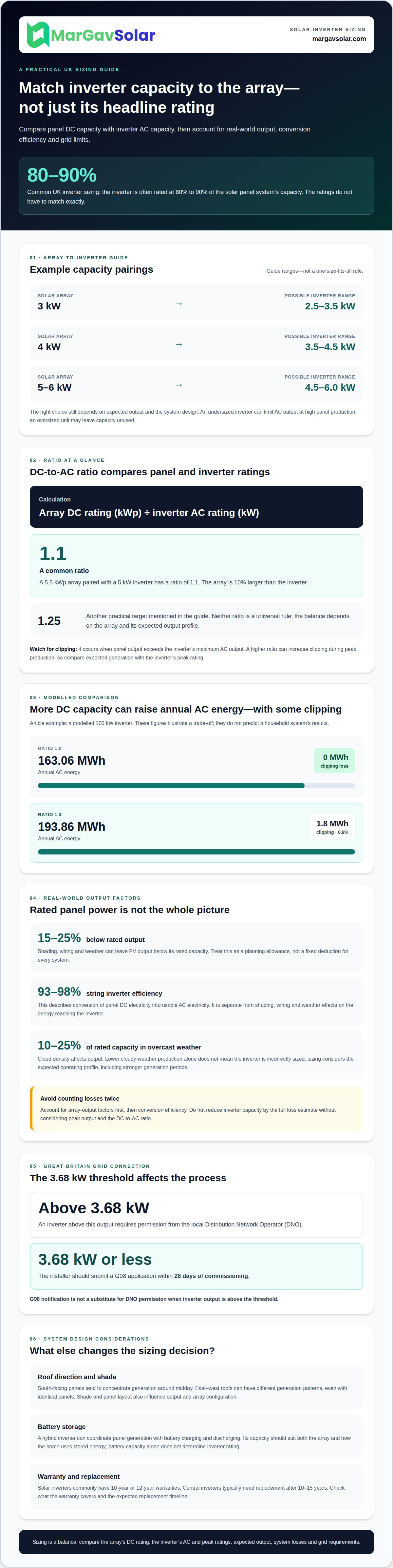
The inverter doesn’t always need to match your solar array’s full rated capacity. In the UK, installers commonly size an inverter at 80% to 90% of the panel system’s capacity, so choosing the right size solar inverter means balancing the array’s output with the inverter’s ability to convert it into usable AC electricity.
It’s understandable to assume a larger inverter is the safer choice, but the right size depends on more than the panels’ headline capacity. System losses, the DC-to-AC ratio and the array’s expected output all matter.
This guide explains how to match inverter capacity to your array, account for real-world losses and understand inverter loading. It also covers why a difference between panel and inverter ratings can be deliberate, and what to consider if you plan to add battery storage or expand the system.
Key Takeaways
- Compare the inverter’s AC capacity with your panels’ DC capacity; a modest difference between them can be intentional.
- Allow for shading, wiring and weather when estimating usable output, rather than sizing from panel ratings alone.
- Roof direction, shade patterns and panel layout can influence how much power reaches the inverter and how the array should be configured.
- According to HM Revenue & Customs, the UK VAT rate on solar installations is 0%.
Accounting for real-world system losses
A solar array’s rated capacity describes output under standard test conditions, not every moment on a UK roof. In practice, shading, wiring and weather can leave PV output 15-25% below rated output. Treat this as a planning allowance, not a fixed deduction from every system’s generation. A clear roof and a shaded roof won’t experience identical losses.
Conversion adds another factor. A string inverter is typically 93% to 98% efficient at converting direct current (DC) from panels into alternating current (AC) for household use. For example, a 4 kW DC input won’t become 4 kW of AC output if conversion losses apply. The inverter’s efficiency describes conversion, while shading and wiring affect the energy reaching it.
UK cloud cover also changes output throughout the day. Panels may produce approximately 10-25% of rated capacity during overcast weather, depending on cloud density. That lower output doesn’t mean the inverter is incorrectly sized. Inverter capacity is selected around the array’s expected operating profile, including stronger generation periods, rather than cloudy conditions alone.
- Separate the effects: Consider shading, wiring and weather as array-output factors, then account for inverter conversion efficiency.
- Use a realistic example: A shaded string of panels may deliver less DC power to its inverter than an unshaded string.
- Avoid overcorrecting: Don’t reduce inverter capacity by the full loss estimate without considering peak output and the DC-to-AC ratio.
For a UK installation, HM Revenue & Customs states that the VAT rate on solar installations is 0%. This tax detail affects installation budgeting, not the technical calculation of inverter capacity. For sizing, compare the array’s rated DC capacity with likely operating conditions and the inverter’s AC conversion performance. Keeping those factors distinct helps prevent weather losses from being counted twice.
DC-to-AC ratio and inverter loading ratio
The DC-to-AC ratio compares panel capacity in kWp with inverter capacity in kW. An inverter loading ratio describes the same relationship: divide the array’s DC rating by the inverter’s AC rating. At a ratio of 1.1, a 5.5 kWp array pairs with a 5 kW inverter. This arrangement lets the panels exceed inverter capacity slightly.
Inverter efficiency, clipping and peak power ratings all affect sizing. Efficiency determines how much DC energy is converted into usable AC power. Clipping occurs when panel output exceeds the inverter’s maximum AC output. A higher DC-to-AC ratio can increase clipping during peak production, so compare expected generation with the inverter’s peak rating.
A ratio around 1.1, with the array 10% larger than the inverter, is common practice. A ratio of 1.25 is another practical target. Neither figure is a universal rule: the right balance depends on the array and expected output profile. A ratio that’s too low can leave inverter capacity underused when panel output is modest.
A modelled 100 kW inverter example shows how the ratio changes annual output and clipping. At 1.0, annual AC energy is 163.06 MWh with no clipping loss. At 1.3, annual AC energy rises to 193.86 MWh, while clipping accounts for 1.8 MWh, or 0.9%. These figures illustrate the trade-off, rather than predict a household system’s results.
- Calculate the ratio: Divide panel kWp by inverter kW.
- Compare peak ratings: Check whether array output can exceed the inverter’s AC limit.
- Weigh clipping: Consider whether extra panel capacity offsets energy lost during peak output.
For a UK home, treat the DC-to-AC ratio as one factor alongside expected production and the inverter’s limits. A planned battery or EV charger may also affect how the system’s AC output is used.
Matching inverter capacity to solar array size
When choosing the right size solar inverter, start with the array’s total panel capacity in kWp and compare it with the inverter’s AC rating in kW. UK installers commonly size inverters at 80% to 90% of the solar panel system’s capacity, although panel and inverter ratings don’t need to match exactly.
For a practical guide, a 3 kW array may suit a 2.5-3.5 kW inverter. A 4 kW array may pair with 3.5-4.5 kW, while a 5-6 kW array may suit 4.5-6.0 kW. These ranges help narrow the options, but expected output and the system design still matter.
Grid connection rules also shape the inverter choice in Great Britain. An inverter above 3.68 kW requires permission from the local Distribution Network Operator (DNO). For an installation that doesn’t exceed 3.68 kW, the installer should submit a G98 application within 28 days of commissioning. G98 notification isn’t a substitute for DNO permission above that threshold.
If you plan to add battery storage, consider how the inverter will manage panel generation and battery charging or discharging. A hybrid inverter can coordinate these functions, and its capacity should suit both the array and how the home uses stored energy. Battery capacity alone does not determine the inverter rating.
Choosing the right size solar inverter also means considering the trade-offs between an undersized and oversized unit. An undersized inverter can limit AC output when panel production exceeds its capacity. An oversized inverter may leave capacity unused; for example, a 6 kW inverter paired with only 5 kW of panels may be oversized for the array.
Check the warranty period, what it covers, and the expected replacement timeline. Solar inverters commonly have 10-year or 12-year warranties, and central inverters typically need replacement after 10-15 years. Replacement costs depend on inverter capacity, type and installation requirements, and are given after a quote request.
How do roof orientation, shading and panel layout affect inverter sizing?
A south-facing roof and an east-west roof can produce different generation patterns, even with identical panels. South-facing panels tend to concentrate generation around midday, while east- and west-facing sections can spread production across more hours. The inverter should suit the array’s combined output, not just its peak rating.
Shading affects how much power reaches the inverter. A chimney shading part of an array affects those panels differently from shade covering every panel. If panels face different directions or receive different levels of shade, grouping them on one string can affect the group’s output. The design should account for each roof section’s orientation and shading pattern.
Layout also affects how panels connect. A string inverter model can typically connect around eight to 12 panels on one string. Panels on separate roof faces may need separate strings, depending on the inverter’s inputs and the system design. Microinverters are typically installed at a rate of one unit for every one to four panels, allowing each unit to serve a smaller panel group.
- Map the roof: Note each panel group’s direction and any shade from chimneys, trees or nearby buildings.
- Separate distinct conditions: Consider whether differently oriented or shaded groups should use separate strings or microinverters.
- Match capacity to the design: Base the inverter choice on the combined array and how its sections generate power.
For example, an array split between east- and west-facing roof sections may generate power over more of the day than a south-facing array. This changes when electricity is produced, not simply the total panel rating. The inverter’s input arrangement must suit the panel groups, and its AC capacity must suit the array’s expected generation.
If shading or a changed roof layout has affected an existing system, arrange an inverter upgrade assessment to consider how its configuration fits the panels.
MarGav Solar: Residential Solar PV Systems
MarGav Solar designs and installs residential solar PV systems for homes in Staffordshire. This can help when you’re comparing inverter capacities, have roof sections with different orientations, or want battery storage included in the system design. The inverter should work with both the panels and how you expect to use the electricity, rather than being selected by panel capacity alone.
MarGav Solar also installs battery storage and EV chargers, which can shape how a home uses solar electricity. If you’re planning a new system or considering solar for your home, contact MarGav Solar to discuss your project.
Plan your solar system around what comes next
Choosing the right size solar inverter is not only a technical decision. It also affects how well the installation fits your plans as household needs change. Before settling on a design, consider your priorities: using more electricity at home, adapting to changing routines or keeping future system options open. These priorities help turn equipment specifications into a choice based on how you live, rather than a calculation in isolation.
Bring your property details, priorities and any planned changes to the design conversation. Separate essential requirements from preferences to make trade-offs easier to discuss. This gives the conversation a practical starting point and connects technical decisions with your expectations for the home. No single rating tells the whole story; the right choice should suit your property and plans.
Talk with MarGav Solar about your solar plans and take a considered next step towards a system shaped around your priorities.
Frequently Asked Questions
What Size Inverter Do I Need for Solar Energy?
For a 10kWp UK solar array, an 8kW or 9kW inverter is a common pairing. The best fit also depends on the inverter’s electrical limits and how the system is configured. Treat the example as a starting point, then compare the panel and inverter specifications for the proposed installation before settling on a capacity.
Are there any alternatives to string inverters?
Yes. Microinverters are an alternative, with units connected to individual panels or small panel groups. A hybrid inverter is another option when battery storage is part of the system. These approaches manage panel output and system components differently, so the choice depends on the array design, roof conditions and whether battery storage is part of the household’s energy plan.
Do you need a three-phase inverter?
No, a three-phase inverter isn’t automatically necessary for every solar installation. It may suit a property with a three-phase supply or a system designed around higher output. In Great Britain, a three-phase inverter can be as large as 11.04kW without requiring permission from the DNO. The property’s electrical supply and connection requirements shape the decision.
How does a solar power inverter work?
A solar inverter converts the direct current electricity produced by panels into alternating current used by household appliances. It also manages power flow between the solar array and the home’s electrical system. For example, electricity generated during daylight can supply household appliances in use, while surplus power may be available for export, depending on the system setup.
How many solar panels can a 5kW inverter handle?
A 5kW inverter can comfortably handle 15 solar panels rated at 400 watts each, giving the array a 6kWp total panel rating. That example helps translate inverter capacity into a panel count, but the number alone doesn’t establish compatibility. Panel electrical characteristics and the inverter’s input limits also matter when assessing a particular system design.
Need Help Choosing the Right Inverter?
For a Staffordshire property, MarGav Solar can plan residential solar PV and battery storage around your needs. Bring your priorities, such as household electricity use or future battery plans, to the conversation. These details help shape an inverter choice around how you want the system to work. Contact MarGav Solar to discuss your project and next steps.


