

A solar grant in the UK usually comes through an eligibility-based scheme, not a single nationwide application for free panels. In England, the Warm Homes: Local Grant may fund solar as part of home energy improvements, while ECO4 is due to end on 31 December 2026. According to HM Revenue & Customs, zero-rate VAT relief on solar panels is available until 31 March 2027.
It can be difficult to tell which support applies to your home, especially when schemes depend on location, household circumstances and energy efficiency. To understand how to apply for a solar grant in the UK, first match your situation to the right scheme, then prepare the evidence it requires.
This guide covers the main grants and funding options, including regional support in Scotland and Wales, and explains how applications are generally submitted. It also outlines what to expect from local-authority schemes and how VAT relief may reduce the cost of eligible solar work.
Key Takeaways
- Match your funding search to your UK nation, household circumstances and property, as eligibility and support vary by scheme.
- In Scotland and Wales, explore nation-specific routes rather than assuming an England-only grant applies to your home.
- Prepare evidence of household income or benefits and your home’s energy rating before starting an application.
- Find out how local authorities and energy suppliers handle applications, and what assessment or survey may follow.
What solar panel grants and funding are available in the UK?
For Staffordshire households, the main routes include ECO4, England’s Warm Homes: Local Grant and zero-rated VAT relief. Understanding how to apply for a solar grant in the UK means matching the scheme to your household and property, then following its application route.
ECO4 Solar Coverage and Eligibility
ECO4 may fund solar panels alongside other home energy improvements, such as insulation or heating measures. According to Ofgem, applicants in England, Scotland and Wales must have household annual income under £31,000 to meet the income criterion. The scheme’s end date is 31 December 2026. Installer and product requirements also matter: schemes discussed here may require MCS certification. For how to apply for a solar grant in the UK through ECO4, check the relevant energy supplier’s application process and whether the proposed work fits its measures.
Combining Grants, Loans and Schemes
You can combine grant and loan support only when the relevant scheme rules allow it. This matters when planning several home improvements: one programme may fund solar while another supports a different measure. Councils assess properties and recommend suitable work, so the approved package determines what the support covers.
Solar Costs and Grant Reductions
Solar costs vary with the property and system design, so there is no single price or grant reduction for every home. Separately, according to HM Revenue & Customs, zero-rate VAT relief on solar panels is available until 31 March 2027. It reduces eligible VAT on installation materials and labour, rather than operating as a grant.
Solar funding options in Scotland and Wales
Funding routes differ across the devolved nations, so a scheme available in Scotland may not apply in Wales or England. For Staffordshire residents, this distinction helps identify local English support and rule out options that apply elsewhere.
Solar and Battery System Funding
Solar and battery funding can support home energy improvements, but some schemes cover specific technologies rather than standard solar panels. In Scotland, the Home Energy Scotland Grant and Loan Scheme stopped accepting standard solar panel applications on 31 July 2024. Some funding may still be available for solar thermal systems. This matters if you’re considering a solar water-heating system instead of photovoltaic panels. In Wales, an interest-free loan may be available alongside the Boiler Upgrade Scheme grant, which supports replacing a fossil fuel boiler with a heat pump, not solar panels.
For funding towards solar PV and battery storage, check which measures the scheme covers and whether both technologies are eligible. A combined system may require separate funding routes, depending on each programme’s rules.
Alternatives to Solar Grants
If you don’t qualify for a solar grant, alternatives may include eligible home-efficiency support, loans for specific upgrades and payment for exported electricity. In Wales, the Nest scheme is aimed at households receiving means-tested benefits and living in an inefficient home. It focuses on suitable energy improvements, so it may help make a home warmer and more efficient even when solar funding isn’t available.
The Smart Export Guarantee can also pay eligible households for surplus electricity they send to the grid. It does not fund the purchase of solar panels, but it can provide an ongoing return after installation.
Tenants and landlords should establish who can apply and approve work. ECO4 may cover private rentals where the landlord gives permission, while a landlord may need to contribute to some improvements under England’s Warm Homes: Local Grant. These rules matter to Staffordshire renters weighing solar panels against other home upgrades. For a tailored view of system options, explore solar panel system planning.
Submitting an application through official portals
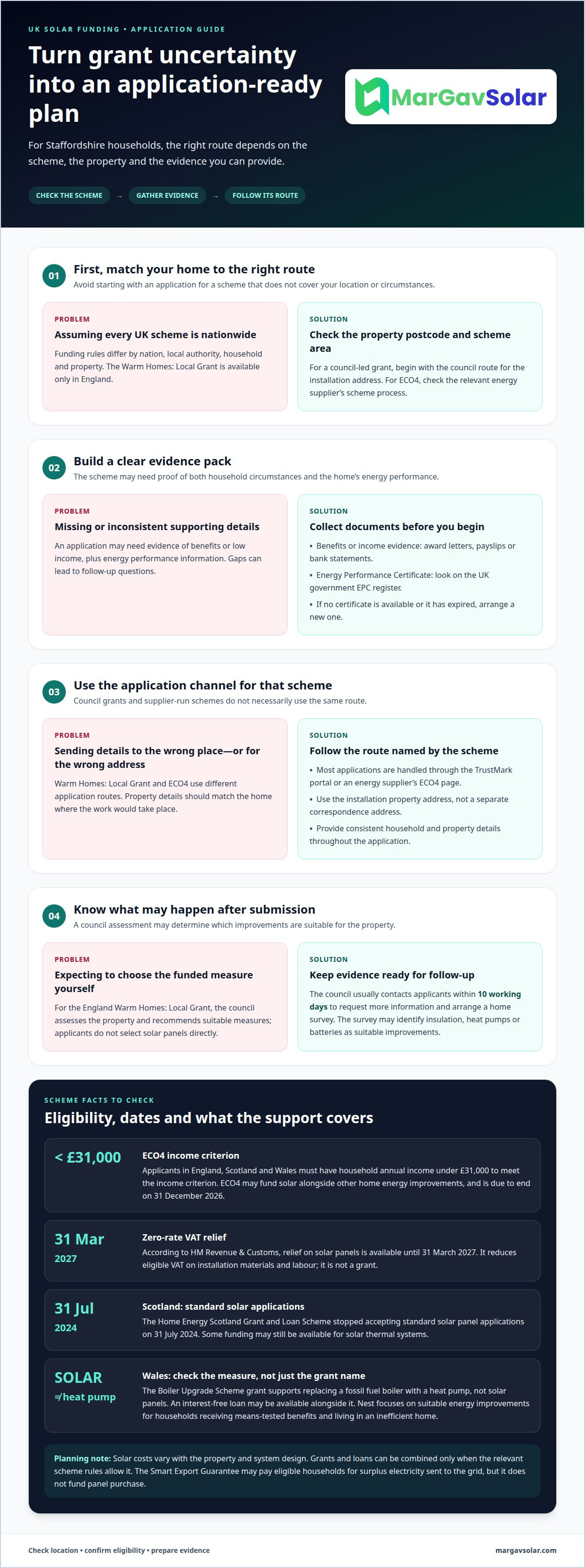
For Staffordshire households, knowing how to apply for a solar grant in the UK starts with identifying the right scheme and application channel. A council-led grant and an energy supplier’s ECO4 process use different portals and assessments.
Application and Postcode Checks
A postcode check identifies whether a home falls within a participating local authority’s area. This matters because council funding criteria vary, and the Warm Homes: Local Grant is available only in England. Start with the council’s application route for the property address. ECO4 applications can instead go through an energy supplier’s scheme page. For a Staffordshire household, the answer to how to apply for a solar grant in the UK depends on which scheme covers the home.
Application Documents and Evidence
An application may require evidence of benefits or low income, such as award letters, payslips or bank statements. These documents help show whether your household meets the scheme’s financial criteria. Energy performance evidence may also be needed. Find the home’s certificate on the UK government EPC register. If there is no certificate, or the existing one has expired, arrange a new one before relying on it in an application.
Most applications are handled through the TrustMark portal or an energy supplier’s ECO4 page. Follow the selected route’s prompts and provide consistent household and property details. Use the address where the proposed measures would be installed, rather than a separate correspondence address.
After an England Warm Homes: Local Grant application, the council usually contacts applicants within 10 working days to request more information and arrange a home survey. The council assesses the property and recommends suitable measures, rather than letting applicants select solar panels directly. The survey helps identify improvements suited to the home, potentially including insulation, heat pumps or batteries. Keep requested evidence together so you can respond clearly to follow-up questions about eligibility and property needs.
Regional grants in Scotland, Wales and Northern Ireland
Funding rules differ across the UK, and the nation where a home is located determines which regional route applies. Staffordshire is in England, where the Warm Homes: Local Grant is the relevant local-authority scheme.
For that grant, eligible households live in privately owned homes and have low incomes. The home usually needs an EPC rating of D, E, F or G, and the Department for Energy Security and Net Zero sets the usual income threshold at £36,000 a year or less. Councils assess the property and recommend suitable energy improvements, rather than allowing applicants to choose solar panels directly.
Scotland has a different route. The Home Energy Scotland Grant and Loan Scheme stopped accepting standard solar panel applications on 31 July 2024. Its loan can still support solar thermal panels, while separate home-efficiency support may cover other improvements, including heat pumps. Remote, rural or island households have a different maximum support level under the scheme.
In Wales, the Nest scheme supports households receiving means-tested benefits and living in inefficient homes. Eligible households can call 0808 808 2244. Homeowners may also access an interest-free loan alongside the Boiler Upgrade Scheme grant, which supports replacing a fossil fuel boiler with a heat pump. These routes focus on home energy improvements, not a general grant for solar PV.
Northern Ireland has distinct support, and ECO4 is unavailable there. Households may qualify for financial help with loft and cavity wall insulation, but this is not a solar panel grant. In private rentals, landlord permission matters for energy improvements; under England’s Warm Homes: Local Grant, landlords may also need to pay towards some work. The right route depends on the property’s location and the improvement needed.
For Staffordshire homes considering solar independently of regional grants, explore solar panel options to plan a suitable installation.
MarGav Solar
MarGav Solar can help you plan a solar installation for your home and consider how it fits your funding plans. After identifying the schemes relevant to your circumstances, you can discuss a practical project with the company’s consultancy and installation team. This may include residential solar PV, battery storage or an EV charging point, depending on your household’s energy needs. If you already have panels, MarGav Solar also provides maintenance and cleaning.
The relevant scheme or local authority decides grant eligibility and awards. MarGav Solar supports the solar project itself, from considering system requirements through to professional installation. Contact MarGav Solar to discuss your home and the next steps.
Turn your funding research into a practical next step
Once you understand how to apply for a solar grant in the UK, decide what you want your home energy system to achieve. Consider how your household uses electricity, whether storing energy is important and how solar fits your longer-term plans. These priorities can help shape a suitable approach, whether you’re planning an installation now or preparing for a future opportunity.
Eligibility and the improvements funded depend on the scheme and your household’s circumstances. If you’re ready to explore a solar project, MarGav Solar can help you consider options for your home and how they fit your needs.
Plan your next solar step with MarGav Solar, and move forward with a clearer idea of what could work for your property.
Frequently Asked Questions
How to Apply and Get Approved Without Delays?
Follow your scheme’s application route and keep the property details consistent throughout. Before submitting, check that document scans are readable and include every requested page, such as a complete benefit award letter or relevant payslip. If the council requests more information or a survey, respond promptly and keep your application reference handy. These steps can help avoid administrative delays.
What solar grants and funding schemes are available in the UK in 2026?
Options include the Warm Homes: Local Grant in England, ECO4, regional programmes and VAT relief. Zero-rate VAT relief on solar panels runs until 31 March 2027, according to HM Revenue & Customs. Scotland and Wales have separate support routes, while scheme eligibility and funded measures vary.
Can UK homeowners get grants for solar panels through local councils or regional schemes?
Eligible homeowners may access support through local-authority or nation-specific schemes, but the improvements covered depend on the programme. In England, councils administer the Warm Homes: Local Grant and assess the property before recommending work. You may qualify for home-efficiency support without being able to request solar panels specifically. For a Staffordshire home, the property’s council area determines the local application route.
Can I get a grant for solar panels if I rent or live in social housing?
Private tenants may qualify for ECO4 if the household meets the scheme criteria and the landlord gives permission for the work. Social housing follows a different route: the Warm Homes: Social Housing Fund supports social landlords upgrading tenants’ homes, including with measures such as solar panels. Tenants should establish whether their landlord is involved in an improvement programme, since the landlord, rather than an individual tenant, applies for that support.
What should I check before choosing a solar installer or applying for funding?
Check whether the scheme requires an MCS-certified installer or products, and whether the proposed work matches its eligible measures. For the Smart Export Guarantee, the system must be installed by an MCS-certified installer. If you also plan to receive export payments, check that the system and meter meet the scheme’s requirements. The MCS directory can help identify certified installers, and the application route may specify what evidence to provide.


