
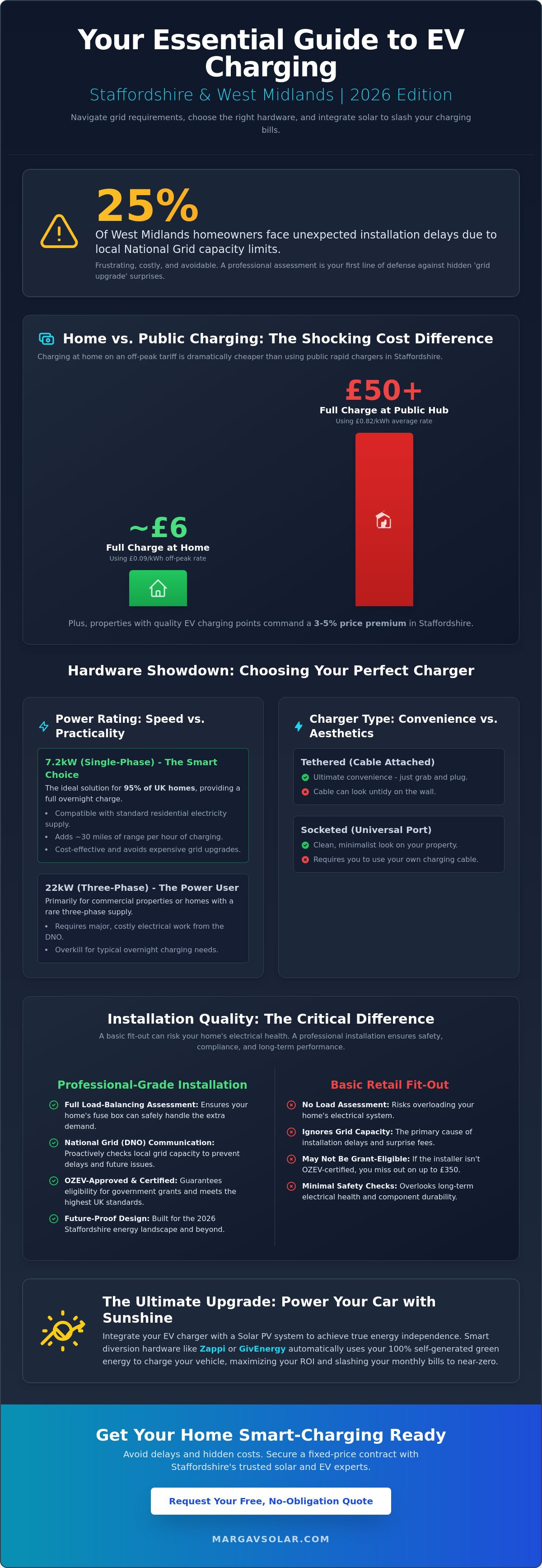
Did you know that nearly 25% of homeowners in the West Midlands face unexpected delays during EV charging point installations because they didn't account for National Grid’s local capacity limits? It's incredibly frustrating to invest in a new vehicle only to find your home’s infrastructure isn't ready for the leap. You likely feel the pressure of rising energy prices and the headache of choosing between a standard 7kW or a high-powered 22kW unit, all while wondering if your current fuse box will even cope with the extra demand.
We agree that you shouldn't have to be an electrical engineer just to fuel your car. You deserve a setup that's safe, legal, and doesn't drain your bank account every time you plug in. This guide will show you how to navigate the specific grid requirements in Staffordshire, select the right hardware for your needs, and integrate solar power to slash your monthly bills. We're breaking down the entire process to get your home smart-charging ready by the end of 2026, ensuring you benefit from the cheapest off-peak rates available today.
Key Takeaways
- Learn how to choose between 7.2kW and 22kW power ratings and determine whether tethered or socketed hardware best suits your Staffordshire driveway layout.
- Understand the essential role of the National Grid (DNO) in professional EV charging point installations to ensure your home system is safe and compliant.
- Discover how to power your vehicle with 100% self-generated green energy by integrating smart solar diversion hardware like Zappi or GivEnergy.
- Identify the key differences between a basic retail fit-out and a professional-grade installation designed for the 2026 Staffordshire energy landscape.
- Find out how to maximize your ROI and avoid hidden 'grid upgrade' surprises by securing fixed-price contracts with local energy experts.
The Landscape of EV Charging Point Installations in Staffordshire
Staffordshire's transition to electric mobility has reached a pivotal peak in 2026. Local data indicates that electric vehicle registrations across the county have climbed by 38% since 2024, stretching from the urban hubs of Stoke-on-Trent to the rural outskirts of the Staffordshire Moorlands. This surge has moved EV charging point installations from a niche home improvement to a fundamental utility. There is a sharp distinction between a professional installation and a standard retail fit-out. A professional service involves a full load-balancing assessment and earthing check, whereas a basic retail fit-out often overlooks the long-term health of your home's electrical system.
The county's diverse geography demands bespoke planning. A terraced property in Stafford requires different cable management and safety considerations than a detached farmhouse in Leek. An electric vehicle charging station must be tailored to the specific grid capacity of the street. Using OZEV-approved installers is still the only way to access the remaining UK government support. As of 2026, the EV chargepoint grant continues to provide up to £350 for eligible landlords and flat owners, making professional certification a financial necessity rather than a choice.
Why Home Installation Trumps Public Charging in the Midlands
Cost efficiency is the primary driver for home setups. Public rapid chargers in Stafford and Cannock currently average £0.82 per kWh. Conversely, Staffordshire residents using off-peak domestic tariffs can access rates as low as £0.09 per kWh. This means a full charge at home costs roughly £6, while the same energy at a public hub exceeds £50. The convenience of starting every morning with a full battery eliminates the need for weekly stops at service stations. Additionally, local property experts suggest that Staffordshire homes with high-quality EV charging point installations now command a 3% to 5% price premium over houses without them.
Understanding the 2026 UK Building Regulations (Part S)
Building Regulations Part S dictates the legal requirements for charging infrastructure in the UK. Every new residential development in Staffordshire must now include at least one 7kW charger per dwelling with a parking space. These regulations also trigger mandatory upgrades during major renovations if the project involves more than 10 parking bays. These rules ensure that the local grid can handle the increased load without causing brownouts in residential neighbourhoods.
Comparing EV Charger Hardware: Power, Plugs, and Smart Features
Choosing the right hardware for EV charging point installations involves more than just picking a brand name. You need to consider how the unit interacts with your home's electrical capacity and the Staffordshire weather. Most residential properties in areas like Lichfield or Stoke-on-Trent operate on a single-phase supply. This limits your charging speed to 7.2kW. While 22kW chargers exist, they require a three-phase connection. This upgrade often costs thousands of pounds and involves significant work from the local Distribution Network Operator. For 95% of drivers, a 7.2kW unit is the sweet spot. Hardware durability is another priority. Staffordshire's climate brings heavy rain and winter frosts, so your charger needs a high Ingress Protection (IP) rating. Look for units with an IP65 or IP66 rating. These ratings ensure the internal electronics remain dry and functional in driving rain. You also have to choose between tethered and socketed designs. Tethered units have the cable permanently attached. They're convenient for quick daily use. Socketed units require you to bring your own cable, but they look neater on the front of a house and offer more flexibility if you switch between different car brands. UK law now requires all new residential chargers to have "smart" functionality. This connectivity allows units to communicate with the grid and your energy provider. These domestic requirements align with broader national standards, such as the Public Charge Point Regulations 2023, which focus on transparency and reliability across the UK's charging network.7KW vs. 22kW: Which Speed Do You Actually Need?
The 22kW "fast charger" is often a myth for typical UK homes. Most Staffordshire houses don't have the three-phase power required to support that speed. A standard 7.2kW charger is perfectly adequate. It adds about 25 to 30 miles of range per hour. For a Tesla Model Y with a 75kWh battery, a full charge from 10% to 100% takes roughly 9.5 hours. A Kia EV6 takes a similar amount of time. Since most cars sit idle overnight, 7kW provides more than enough power to start every morning with a full battery.Smart Features That Save Money
Modern chargers do more than just deliver electricity; they manage your costs. By using app-based scheduling, you can set your car to charge only during off-peak hours. Many Staffordshire residents now use "EV tariffs" from providers like Octopus or OVO, where electricity prices drop significantly between 11 PM and 5 AM. Safety features like load balancing are also standard in high-quality hardware. This prevents the charger from drawing too much power when your oven, shower, and kettle are all running at once. Dynamic Load Management is a system that monitors the total electrical demand of a home and automatically adjusts the power sent to the EV charger to prevent overloading the main fuse. If you're unsure which hardware fits your specific driveway layout, you can request a technical site surveyThe Installation Process: Navigating the Staffordshire Power Grid
A typical installation day with MarGav Solar begins at 8:00 AM with a final site safety audit. Our engineers verify your domestic supply capacity and inspect your consumer unit to ensure it meets current electrical regulations. We secure the charging unit to your chosen location, then run the necessary cabling through internal cavities or external conduit. Every project concludes with a rigorous commissioning test and a digital handover. We walk you through the smartphone app so you can schedule charging during off-peak hours when electricity prices are lower. Safety is our priority, which is why we maintain full NICEIC and OZEV credentials. These certifications are non-negotiable for EV charging point installations. They ensure all work complies with BS 7671 standards, protecting your home insurance and vehicle warranty.
DNO Notifications and Applications
Staffordshire falls under the jurisdiction of National Grid Electricity Distribution (NGED). For most standard 7kW chargers, we follow the "Connect and Notify" protocol. This allows us to complete the installation and inform the DNO within 28 days. However, if your property has a "looped service," where your power line is shared with a neighbor, we must "Apply and Plan" before any work starts. This configuration is common in older terrace streets across Stafford and Newcastle-under-Lyme. MarGav Solar manages these technical applications on your behalf, coordinating directly with the DNO to ensure your fuse is upgraded if necessary. This proactive grid management aligns with the UK government's electric vehicle infrastructure strategy, which focuses on preparing local networks for the 2030 transition to electric transport.
Physical Installation Challenges in Rural Staffordshire
The geography of Staffordshire presents unique logistical hurdles for EV charging point installations. Properties in the Peak District or rural Lichfield often feature detached garages or gravel drives exceeding 30 meters in length. These setups require specific voltage drop calculations and the use of Steel Wire Armoured (SWA) cabling buried in trenches. We provide several solutions for these environments:
- Standalone Pedestals: Ideal for homes where the parking area is not adjacent to a structural wall.
- Groundworks: Professional trenching and reinstatement for long cable runs across gardens or driveways.
- Load Balancing: Smart hardware that prevents your home from drawing more power than the main fuse can handle.
Many homeowners choose to integrate their charger with a solar panel installation in Staffordshire. This allows you to divert excess green energy directly into your car battery, significantly reducing your carbon footprint. We specialize in configuring these hybrid systems to ensure your car charges primarily from your roof rather than the grid.
Maximising ROI: Integrating EV Charging with Staffordshire Solar PV Systems
The dream of driving on sunshine is a financial reality for Staffordshire residents in 2026. By linking your solar panels directly to your car, you bypass the National Grid and its associated costs. High-quality EV charging point installations act as the bridge between your roof and your wheels, allowing you to capture every spare kilowatt of green energy. Hardware such as the Myenergi Zappi or the GivEnergy EV charger is essential for this setup. These units communicate with your solar inverter to ensure that your car only takes power when your home's demand is met and your panels are producing a surplus.
The economic benefits are substantial. While a standalone solar array has a respectable payback period, adding an EV into the mix accelerates your return on investment. If you drive 10,000 miles a year, charging via solar can save you over £1,100 annually compared to standard grid tariffs. In Staffordshire, we see roughly 1,450 hours of sunshine per year. While December might only provide enough light for short local trips, the period from April to September offers a massive surplus. During these months, your EV charging point installations can often run entirely on self-generated power, effectively giving you free motoring for half the year.
How Solar Diversion Works
Solar diversion is the technology that prevents your green energy from being exported to the grid for a low "Smart Export Guarantee" (SEG) rate. Using "Eco" and "Eco+" modes, your charger monitors production in real-time. Eco+ mode is the gold standard; it pauses charging the moment a cloud passes over your Staffordshire home, resuming only when solar output exceeds 1.4kW. This precision is managed by CT clamps, which are small sensors clipped around your main incoming power cables. For a deeper look at how to manage these flows, you can explore the GivEnergy Cloud for detailed monitoring of your home's energy ecosystem.
Battery Storage as a Buffer
Staffordshire weather is famously unpredictable. A home battery acts as a vital buffer, catching solar energy during the morning and holding it until your car is plugged in during the afternoon. However, you should be strategic about battery health. We don't recommend frequently draining your home battery to 0% just to top up your car, as this can increase wear on the cells. It's often better to let the car take the "overflow" while the home battery maintains a reserve for your evening lights and appliances. The round-trip efficiency of solar-to-battery-to-EV charging typically sits around 85% to 90%, meaning you lose about 10% of your energy through heat and conversion during the process.
Ready to power your car with 100% clean, local energy? Contact our Staffordshire installation team for a custom solar and EV integration quote today.
Why MarGav Solar is the Trusted Choice for Staffordshire EV Installations
MarGav Solar has spent over two decades building a reputation as Staffordshire's premier energy specialists. Since 2004, our team has delivered thousands of renewable energy projects across the county. We understand that EV charging point installations are more than just plugging in a box; they're an investment in your home's infrastructure. Our local presence means we're familiar with the specific electrical grid constraints in towns like Stafford, Cannock, and Stoke-on-Trent.
Choosing a local provider means you aren't dealing with a faceless national call center. We manage everything in-house, from the initial site survey to long-term maintenance. Because we also specialize in solar panels and battery storage, we can synchronize your vehicle charging with your own green energy production. This holistic approach can reduce your charging costs to almost zero during peak summer months.
One major pain point for homeowners is the "hidden cost" of grid upgrades. Many installers quote a low price then add hundreds of pounds later when the Distribution Network Operator (DNO) requires a fuse upgrade. We provide fixed-price contracts. If your property needs a service cutout upgrade or a new consumer unit, we identify that during the initial survey. You'll never face an unexpected "grid upgrade fee" on installation day.
- 20+ Years Experience: Decades of expertise in the Staffordshire energy sector.
- Fixed-Price Guarantee: No hidden surprises or last-minute cost additions.
- Integrated Systems: One contractor for solar, batteries, and EV charging.
- Local Support: Rapid response times for maintenance across the Midlands.
Expert Consultancy Over Simple Sales
We don't just sell hardware; we engineer solutions. Our technical team evaluates your property's electrical load to ensure your new charger won't trip your main fuse when other appliances are running. This thorough assessment is vital for both residential and commercial clients aiming for maximum efficiency. For more detailed advice, read our EV Charging Points in Staffordshire: The 2026 Homeowner’s Guide.
Ready to Start Your Staffordshire Installation?
Getting started is straightforward. First, contact us with your MPAN (Meter Point Administration Number) and a clear photo of your fuse board. Second, we'll perform a remote or on-site technical survey. Third, we'll provide a comprehensive, fixed-price quote. This streamlined approach ensures your EV charging point installations are often completed within 14 days of your initial inquiry. Book your Staffordshire EV charging site survey today and secure your energy future.
Power Your Journey With Staffordshire Expertise
The road to 2026 demands a smarter approach to home energy. Successful EV charging point installations require more than just hardware; they need a seamless integration with the local power grid and your solar PV system. By pairing a smart charger with renewable energy, you can maximize your return on investment and reduce reliance on fluctuating utility prices. Choosing the right plug type and smart features today ensures your home remains compatible with the next generation of electric vehicles entering the UK market.
MarGav Solar brings 20+ years of Staffordshire experience to every project. As NICEIC Certified Installers and OZEV Approved specialists, we manage the entire process from technical assessment to grant claims. We've spent two decades helping local homeowners navigate the complexities of the regional energy landscape. Don't leave your installation to chance when you can work with proven local experts who understand the Staffordshire grid inside out.
Request a Fixed-Price EV Installation Quote from MarGav Solar
Take the first step toward cheaper, cleaner motoring today.
Frequently Asked Questions
Do I need planning permission for an EV charging point in Staffordshire?
You generally don't need planning permission for EV charging point installations in Staffordshire because they fall under permitted development rights. This applies if the charger is under 1.6 metres high for ground mounts or doesn't exceed 0.2 cubic metres on a wall. If your home is a listed building or sits within one of Stafford's 31 conservation areas, you must consult Stafford Borough Council before proceeding.
How much does a standard EV charging point installation cost in 2026?
A standard installation typically costs between £800 and £1,200 according to 2024 industry averages from Checkatrade. This price includes the unit and labour for a straightforward back-to-back setup. Factors like long cable runs over 10 metres or the need for groundworks will increase these figures. Smart features and tethered cables also add about £100 to the total cost of the project.
Can I install an EV charger myself to save money?
You can't install an EV charger yourself because it's a legal requirement under Part P of the Building Regulations to use a qualified electrician. Attempting a DIY install voids your warranty and might invalidate your home insurance. Professional installers must also notify the local Distribution Network Operator, which is National Grid Electricity Distribution for the Staffordshire area, to ensure the local grid can handle the load.
What happens if my home in Stafford has a looped supply?
National Grid Electricity Distribution must unloop your connection before an installer can finish the job if your Stafford home has a looped supply. This setup means your house shares a service cable with a neighbour, which can't handle the 32-amp load of a 7kW charger safely. National Grid usually performs this work for free, but it adds 4 to 12 weeks to your project timeline.
Will an EV charger work with my existing solar panels?
Your EV charger will work seamlessly with existing solar panels if you choose a model with solar matching capabilities. These units use CT clamps to monitor your generation and divert excess energy into your car rather than the grid. This allows you to charge for 0p per mile during peak daylight hours. It's a popular choice for the 1.3 million UK homes that already have solar PV installed.
How long does the actual physical installation take?
The physical process of EV charging point installations usually takes between 2 and 4 hours to complete. This includes mounting the unit, drilling through the external wall, and connecting to your consumer unit. If your fuse box is far from the driveway or requires a mini-consumer unit, the job might extend to a full day. Your installer will test the connection thoroughly before they leave your property.
Can I get a grant for EV charging point installations in Staffordshire?
You can access the OZEV EV Chargepoint Grant which provides up to £350 or 75% of the cost for eligible residents. This scheme is currently available to tenants, flat owners, and landlords across Staffordshire. While the grant for single-family homeowners ended in April 2022, small businesses can still claim up to £350 per socket through the Workplace Charging Scheme to support their electric vehicle fleet.
Is a 22kW charger worth the upgrade for a residential property?
A 22kW charger isn't worth the upgrade for most residential properties because it requires a three-phase electricity supply. Most Staffordshire homes run on a single-phase supply limited to 7kW charging speeds. Upgrading your house to three-phase can cost over £3,000, which doesn't provide a good return on investment when a standard 7kW unit adds 25 miles of range per hour while you sleep.


