
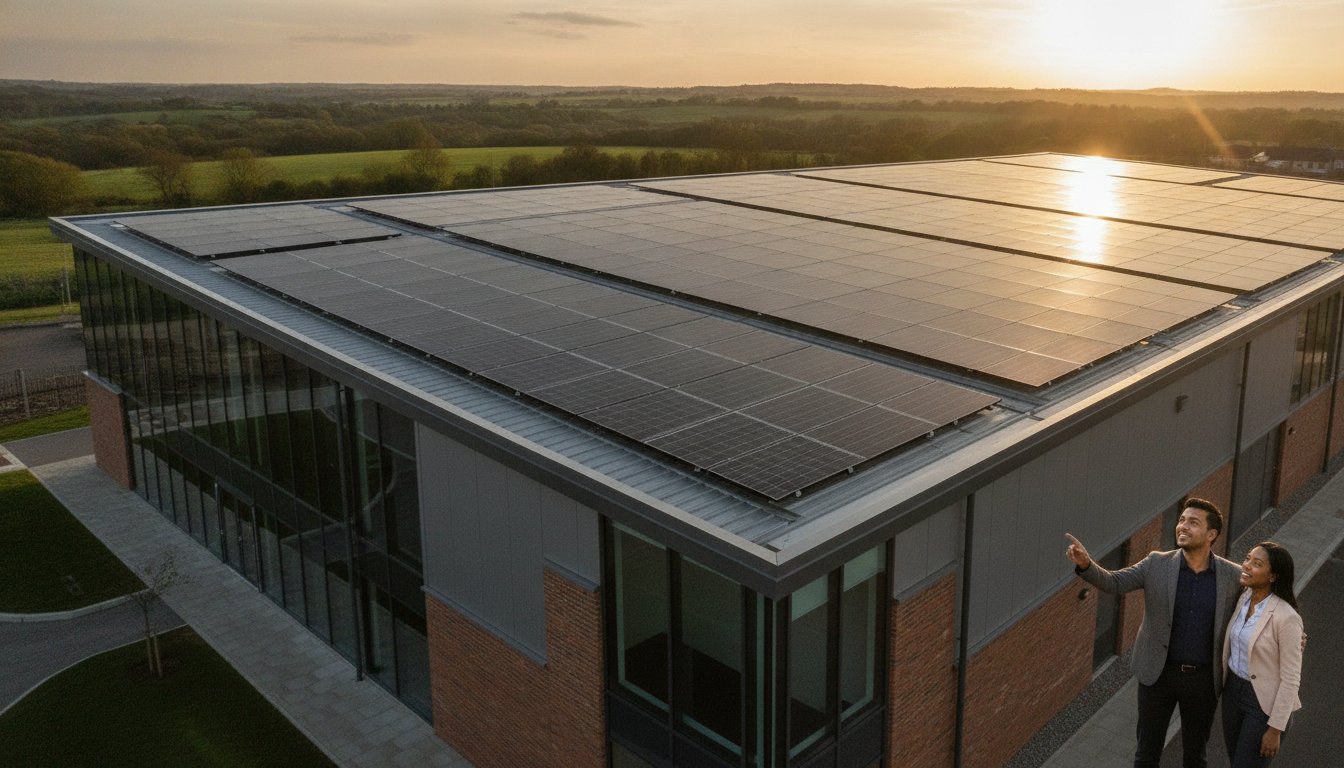
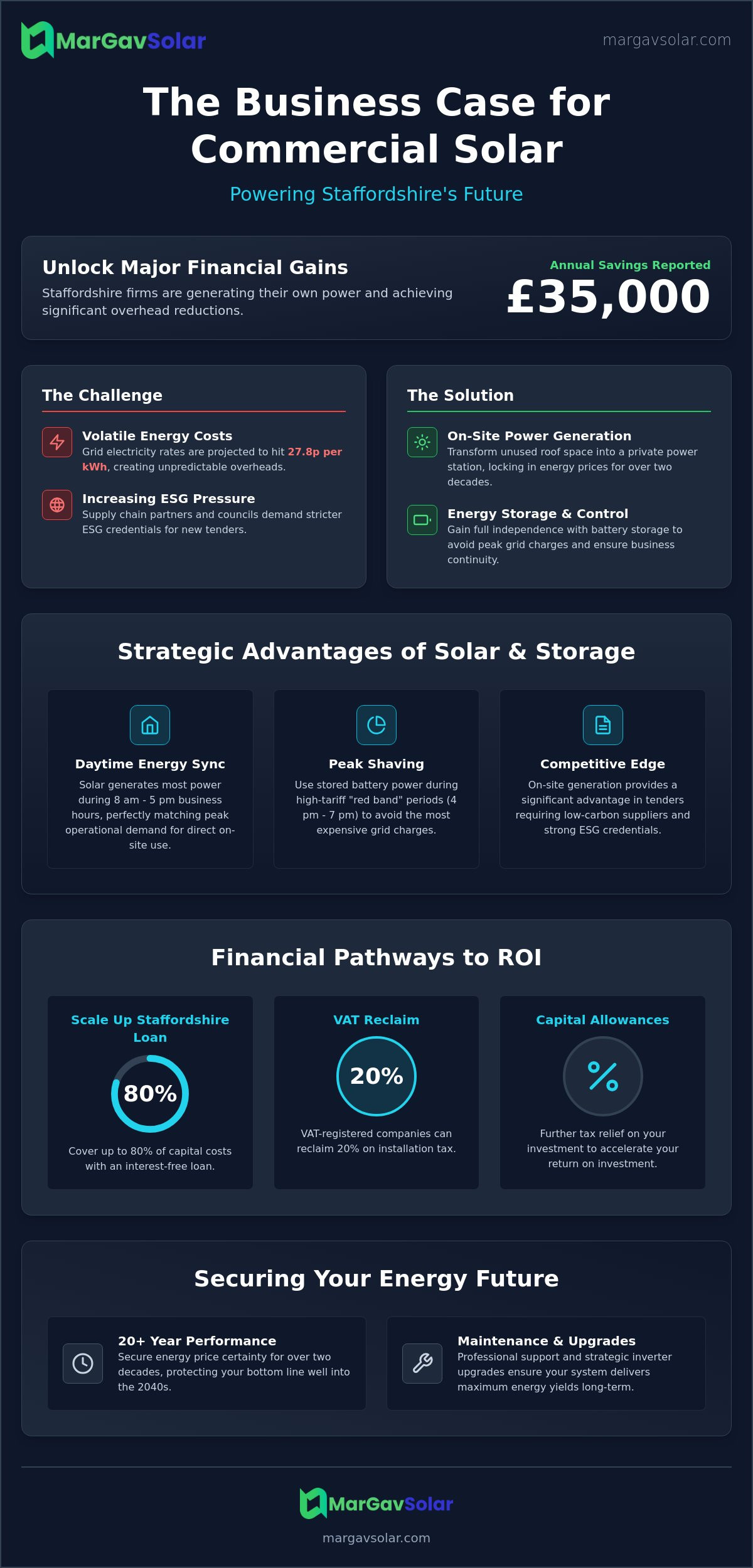
Did you know that some Staffordshire firms are saving £35,000 every year by generating their own power? With grid electricity rates for small businesses hitting 27.8p per kWh in July 2026, the most effective way to reduce business energy costs with solar Burton upon Trent is to stop relying on the volatile National Grid and start utilizing your own roof space. It's frustrating to watch overheads climb while supply chain partners demand stricter ESG credentials for every new tender.
We're here to help you navigate this transition with confidence. This guide outlines how Burton businesses are securing energy price certainty for over 20 years through strategic solar PV and battery storage. We'll explore the Scale Up Staffordshire interest-free loan which can cover up to 80% of your capital costs, explain how VAT-registered companies reclaim their 20% installation tax, and look at how smart export tariffs can turn your surplus energy into a new revenue stream. You'll gain a clear path to ROI that protects your bottom line well into the 2040s.
Key Takeaways
- Learn why large industrial roof spaces in areas like Centrum 100 are ideally suited to reduce business energy costs with solar Burton upon Trent.
- Understand how commercial battery storage enables "peak shaving" to avoid the most expensive grid charges during high-demand business hours.
- Discover the financial benefits of capital allowances and how to correctly navigate the 2026 VAT landscape for commercial installations.
- Gain clarity on the National Grid DNO application process, including the technical differences between G98 and G99 grid connections.
- See how professional maintenance and strategic inverter upgrades ensure your system delivers maximum energy yields for over 20 years.
The Business Case for Solar PV in Burton upon Trent
Commercial solar PV systems aren't just a "green extra" anymore. They are high-yield infrastructure projects designed specifically for the expansive roof spaces found across Burton's industrial heartlands. For a company operating out of a facility in Centrum 100 or the Albion Gateway, these systems transform an idle asset into a private power station. With one Staffordshire firm reporting annual savings of £35,000, the decision to reduce business energy costs with solar Burton upon Trent has shifted from an environmental goal to a core financial strategy.
Investing in solar also has a direct impact on commercial property attractiveness. Energy-efficient buildings with lower operational overheads often see improved valuations because they offer long-term cost stability to future tenants or buyers. As Solar power in the United Kingdom continues to grow, businesses without self-generation capabilities risk being left behind by more agile competitors who have already locked in their electricity rates for the next two decades.
Daytime Energy Synchronisation
The biggest advantage for businesses in Burton, particularly those in the manufacturing or retail sectors, is the alignment between solar production and operational hours. Unlike residential systems that often produce peak power while the owners are away, commercial solar generates electricity exactly when your machinery and lighting need it most. For a manufacturing plant in Staffordshire, the load profile typically spikes between 8 am and 5 pm. Direct Self-Consumption is the primary driver of commercial ROI because every unit of energy you generate and use on-site is a unit you don't have to buy from the grid at rates that can reach 27.8p per kWh.
This synchronisation is also a priority for technology-driven service industries. For example, audio-visual production specialists like NextGen AV require significant power to run high-end equipment, and adopting similar energy-efficiency strategies is key to maintaining competitive operational costs in any region.
ESG and Tendering Advantages in Staffordshire
The pressure to meet Environmental, Social, and Governance (ESG) targets is no longer restricted to huge corporations. Local councils and major contractors at sites like Dove Valley Park now prioritise low-carbon suppliers during the tendering process. If your business can demonstrate a clear path to Net Zero through on-site solar generation, you gain a significant competitive edge.
Beyond the boardroom, using solar to reduce business energy costs with solar Burton upon Trent serves as a visible marketing asset. Local brands can leverage these credentials to build trust with an eco-conscious public. It's a visible commitment to the local environment that protects your bottom line while enhancing your reputation in the Staffordshire business community.
Maximising ROI with Commercial Battery Storage
Integrating solar battery storage is the most effective way to gain full control over your energy overheads. While panels reduce your reliance on the grid during the day, batteries allow you to store that free energy for use during high-tariff periods. When you're looking to reduce business energy costs with solar Burton upon Trent, the battery acts as the brain of the operation. It specifically addresses the issue of "red band" charges. These are the premium rates applied by the Distribution Network Operator (DNO) during peak demand hours, usually between 4 pm and 7 pm. By discharging stored energy during these windows, a process known as peak shaving, you can avoid the most expensive electricity of the day.
Energy arbitrage offers another layer of financial protection. By charging batteries from the grid during low-cost overnight windows and using that power during the day, you create a buffer against price spikes. This isn't just about savings; it's about business continuity. In industrial zones where the grid might experience fluctuations or minor outages, a battery system acts as an uninterruptible power supply (UPS). This protects sensitive equipment and prevents data loss in office environments, ensuring that a local grid blip doesn't result in hours of downtime for your workforce.
Scaling Storage for Industrial Needs
Modern commercial systems are modular. You don't need to commit to a massive installation on day one. Many Burton businesses start with a manageable capacity and expand as their needs grow. Using advanced monitoring tools like the GivEnergy Cloud, facility managers can oversee energy flows across multiple sites from a single dashboard. This level of granular control ensures your inverter and storage setup are always performing at peak efficiency. It allows you to track exactly how much solar energy is being diverted to storage versus how much is being used by on-site machinery in real-time.
Smart Export and Revenue Generation
Surplus energy doesn't have to go to waste. Through the Smart Export Guarantee (SEG), your business can sell excess power back to the grid. In 2026, some Midlands suppliers are offering export rates as high as 25p per kWh, particularly for businesses that can manage their export during peak hours. Finding the right balance between self-consumption and export is key to reduce business energy costs with solar Burton upon Trent effectively. If you're unsure which setup fits your facility, you can explore our range of battery storage solutions to see how they integrate with your current infrastructure.
Financial Incentives and Tax Benefits for 2026
Investing in renewable infrastructure is a calculated financial move that significantly impacts your balance sheet. While residential users enjoy 0% VAT, commercial installations in July 2026 attract the standard 20% rate. However, most VAT-registered companies in Burton can reclaim this cost in full, effectively neutralising the tax burden. This tax transparency, combined with regional business energy efficiency grants and schemes, makes it easier than ever to reduce business energy costs with solar Burton upon Trent without draining your cash reserves.
Payback periods for these systems currently range between 3 and 10 years, depending on your operational profile. Offices often see the fastest return because their peak energy demand perfectly aligns with solar generation hours. Retailers, including digital brands like VapeMarley, benefit from consistent lighting and climate control loads, while large-scale warehouse operators in industrial zones leverage massive roof coverage to drive down the cost per installed kilowatt. For businesses looking for alternatives to outright purchase, Power Purchase Agreements (PPAs) allow you to host a system and buy the generated electricity at a lower rate than the grid, though this usually results in lower long-term savings compared to direct ownership.
The Full Expensing Regime
The UK's "Full Expensing" capital allowance is a powerful tool for Staffordshire SMEs. It allows companies to deduct 100% of the cost of qualifying plant and machinery from their taxable profits in the year of purchase. If your business makes a £60,000 investment in a solar PV system, you could potentially deduct that entire amount from your taxable profits in the first year, providing an immediate and substantial boost to your cash flow. We recommend consulting with your financial advisor to understand how this asset depreciation fits into your long-term tax strategy.
Smart Export Guarantee (SEG) for Burton Businesses
By March 2025, over 270,000 installations were signed up for SEG tariffs, representing a 63% increase year-on-year. To reduce business energy costs with solar Burton upon Trent, you should look for suppliers offering time-of-use export rates. In July 2026, some providers are offering up to 32.17p per kWh during peak evening windows. To qualify, your system must be installed by an MCS-certified professional and have a half-hourly export meter. Smaller systems under 50kW follow a simpler registration process, while larger commercial arrays may require more detailed grid connection agreements to facilitate high-volume exports.
Local businesses can also explore the Scale Up Staffordshire loan. This interest-free initiative covers 80% of capital improvements, including solar, for amounts between £5,000 and £100,000. It's an excellent way to bridge the gap between initial investment and the point of ROI.
Navigating DNO Applications and Local Regulations
One of the most critical steps to reduce business energy costs with solar Burton upon Trent involves securing permission from the Distribution Network Operator (DNO). In our region, this is National Grid Electricity Distribution. Unlike residential setups, commercial systems are almost always larger than the 3.68kW per phase threshold. This means you can't just "fit and forget"; you need formal consent before the installation begins. If your facility is located in a high-demand industrial hub like Centrum 100, the local substation might already be near its capacity. In these cases, we often look at export limitation or "G100" solutions to ensure your system doesn't overload the local grid while still providing maximum power for your own use.
Structural integrity is another factor that businesses sometimes overlook. Commercial roofs, especially older warehouse designs in the Albion Gateway area, must be assessed to ensure they can handle the dead weight of a large PV array and the additional wind loading. A professional survey is essential to confirm that your building's skeleton can support your energy goals for the next 25 years. If you're ready to start this process, you can get a professional grid assessment to see what's possible for your specific site.
The G99 Application Process
For any system exceeding 3.68kW per phase, a G99 application is mandatory. This is a detailed technical submission that outlines how your solar panels and inverters will interact with the National Grid. The process typically takes between 45 and 65 working days in Staffordshire, so it's vital to factor this into your project timeline. Using NICEIC-certified installers is a non-negotiable requirement here. They provide the necessary technical drawings and single-line diagrams that DNO engineers require to approve your connection.
Planning Permission for Commercial Solar
Most commercial solar installations fall under Permitted Development Rights, meaning you won't need full planning permission from East Staffordshire Borough Council. However, there are exceptions. If your business is based in a listed building or within one of Burton's conservation areas, you'll likely need to submit a formal application. Even under permitted development, there are height and boundary restrictions to follow. Modern systems often require a strategic inverter upgrade to ensure the system remains compliant with the latest grid-export control regulations, which is a key part of the council's building regulations approval process.
MarGav Solar: Your Local Partner for Commercial Energy
Choosing the right partner is just as important as the hardware itself. At MarGav Solar, we bring over 20 years of expertise to the Staffordshire renewable energy sector. We understand that a business in the heart of Burton faces different challenges than a residential property. Whether it's navigating the specific requirements of the local National Grid substations or understanding East Staffordshire Borough Council's planning nuances, our local presence ensures your project stays on track. We don't just sell panels. We provide a comprehensive strategy to reduce business energy costs with solar Burton upon Trent by designing systems around your actual consumption data.
Our approach begins with a detailed consultancy phase. We analyse your specific load profile to ensure the PV array and battery storage capacity are perfectly balanced. This customisation prevents the common mistake of over-specifying a system, which can delay your ROI, or under-specifying, which leaves you vulnerable to grid price spikes. By focusing on your facility's unique energy footprint, we ensure every kilowatt-hour generated works toward your bottom line. Being based near Burton allows us to offer faster response times and a deeper understanding of the local infrastructure than national providers.
Our Commercial Installation Standards
We believe in total transparency for our partners. That's why we operate with fixed-price contracts. For Burton business owners, this means the price you're quoted is the price you pay. There are no hidden fees or unexpected technical additions halfway through the build. We select high-efficiency hardware designed for commercial longevity, ensuring your investment remains productive for decades. Every installation adheres to strict NICEIC and MCS standards. This provides the safety and compliance documentation required for commercial insurance and building regulations.
Long-term Support and Maintenance
A commercial solar system is a 25-year asset, but it requires professional care to maintain its peak efficiency. Dust, debris, and local environmental factors in industrial zones can slowly degrade performance if left unchecked. We provide long-term maintenance and cleaning services to ensure your system continues to deliver the highest possible yields. Regular technical inspections help identify potential issues with components like inverters before they lead to system downtime.
Our remote monitoring services allow us to track your system's output in real-time. If an inverter requires attention or a string of panels isn't performing as expected, we can often identify the issue before it significantly impacts your savings. This proactive approach is essential for any company aiming to reduce business energy costs with solar Burton upon Trent reliably. If you're ready to secure your energy future, you can contact MarGav Solar for a free commercial energy assessment today.
Take Control of Your Operational Overheads
Transitioning to self-generation is no longer just a sustainability goal; it's a vital financial hedge. By combining high-yield PV arrays with modular battery storage, you can effectively reduce business energy costs with solar Burton upon Trent while shielding your company from the next decade of grid volatility. We've seen how the combination of capital allowances, interest-free Staffordshire loans, and smart export tariffs can transform your roof into a high-performing asset that pays for itself in record time.
MarGav Solar is your dedicated Staffordshire-based team with over 20 years of industry experience. As NICEIC and MCS Certified specialists, we offer fixed-price installation contracts that ensure your project is delivered with absolute budget certainty. Our local knowledge of the National Grid requirements in Burton means we handle the technical complexities so you can focus on running your business. Don't let rising energy rates dictate your profit margins for another year.
Ready to see the data for your specific site? Request a Free Commercial Solar ROI Assessment today and discover how quickly your facility can achieve energy independence. Your path to a more resilient, low-carbon business starts here.
Frequently Asked Questions
Do I need planning permission for commercial solar panels in Burton upon Trent?
Generally, you won't need planning permission because most commercial solar installations fall under Permitted Development Rights. However, you'll need to submit a formal application to East Staffordshire Borough Council if your business is located in a listed building or a conservation area. It's best to verify these details early to ensure your project complies with local height and boundary restrictions.
How long is the typical payback period for a business solar installation in 2026?
The typical payback period for a commercial system in July 2026 ranges between 3 and 10 years. This timeline is heavily influenced by your daytime energy demand and the current grid rates, which reached 27.8p per kWh for small businesses this year. High-consumption sectors like manufacturing often see the fastest return on investment due to their high self-consumption rates.
What is a G99 application and why does my business need one?
A G99 application is a technical request for permission to connect a power-generating system to the National Grid. It's mandatory for any commercial solar setup exceeding 3.68kW per phase. This process is vital for maintaining local grid stability and ensures that your installation won't cause safety issues for the wider network in Staffordshire industrial zones.
Can solar panels power my business during a grid power cut?
Standard solar installations will automatically shut down during a power cut to protect engineers working on the lines. To keep your business running, you'll need to integrate a battery storage system with backup or "islanding" capabilities. This allows your facility to operate independently from the grid, using stored energy to power critical machinery and IT systems.
Is my commercial roof in Burton suitable for a large solar array?
Most industrial and office roofs in Burton are suitable, but a professional structural survey is a non-negotiable first step. We assess the orientation, pitch, and load-bearing capacity of your roof to ensure it can safely handle the weight of the panels and additional wind pressure. This is particularly important for older warehouse structures in areas like the Albion Gateway.
How does battery storage help with "Peak Shaving" for industrial units?
Battery storage allows you to discharge stored energy during "red band" periods when grid electricity is at its most expensive. This process, known as peak shaving, is a strategic way to reduce business energy costs with solar Burton upon Trent by avoiding high-tariff windows between 4 pm and 7 pm. It flattens your demand profile and protects your bottom line from daily price spikes.
Are there any specific grants for businesses in Staffordshire for solar energy?
Businesses can currently access the Scale Up Staffordshire loan, which offers interest-free funding for capital improvements. This scheme covers 80% of the costs for energy efficiency upgrades, with loan amounts available between £5,000 and £100,000. It's an excellent financial tool for SMEs looking to reduce business energy costs with solar Burton upon Trent while preserving their cash flow.
How often do commercial solar panels need maintenance and cleaning?
We recommend a professional technical inspection and cleaning at least once per year to maintain peak performance. In industrial areas where dust or bird droppings are more prevalent, bi-annual cleaning may be necessary to prevent shading losses. Regular maintenance also includes checking your inverter's health and ensuring all electrical connections remain secure and efficient.


