
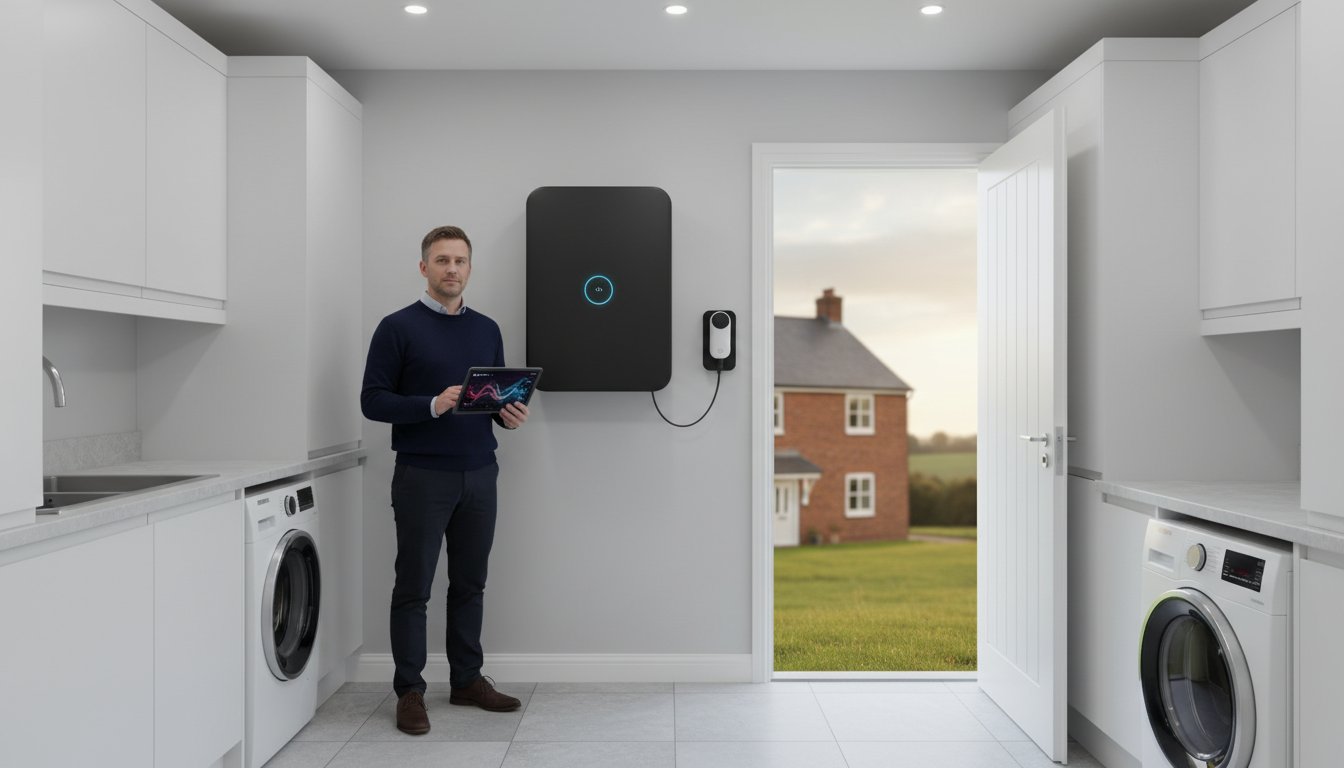
What if you could stop checking the National Grid status every time a storm hits the Potteries and instead watch your energy meter stand perfectly still? You aren't alone in feeling frustrated by UK electricity prices that remain roughly 50% higher than 2021 levels, making every peak-hour load of laundry feel like a financial penalty. It's often confusing to weigh up modular setups against All-in-One units, especially when you're worried about how they'll play with the specific grid infrastructure across Staffordshire.
This 2026 guide is designed to help you master the selection and setup of a giv energy battery system to slash your energy bills and achieve total power independence. You'll learn how to store cheap, off-peak electricity and keep your lights on during local outages without any complex guesswork. We'll explore the best configurations for West Midlands homes and show you exactly how to integrate your storage with smart tariffs like Octopus Energy to maximize your return on investment.
Key Takeaways
- Understand how Staffordshire’s specific climate makes energy storage essential for capturing maximum solar yield and achieving home power independence.
- Compare the high-performance All-in-One system against modular options to find the ideal giv energy battery configuration for your household needs.
- Master the calculation steps to size your system correctly, balancing your annual electricity consumption with your roof’s solar generation potential.
- Learn to leverage the GivEnergy Portal and smart tariffs to automate charging during off-peak windows for significant bill savings.
- Navigate the UK’s regulatory landscape, including MCS certification and National Grid G98/G99 applications, for a seamless professional installation.
Why Staffordshire Homeowners are Switching to GivEnergy Battery Storage
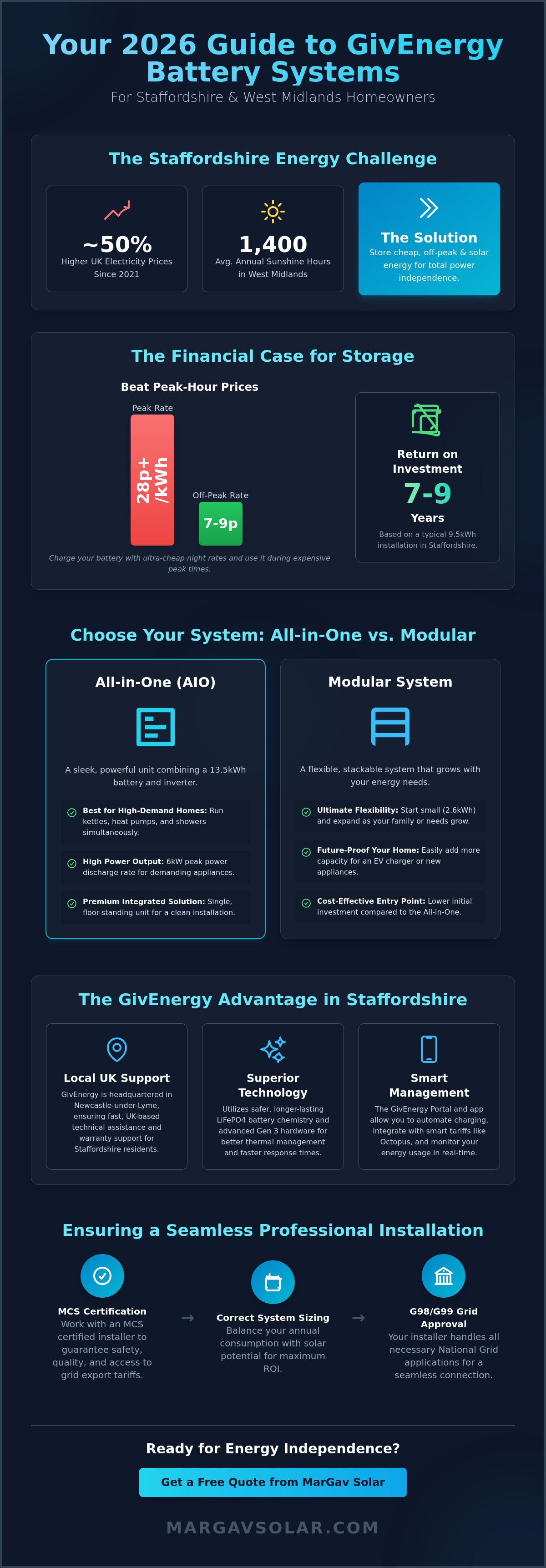
Staffordshire residents face a specific energy challenge. With an average of 1,350 to 1,450 sunshine hours per year in the West Midlands, maximizing solar yield is difficult without a way to save power for later. A giv energy battery uses Lithium Iron Phosphate (LiFePO4) technology to capture excess solar generation during the day or cheap off-peak electricity overnight. This chemistry is safer and lasts longer than traditional lithium-ion alternatives, making it a staple for modern British homes. Achieving energy independence in Stafford, Stoke-on-Trent, or the surrounding villages means reducing reliance on the National Grid. By integrating home energy storage systems, households can run their appliances on stored green power even during cloudy Midlands days. The GivEnergy ecosystem creates a seamless loop between the hardware and the homeowner. It consists of high-performance inverters, scalable batteries, and a smart portal that allows for real-time monitoring. You can automate your energy usage to ensure you never pay peak prices again.The Financial Case for Storage in the UK 2026
In 2026, the price gap between peak daytime rates and off-peak "smart" tariffs in the West Midlands remains a primary driver for adoption. Many local residents now utilize tariffs that offer electricity for as little as 7p to 9p per kWh during night hours, while daytime peak rates often exceed 28p per kWh. A battery protects you against the price volatility that has characterized the UK energy market over the last five years. Based on current energy export and import data, a typical Staffordshire 9.5kWh installation achieves a full return on investment through energy savings within a seven to nine year period.GivEnergy vs. Other Brands: Why We Recommend It Locally
While the Tesla Powerwall is a well-known name, it offers a fixed-capacity approach that doesn't suit every household. The giv energy battery provides modular flexibility. This means you can start with a smaller 5.2kWh unit and add more capacity as your family grows or if you install an electric vehicle charger. Local support is another deciding factor. Since GivEnergy is headquartered in Newcastle-under-Lyme, Staffordshire residents benefit from UK-based technical assistance and faster warranty responses than they would with brands based overseas. This proximity ensures that software updates and hardware support are tailored specifically to the UK grid. You can find a deeper breakdown of these features in our GivEnergy batteries guide.- Modular Design: Expand your storage from 2.6kWh up to 13.5kWh and beyond.
- UK Support: Direct access to Newcastle-under-Lyme based engineers.
- Smart Management: Use the GivEnergy app to force-charge during cheap windows.
Comparing the GivEnergy Range: All-in-One vs. Modular Systems
Selecting the right giv energy battery involves choosing between a sleek, integrated unit or a flexible, stackable system. The hardware has evolved through three distinct generations. While Gen 1 and Gen 2 systems laid the groundwork for domestic storage, the Gen 3 hardware available in 2026 offers superior thermal management and faster communication speeds. This evolution ensures that your system can handle the rapid fluctuations of UK solar generation, even on a cloudy afternoon in the West Midlands.
The primary choice for Staffordshire homeowners is between the All-in-One (AIO) and the modular LiFePO4 battery series. Your decision will likely depend on your daily energy consumption, your peak power requirements, and the physical space available in your garage or utility room. Because these systems integrate directly into your home's electrical grid, it's vital to work with an installer registered with the Microgeneration Certification Scheme (MCS). This certification ensures the installation meets national safety standards and allows you to access certain grid export tariffs.
The All-in-One: Best for High-Demand Staffordshire Homes
The GivEnergy All-in-One is a premium solution that combines a powerful inverter and a 13.5kWh battery into a single, floor-standing unit. It's specifically designed for households with high electricity needs. With a 6kW peak power discharge rate, it can comfortably run power-hungry appliances like electric showers, kettles, and heat pumps simultaneously without needing to draw expensive electricity from the grid.
In a typical Stafford semi-detached home, the AIO is often installed in a garage due to its larger footprint. It includes the Giv-Gateway, which provides whole-home backup. If there's a local power cut, the system switches to battery power in less than 20 milliseconds, keeping your lights and essential appliances running without interruption.
Modular Batteries: Scaling Your Storage as Your Family Grows
Modular systems offer a more tailored approach. You can choose from 2.6kWh, 5.2kWh, or the high-capacity 9.5kWh units. These are ideal if you have limited space or want to start with a smaller investment. The 9.5kWh units are particularly popular because they are stackable. You can combine multiple units to create a massive storage bank of 19kWh or even 47.5kWh for larger rural properties.
One major advantage of this range is the ability to add capacity later. If you install an electric vehicle charger or a heat pump in two years, you can simply add another battery pack to your existing stack. You should avoid mixing different battery sizes, such as a 2.6kWh with a 9.5kWh, to maintain system efficiency. If you're trying to decide which configuration fits your home's layout, you can request a home energy assessment to see a custom design. Most modular units are compact enough to be wall-mounted in a utility room, keeping the floor clear for other storage.
How to Size Your GivEnergy Battery for Maximum ROI in Staffordshire
Selecting the right capacity for your energy storage system is the difference between a 7-year and a 12-year payback period. You don't want to pay for capacity you'll never fill, but an undersized system will leave you buying expensive peak-rate power from the grid. Follow these four steps to find your ideal fit.
Step 1: Analyse your annual consumption. Gather your electricity bills from the last 12 months. Note the total kWh used. A typical UK home uses about 2,700 kWh to 3,500 kWh annually, but Staffordshire homes with older insulation or larger footprints often exceed 4,500 kWh.
Step 2: Calculate solar yield. Your roof orientation in Staffordshire dictates how much "free" energy you can store. A south-facing roof in Stafford might generate 950 kWh per kWp installed, while a west-facing array in the windy Moorlands might produce slightly less. This determines how quickly you can charge your giv energy battery during daylight hours.
Step 3: Determine your baseload. This is the power your home sips while you sleep. It includes your fridge, freezer, and devices on standby. Understanding how battery storage works to cover this constant drain is vital. If your baseload is 0.5kW, you'll need 4kWh just to get through an 8-hour night before even considering your morning kettle.
Step 4: Match to evening usage. Most families use 60 percent of their energy between 5 PM and 11 PM. Your battery should be large enough to cover this peak without relying on the grid.
Example Sizing for Staffordshire Property Types
For a standard 3-bed semi-detached home in Stafford, the 9.5kWh giv energy battery is frequently the "sweet spot". It offers enough depth of discharge to power a full evening of cooking and laundry. Larger detached homes in Stone with high occupancy typically require 13.5kWh or even 19kWh capacities to remain self-sufficient. Conversely, small terraced houses with lower demand can utilise the 5.2kWh modular units. These are excellent for space-saving efficiency in tight utility rooms.
Future-Proofing for EV Charging and Heat Pumps
Your 2026 energy profile will likely look different than it does today. If you're planning to install EV charging points in Staffordshire, your battery needs will spike. A single EV charge can require 40kWh to 70kWh, far exceeding a standard home battery. However, a well-sized system can "buffer" the load or discharge during expensive periods to save costs. Similarly, heat pumps shift your heavy usage to winter months when solar generation is lowest. In these cases, we recommend slightly oversizing your storage to take advantage of cheap overnight off-peak tariffs.
Smart Integration: Linking Your Battery with Solar, EV, and Agile Tariffs
Installing a giv energy battery transforms your home from a passive consumer into an active participant in the energy market. The true value lies in the GivEnergy Portal, which provides a live dashboard of every watt flowing through your property. You can monitor solar generation, house load, and battery health in real-time, allowing you to identify exactly where your energy goes. It's not just about watching numbers; it's about control.
Automation is the key to massive savings. By linking your system with smart tariffs like Octopus Agile or Flux, your home becomes an algorithmic money-saver. In 2024, price gaps between off-peak and peak rates remain significant. You can automate your system to fill your storage at 7p/kWh during the night and use that power during the evening peak when grid prices often hit 30p/kWh. This 23p per unit difference can save a typical Staffordshire family hundreds of pounds every year. The GivEnergy Cloud handles these updates remotely, ensuring your system always runs on the most efficient logic without you lifting a finger.
Maximising the GivEnergy Cloud
The cloud interface allows you to set precise 'Timed Charge' and 'Timed Discharge' windows. This is vital for winter months when solar yield is lower. You can also enable weather forecasting features. If the system sees a 90% chance of clear skies over Stafford, it will intelligently hold back battery capacity to leave room for free solar energy rather than filling up on grid power. To master these settings, check out our GivEnergy Cloud guide.
Smart Home Synergy: EV Chargers and Inverters
Your giv energy battery works best when it talks to your other high-drain devices. The GivEnergy EV charger communicates directly with your inverter to prevent your car from accidentally draining your home battery. It ensures the car only takes excess solar or cheap off-peak grid power. You'll also need to ensure your inverter throughput matches your needs; a 5kW rating is usually the sweet spot for handling domestic loads while charging. You can even set up 'Solar Diversion' to send surplus electricity to your immersion heater, effectively turning your hot water tank into a second battery.
Ready to automate your home energy and slash your monthly bills? Contact our Staffordshire installation team for a custom system design.
Professional GivEnergy Installation in Staffordshire: The MarGav Solar Process
Choosing a giv energy battery is a significant step toward energy independence, but the hardware is only as reliable as its installation. MarGav Solar brings 20 years of electrical expertise to every Staffordshire home, ensuring your system meets the highest safety standards. We maintain full MCS and NICEIC certifications, which are mandatory for UK homeowners. Without these, you cannot access the Smart Export Guarantee (SEG) to get paid for excess energy, and your home insurance might be voided in the event of a claim.
Our team manages the entire technical process with the National Grid (formerly Western Power Distribution) across Stafford and the wider Midlands. Most domestic installations require a G98 application for systems under 3.68kW, but larger GivEnergy setups often need G99 prior approval. We handle these complex filings to ensure your system remains compliant with local grid constraints. This professional oversight protects your 10 to 12 year GivEnergy warranty, as the manufacturer requires commissioning by certified experts to keep the guarantee valid.
The Local Installation Journey
The process begins with a detailed home survey. We don't just look at your roof; we inspect your consumer unit and identify the most efficient cable runs to minimize disruption. On installation day, our engineers arrive at your Stafford property with all components ready for a clean, one day setup. We prioritize a tidy workspace and finish with a comprehensive handover. We don't leave until your giv energy battery is synced with the mobile app, showing you exactly how much you're saving in real time.
Why Local Expertise Matters in the Midlands
Staffordshire has unique grid characteristics, particularly in rural pockets where infrastructure capacity varies. Our deep knowledge of local District Network Operator (DNO) requirements means we anticipate hurdles before they cause delays. Because we're based in the Midlands, we offer rapid response times for system optimisations or maintenance. While national firms might take weeks to visit for a simple check, our local presence ensures your system runs at peak efficiency year round. Regular maintenance, including firmware updates and physical terminal checks, extends the lifespan of your investment well beyond the first decade.
Book your Staffordshire home solar survey with MarGav Solar today to secure your energy future with a team that knows the local landscape.
Take Control of Your Staffordshire Energy Future
Investing in a giv energy battery transforms how you power your home. By 2026, smart tariffs and storage are essential tools to shield your household from fluctuating grid prices. You've seen how choosing between modular and all-in-one systems depends on your specific daily kilowatt-hour usage and future EV plans. Correct sizing isn't just about capacity; it's about ensuring your return on investment through intelligent discharge during peak hours.
MarGav Solar provides over 20 years of renewable energy expertise right here in Staffordshire. As NICEIC and MCS certified installers, we guarantee your system meets every UK safety and performance standard. Our 5-star reputation for maintenance and aftercare ensures your investment stays protected for years to come. It's time to stop sending your excess solar power back to the grid for pennies and start using it when you need it most.
Request a Free GivEnergy Installation Quote for Your Staffordshire Home
Your journey toward energy independence starts with a single smart choice. We're ready to help you build a more sustainable, cost-effective home today.
Frequently Asked Questions
Is a GivEnergy battery worth it without solar panels?
Yes, a giv energy battery provides value without solar panels by leveraging off-peak energy tariffs. You can charge the unit at night when electricity costs are often 50% lower than daytime peak rates. This strategy allows Staffordshire residents to power their homes during the day using stored, cheaper energy. It's an effective way to reduce annual bills by roughly £400 based on 2024 market data.
How long does a GivEnergy battery last in a typical UK home?
A GivEnergy battery typically lasts between 10 and 15 years in a standard UK household. The manufacturer provides a 10 year warranty or a throughput guarantee of 10,000 cycles for their latest lithium iron phosphate models. Because most homes complete one full cycle per day, the battery maintains 80% of its original capacity after a decade of constant use.
Can I install a GivEnergy battery myself to save on costs?
You cannot legally or safely install a battery system yourself because it involves high-voltage DC wiring and grid connection. UK law requires a qualified electrician to sign off the installation under Part P of the Building Regulations. Without an MCS-certified installer or a G99 application to the local DNO, you won't qualify for the 10 year warranty or any export payments.
What happens to my GivEnergy battery during a power cut in Staffordshire?
Your home stays powered during a grid failure if your installer includes an Emergency Power Supply (EPS) circuit. This feature switches the giv energy battery to backup mode in less than 20 milliseconds. In Staffordshire, where winter storms can cause local outages, this ensures essential appliances like lights and refrigerators keep running. It won't power heavy loads like electric showers unless you install multiple units.
Do I need to upgrade my fuse box (consumer unit) for a battery installation?
You don't necessarily need a full consumer unit upgrade if your current board meets BS 7671 18th Edition standards. An electrician will check for spare ways and proper RCD protection to ensure the new circuit is safe. If your fuse box is more than 20 years old, a replacement might be required to handle the bidirectional flow of electricity safely.
How much space does a GivEnergy 9.5kWh battery actually take up?
The GivEnergy 9.5kWh battery occupies a footprint of 480mm in width, 626mm in height, and 220mm in depth. It weighs approximately 110kg, so it requires a solid floor or a load-bearing wall for mounting. Its slim profile means it fits comfortably in garages, utility rooms, or even under-stairs cupboards where at least 100mm of clearance is available on all sides for ventilation.
Can GivEnergy batteries be installed outside in the Staffordshire weather?
GivEnergy batteries are suitable for outdoor installation because they carry an IP65 ingress protection rating. This means the casing is completely dust-tight and protected against rain or low-pressure water jets. While they operate between -20°C and 50°C, installing them in a sheltered spot protects the finish from the 800mm of average annual rainfall seen in Staffordshire.
Does adding a battery affect my existing SEG (Smart Export Guarantee) payments?
Adding a battery doesn't cancel your Smart Export Guarantee (SEG) contract, but it reduces the volume of energy you send back to the grid. You'll use more of your generated solar power internally, which is more cost-effective than exporting it for the 5p to 15p per kWh currently offered by UK suppliers. Your total SEG payments will decrease because your self-consumption percentage increases.


