

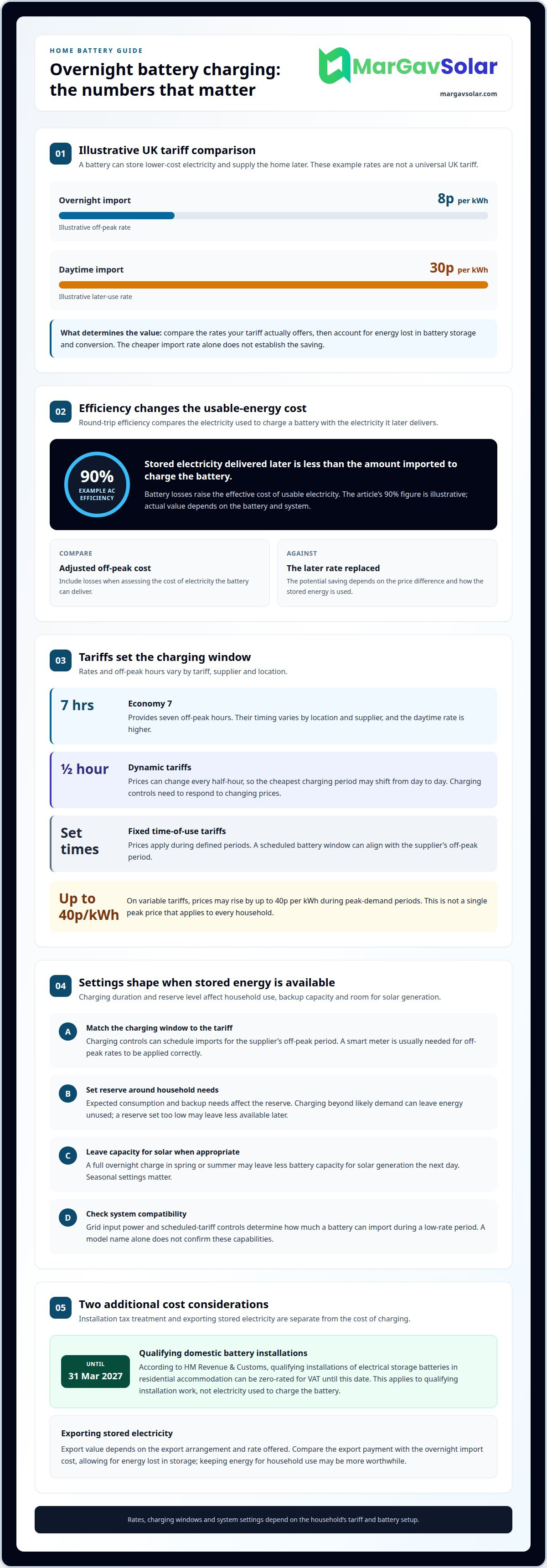
Yes, a home battery can be set to charge from the grid overnight and power your home later, when electricity rates are higher. In an illustrative UK tariff comparison, the overnight rate is 8p per kWh and the daytime rate is 30p per kWh. The difference between your rates matters, but so do battery losses and the amount of electricity your household uses.
It’s natural to ask whether a cheaper overnight rate will lower your bill. Charging a battery from the grid overnight can shift some electricity use away from peak periods, but the savings depend on your tariff and battery settings. A smart meter is usually needed for a supplier to apply off-peak rates correctly. This guide explains how overnight charging works, what affects its cost and when it may complement solar generation. Seasonal settings matter too: an overnight charge may leave less capacity for solar power the next day.
Key Takeaways
- Compare the full off-peak and daytime tariff structure: Economy 7 provides seven off-peak hours, but their timing varies by location and supplier.
- Factor in round-trip efficiency when weighing savings, because the electricity delivered from a battery is less than the amount imported to charge it.
- Use battery charge windows and reserve levels that suit your household’s needs rather than assuming a full charge every night is best.
- Qualifying installations of electrical storage batteries in residential accommodation can be zero-rated for VAT until 31 March 2027, according to HM Revenue & Customs.
Can You Charge a Solar Battery From the Grid?
Yes. A compatible home battery can charge from the grid during cheaper periods and supply electricity later, when rates are higher.
Off-Peak Tariffs for Battery Charging
An off-peak tariff offers cheaper electricity during set periods, which a battery can store for later use. The saving depends on the gap between your import rates and the battery’s energy losses. For example, an illustrative tariff comparison uses 8p per kWh overnight and 30p per kWh during the day. Charging in the cheaper period may lower the cost of electricity used the following morning.
Battery controls can schedule charging to match the tariff window, while leaving room for solar generation. For a Sunpura S2400, the relevant specifications are its grid input power and whether its controls support scheduled tariff periods. Those details affect how much electricity it can take during a low-rate window; the model name alone doesn’t establish either capability.
Fixed, Dynamic, and Economy 7 Tariffs
A fixed time-of-use tariff sets prices for defined periods, while a dynamic tariff changes rates with market conditions. Dynamic electricity prices can change every half-hour, so the cheapest charging window may shift from day to day. Economy 7 provides seven off-peak hours, but their timing varies by location and supplier, and its daytime rate is higher.
These tariff differences affect when a battery should charge. A fixed overnight window can suit a set schedule; dynamic rates require controls that respond to changing prices. Economy 7 users need to match their battery’s charging period to the hours assigned by their supplier, rather than assuming every household has the same overnight window.
Grid Charging Rules and Electricity Rates
For household grid charging, you need a compatible battery system, a tariff with suitable off-peak periods and the supplier’s charging times. A smart meter is usually needed for the supplier to apply off-peak rates correctly. Tariff terms determine the actual window and rate, so there is no single UK schedule that applies to every household.
There’s no single current UK off-peak or peak price for all homes. As illustrative figures, 8p per kWh overnight and 30p per kWh during the day show how a rate difference can create a charging opportunity. On variable tariffs, prices may rise by up to 40p per kWh during peak-demand periods. Compare the rates and charging windows that apply to your own tariff.
Charging a home battery from the electricity grid overnight
A home battery can store cheaper overnight electricity for use around the house later. The value depends on the charging schedule, reserve setting and export arrangement.
Setting Battery Charging Windows
Charging windows are the programmed periods when a battery imports electricity under your tariff. Set them to match the off-peak period to avoid charging at more expensive times.
For example, schedule charging only within the supplier’s off-peak window and keep a reserve for evening use. Set that reserve according to expected consumption and whether you need backup power. Charging beyond your household’s likely demand can leave energy unused, while setting the reserve too low may leave less available later.
Shifting Electricity Use for Grid Balancing
Shifting electricity use means drawing on stored energy during busier periods instead of importing electricity then. This can reduce your household’s grid demand when electricity use is high.
Charging overnight and using the battery later moves some consumption to a different period. The benefit is clearest when the charging window fits both your tariff and household routine. Seasonal settings matter as well: a full overnight charge in spring or summer may leave less capacity for solar generation the next day.
VAT treatment can also affect the cost of installing domestic battery storage. According to HM Revenue & Customs, qualifying installations of electrical storage batteries in residential accommodation can be zero-rated for VAT until 31 March 2027. This concerns qualifying installation work, not the cost of electricity used to charge the battery.
Exporting stored electricity is separate from using it at home. A battery may send electricity to the grid, but the value depends on your export arrangement and the rate offered. If you import electricity overnight and later export it, compare the export payment with the import cost, allowing for energy lost during storage. That comparison helps show whether exporting or keeping the energy for household use is more worthwhile.
Battery storage solutions can be designed around household consumption, solar generation and charging preferences. Explore Battery Storage Solutions when planning a system that combines grid charging with home energy use.
Charging Your Battery Storage Overnight: Is it Worth It and How Does It Work?
A home battery imports electricity during a cheaper tariff window, stores it and supplies household demand later. Charging a battery from the grid overnight can be worthwhile if the lower import rate outweighs storage losses and battery use.
Charging Costs and Round-Trip Efficiency
Round-trip efficiency compares the electricity used to charge a battery with the amount it later delivers. This matters because conversion and storage losses increase the effective cost of usable electricity.
With an illustrative AC round-trip efficiency of 90%, stored electricity costs about 11.1p per delivered kWh. The gross price spread in this example is about 18.9p for each delivered kWh, before considering battery wear or other costs. This calculation helps show why the cheapest import rate alone doesn’t determine the saving.
Overnight Charging Savings
Overnight charging saves money when the off-peak price, adjusted for losses, is lower than the later rate it replaces. Compare the effective cost of delivered electricity with the price you would otherwise pay.
Solar panels add another consideration: a full battery may have less capacity for the next day’s solar generation. Installation costs also affect the overall value. The price depends on the system design, battery capacity and installation requirements, and is provided after a quote request.
How Overnight Grid Charging Works
A home battery uses its inverter and controls to import electricity during a programmed tariff window. It stores that energy and supplies household demand later, according to its settings.
Charging can be scheduled automatically, with a reserve kept for backup needs. The useful charge depends on the battery’s capacity, the window’s length and how quickly it can accept electricity. Grid charging overnight works best when the schedule matches both the tariff and expected household demand.
Safety, Efficiency, and Battery Degradation Risks
Battery management systems control charging, discharging and temperature limits in lithium battery systems. Frequent deep cycling, high charge rates and heat can influence battery wear; most modern batteries have a lifespan of 6000 cycles.
Standard solar and battery systems disconnect from the grid during a power cut. Backup requires compatible equipment, and its capability depends on inverter output and the electrical loads used. PAS 63100:2024 addresses fire-safety requirements for domestic electrical energy storage systems.
Charging a home battery from the grid overnight
Overnight grid charging works best as part of a plan for using the battery’s stored energy. The key question is not simply whether it can charge, but how its settings balance cheaper imports, later household demand and room for solar generation.
A programmed window could run from 00:30 to 04:30, matching a suitable low-rate period. The inverter controls when the battery imports electricity, while its settings determine how much it stores and when it discharges. A four-hour window doesn’t guarantee a full battery: charging speed and available capacity affect the amount it can accept.
Match the target to the season. In spring and summer, charging to 50% or 70% can leave capacity for daytime solar generation. Solar panels supply household electricity use before excess generation goes to the battery. If overnight charging fills the battery first, less space remains for that surplus. In winter, when solar generation is lower, a higher overnight target may better match household demand.
The household’s evening routine also matters. The UK peak-demand period is 4–7 pm, so stored energy can be set to support consumption then. A reserve of 20% is one example of retaining capacity for a power cut, although standard systems disconnect during outages unless compatible backup equipment is installed. The right reserve therefore depends on the system’s backup capability and the household’s priorities.
Avoid setting a solar battery to reach 100% from the grid every night throughout the year without a clear reason. A seasonal schedule can reduce unnecessary grid charging and preserve room for solar power. The inverter, battery capacity, tariff window and household use all shape useful settings; a one-hour cheap period may not provide enough time to charge a 10 kWh battery fully.
For a system planned around solar generation, evening demand and overnight charging, explore battery storage options.
MarGav Solar: Battery Storage Solutions
MarGav Solar provides battery storage solutions for households considering overnight charging alongside solar generation and electricity use. A system can be planned around your tariff periods, later household demand and the capacity needed for solar charging during daylight. If you’re adding solar panels, MarGav Solar can consider solar PV and battery storage together. EV charging points may also suit homes where electricity use includes charging an electric vehicle.
The right setup depends on how grid imports, stored energy and solar generation work together in your home. Contact MarGav Solar to discuss battery storage for your household.
Plan Your Battery Around Everyday Use
Let your household routine guide the next decision. A useful battery plan fits when you use electricity, how your needs change through the year and whether you expect to add equipment later. Review the schedule as those needs evolve.
Before deciding on charging a battery from the grid overnight, consider how the system will work alongside solar generation and your usual energy use. Focus on the practical value for your home, rather than simply filling the battery whenever a lower-rate period appears.
For advice on a setup that suits your home and energy plans, contact MarGav Solar for battery advice. A considered next step can help you move towards a system that feels right for your household.
Frequently Asked Questions
What Are Off-Peak Hours?
Off-peak hours are tariff periods when electricity costs less than during higher-priced periods. Their timing depends on the tariff and supplier, so households in Staffordshire can have different charging windows. For Economy 7, the off-peak allowance is seven hours, with the exact times set when you sign up. Check the times shown on your own tariff details before scheduling a battery.
What changes if you also have solar panels?
Solar panels provide daytime electricity, so the battery needs room to store surplus generation. For example, you could prioritise using solar power at home and charge from the grid only when forecast generation and stored energy are unlikely to meet later demand. The right balance changes with the season and household routine. Solar electricity can also be exported, depending on your preferences and export arrangement.
Which UK electricity tariffs offer cheap overnight rates for battery charging?
Economy 7 and time-of-use tariffs can include cheaper overnight periods. Economy 7 provides seven off-peak hours, while dynamic tariffs can change prices every half-hour. Suppliers set the applicable times and rates, and Economy 7 includes a higher daytime rate. Compare the whole tariff, not just the overnight unit price, because daytime electricity use may affect the overall value.
How much does it cost to charge a home battery overnight, including losses?
Calculate the imported electricity cost, then account for the battery’s round-trip efficiency. For instance, divide your off-peak unit price by the efficiency expressed as a decimal to estimate the effective cost per delivered kWh. At 90% efficiency, each delivered kWh requires more than one imported kWh. Your actual bill also depends on how much energy you charge and later use.
How do I set up a home battery to charge during off-peak hours?
Use the battery or inverter controls to enter the tariff’s charging window and set a suitable charge target. For example, if the cheaper period ends before morning demand begins, schedule charging to finish within that window. Enable automatic tariff control only if your system supports it. Allow for expected solar generation and your preferred reserve when setting the controls.
Is it cheaper to charge a battery overnight or use solar power and export surplus?
Compare the cost of overnight imports, including storage losses, with the export payment for surplus solar electricity. Using solar power at home can avoid buying electricity later, while exporting may earn payment under your export arrangement. The better option depends on the rates and when your household needs power. In Staffordshire, compare the actual tariff and export terms with your household’s usage pattern.


