
Most UK homeowners view solar panels as a 20-year investment, but the reality is that a well-installed system could still be powering your home well into the 2060s. When asking how long do solar panels last UK residents are often surprised to learn that modern monocrystalline technology has pushed the functional lifespan to between 30 and 40 years. It is natural to worry that the damp British climate or hidden maintenance costs might cut that timeline short, or that your warranty is simply a countdown to an expensive failure. You want to be certain that your switch to renewable energy provides a reliable, long-term return on your investment.
This 2026 guide clarifies exactly what to expect from your system health over the coming decades. We will explain how annual degradation rates of just 0.2% to 0.5% affect your savings and why the UK's moderate temperatures are actually a benefit for panel longevity. You'll learn when to plan for "mid-life" component refreshes, such as inverter replacements, and how to keep your installation running at peak efficiency for 30 years or more. By the end, you will have a clear timeline for your system's health and the confidence to treat solar as a multi-decade asset.
Key Takeaways
- Modern solar systems are 30-year assets that often outlast their 25-year performance warranties to provide decades of free energy.
- Learn exactly how long do solar panels last UK based on 2026 data, including the distinction between a manufacturer’s guarantee and the actual functional lifespan.
- Identify which components, like string inverters or batteries, will likely need a mid-life replacement to keep your system running efficiently.
- Discover how professional maintenance and weekly performance monitoring can prevent permanent cell damage and maximize your long-term return on investment.
- Understand the "Profit Phase" of your installation and how rising energy prices impact the long-term ROI of your renewable energy system.
How Long Do Solar Panels Last in the UK? (2026 Reality Check)
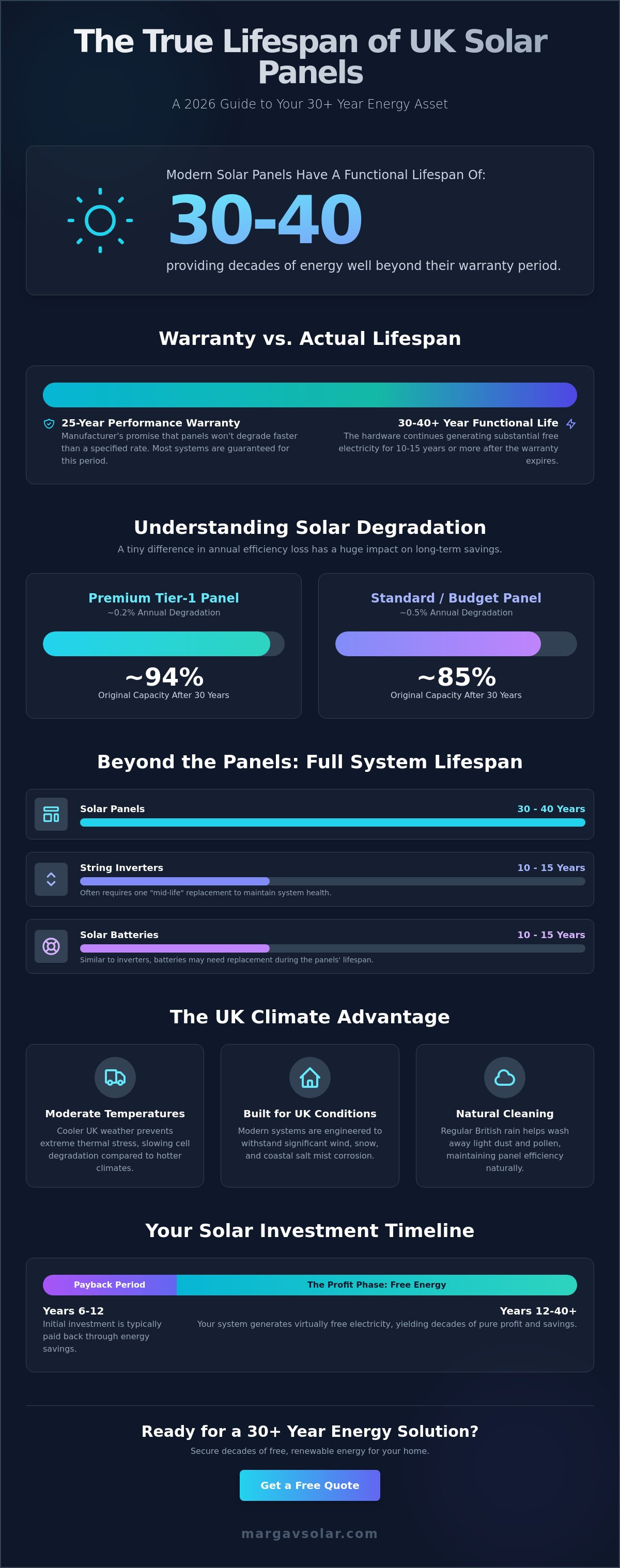
When homeowners ask how long do solar panels last UK experts now point toward a 30 to 40-year lifespan. While the industry standard was once 25 years, advancements in monocrystalline technology have significantly extended the functional life of modern installations. A solar panel does not simply "die" or stop producing electricity after a certain date. Instead, it slowly loses efficiency over time. In 2026, a Tier 1 panel is expected to still operate at 87% to 90% of its original capacity after 30 years of service. This means your system continues to provide substantial savings on electricity bills long after the initial payback period, which typically falls between 6 and 12 years in the UK.
Useful Life vs. Manufacturer Warranties
It is vital to distinguish between a warranty and the actual useful life of the equipment. Most residential solar PV systems come with a 25-year performance warranty. This is a manufacturer's promise that the panels will not degrade faster than a specified rate. However, the hardware often continues to generate power for another decade beyond this guarantee. Solar panel degradation is a slow, predictable process; it's not a sudden failure. We are now seeing a shift toward 30-year warranties for premium N-type solar cells, reflecting the increased confidence in long-term durability. If your panels are still producing 80% of their original output at year 35, they are still a highly valuable asset for your home.
UK Weather and Panel Durability
Many people worry that the British weather will damage their system, but the UK climate is actually ideal for panel longevity. Solar cells are electronic components that lose efficiency as they get hotter. The UK’s moderate temperatures prevent the extreme thermal stress found in desert climates, which helps slow down the internal degradation of the cells. High-quality panels are also built to withstand the specific environmental pressures of the British Isles.
- Wind and Snow: Modern mounting systems are designed to handle significant wind loads and the pressure of heavy snow, even in more exposed regions like Staffordshire or the Scottish Highlands.
- Natural Cleaning: While professional cleaning is still recommended to maintain peak efficiency, regular British rain acts as a natural rinsing agent to clear away light dust and pollen.
- Salt Mist Resistance: For those living on the coast, modern panels include protective layers to resist corrosion from salt-heavy air.
The durability of these systems is well-proven. The world's first modern solar panel is now over 60 years old and remains functional. With no moving parts to wear out, your 2026 installation is built to be a permanent fixture of your home's infrastructure, providing virtually free electricity for the better part of four decades.
Understanding Solar Degradation Rates
Solar degradation is the natural, gradual reduction in power output that occurs as solar cells age. On average, the industry standard for annual degradation is 0.5%. While this decline is inevitable, the rate at which it happens varies significantly based on equipment choice and environmental conditions. Understanding this process is key to answering how long do solar panels last UK in terms of actual financial value. It's not just about whether the panels work, but how much energy they continue to produce as they reach their second and third decades.
Light Induced Degradation (LID) is often the first hurdle. It occurs within the first few hours of sun exposure. This decline is inevitable. However, premium panels are chemically treated to resist this initial dip, ensuring the system maintains its peak efficiency for much longer. A 0.3% difference in annual degradation might seem negligible, but it shifts the entire ROI landscape. Over a 25-year period, a panel with a 0.2% degradation rate will still be producing around 95% of its original power. A budget panel at 0.5% will have dropped to 87.5% or less. This performance gap represents hundreds of pounds in lost savings over the system's life.
The Impact of Panel Quality on Longevity
Tier 1 manufacturers invest heavily in material science to ensure their cells are protected from the elements. Glass-on-glass panels, for example, replace the traditional plastic backsheet with a second layer of tempered glass. This creates a near-impenetrable seal against moisture ingress, which is a leading cause of early cell failure. Recent research into extending solar panel lifespan highlights how these structural improvements are making 30-year lifecycles the new baseline. Proper solar panel installation also plays a critical role. Poor mounting can cause micro-cracks in the cells that accelerate degradation. By choosing high-quality components, you ensure that the answer to how long do solar panels last UK remains a positive one for your household budget.
Environmental Factors in Staffordshire
Local conditions in areas like Staffordshire can introduce specific "soiling" challenges that impact performance. These factors can accelerate physical wear if left unmanaged:
- Agricultural Dust: Fine particles from nearby farms can settle on the glass, creating "hot spots" where cells overheat and degrade faster.
- Bird Proofing: If pigeons nest under your panels, the accumulation of acidic droppings can damage both the wiring and the surface of the cells.
- Air Quality: Particulate matter from local traffic or industry can reduce the light reaching the silicon, though regular rain helps clear much of this.
If you are concerned about your current system's performance, a professional solar maintenance check can identify if your degradation rates are within normal limits.
Beyond the Panels: Lifespan of Inverters and Batteries
While the silicon cells on your roof are built for the long haul, a solar installation is a multi-component ecosystem. When discussing how long do solar panels last UK homeowners often overlook the "weakest link" in the chain: the solar inverter. This device converts the DC power from your panels into usable AC power for your home. Unlike the panels, which have no moving parts, inverters contain complex electronics that work under high thermal stress. A typical string inverter has a lifespan of 10 to 15 years, while microinverters can last 20 to 25 years. This means you should budget for at least one inverter replacement during the 30 to 40-year life of your panels.
Understanding this mid-life refresh is essential for a realistic ROI. Most homeowners will reach their financial "break-even" point well before an inverter fails. This makes the cost of a replacement a manageable maintenance step rather than a system-ending disaster. By planning for this update around the 12 to 15-year mark, you ensure that your conversion hardware stays as efficient as the durable panels it serves.
The Solar Inverter: The Heart of the System
Signs of a failing inverter include frequent error codes, a noticeable drop in daily generation, or physical signs of heat damage. According to the Energy Saving Trust guide on solar panels, replacing an older unit with a modern, more efficient model can often pay for itself by capturing more energy from the same roof space. Choosing professional inverter upgrades rather than basic repairs allows you to benefit from better monitoring and higher conversion rates. Placement is also critical. Installing the unit in a well-ventilated, cool area like a garage or shaded external wall can significantly extend its operational life compared to a hot, cramped loft space.
Battery Storage Longevity
Modern LFP (Lithium Iron Phosphate) batteries are a significant step up from older lithium-ion technologies. These units are typically rated for 6,000 to 10,000 cycles, which translates to a 15 to 20-year lifespan in a standard UK home. Even after 10 years of daily use, a high-quality battery should retain roughly 80% of its original capacity. Managing these cycles is vital for longevity. Using tools like the GivEnergy Cloud helps homeowners monitor discharge rates and prevent the deep cycling that can shorten a battery's life. By keeping an eye on your system's health through smart apps, you can catch faults early and ensure your storage solution remains a productive part of your home for decades.
5 Ways to Maximise the Lifespan of Your Solar System
While technology determines the baseline for how long do solar panels last UK installations are ultimately defined by how well they are managed. A "fit and forget" approach might work for a few years, but reaching a 30 or 40-year lifespan requires proactive care. Environmental factors in the UK, from Staffordshire farm dust to coastal salt spray, can create unique challenges for your hardware. By following a consistent maintenance schedule, you ensure that your system remains a high-performing asset rather than a declining one.
- Schedule Professional Cleaning: This prevents the formation of "hot spots." These occur when dirt or debris causes specific cells to overheat, potentially leading to permanent cell damage.
- Monitor Performance Weekly: Use your mobile app to check generation levels. Catching a small dip early can prevent a minor fault from becoming an expensive repair.
- Ensure Adequate Ventilation: Heat is the primary enemy of inverters and battery storage units. Keep the areas around these components clear of clutter to allow for natural cooling.
- Prune Nearby Trees: Overhanging branches do more than just block light. They drop sticky sap and leaves that can harden on the panel surface, making natural rain cleaning less effective.
- Invest in Bird Proofing: Pigeons nesting under panels can damage wiring and leave acidic droppings that etch the glass over time.
The Importance of Professional Maintenance
Many homeowners consider DIY cleaning with a garden hose, but this can often do more harm than good. Tap water in many parts of the UK is "hard" and leaves mineral deposits behind. A professional solar panel maintenance check involves using deionised water and soft-reach brushes that won't cause micro-scratches. These inspections also cover NICEIC-standard electrical checks. Technicians ensure that all connections remain tight and that the DC isolators are functioning correctly, which is vital for both safety and longevity.
Smart Monitoring and Early Detection
Modern monitoring software is your first line of defence against system aging. By checking your app regularly, you can identify "string failures" where an entire row of panels stops contributing to your home's power. This often happens long before you would notice a change in your quarterly electricity bill. Proactive detection is also essential for preserving manufacturer warranties. Most brands require proof that the system has been monitored and maintained to honour a performance claim. If you haven't had your system inspected recently, booking a professional solar maintenance and cleaning service is the most effective way to secure your 30-year ROI.
Is a 30-Year Solar Investment Worth It in 2026?
Most financial analyses of renewable energy focus on the 10-year break-even point. This is a mistake. When evaluating how long do solar panels last UK installations should be viewed as 30-year assets rather than short-term upgrades. By 2026, the typical payback period for a residential system has settled between 6 and 12 years. This leaves you with two to three decades of what we call the "Profit Phase." During this time, your system has already covered its own costs, and every kilowatt-hour generated is effectively putting money back into your pocket. With energy prices remaining volatile, having a fixed, zero-cost energy source is the ultimate hedge against inflation.
The integration of solar battery storage has fundamentally changed the ROI calculation. In the past, homeowners exported much of their excess energy to the grid for minimal returns. Today, a battery system allows you to reach 70% to 80% self-consumption. This keeps your generated power within your own home, accelerating the break-even point and protecting you from rising evening tariffs for decades to come.
The Long-Term Financial Outlook
The numbers behind a 2026 installation are compelling. UK homeowners can expect to save between £400 and £1,110 per year on electricity bills. Over a 25 to 30-year lifespan, even after accounting for a mid-life inverter replacement, total savings often reach well into five figures. Beyond the direct bill reductions, solar panels are increasingly recognised as a value-add for Staffordshire properties. As more drivers switch to electric vehicles and homeowners adopt heat pumps, a house with a pre-installed, high-capacity solar array becomes significantly more attractive to future buyers. You aren't just buying panels; you're future-proofing your home's infrastructure.
Why Choose MarGav Solar for the Long Haul?
Securing a 30-year return requires an installation partner who understands the local landscape. MarGav Solar brings over 20 years of expertise specifically to the Staffordshire region. We don't just fit panels and leave. We provide end-to-end support that covers everything from the initial bespoke design to long-term maintenance and cleaning. Our focus is on high-efficiency hardware with the most robust degradation profiles available in 2026. We ensure your system is built to survive the British weather while maintaining the performance levels needed to stay profitable until the 2050s and beyond. When you invest with us, you're choosing a team committed to keeping your system running at peak performance for its entire functional life.
Secure Your Decades of Clean Energy
Viewing solar power as a short-term fix ignores the reality of modern technology. Your installation is a robust, 30-year asset that continues to pay dividends long after the initial costs are recovered. By managing the mid-life refresh of your inverter and maintaining a consistent cleaning schedule, you ensure your system remains efficient well into the 2050s. When you understand how long do solar panels last UK homeowners can move forward with the confidence that their investment is protected against rising energy costs and inflation.
Ensuring this longevity requires an expert partner. With 20+ years of industry expertise and a team of NICEIC Certified Installers, we provide the technical support needed to keep your array at peak performance. Whether you need a performance review or a fixed-price installation contract, we are here to support your energy journey for the long haul. Request a Professional Solar Health Check in Staffordshire today and protect your home's future. Your transition to energy independence is a marathon, not a sprint, and we're ready to help you every step of the way.
Frequently Asked Questions
Do solar panels stop working after 25 years?
No, solar panels don't stop working once they reach the end of their warranty period. Instead, they gradually produce less electricity as the silicon cells age. Most modern panels will still generate around 80% to 90% of their original rated power after 25 years of service. This means your system continues to provide significant savings on your energy bills for another decade or more beyond the manufacturer's guarantee.
How much does it cost to replace a solar inverter in the UK?
The cost to replace a solar inverter varies depending on the size of your system and whether you choose a standard string inverter or a microinverter setup. It's a standard maintenance step that most homeowners should budget for around the 12 to 15-year mark. You should check with a professional installer for a specific quote that covers both the new hardware and the expert labour required for a safe installation.
Does the UK weather make solar panels degrade faster?
The UK climate is actually very favourable for solar panel longevity. High temperatures are the primary cause of accelerated degradation in silicon cells. Because the UK rarely experiences extreme heat, panels here often degrade more slowly than those in hotter climates. This moderate weather helps preserve the internal components and ensures that the answer to how long do solar panels last UK remains a positive one for local homeowners.
Can I replace just one solar panel if it breaks?
You can replace a single solar panel if it suffers physical damage from an external event. However, the replacement panel must have electrical specifications that match your existing array to ensure the system remains balanced and efficient. A professional technician can determine if a single panel swap is possible or if a small string update is needed to keep your system performing at its peak.
How do I know if my solar panels are losing efficiency?
The best way to track efficiency is by using the monitoring app provided with your inverter. By comparing your current generation data with historical records or local weather-adjusted averages, you can spot any unusual drops in performance. If your output is declining by more than the standard 0.5% per year, it may be time for a professional maintenance check to identify potential issues like "soiling" or cell damage.
Is it worth getting a battery if I want the system to last 30 years?
Adding a battery is a smart way to maximise your long-term return on investment. While a high-quality LFP battery might need replacing once during the 30-year lifespan of your panels, the ability to use your own stored energy significantly increases your annual savings. This combination allows you to stay energy independent and protects you from rising grid prices for the entire life of your system.
What happens to solar panels at the end of their life?
Solar panels are highly recyclable and are covered by the UK's WEEE (Waste Electrical and Electronic Equipment) regulations. Most of the materials, including the glass, aluminium frame, and silicon cells, can be recovered and reused in other industries. When your panels eventually reach the point where they are no longer useful, professional installers can help arrange for their responsible removal and recycling.
Do I need to clean my solar panels to make them last longer?
Regular cleaning is vital for preventing permanent damage caused by "hot spots." When dirt or debris settles on a specific part of the panel, it can cause those cells to overheat, which accelerates degradation. Keeping the glass clear ensures that light is distributed evenly across the array. This simple maintenance step is essential for extending how long do solar panels last UK and maintaining high efficiency for decades.


