
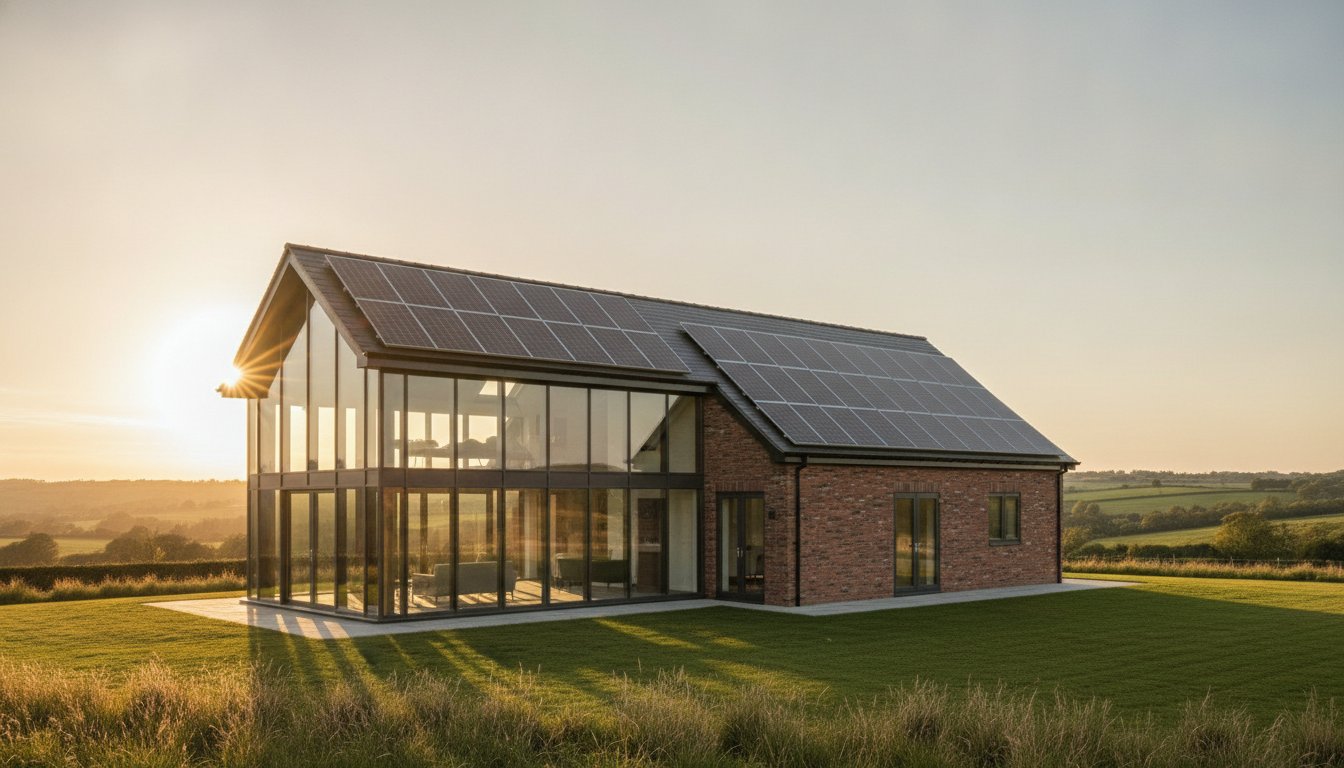
You've probably been told that a south-facing roof is the only way to make solar work, but in 2026, that traditional wisdom is being turned on its head. Finding the best direction for solar panels UK wide involves more than just pointing them at the midday sun; it's about matching energy production to your actual lifestyle. While south still grabs the most raw sunlight, an east-west split often delivers better financial returns for households using modern battery storage. It's completely normal to feel hesitant about your roof's orientation, especially with the UK's famously unpredictable weather and the pressure to ensure a solid return on investment.
This article clarifies the optimum orientation and tilt to help you slash electricity bills by up to £800 annually and achieve true energy independence. You'll discover the precise angles needed for your specific location, whether you're in the sunny south or the north. We'll also explain how current incentives like 0% VAT and the Smart Export Guarantee change the math for your home. By the end, you'll know exactly how to maximise your yield and whether a battery storage solution is the missing piece for your array.
Key Takeaways
- Learn how to identify the specific solar azimuth that matches your household's peak energy usage times rather than just chasing the midday sun.
- Understand why the best direction for solar panels UK wide is only half the battle, and how your roof's tilt angle impacts your total annual yield.
- Get clarity on whether north-facing roofs are ever a viable option and how modern technology helps overcome common shading obstacles.
- Discover how to integrate your solar array with EV charging points and battery storage to maximise your independence from the grid.
- See how 2026 specific financial incentives and export schemes can significantly improve the return on investment for less-than-perfect roof orientations.
Understanding Solar Orientation: Why Direction and Azimuth Matter
Solar orientation isn't just a technical term; it's the foundation of your system's performance. Solar azimuth is the compass direction from which the sunlight arrives. In the UK, because we sit in the northern hemisphere, the sun spends its entire transit across the southern sky. This geographical reality makes south the primary target for anyone hunting the best direction for solar panels UK wide. When your panels face south, they catch the sun at its highest and most intense point during the middle of the day, resulting in the highest possible total energy yield over the course of a year.
However, orientation also dictates when your power is actually produced. A perfectly south-facing array peaks at noon. If you're out at work all day and don't have a battery, much of that peak energy might be exported back to the grid rather than powering your home. Shifting the orientation can "time" your production. Facing panels toward the east provides a morning boost, while a western orientation captures the sinking sun. Deciding on the best direction for solar panels UK homes require involves balancing this raw production with your family's daily routine.
The Difference Between Orientation and Tilt
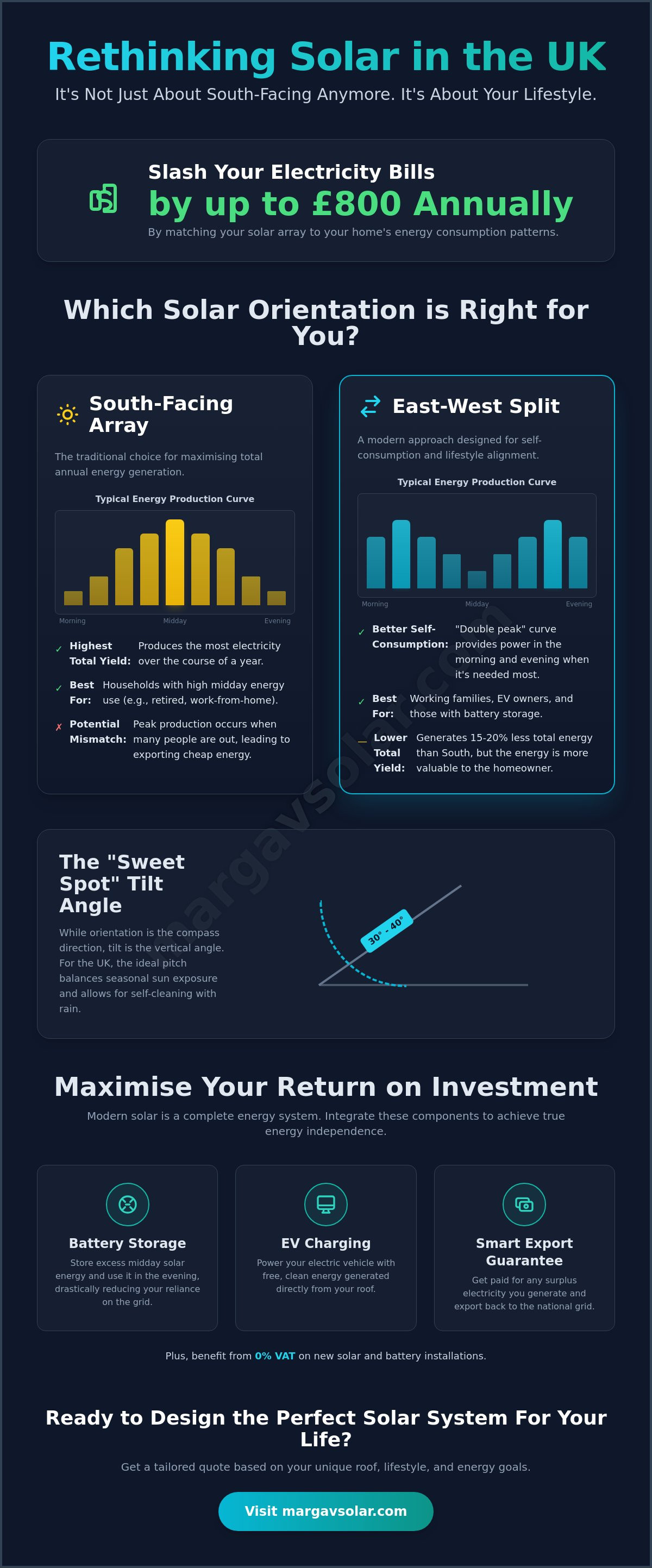
Think of orientation as the "where" and tilt as the "how high." While orientation is the compass direction your roof faces, tilt, or pitch, is the vertical angle of your panels relative to the flat ground. Solar panel technology relies on these two factors working in harmony to maximise photovoltaic efficiency. If your orientation is slightly off-south, you can often compensate by adjusting the tilt angle to catch more direct rays. Most UK roofs have a standard pitch between 30 and 40 degrees. This range is generally considered the "sweet spot" for our latitude, as it allows the panels to stay relatively clean while capturing sunlight effectively throughout the changing seasons.
The Role of Solar Irradiance in the UK
UK weather is a unique mix of direct sunlight and diffuse light filtered through clouds. Even on a grey day, your panels are still generating electricity. Diffuse light comes from all angles, meaning orientation matters slightly less during heavy overcast periods. Direct light is where the most significant savings occur. For those considering Solar Panel Installation in Staffordshire, it's reassuring to know that modern PV cells are sensitive enough to generate high yields despite the occasional "Midlands gloom." The goal of a professional design is to position the array so it captures every possible photon during clear, high-intensity windows while remaining productive during the UK's many cloudy afternoons.
South vs. East-West: Comparing the Best Directions for UK Homes
While south has long been the gold standard, the best direction for solar panels UK homeowners choose is shifting toward lifestyle compatibility. For years, the goal was simply to produce the most electricity possible over 12 months. Now, with the push for self-consumption, the priority is generating power when you are actually at home to use it. If you generate a massive surplus at midday while the house is empty, you're forced to export it, often for a lower rate than you pay to buy it back in the evening. This is why the best direction for solar panels UK wide is now often defined by your specific consumption habits.
South-facing panels typically yield 15-20% more total energy than East or West alone. This raw volume is impressive, but it creates a steep "bell curve" of production that peaks when many families are out. In contrast, an East-West split creates a flatter, longer production curve. This "double peak" approach aligns with the natural rhythm of modern life, providing power for the morning kettle and the evening oven. Recent UK government solar initiatives highlight the drive toward making solar more accessible, but choosing the right orientation remains a personal decision based on your energy profile.
The Case for South-Facing Arrays
A south-facing system is the powerhouse of the solar world. It is the ideal setup for households with high midday electricity demands, such as retirees or those who work permanently from home. If you have high-drain appliances running throughout the day, a southern orientation ensures you are using your own free energy during the sun's most intense hours. It also maximises your potential earnings from the Smart Export Guarantee (SEG), as you'll likely have a larger total volume of surplus energy to sell back to the grid over the year.
The Hidden Advantages of East-West Orientation
East-West systems are gaining popularity because they solve the timing issue. By splitting panels across two roof slopes, you capture the sun as it rises in the east and as it sets in the west. This orientation is particularly effective when paired with solar battery storage, as the morning peak begins charging the battery earlier, and the evening peak keeps it topped up longer. Because you aren't cramming everything onto one south slope, you can often install more panels in total, which helps offset the slightly lower yield per panel. You can explore our solar solutions to see which configuration fits your roof space best.
Calculating the Perfect Tilt Angle for Staffordshire and the Midlands
While finding the best direction for solar panels UK wide is a vital first step, the angle at which those panels sit determines how effectively they catch the light. Latitude is the deciding factor here. Staffordshire sits at approximately 52.8° North. This means the sun is lower in the sky than it is in southern Europe or even the South Coast of England. To capture the maximum amount of energy, your panels need to be tilted so they are as perpendicular to the sun's rays as possible during the peak hours of the day.
For Staffordshire, a tilt between 35 and 45 degrees is considered optimal for year-round performance. Most UK homes are built with a roof pitch between 30 and 40 degrees. This standard pitch is generally "good enough" for most residential installations. You don't usually need to reconstruct your roof to find the absolute perfect angle, as the difference in yield between a 30-degree and a 40-degree tilt is often less than 1%. The goal is to strike a balance between the high summer sun and the low winter sun. A steeper tilt helps significantly during the dark winter months when the sun barely clears the horizon, while a shallower tilt performs better during the long days of June and July.
Flat Roofs and Ground-Mounted Systems
If you have a flat roof extension or a large garden, you aren't restricted by the existing pitch of your house. We use specialised mounting frames to create the perfect angle from scratch. It's critical to maintain a minimum tilt of at least 10 degrees. Anything flatter than this allows rainwater to pool and dust to settle on the glass, which quickly degrades performance. Regular solar panel maintenance is easier when the panels are angled enough for the rain to provide a natural "self-cleaning" effect. For ground-mounted systems, we can often set the tilt to exactly 40 degrees to squeeze every possible kilowatt-hour out of the Midlands sky.
Optimising Inverters for Different Angles
When your system uses multiple tilts or orientations, the technical setup behind the scenes becomes more complex. Traditional string inverters can sometimes be limited because they perform only as well as the weakest panel in the chain. If you have one set of panels at 40 degrees and another on a flat roof at 15 degrees, they will peak at different times. This is where inverter upgrades like microinverters or power optimisers become essential. These devices manage each panel individually, preventing a lower-performing section from dragging down the rest of the array. This ensures your system doesn't "clip" or waste potential energy during those high-intensity summer peaks when the sun hits different parts of your roof at varying angles.
Overcoming Obstacles: North-Facing Roofs and Shading Issues
Many homeowners assume that a north-facing roof is an automatic dealbreaker for solar. It isn't. While we've established that south is the best direction for solar panels UK wide for raw volume, modern high-efficiency panels have changed the calculus for properties that don't have the luxury of a perfect southern exposure. Shading often poses a bigger threat to your ROI than the compass direction itself. A single chimney shadow creeping across a south-facing string system can be more detrimental than a clear, unobstructed north-facing array using modern optimisers like Tigo or SolarEdge. These devices allow each panel to operate independently, so one shaded module doesn't drag down the performance of the entire string.
Staffordshire’s local topography also plays a role in your system's design. Properties nestled in the valleys of the Staffordshire Moorlands or those near dense woodland in Cannock Chase face unique challenges with "horizon shading." This happens when the sun disappears behind a hill or tree line earlier than the official sunset time. When determining the best direction for solar panels UK residents must look beyond the roof itself and account for these environmental factors. A professional design compensates for these obstacles by choosing the orientation that provides the longest window of unobstructed light, even if it's slightly off-centre from the south.
When North-Facing Might Actually Work
North-facing roofs are no longer the "no-go zone" they used to be. For houses with a very low roof pitch, typically under 15 degrees, the difference in yield between north and south is much smaller than on a steep Victorian terrace. You can often supplement a primary south-facing system with panels on a northern slope to increase your total generation capacity for high-demand appliances. Even a North-facing roof can achieve 60% of the yield of a South-facing one in the UK, which can still be financially viable given the 0% VAT incentive and the current cost of grid electricity. This approach is particularly effective if you have a large family or an electric vehicle that requires a high volume of daily charging.
The Shading Audit: A Critical Step
A south-facing roof with a chimney or a large overhanging tree can be significantly less productive than a clear East-facing roof. At MarGav Solar, we use advanced 3D shading simulations during the consultancy phase to map exactly how shadows move across your tiles throughout the seasons. This data-driven approach ensures that your yield projections are realistic and honest. Our reliance on NICEIC certification means we adhere to strict standards for safety and accuracy in every installation we design. We don't guess; we calculate the precise impact of every obstacle to ensure your system delivers the independence you expect.
Ready to see how much energy your roof can really generate? Request your bespoke solar design from MarGav Solar to get a professional shading analysis for your home.
Maximising ROI: Designing for Your Life, Not Just the Compass
The best direction for solar panels UK homeowners select should ultimately reflect their future plans, not just their current roof layout. If you're planning to install an EV charging point in the next few years, your energy needs will shift dramatically. A system that produces most of its power at midday might not be the most efficient choice if you primarily charge your vehicle overnight or in the early evening. By looking at your total energy ecosystem, we can design a system that maximises your return on investment through better self-consumption rather than relying solely on the Smart Export Guarantee (SEG) credits.
At MarGav Solar, we bring 20 years of experience in Staffordshire energy solutions to every project. We've seen first-hand how "rule of thumb" advice often leads to missed opportunities for savings. Every household has a unique fingerprint of energy usage. Professional design means we don't just point panels south; we calculate how your specific orientation will interact with your battery storage and EV charger to ensure the lowest possible grid dependency. This bespoke approach ensures the best direction for solar panels UK residents choose is the one that actually matches their lifestyle.
Smart Home Integration with GivEnergy
Managing energy across different roof directions is simplified through advanced monitoring platforms. The GivEnergy Cloud allows you to track exactly how much power your east or west-facing panels are contributing at any given moment. This data is vital for predictive charging, where the system uses local weather forecasts to decide whether to save battery space for a sunny afternoon or top up during cheap overnight tariffs. Scheduling high-drain appliances to run during your orientation's peak production hours can significantly boost your long-term ROI.
Getting Your Custom Solar Design
While online calculators provide a rough estimate, a physical site survey is non-negotiable for an accurate financial projection. We look at the nuances of your roof's condition, the exact path of shadows from neighbouring structures, and the best cable routes for your inverter and battery. This level of detail allows us to provide a fixed-price installation contract, ensuring there are no surprises once the scaffolding goes up. The best direction for solar panels UK homes can utilise is the one that has been verified through a professional, local audit rather than a generic estimate.
Your journey toward energy independence starts with a clear plan. Booking a Staffordshire solar consultation allows you to see a full 3D simulation of your property's potential. We'll help you navigate the orientation choices and technical specifications to build a system that serves your home for decades.
Start Your Journey Toward Energy Independence
Choosing the best direction for solar panels UK homeowners can utilise is no longer a one-size-fits-all decision. We've explored how south-facing roofs offer maximum raw energy, while east-west configurations often better serve modern families with high morning and evening consumption. Even if your roof isn't perfectly oriented, modern battery storage and power optimisers ensure you can still achieve a significant return on investment. Getting these technical details right is the difference between a standard setup and a high-performance energy system tailored to your life.
With over 20 years of expertise in UK solar, our team of NICEIC Certified Installers provides dedicated, Staffordshire-based local support. We take the guesswork out of your installation by providing precise shading analysis and bespoke system designs. You don't have to settle for generic advice when you can have an array designed for your exact coordinates. Book your free Staffordshire solar roof assessment with MarGav Solar today and discover the true potential of your home. It's time to stop worrying about rising energy costs and start generating your own clean power.
Frequently Asked Questions
Do solar panels have to face South in the UK?
No, solar panels don't have to face south to be a worthwhile investment. While south-facing systems produce the highest total volume of electricity over a year, the best direction for solar panels UK homes require depends on your specific lifestyle. Many people find that east or west-facing systems work better for their morning and evening routines. This shift in focus prioritises using your own energy as it's generated rather than just chasing the highest annual total.
Is East or West better for solar panels in the UK?
East and West orientations are both excellent options but they provide power at different times of the day. East-facing panels are perfect for early risers who need power for the breakfast rush and morning chores. West-facing panels are better for families who use more electricity in the late afternoon and evening. Pairing both directions on a single house creates a balanced production curve that reduces your reliance on the grid throughout the entire day.
What is the best angle for solar panels in Staffordshire?
For homes in Staffordshire, the ideal tilt angle is between 35 and 45 degrees. This range is specifically calculated to match our local latitude of 52.8° North. While most UK roofs are built at a pitch of 30 to 40 degrees, which is perfectly adequate, we can use mounting frames on flat roofs to hit that exact sweet spot for maximum year-round efficiency. This ensures your system captures the most energy possible across all four seasons.
Will solar panels work on a North-facing roof?
Solar panels will certainly generate electricity on a North-facing roof, though the output is lower than other orientations. In the UK, a north-facing system typically produces about 60% of what a south-facing one would. This can still be a worthwhile investment if the roof has a shallow pitch or if you're looking to maximise every inch of available space to charge an EV. It's often a viable way to supplement a primary array on a better-facing slope.
How much electricity do solar panels lose if they are at the wrong angle?
The efficiency loss from an "imperfect" angle is often much smaller than homeowners fear. Moving 10 or 15 degrees away from the optimum tilt usually results in a yield loss of just 1% to 2%. Direction has a much larger impact than tilt on your total generation. As long as your panels aren't completely flat or heavily shaded, they'll still provide a substantial return on your investment over their long lifespan.
Does the best direction for solar panels change in winter?
The sun stays much lower in the sky during the winter months, which makes orientation and tilt even more critical. While you can't move your panels as the seasons change, the best direction for solar panels UK installers recommend is a compromise that works for all conditions. A steeper tilt can help slightly in the winter to catch the low sun, but a standard roof pitch remains the most reliable year-round solution for most UK properties.
Can I have solar panels on two different roof directions?
Yes, installing panels on multiple roof slopes is a common and effective strategy. This approach, often called a split-array, allows you to capture sunlight from different parts of the sky throughout the day. We use advanced inverter technology or power optimisers to manage these different sections separately. This ensures that panels on the shaded side of the house don't drag down the performance of the panels currently sitting in direct sunlight.
How does shading affect the best direction for my panels?
Shading is often more important than orientation when it comes to your final energy yield. A clear, unshaded East-facing roof will frequently outperform a South-facing roof that's partially blocked by a large chimney or overhanging trees. During our site surveys, we use 3D modelling to track how shadows move across your roof tiles. This helps us decide if a slightly less "perfect" compass direction is actually the more productive choice for your specific home.


