
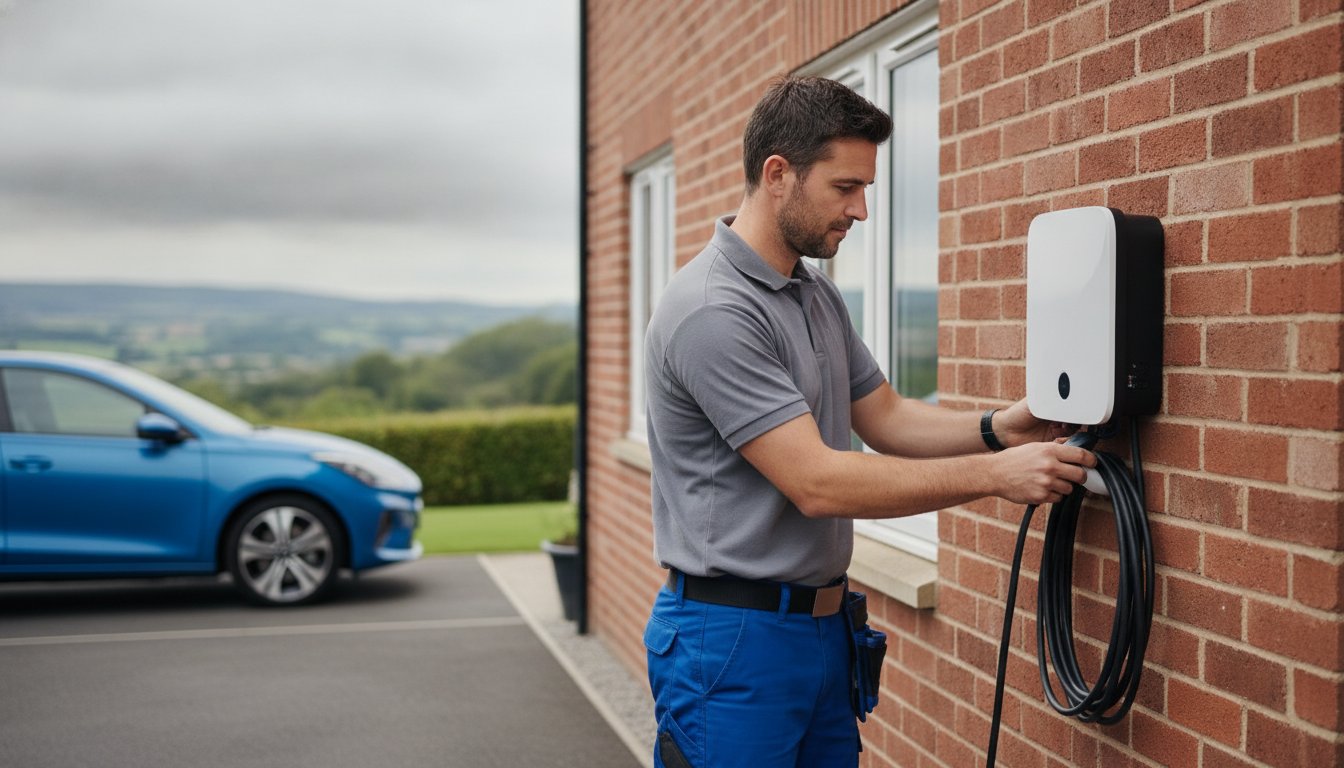
Is the "standard installation" price you see online actually what you'll pay, or is it just the starting line for a more complex electrical project? Many UK drivers find that the cost to install EV charger at home UK isn't always as straightforward as a single sticker price. It's common to feel a bit of anxiety over potential hidden costs like consumer unit upgrades or the confusion surrounding who's actually eligible for government support in 2026.
We understand that you want a safe, efficient setup without any expensive surprises. This guide clarifies the real-world variables of home charging, from hardware choices to the specific OZEV grant criteria that still offer up to £500 in savings for eligible renters and landlords. You'll learn how to maximize your long-term ROI through solar integration and exactly what's required to ensure your installation is fully certified and future-proof.
Key Takeaways
- Learn how to distinguish between a basic "standard" installation quote and the actual total project cost for your specific property.
- Discover the primary variables that impact the cost to install EV charger at home UK, including your consumer unit's age and the length of cable runs.
- Identify which charger features, such as smart load balancing or tethered cables, offer the best balance of convenience and long-term value for your lifestyle.
- Find out how to maximize your return on investment by utilizing 2026 OZEV grants and integrating your charger with residential solar PV systems.
- Understand the safety and warranty benefits of hiring certified local professionals to handle complex electrical upgrades and provide ongoing support.
Breakdown of Home EV Charger Installation Costs in 2026
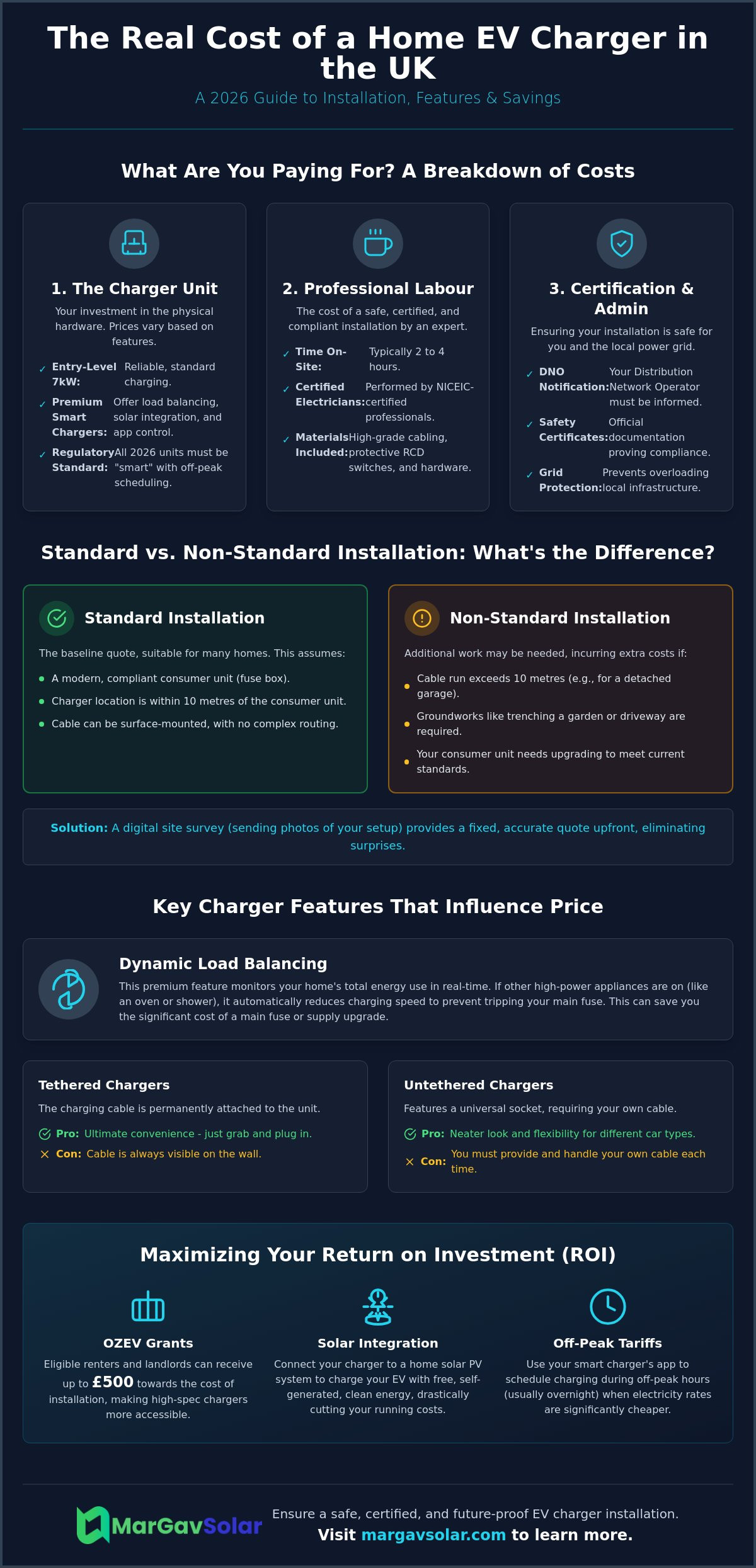
Understanding the cost to install EV charger at home UK requires looking at the sum of three parts: the hardware, the labour, and the official certifications. By 2026, the market has evolved significantly since the early days of UK plug-in vehicle statistics first showed a surge in adoption. Most homeowners start with a "standard installation" quote. This baseline assumes your consumer unit is modern and the charger is positioned within 10 metres of your power supply. A critical part of this process involves your Distribution Network Operator (DNO). They must be notified of the new high-load device to protect the local grid. In some cases, the DNO might require an un-fusing of a looped supply before work can begin, which can affect your timeline even if it doesn't always impact your direct invoice.
Hardware vs. Labour: Where Your Money Goes
Your investment is split between the physical unit and the technical expertise required to fit it safely. Entry-level 7kW units provide reliable charging, but premium smart chargers offer advanced features like load balancing and seamless integration with residential solar PV systems. Labour costs account for the time of NICEIC-certified electricians, who typically spend between two and four hours on-site. This fee covers more than just manual work; it includes the cost of high-grade cabling, protective RCD switches, and weather-proof mounting hardware. Under 2026 energy regulations, all new chargers must meet strict "smart" criteria, including default off-peak charging schedules and encrypted data security, which has standardised the minimum hardware requirements across the industry.
Standard vs. Non-Standard Installation
A standard installation is the most cost-effective route, but many UK homes require bespoke solutions. If your driveway is far from your consumer unit or you have a detached garage, you'll likely face non-standard costs. Triggers for these additional fees include groundworks, such as trenching through a garden, or complex internal routing through multiple walls. Because every home is different, a digital site survey is now the industry standard. By submitting photos of your fuse box and preferred charger location, you can get an accurate fixed price. This transparency helps avoid the fear of hidden electrical upgrade costs that often causes hesitation for new EV owners. Getting this right ensures the cost to install EV charger at home UK remains a predictable investment rather than a source of financial stress.
Choosing Your Charger: Features That Influence the Price
The hardware you select dictates a significant portion of the total cost to install EV charger at home UK. While the market offers a range of options, the 2026 landscape is dominated by smart units that do far more than just deliver electricity. A key feature that often accounts for price variance is dynamic load balancing. This technology monitors your home's total power consumption in real-time. If you're running the oven and a power shower simultaneously, the charger automatically scales back its output to prevent tripping your main fuse. It's a sophisticated safety feature that can save you from the much higher costs of a main fuse upgrade or a three-phase supply installation.
Smart Features and App Integration
Dumb chargers have largely vanished from the UK market due to strict energy regulations. Modern smart chargers allow you to sync your charging sessions with off-peak electricity tariffs, which is essential for reducing your long-term running costs. Many premium units also offer over-the-air (OTA) software updates. These updates ensure your hardware remains compatible with the latest vehicle software and grid requirements without needing a physical replacement. For those looking to mitigate their initial layout, the recent EV chargepoint grant increase provides vital support for eligible renters and landlords, making high-spec smart chargers much more accessible.
Tethered or Untethered: Which is Right for You?
Deciding between a tethered or untethered unit is a choice between convenience and aesthetics. A tethered charger has the cable permanently attached. You just pull up and plug in. It's the most popular choice for private driveways. Untethered units feature a socket instead, requiring you to use your own separate Type 2 cable. While untethered units look neater on the wall and offer flexibility if you change car brands, you must factor in the additional cost of purchasing a high-quality cable if one didn't come with your vehicle. If you're considering a more comprehensive energy setup, exploring EV charging points that integrate with your home’s existing infrastructure is a smart way to ensure long-term compatibility.
Durability is another factor that separates budget units from premium models. Look for high IP (Ingress Protection) ratings, such as IP65, which indicate superior resistance to dust and heavy rain. Cheaper plastic casings may become brittle after years of exposure to UV rays and frost. Investing in a unit with a robust, weather-resistant housing ensures your charger remains safe and functional for the decade ahead. Finally, always match the charger to your car's maximum AC rate. Most UK homes use 7kW single-phase charging; paying for a 22kW unit is often unnecessary unless you have a specific requirement and the rare three-phase power supply to support it.
Site-Specific Factors Affecting Installation in Staffordshire
National providers often overlook the quirks of local architecture, but Staffordshire residents know that a Victorian terrace in Stoke has very different needs than a modern build in Stafford. The total cost to install EV charger at home UK is frequently shaped by these local site conditions. While a standard installation assumes your charger is within 10 metres of the consumer unit, many properties in our region require bespoke routing through lofts or even underground trenching across gardens. National call centres often offer a flat rate, but they rarely account for the specific electrical heritage of our local properties, which can lead to unexpected "non-standard" surcharges later.
Consumer Unit Upgrades and Safety
Your consumer unit, or fuse box, acts as the brain of your home's electrical system. Many older properties in Staffordshire haven't had an electrical refresh in decades. If your unit is full or lacks modern safety features like Type A RCDs, an upgrade is necessary before adding a high-draw EV circuit. By 2026, Surge Protection Devices (SPD) have become a critical requirement to safeguard your vehicle's sensitive electronics from power spikes. Ensuring your installer holds NICEIC certification is the best way to guarantee these safety standards are met. This professional oversight is also a prerequisite for accessing various government grants for EV chargers, which can significantly offset the price of these initial safety upgrades.
Physical Installation Challenges
Physical layout is the next major price driver. If your driveway isn't directly adjacent to your meter, the cost of cabling increases. For detached garages or parking pedestals, groundworks become necessary. Professional trenching usually costs around £30 per metre, and you might face additional charges for mini-digger hire if your soil is particularly rocky or difficult to navigate. Mounting the unit on a brick wall is the most affordable option, but a standalone pedestal offers more flexibility if your parking space is away from the house. Routing cables through crawl spaces or under floorboards also takes more time than a simple external run. Navigating these choices requires an installer who understands local building styles and the specific capacity limits of the local grid. Getting an accurate cost to install EV charger at home UK starts with a thorough site survey that identifies these physical hurdles before work begins.
Maximising ROI: Grants, Solar Integration, and Tariffs
While the initial cost to install EV charger at home UK is a primary concern, the long-term return on investment (ROI) is what truly defines the value of the project. A high-quality installation doesn't just provide a place to plug in; it acts as a gateway to significantly lower fuel costs. By 2026, the gap between public charging and home charging has widened. Off-peak electricity rates can be as low as 9-10p per kWh, compared to public rapid chargers that often exceed 75p per kWh. This means a driver doing 10,000 miles a year could save over £1,000 annually just by switching to a home-based smart charger.
The 2026 OZEV Grant Update
Government support hasn't disappeared, but it has become more targeted. The OZEV EV Chargepoint Grant currently offers up to £500, or 75% of the total installation cost, for specific groups. This scheme is confirmed to run until March 31, 2027. To qualify, you must live in a flat you own or be a tenant in any residential property. Landlords are also eligible and can apply for up to 200 grants per year across their portfolios. Standard homeowners in single-family houses are currently excluded from this specific fund. To claim the grant, you must use an OZEV-authorised installer who will handle the technical submission on your behalf, ensuring the hardware meets all current smart-charging regulations.
Solar and Battery Synergy
The most effective way to reduce your charging costs to near zero is by integrating your charger with solar PV systems. During daylight hours, a "solar diverter" can detect when your home is producing more energy than it's using. Instead of sending that excess power back to the grid for a few pence, the system diverts it directly into your car's battery. If you're at work during the day, solar battery storage allows you to capture that free energy and use it to charge your EV overnight. This setup turns your car into a mobile energy store, effectively giving you "free" miles generated right from your roof.
To start building your own energy-independent charging setup, you can explore our range of EV charging points designed for seamless smart home integration. Combining a smart tariff with renewable energy isn't just about saving money; it's about making your home's infrastructure work harder for you. By choosing hardware that supports these integrations now, you avoid the cost of replacing incompatible units in just a few years. A safe, certified installation is the foundation of this strategy, ensuring you can take full advantage of every penny saved on the grid.
Why Professional Local Installation is the Best Investment
While you might be tempted to hunt for the absolute lowest cost to install EV charger at home UK, cutting corners on labour often leads to expensive failures. Uncertified "cowboy" installations aren't just a legal risk; they're a significant fire hazard. Modern EV chargers pull a heavy electrical load for hours at a time, which can melt poorly fitted components or undersized cabling. Beyond safety, an uncertified install will void your manufacturer's warranty and likely your home insurance policy. Choosing a professional ensures your hardware is registered correctly and your home's electrical system is balanced for the long term.
Professional EV charging point installations also act as a tangible investment in your property. By 2026, home chargers have become a "must-have" for potential buyers, much like double glazing or modern boilers. A tidy, certified installation with a clear paper trail adds far more value than a messy, DIY-looking job. It provides the next homeowner with the confidence that the electrical work meets current UK building regulations and won't require immediate remedial work.
Local Expertise and Maintenance
National companies often rely on a rotating door of subcontractors who might never visit your property in Staffordshire twice. In contrast, local installers provide a level of accountability that national call centres can't match. MarGav Solar’s 20 years of experience in complex electrical projects means we understand the specific grid constraints and housing styles across our region. This local knowledge allows for accurate, fixed-price quoting based on a physical site visit rather than a grainy smartphone photo. If a component fails or your software needs a manual reset, having a local team ready for ongoing support is invaluable for your peace of mind. You aren't just paying for the install; you're paying for a relationship with a team that stands by their work.
Ready to Charge? Your Next Steps
Moving from a petrol station habit to home charging is a simple transition when you have the right partner. Your first step is booking a professional site survey. This visit confirms your consumer unit's capacity and identifies the most efficient cable route to your parking space. On installation day, ensure your driveway is clear and your Wi-Fi password is handy, as the installer will help you set up the smartphone app for off-peak scheduling. If you're looking for a safe, compliant, and efficient setup, you can get a fixed-price EV charger installation quote from MarGav Solar to lock in your 2026 pricing today. Taking this step now ensures your home is ready for the future of transport with a system that is built to last.
Ready to Future-Proof Your Home Charging?
Investing in your home's charging infrastructure is about more than just convenience. It's a strategic move to lower your long-term energy bills and increase your property's value. By understanding the variables behind the cost to install EV charger at home UK, you can avoid hidden fees and select hardware that integrates perfectly with your lifestyle. Whether you're a landlord looking to utilize the latest OZEV grants or a homeowner aiming for total energy independence through solar power, the right setup starts with technical precision.
At MarGav Solar, we bring over 20 years of renewable energy expertise to every project. Our NICEIC Certified Installers provide fixed-price installation contracts, so you'll never have to worry about unexpected costs on the day. We're here to help you navigate the complexities of modern electrical standards and grant eligibility with ease. Don't leave your electrical safety to chance with uncertified providers.
Request a Professional EV Charger Consultation today to get started on your journey toward cleaner, cheaper motoring. Your future-proof charging station is just one expert installation away.
Frequently Asked Questions
Is it cheaper to install an EV charger myself?
You cannot legally or safely install an EV charger yourself in the UK. All installations must be performed by a qualified, OZEV-authorised electrician to comply with Part P of the Building Regulations and IET wiring standards. Attempting a DIY installation voids your hardware warranty, risks electrical fires, and makes you ineligible for government grants or home insurance claims. It's always a better investment to pay for professional certification.
How much does it cost to charge an EV at home compared to petrol?
Home charging is approximately 70% to 80% cheaper than running a petrol or diesel vehicle. With off-peak electricity rates currently around 9-10p per kWh, a full charge for a typical 60kWh battery costs about £6. In contrast, a petrol car achieving 45mpg would cost significantly more to cover the same distance, especially with public charging prices often exceeding 75p per kWh in 2026.
Can I get a grant for an EV charger if I have a driveway?
Standard homeowners with private driveways are not currently eligible for the £500 OZEV grant. This financial support is specifically reserved for renters, flat owners, and landlords. If you live in a single-family home with a driveway, you'll need to cover the full cost to install EV charger at home UK without government assistance, though you still benefit from the massive long-term fuel savings of home charging.
What is included in a "standard" EV charger installation?
A standard installation typically includes the charger unit itself and up to 10 metres of cabling from your consumer unit. It also covers the labour of a certified installer, the mounting of the device on a brick or stone wall, and the filing of all necessary compliance certificates. Requirements for groundworks, trenching, or internal routing through multiple rooms are usually considered non-standard and will incur additional fees.
Do I need to upgrade my fuse box to install a 7kW charger?
You only need a fuse box upgrade if your current consumer unit lacks spare capacity or modern safety features like Type A RCD protection. Many older properties in Staffordshire require an upgrade to safely handle the sustained 32-amp draw of a 7kW charger. A professional site survey will determine if your existing board is compliant or if a new unit is required to meet 2026 safety standards.
How long does a home EV charger installation take?
A standard home EV charger installation typically takes between two and four hours to complete. This timeframe assumes the installer has clear access to your consumer unit and the charger's mounting location. If your project involves complex cable routing through lofts or physical groundworks like trenching under a driveway, the process can extend to a full day of work to ensure everything is finished correctly.
Can I charge my EV using my existing solar panels?
Yes, you can use your existing solar panels to charge your vehicle by installing a solar-compatible charger or a power diverter. These systems monitor your home's energy production and direct surplus electricity into your car's battery instead of the grid. This is the most effective way to lower the cost to install EV charger at home UK by maximizing your use of free, self-generated renewable energy.
What happens if my EV charger stops working?
If your charger stops working, you should first check your smartphone app for error codes and ensure the circuit breaker hasn't tripped. Most professional-grade hardware comes with a three-year manufacturer warranty that covers technical faults. If the issue isn't a simple power trip, you should contact your original installer to perform a diagnostic check and handle any necessary repairs or warranty replacements under their service agreement.


