

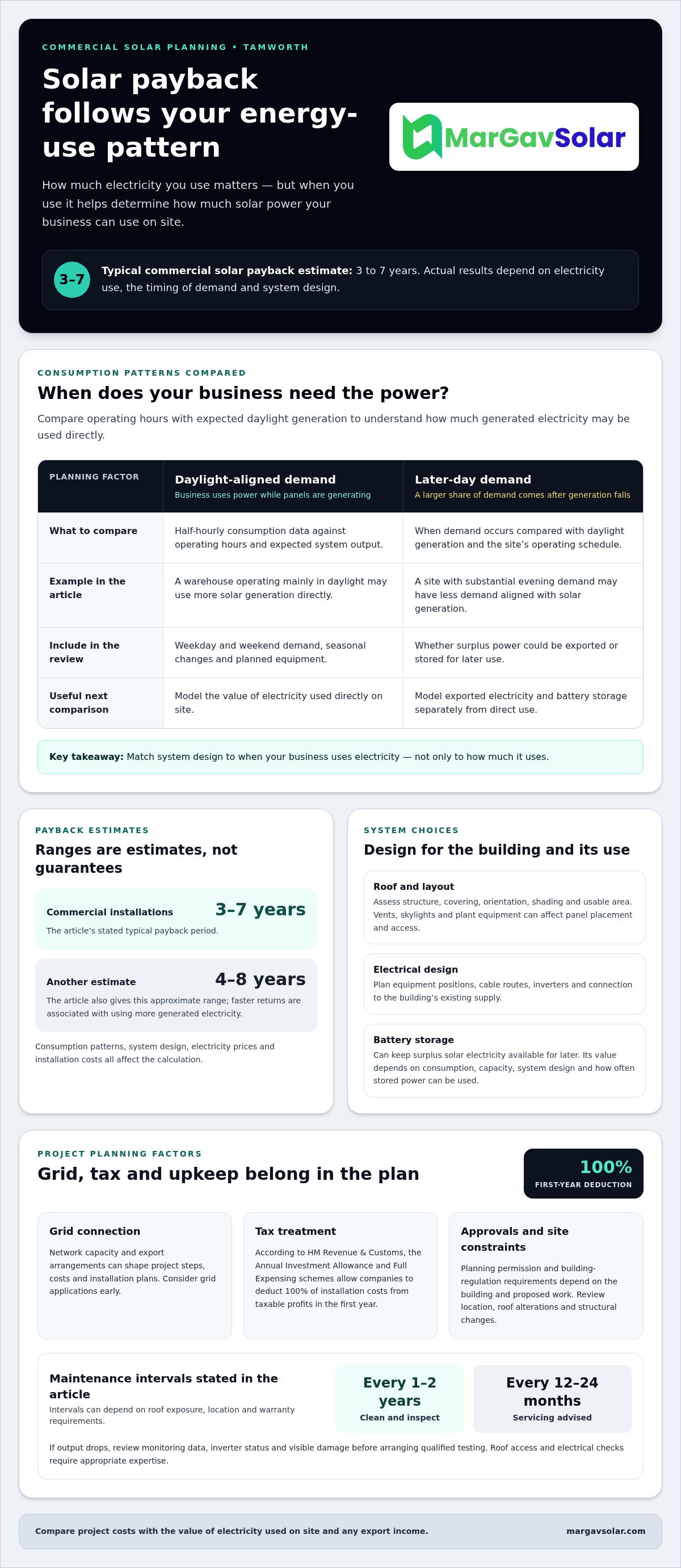
The payback period matters more than the panel count. A commercial solar consultation in Tamworth can help establish whether a proposed system suits your business, with commercial installations typically paying back in 3 to 7 years. The actual result depends on how much electricity you use, when you use it and how the system is designed.
Before committing, it helps to understand what can shape a commercial solar project’s costs. Roof capacity, equipment choices and grid requirements all matter. Start with your electricity use: a system that generates power when your business needs it can make better use of the energy produced.
This guide explains how consumption patterns and system design affect costs and payback, what grid requirements and export arrangements mean, and how warranties and maintenance fit into long-term planning. It also outlines what a consultation should clarify, so you can compare project costs with the value of electricity your business may use on site.
Key Takeaways
- Match system design to when your business uses electricity, not just how much it uses; timing affects how much generated power can be used on site.
- Factor grid connection requirements into project planning, since network capacity and export arrangements can shape the steps and costs involved.
- Use an energy audit to understand consumption patterns, roof suitability and the system design that best fits your business.
- Plan for warranties and maintenance as part of the system’s long-term performance, rather than treating them as afterthoughts.
- According to HM Revenue & Customs, the Annual Investment Allowance and Full Expensing schemes allow companies an annual deduction of 100% of installation costs from taxable profits in the first year.
Commercial solar design, grid applications and maintenance
Commercial solar design brings roof capacity, electricity use and grid arrangements together in one project plan. In Tamworth, each factor can influence installation decisions and the maintenance needed to keep a system working as intended.
Business Roof Suitability Assessment
A roof assessment considers its structure, covering, orientation, shading and usable area. The survey should identify features such as vents, skylights and plant equipment that can limit panel placement or affect access. On industrial buildings, roof condition and load capacity matter alongside available space. These findings help shape a layout suited to the building, rather than simply filling the roof.
Planning Permission and Building Regulations
Planning permission and building-regulation requirements for commercial solar panels in Tamworth depend on the building and proposed work. A project review should identify relevant site constraints, including location, roof alterations and structural changes, then establish which approvals or assessments apply before installation. Requirements vary, so not every commercial roof should be treated alike.
System design also needs to account for electrical equipment and the route between panels, inverters and the building’s existing supply. A clear plan records equipment positions, cable routes and how the system connects with business operations. Consider grid applications early, since the distribution network operator’s requirements can affect export arrangements and installation plans.
For tax relief, according to HM Revenue & Customs, the Annual Investment Allowance and Full Expensing schemes allow companies to deduct 100% of installation costs from taxable profits in the first year. The annual deduction can make tax treatment relevant to project budgeting, so businesses should include it when reviewing overall costs.
Battery storage can keep surplus solar electricity available for later, such as when demand continues after generation falls. Its value depends on the business’s consumption pattern, battery capacity, system design and how often stored power can be used. Compare these factors with expected generation to assess whether storage suits the site’s operating needs.
Maintenance planning should cover inspection, cleaning and a clear process for fault finding. Solar panel owners are advised to schedule a clean and inspection every 1-2 years; servicing is advised every 12-24 months, depending on roof exposure, location and warranty requirements. If output drops, review monitoring data, inverter status and visible damage before arranging qualified testing. Roof access and electrical checks require appropriate expertise, while documented workmanship and maintenance records help track system condition over time.
Business electricity use and solar payback
Solar payback depends partly on how much electricity a business can use while its panels are generating. A commercial solar consultation in Tamworth should compare half-hourly consumption data with operating hours, tariffs and proposed system output.
Gather electricity bills and interval data covering typical trading periods. Note when equipment runs, including refrigeration, machinery, lighting and office systems. A warehouse operating mainly in daylight may use more solar generation directly than a site with substantial evening demand. The timing of use affects the value of the electricity produced.
Commercial solar installations in Tamworth typically have a payback period of 3 to 7 years. Another estimate puts payback at around 4 to 8 years, with faster returns when businesses use more generated electricity. These are project estimates, not a fixed outcome: consumption patterns, system design, electricity prices and installation costs all shape the calculation.
These examples show how project scale and site design affect budgets; they are not a quote for a specific building.
The final project price depends on the site, system size, roof work and electrical design, and is provided after a quote request. Payback modelling should compare total project costs with the value of electricity used on site and any export income. Apply the same assumptions to each scenario, so the effects of changes in system size or usage are clear.
Inverters convert panel output into electricity a building can use. Their capacity and configuration affect how the system delivers power, while monitoring data can show whether generation matches expectations. A battery can store surplus energy for later use, but its value depends on demand, storage capacity and charging patterns.
- Compare weekday and weekend demand against expected daylight generation.
- Include seasonal operating changes and planned equipment in the consumption review.
- Model direct use, exported electricity and battery storage as separate scenarios.
These steps help businesses judge whether a proposed system fits real operations, rather than relying on panel capacity alone. For sites considering stored solar power, explore battery storage options as part of the energy planning process.
Evaluating battery storage options alongside larger system estimates provides further points of comparison when reviewing potential project scale and costs.
Use estimates as planning references, not as a substitute for a site-specific assessment. Check that each option’s assumptions reflect the building’s electricity use, proposed system design and expected use of generated power. A larger system may produce more electricity, but its suitability still depends on how well generation matches demand. Reviewing costs and projected returns together helps identify which option merits closer consideration and what to clarify before requesting a quote.
Grid connection and DNO requirements
A commercial solar system connects to the electricity network through equipment sized for the site. In Tamworth and wider Staffordshire, the distribution network operator (DNO) assesses proposed connections and export arrangements. Understanding this process early helps businesses plan installation stages, equipment and the use of surplus generation.
First, establish the intended system design and how it relates to the building’s existing electrical supply. The application should describe the proposed generation and connection. The DNO then considers network conditions and the requested arrangement. Its requirements may mean the design needs changes before installation proceeds.
This is a connection-related fee, not a complete measure of project cost. The connection design, site requirements and any network work also affect the overall process. Include the fee as a separate line when reviewing the project budget.
Exporting surplus commercial solar electricity depends on the agreed connection and export terms. Smart Export Guarantee rates vary by supplier and tariff, so compare the payment rate with the contract conditions. Model exported electricity separately from power used on site, rather than treating all generation as equally valuable.
In the West Midlands, a site’s daytime demand can affect how much generation remains available for export. A business running machinery during sunny operating hours, for example, may use more power directly. A site with lower daytime demand may export more surplus, depending on its system design and connection arrangement. Battery storage can shift some surplus for later use, reducing the amount available to export.
Plan the project sequence around the DNO decision before installation. Keep the proposed design, connection details and export assumptions aligned, so revisions do not leave the business working to an outdated arrangement. Record the DNO’s response and any required design changes with the project documents. This gives the installer and site team a shared reference during commissioning.
- Set out the proposed system and connection arrangement.
- Separate on-site electricity use from expected exports in financial modelling.
- Record DNO requirements and incorporate them into the installation plan.
- Compare available export tariffs using their payment rates and terms.
These considerations apply to commercial properties, not only domestic solar installations. A factory in Staffordshire, for instance, may have a different demand profile and export requirement from a small office. Reviewing generation, site use and network arrangements together helps identify the key questions before installation.
Commercial solar consultation and energy audits
A useful consultation turns a business’s energy records and building details into a practical solar plan. In Tamworth, an assessment can clarify how renewable generation may fit operations, what information is needed and which design choices deserve close attention.
Gather electricity bills, meter records and a list of major equipment. Include operating schedules for machinery, refrigeration, lighting and office systems. An industrial site with daytime production has a different demand profile from a warehouse that uses most of its power outside operating hours. These details connect energy use with the hours when solar panels generate electricity.
At the site, review the roof, electrical intake, inverter location and possible cable routes. Record shading, roof features and access constraints that could affect panel layout or installation. Identify planned building work, such as roof repairs, because timing can change the design sequence. Clear site notes keep the proposed system grounded in the actual property.
Ask for audit findings to distinguish measured information from modelling assumptions. A useful report explains how the proposed capacity relates to recorded demand, expected generation, self-consumption and exports. It should also show how different operating patterns affect the forecast. For example, a business adding daytime machinery may use more solar electricity directly than one whose demand stays unchanged.
Check that the design explains its main components and their roles. Panels generate direct current, while inverters convert it for use by the building. The assessment should show how equipment placement, electrical connection and any export arrangement work together. If battery storage is included in the assessment, it should explain how stored energy could match demand outside generation hours.
For solar PV systems, consider the installer’s technical competence and the clarity of the proposed design. Certification is one consideration when assessing technical competence, alongside a clear design, documented workmanship and a defined installation scope. Ask the consultation to identify the relevant system components and work covered, so you understand what the proposal includes.
- Bring bills, meter records and equipment schedules to the review.
- Ask how the forecast separates on-site use from exported generation.
- Compare the design assumptions with the building’s real operating pattern.
- Keep the audit findings with system and maintenance records.
A thorough audit gives decision-makers a basis for comparing designs, rather than relying on panel numbers alone. It also provides a practical reference for checking performance after installation: compare recorded generation with the forecast, then investigate sustained differences through system monitoring and qualified fault-finding.
What does a commercial solar consultation in Tamworth include?
A commercial solar consultation in Tamworth turns business priorities into a project plan. It should bring together site details, energy records, proposed equipment and next steps. Its value lies in showing how these elements fit together, rather than providing a panel estimate without context.
Start with your business objectives. A manufacturer may want to reduce daytime grid electricity use, while a storage site may prioritise predictable operating costs. Identify planned changes, such as new machinery or longer operating hours, because they can alter future demand. This gives the assessment a practical timeframe and purpose.
Review building information alongside electricity records. Provide available bills, meter data, operating schedules and details of major equipment. A site plan can help locate roof areas, electrical equipment and access routes. During the assessment, note constraints such as shading, roof repairs or areas reserved for ventilation equipment.
Next, review the proposed design and its assumptions. Ask how panel placement relates to usable roof space, and how the inverter arrangement serves the building. The proposal should explain expected generation, on-site use and surplus exports separately. If two layouts are considered, compare their trade-offs against the business’s actual operating pattern.
Discuss project delivery as well as equipment. The plan should explain how installation could affect access, deliveries, staff movement and operating areas. For example, a site with loading bays may need a clear work sequence that keeps essential routes usable. Identify who coordinates building access and how site-specific constraints are recorded.
Before deciding, check that the written proposal sets out a clear scope and explains its assumptions in plain language. Look for design details, connection considerations, expected generation, maintenance responsibilities and warranty information. These details make alternatives easier to compare consistently, rather than focusing only on headline system capacity.
- Gather energy records and operating schedules.
- Share building plans and known roof constraints.
- Ask for generation, on-site use and exports to be shown separately.
- Record outstanding decisions, responsibilities and project dependencies.
Use the consultation outcome to decide whether the design fits current needs and planned operations. If you’re ready to discuss a commercial solar project, start a solar consultation and outline your site’s priorities.
your site, operating pattern and outstanding questions. If the project relates to Centurion Park, clarify whether the assessment covers the DFS unit or another premises. Centurion Park in Tamworth includes a DFS unit measuring 52,500 square feet.
Keep site notes, roof constraints and electricity records tied to the right building. Ask the adviser to state what has been inspected, what remains unverified and what information is needed before a final design can be considered. Close with a written record of outstanding decisions, who is responsible for each item and when the proposal can be reviewed again. This keeps follow-up focused on practical fit, rather than treating a general discussion as confirmation that a layout is ready to proceed.
MarGav Solar: Residential Solar PV Systems
MarGav Solar helps property owners explore solar energy through its Residential Solar PV Systems, with Battery Storage Solutions, EV Charging Points and Solar Panel Maintenance & Cleaning also available. These options suit different needs, from generating electricity for a home to storing surplus power or supporting an electric vehicle.
For Staffordshire businesses considering solar, a consultation can help clarify site requirements, energy use and possible next steps. MarGav Solar also provides solar panel maintenance and cleaning, as well as inverter upgrades and replacements for existing systems.
To discuss your solar requirements, contact MarGav Solar or visit margavsolar.com.
Turn your solar plans into a practical next step
Turn your project priorities into a clear brief: what the building needs, how the business operates and which outcomes matter most. A commercial solar consultation in Tamworth can shape the discussion around your site and plans, connecting the decisions ahead to real business needs.
MarGav Solar offers Residential Solar PV Systems, Battery Storage Solutions and EV Charging Points. These offerings may also suit separate property or energy needs alongside a business project.
Bring your priorities and project questions together, then contact MarGav Solar to discuss your project. A focused conversation is a useful way to explore the next step and move forward with greater clarity.
Frequently Asked Questions
What are typical savings and payback periods for business solar panels in Tamworth?
Business solar payback estimates in Tamworth range from 3 to 7 years, while another local estimate gives around 4 to 8 years. Savings depend on how much generated electricity the business uses, its tariff and export arrangements. To assess a forecast, compare it with actual bills across different operating periods, including quieter seasons. This helps show whether projected savings reflect the business’s real demand rather than an assumed pattern.
What questions should I ask when comparing commercial solar quotes and warranties?
Ask MarGav Solar for a proposal that itemises the equipment, installation work and grid-related considerations, then compare each element consistently. For warranties, clarify which components and workmanship are covered, when cover begins and what steps apply if a fault occurs. Check whether maintenance responsibilities are set out separately. In Staffordshire, compare generation assumptions and export treatment too, so differences in forecast savings are clear rather than obscured by headline totals.


