

The charger itself isn’t the only factor affecting installation time. EV charging solutions in Rugeley can take different amounts of time depending on the property, cable route and electrical work required. The schedule is shaped by the site, not by a standard duration.
It’s understandable to want a clear idea of disruption before arranging a home, workplace or commercial charger. This guide explains what affects installation time, how Type 2, CCS and CHAdeMO connectors differ, and what to expect when planning charging for different kinds of properties.
You’ll also learn how installation typically moves from site assessment to fitting and commissioning, what practical details can affect the work, and how solar panels or battery storage may fit into a wider energy plan. This will help you understand the choices and decide what suits your Rugeley property.
Key Takeaways
- Learn how Type 2, CCS and CHAdeMO connectors differ, and why matching the connector to your vehicle matters.
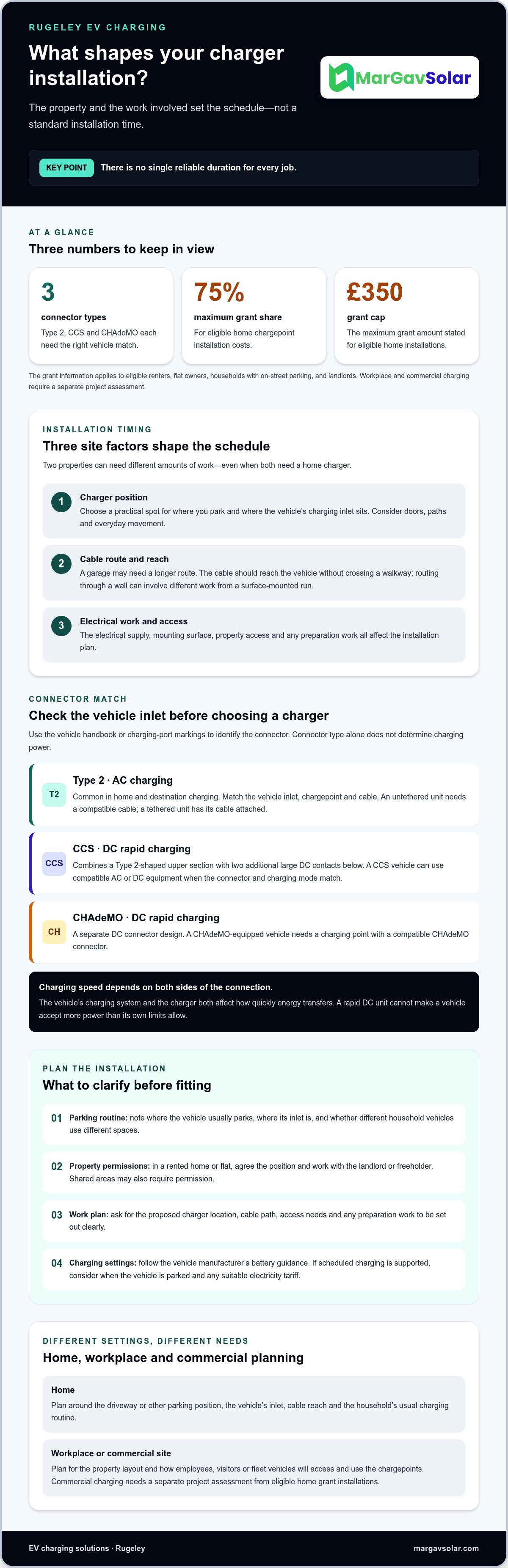
- Installation time depends on the charger’s position, cable route and electrical work needed at the property.
- According to the UK Government, eligible renters, flat owners, households with on-street parking and landlords can receive a grant covering up to 75% of home chargepoint installation costs, up to £350.
- Home and workplace charging plans call for different decisions about access, charger placement and how people will use the equipment.
- Understand what affects charging speed and availability, including the connection between the charger and the vehicle.
CCS, Type 2 and CHAdeMO connectors
Before choosing a charger, identify the inlet on the electric vehicle and the connector it accepts. In the UK, Type 2 is used for AC charging, while CCS and CHAdeMO are connectors for DC rapid charging. The vehicle’s handbook or charging-port markings can help you identify the right match.
Type 2 has a familiar role in home and destination charging. A home chargepoint with a Type 2 socket needs a compatible cable, while a tethered unit has its cable attached. For example, a driver can use a Type 2 cable between a suitable vehicle and an untethered chargepoint. Check both ends before setting off.
CCS, also called Combined Charging System, builds on the Type 2 design. Its connector adds two large contacts below the Type 2 section for DC charging. A vehicle with a CCS inlet can therefore use compatible AC or DC charging equipment, but the connector and charging mode must match the charger.
CHAdeMO is a separate DC connector design and doesn’t use the CCS arrangement. A CHAdeMO-equipped vehicle needs a compatible CHAdeMO connector at the charging point. Check the car’s inlet rather than relying on a charger photo or a connector name remembered from another vehicle.
- Type 2: match the AC chargepoint, vehicle inlet and cable.
- CCS: look for the Type 2-shaped upper section and additional DC contacts.
- CHAdeMO: choose a charging point with the matching CHAdeMO connector.
Connector type alone doesn’t determine charging power. Both the vehicle’s charging system and the charger affect how quickly energy transfers. A rapid DC unit can’t make a vehicle accept more power than its own limits allow. For home charging, consider the car’s onboard AC charging capability; for public rapid charging, check its DC compatibility.
Public smart chargers can also use a shared data connection between the car, charger and cloud to identify the vehicle being charged. This exchange is separate from the physical connector, so a plug that fits the inlet doesn’t explain every charging feature. Follow the charger’s on-screen instructions after connecting.
For local planning, MFG8243001 is listed 9 km from EV Aldi Rugeley. Treat a named charging point as a location reference, then check its connector type against your vehicle before making it part of a journey. In Rugeley, that simple match helps narrow down suitable charging options.
How long does it take to install an EV charger?
Installation time depends on the property and work involved, so there’s no single reliable duration for every job. In Rugeley, placement, cable routing, electrical arrangements and access all affect the schedule. In a rented home or flat, agree the proposed position and work with the landlord or freeholder before installation. Shared areas may also require permission.
Choose a position that suits where you park and connect your vehicle. A charger near a driveway parking space can make daily use simpler, while a garage installation may require a longer cable route. The installer also needs to consider the route from the electrical supply, the mounting surface and whether the cable can reach the inlet without crossing a walkway.
Keep your usual routine in mind. If the vehicle is usually parked overnight, position a home unit for convenient connection at that time. If household members use different parking spaces, consider whether the location and cable reach work for each vehicle. Avoid placing the charger where it obstructs doors, paths or everyday movement around the property.
Good installation advice explains practical trade-offs instead of defaulting to the shortest cable route. For example, routing a cable neatly through a wall may involve different work from a surface-mounted run. Ask for the proposed charger location, cable path and any preparation needed to be clearly set out. This makes it easier to compare the plan with your parking habits.
Battery charging needs depend on the vehicle and your routine. Follow the vehicle manufacturer’s guidance on its battery and charging settings. If your car supports scheduled charging, set it around when the vehicle is parked and any suitable electricity tariff. Don’t assume every battery or vehicle uses the same settings.
- Before installation: choose the parking position and note where the vehicle’s charging inlet sits.
- For rented or shared property: agree the proposed location and cable route with the relevant property decision-makers.
- For the installation plan: consider access, cable routing, the electrical supply and any preparation work.
These practical details help explain why two homes can have different schedules, even when both need a home charger. A clear plan connects the chargepoint location to the vehicle’s routine and the property’s layout. For tailored EV charger installation planning, consider how EV charging solutions in Rugeley can fit your parking and charging habits.
Home and commercial EV charger installation in Rugeley
For Rugeley households and businesses, first consider whether the chargepoint is for a private home or a shared workplace. A driveway installation may suit one electric vehicle, while a business site needs a plan for employee, visitor or fleet access. The property layout and charging routines shape the installation.
According to the UK Government, OZEV grants for renters, flat owners, households with on-street parking, and landlords cover up to 75% of home chargepoint installation costs, up to £350. These grants relate to eligible home installations, so workplace and commercial charging require a separate project assessment.
For a house, map where the vehicle parks and where its charging inlet sits. Then identify a practical chargepoint position, the cable route and access to the electrical supply. A wall beside a driveway may work well, while a detached garage could call for a different route. These details help establish the work involved.
Flats and rented homes add permissions to the planning process. Residents may need approval for equipment attached to a building or a cable route through shared space. Landlords planning chargers for tenants can account for parking allocation, access and how residents will use the chargepoints. Resolve these points before installation begins.
Commercial sites have different operational needs. A small workplace might prioritise staff parking, while a fleet depot may need chargers near regular vehicle bays. Consider who can use each charging point, how drivers will access it, and whether the layout keeps parking and pedestrian routes clear. These decisions inform the site design.
Photos and comments from other users can offer useful visual context, especially when they show how a chargepoint sits beside a driveway, wall or parking bay. Treat each image as an example, not a template: Rugeley properties differ in access, boundaries and parking arrangements. Comments may share practical experiences, but they can’t show hidden cable routes or electrical conditions.
- Home: map parking, vehicle inlet position and a workable cable route.
- Flat or rented property: establish permissions for equipment and any shared areas.
- Workplace: define user groups, parking patterns and access arrangements.
- Commercial site: plan charger locations around fleet or visitor movement.
If you’re considering an eligible grant for a home installation, review the UK Government criteria. For a business, start with how the site is used: staff turnover, visitor access and fleet routines can call for different layouts. Photos of nearby installations may help you frame questions, but your property’s parking and cable route remain central.
Residential and commercial EV charging in Rugeley starts with the same practical steps: identify users, assess parking, choose a location and plan access. A grant may support eligible home chargepoint installation, while workplace planning centres on how the site operates. Distinguishing between these needs helps households and businesses prepare the right project.
Home and workplace EV charger installations in Rugeley
A home installation needs to suit a household’s parking routine; a workplace installation must also accommodate staff, visitor or fleet access. In Rugeley, the property layout and intended users shape the practical plan.
Indoor and Outdoor Installation
An indoor chargepoint may suit a garage where the vehicle parks near a suitable wall. An outdoor unit can serve a driveway or workplace bay, placing the connection near the usual charging space. Compare the proposed position with the vehicle’s inlet, door access and pedestrian routes. At a workplace, include staff and visitor parking bays in the assessment.
In either setting, map the cable route from the chargepoint towards the electrical supply. A wall beside a driveway may offer a direct route, while a garage or detached parking area can change the layout. Note obstacles such as doors, storage and pedestrian paths. This gives the installation plan useful, property-specific detail instead of treating every Rugeley home or business alike.
Installation Time
There’s no single installation duration for every property. The schedule depends on the chosen location, cable route, access to the work area and any electrical preparation required. A clear wall beside a parking space, for example, presents a different job from a route through several rooms or to a separate garage. Site conditions determine how much work the installation involves.
Before work starts, clarify where the vehicle parks and where its charging inlet sits. At a workplace, identify which bays are available during installation and how staff or visitors can move around the work area. A clear plan helps the installer understand access and placement, while unexpected obstacles or extra preparation can affect the schedule.
Homeowners can clear the garage wall or driveway area chosen for the unit. For a workplace installation, share the parking layout and normal site activity, such as delivery access or shift changes. This helps coordinate the work with daily use. The charger’s final position should suit the intended vehicle, not simply fit the easiest wall.
For Rugeley installations, consider how charging needs could change. Replacing a household vehicle may mean a different inlet position or parking routine. A business adding fleet vehicles may need to review bay allocation and charger access. Record these requirements early to keep the installation plan aligned with actual use.
- At home: identify the regular parking space, inlet position and clear work area.
- At work: map staff, visitor or fleet bays and account for site activity.
- For either site: review the cable route, access and any preparation before scheduling work.
EV charger availability and speed
Public charging around Rugeley depends on location, connector compatibility and the charging point’s operating status. A local listing places MFG8243001 9 km from EV Aldi Rugeley, giving drivers a nearby location reference. Check the precise site and available connector before planning a stop around it.
Before setting out, check the charging point’s displayed status or the operator’s own service information. A unit marked occupied, unavailable or out of service may affect your route. Build flexibility into your journey by identifying another suitable stop, especially when the vehicle’s remaining range makes a particular location important.
Charging speed depends on the vehicle, the equipment and the battery’s ability to accept power. A vehicle may draw less power than the charger can provide, so the charger’s advertised capability alone won’t predict session time. Battery condition and charging settings also affect how quickly energy enters the vehicle. Check the vehicle guidance and charger information together.
Which networks operate in Rugeley, and which app or membership is needed? The available facts identify MFG8243001 as a nearby location, but don’t establish a network list or universal payment method. Access and payment instructions are set by the individual operator, so read the charging point’s screen or signage before connecting.
Are there free EV chargers in Rugeley, and what parking or time limits apply? A public charging point’s tariff and parking conditions are separate details, so check both at the site before leaving the vehicle. A free charging session doesn’t automatically mean parking is free or unrestricted.
For a smoother stop, make a simple check before you travel:
- Match the connector: compare the vehicle inlet with the charging point’s connector details.
- Check status: use the operator’s current information or the unit display.
- Review access: read payment instructions, tariff details and parking signs at the location.
- Allow for the vehicle: use its charging guidance to understand the power it can accept.
Charging rates can also vary during a session. The vehicle controls how much power it accepts, and that rate may change as its battery charges. As a result, two vehicles connected to the same equipment may charge at different speeds. For a planned journey, use the vehicle’s charging information alongside the charging point’s details.
Availability matters for workplace and public charging. A driver arriving during a busy period may need another unit or stop, while workplace users may follow access rules for staff or visitors. Check the location, connector, status and parking terms separately. This routine can make charging decisions around Rugeley more predictable.
MFG8243001 is listed 9 km from EV Aldi Rugeley as a nearby charging location; confirm its exact site before travelling.
The available details do not identify which networks operate in Rugeley or require a particular app or membership. Check the individual charger’s screen or signage for access and payment instructions.
Whether charging is free, and any parking or time restrictions, depends on the individual site. Check its tariff and parking signs: free charging doesn’t necessarily mean free or unrestricted parking.
MarGav Solar: Residential Solar PV Systems
MarGav Solar helps homeowners planning an EV chargepoint alongside wider home energy improvements. Its Residential Solar PV Systems, Battery Storage Solutions and EV Charging Points can be considered together when planning how a home generates, stores and uses electricity. Solar Panel Maintenance & Cleaning can also help homeowners care for an existing solar system.
This is a practical next step if you’re weighing a home charger alongside solar generation or battery storage, rather than treating each decision in isolation. The right combination depends on your property and energy use, including when you typically charge the vehicle. For EV charging solutions in Rugeley as part of a wider home energy plan, contact MarGav Solar to discuss your project.
Plan a charging setup that fits your next step
Choosing EV charging solutions in Rugeley is a chance to look beyond your next charging session. Consider how your household or business may use electricity over time and whether vehicle charging should be part of a broader energy plan. A clear view of your priorities can help shape decisions that suit your property and daily routine.
MarGav Solar offers EV Charging Points, Residential Solar PV Systems and Battery Storage Solutions. These options can support a project focused on vehicle charging alone or one that also considers how a property generates and stores electricity. Start with the outcome you want, such as a convenient home charging routine or a coordinated workplace setup.
Take the next step by outlining your property type, parking arrangements and charging needs. Contact MarGav Solar about EV charging to discuss your plans and explore a suitable way forward. With your priorities clearly set, you can move towards a charging setup that feels practical for everyday use.
Frequently Asked Questions
How much does it cost to charge?
The cost depends on how much electricity the vehicle takes and the tariff. For home charging, the household electricity rate determines the cost. At a public point, the operator sets the tariff and may display it before charging begins. Compare the rate with your expected charging needs, then use the vehicle’s charging information to estimate how much energy the session may add.
Which Rugeley EV chargers are rapid or ultra-rapid, and what are their charging speeds?
MFG8243001, listed 9 km from EV Aldi Rugeley, is a local location reference; its distance alone doesn’t identify a charger’s speed. Look for the rapid or ultra-rapid classification and power information on the individual unit or its live listing. The speed a vehicle receives also depends on its own charging capability, so the unit’s stated power won’t necessarily be the vehicle’s actual rate.
What are the current prices and payment methods at EV charging points in Rugeley?
Each charging operator sets its own tariffs and payment options, so there’s no single price or payment method for every Rugeley location. Before charging, read the unit’s screen, signage or operator instructions for the applicable rate and accepted payment method. If you use an app or account, follow the instructions for that unit; don’t assume the same payment option works at every site.
How can residents install a home EV charger in Rugeley, and what does installation cost?
Note where the vehicle parks and where a charging point could connect to the property’s electrical supply. A site assessment can establish the equipment position, cable route and any electrical work required. Installation cost depends on these property-specific factors and is provided after a quote request. If you’re also planning solar or battery storage, consider how they fit your home’s wider energy use.
How reliable and accessible are Rugeley’s public EV chargers, including 24-hour access and contactless payment?
Access, operating status and payment options vary between public charging locations. A site may have its own opening arrangements, and contactless payment depends on what that unit offers. Before travelling, review the chargepoint’s current status and access details. At the location, follow its signage for payment and parking conditions. Keep an alternative charging stop in mind in case the unit is unavailable.
What are the nearest EV charging alternatives to Rugeley, and how do their prices and speeds compare?
MFG8243001 is listed 9 km from EV Aldi Rugeley and provides a nearby location reference. Compare any alternative by looking at its distance, connector, stated charging power and displayed tariff. The vehicle’s charging capability affects the speed it can receive, while the operator determines the applicable price and payment method. Compare those details for each location rather than assuming nearby points offer identical terms.


